Lambert-Saint Louis International Airport, Still Taxiing

2015 was, at first blush, a good year for Lambert Saint Louis International Airport (STL). Passenger levels are up, the airport added a couple of new destinations, and a long-awaited renovation project was completed. There’s talk of a new Mexico hub. The airport manager, Rhonda Hamm-Niebruegge, was named airport director of the year by Airport Revenue News.

But looks can be deceiving. For one thing, passenger growth at the airport (1%) lagged behind the national average (4%). This mirrors Saint Louis’s overall economic performance in the last year, which, while improving, is growing at a slower rate than much of the rest of the country. Look back further than last year and the situation is worse. STL’s traffic is still 12% lower than it was just before the recession. In fact, there were fewer passengers and flights from STL in 2015 than there were in 2010, after the recession had ended.

Year

2010

2015

Non-stop destinations

55

60

Total flights

195,409

185,474

Total passengers

6,276,530

6,247,994


The only category where the airport is has had success is in adding non-stop destinations, which increased from 55 to 60 in the last five years. But even here, improvement isn't necessarily as impressive as it first appears. Most of the added destinations are seasonal options, bound for resort destinations in the Caribbean. STL flies to fewer national, year-round destinations than it did five years ago.

Why is STL having such a difficult attracting more flights and more passengers? The culprit may be a slow Saint Louis economy, which airport managers have little control over. However, the airport is still dealing with a hangover from the new (and ultimately unneeded) runway it built in the early 2000s. That has made the airport more expensive, and therefore less attractive for additional airline service. For example, low-cost airline Allegiant recently chose to use Mid-America Regional Airport for new flights to Florida.

While it’s easy to blame things outside the airport’s control, STL’s leadership can make the best of a difficult situation. That means resisting the impulse, so prevalent in civic affairs, to try spending their way to health with lavish improvement projects. Providing efficient and plentiful air service is better than less service and more luggage shops. Bringing in more freight traffic may allow the airport to use extra room it thought it would need for the TWA hub. If STL leadership can implement a cost-effective, customer-oriented strategy, it will help not just the airport, but the entire Saint Louis region.

More Evidence on the Negative Effects of the Minimum Wage

University of California–San Diego economist Jeffrey Clemens’s recently published analysis once again indicates that raising the minimum wage has detrimental effects on low-skilled workers. Clemens’s analysis investigated the effect of the increases in the Federal minimum wage from $5.15 to $7.25 between 2007 and 2009 on the most vulnerable group of workers: those aged 16 to 30 without a high school education. 

Because the minimum wage increase was not equally binding in all states, Clemens was able to analyze the differential effect of the hike across groups of workers and states. After controlling for the overall negative economic effects stemming from the Great Recession, Clemens reports as follows:

My baseline estimate is that this period's full set of minimum wage increases reduced employment among individuals ages 16 to 30 with less than a high school education by 5.6 percentage points. This estimate accounts for 43 percent of the sustained, 13 percentage point decline in this skill group's employment rate. . . .

As argued before in numerous analyses published by the Show-Me Institute and others, raising the minimum wage simply does not improve the economic welfare of all low-wage workers. Clemens’ work reaffirms the notion that those whom minimum wage increases are touted as benefiting the most are in fact those who are the most likely to be harmed. 

There are better ways to improve the welfare of the most vulnerable workers in society. Improving and expanding programs like the earned income tax credit (EITC) should be considered before more minimum wage increases do further harm to the neediest in society.

Streetcars and the Error of Confusing Correlation vs Causation

On January 20, I will participate in a panel discussion of the Kansas City streetcar sponsored by the American Public Square. I am eager to participate and hope you can attend. 

To their credit, Kansas City's streetcar aficionados rarely make the claim that streetcars are good transit. They aren't. They are woefully expensive for the service they offer, are inflexible, and are slow. Bus rapid transit such as the MAX on Troost is a much more effective method of moving people.

In Kansas City and elsewhere, the matter comes down to one of correlation versus causation. Streetcar proponents want desperately to claim that the streetcar causes economic development downtown. It doesn't. In fact, all sorts of literature in the United States and around the world fails to show that streetcars cause economic development. There might be a correlation, however, as economic development often occurs along streetcar routes. Why? Because cities such as Kansas City lard their streetcar routes with all sorts of taxpayer subsidies such as tax increment financing and property tax abatements that are much more likely to drive development. Economic development may occur along streetcar routes, but it is not caused by them.

In fact, a 2010 study sponsored by the Federal Transit Administration found that,

The literature regarding empirical measurement of actual changes in economic activity, such as changes in retail sales, visitors, or job growth, is almost nonexistent for streetcars.  

This finding undercuts the primary claim made by advocates of streetcars—that they spur economic development. The same report adds,

Given that federal funding for streetcars emphasizes economic development, along with many local policymakers’ objectives to stimulate economic development, the literature is particularly weak on impacts of streetcars on economic development, such as the attraction of jobs, retail sales, and tax revenue.

In Kansas City, officials have strung together a laughable list of projects supposedly caused by the streetcar. We've debunked them here and here and here. While there may be a correlation between development and the streetcar, it isn't plausible to claim that the streetcar caused the development.

Consider that in the 2013 and 2014 seasons up to May 22, 2014, when ground was broken on the Kansas City streetcar line, the Royals record was 109-99, for a winning percentage of .524. Since the streetcar tracks were laid, however, the Royals went 183-126, including two World Series appearances and one world championship. That's a winning percentage of .592. If I suggested that the relationship between the streetcar construction and Royals’ success was one of causation—the streetcar caused the Royals to win two pennants and the World Series—I'd be laughed out of the room.

Yet this is exactly the sort of specious argument streetcar proponents make when they point to downtown development. The progress of the streetcar and the Royals’ success may run in parallel, but there is no relationship between them or among their causes. Like the streetcar and many developments attributed to it, the relationship is illusory.

New Study Shows Negative Effect for Vouchers. We’ve Got Some Explaining To Do.

After an unbroken streak of gold-standard, random assignment studies finding either positive or neutral results for school voucher programs, a new paper published by NBER finds large, negative results for the Louisiana Scholarship Program.

My friends Adam Peshek, Matt Ladner,  Jason Bedrick, Lindsey Burke, and Jonathan Butcher have written what I think are fair explanations of the findings.  Based on survey research and buttressed by the enrollment patterns of schools participating in the program, it appears that the requirements that the program placed on schools kept good schools from participating.  This drove students into lower-quality schools and, not surprisingly, worse outcomes.  Yet another reason to remember that program design matters.

Let me add two points:

First, we should be Bayesians.  To borrow from the branch of statistics, when trying to understand a phenomenon we should make assumptions about how it works, test them, update our assumptions based on the results of our tests, test them, update again, and so on, in a slow march toward the truth.  Study after study has supported the belief that private school choice programs benefit the students who participate (across a number of indicators). This study should decrease our confidence, but—especially given the issues that Peshek and others raise with the fundamental design of the program—it should not decrease it a great deal. That said, there is clearly a lot going on here, and we need to keep digging and updating what we know.

Second, and more importantly, if you live by the sword, you die by the sword. For years now, advocates (present company included) have used state math and reading test scores as the primary means to argue that school choice “works.”  In addition to probably not capturing everything that we want out of schools, we should also take into account that it appears that more and more families are opting into private schooling  to get away from schools that they think are obsessed with standardized testing . We should not be surprised when we look at standardized test scores from private schools and see that these students are scoring lower.  In fact, we should probably expect it.  But, if we’re going to support our arguments for choice with test scores (using them to show either shortcomings in public schools or the benefits of choice), we have hitched our wagon to them and can’t be surprised if people attack vouchers when poor test score results come out. Similarly, advocates (present company included) have treated voucher programs as interchangeable when talking about their effects, even though they differ in meaningful ways. If we’ve talked about their benefits without taking program design into account, we can’t be surprised if people attack their shortcomings without doing it either.

I hope this study causes a course correction in the school choice community on several fronts (understanding the costs of regulation, how we think about test scores, the fact that all voucher programs are not created equal). It should be a wakeup call, not a death knell.  

The Loop Trolley Bailout: A Retrospective

On December 8, the Saint Louis County Council voted to bail out the Loop Trolley, a 2.2-mile vintage streetcar line currently under construction. Back when the trolley was in the planning phase, Show-Me Institute researchers pointed out that the project was redundant as a transportation option. The trolley’s route, from the History Museum to the Delmar Loop, is served by seven MetroBus routes and the MetroLink.

Despite these objections, Saint Louis regional officials allowed the project to move forward. The trolley, they promised, would lead to development. Trolley planners also assured residents that the money needed would come from a transportation development district (TDD) around the line, along with federal grants. As we pointed out in a previous post, trolley planners originally stated that cost overruns would not be the responsibility of city or county taxpayers.

However, as of late 2014, the Loop Trolley faced cost overruns. Initial construction bids came back $11 million over the project’s $43 million budget. The project was put out to bid once more, and Loop Trolley planners announced the project was within the budget and everything was fine. But actually, the second round of bids still came back $8 million over budget.

Instead of looking to the Trolley’s TDD to cover cost overruns, trolley planners sought regional tax dollars. This included money from Great Rivers Greenway (a sales tax–funded body designed to build recreational trails) and an additional $5.4 million federal grant (which required a local match).

None of these efforts was known to the public until November, 2015, well after the construction of the trolley was underway. The overruns only became public because the Saint Louis County Council had to approve the $3 million needed to match the aforementioned federal grant. That money will come from County’s mass transit fund, which means that more than $8 million is being diverted from transit projects in the County. That $3 million easily could have matched other, similarly sized federal grants for transit projects of the county’s choosing. Now it will be spent on the trolley.

Summing it up, trolley planners sold their project to Saint Louis residents with a budget that would not work and promises they could not keep. When that became apparent, those planners said nothing, quietly committed local residents to pay for overruns, and then started putting rails in the streets. Presented with this fait accompli, the County Council approved what amounts to an $8 million bailout. In essence, the Council rewarded the tactics of trolley planners.

Rebecca Friedrichs’ Supreme Court Case Could Expand Workers Rights in Missouri

Next week the nation’s highest court will hear oral arguments in a case that will decide the constitutional rights of thousands of government workers. The court will decide whether the constitution protects a government employee’s right not to be associated with, or pay for, speech with which she disagrees.

Rebecca Friedrichs is a public school teacher in California who has long struggled with the California Teachers Association, a union that advocates for policies that run counter to Rebecca’s beliefs. Because a majority of the teachers in Rebecca’s school district at one time voted to elect the California Teachers Association to represent them, every current teacher in the district—including Rebecca—is now forced to pay to support the Association.

Rebecca believes this violates her rights. And she has a pretty strong case.

Rebecca’s case is fundamentally about the right of an individual or a minority in a group to think differently than the majority. The majority of the teachers in Mrs. Friedrichs’ school district support a union with an agenda that she disagrees with. Rebecca stands apart as someone who wants to speak with her own voice.

The court’s decision could affect public employees here in Missouri. If the court sides with Mrs. Friedrichs, it would expand the first amendment rights of thousands of teachers, fire fighters, and other Missouri government workers. As a result, each Missouri government employee could choose whether or not to support the union that operates in his or her workplace.


The Unfortunate Truths Behind Rams’ Relocation Statement

The Rams' statement on why they want to move to L.A. is self-serving, capped off with an incredibly cheesy quote from the Los Angeles Times. The statement cherry picks articles from the Saint Louis media, not indicative of their full view on the situation, that appear to support a Rams move. The shots at the Dome are overblown, and calling fan support weak is completely out of line when the Rams have been so bad for so long. And, rest assured, remaining in Saint Louis is by no means financially ruinous for the insanely lucrative NFL.

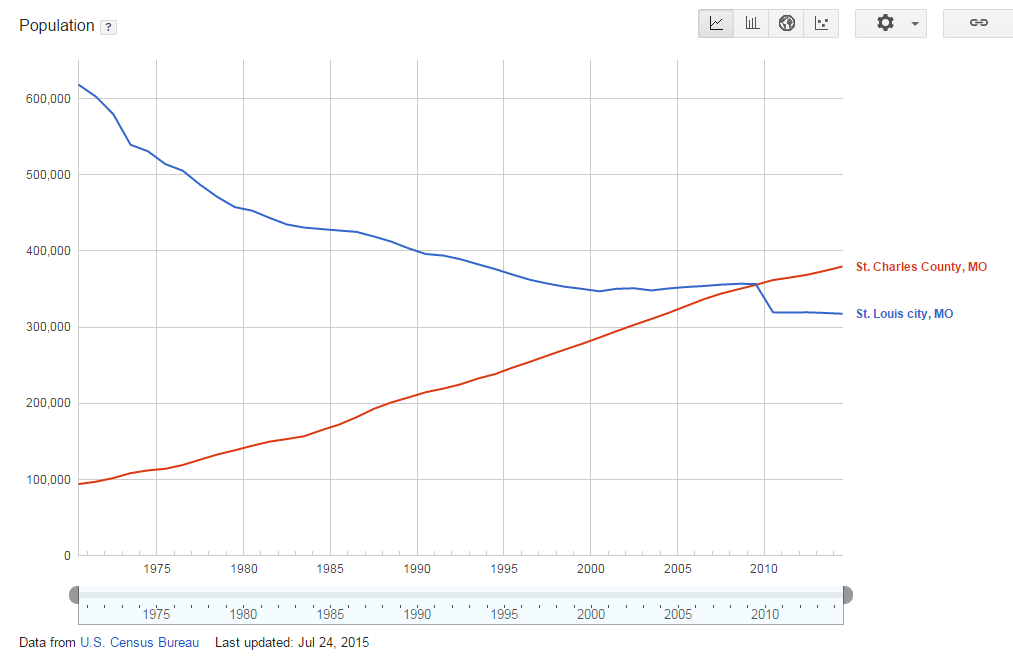
However, as hard as it may be for Saint Louisans to hear, the report had a lot of truth in it, especially regarding Saint Louis’s economic situation. The statement rightfully points out (as we at the Show-Me Institute have written) that, when it comes to population and jobs, Saint Louis really has fallen behind and has yet to turn things around. Saint Louis City has lost much of its population; the city had around 750,000 residents in 1960, and today it’s close to 300,000. From 2000 to 2010, Saint Louis City lost population and Saint Louis County essentially stagnated.

Most of the population growth during that time was in the far suburbs and downtown (which received significant subsidies), and overall, population was stagnant.

The story is equally depressing when it comes to job growth. Saint Louis had anemic employment growth before the recession, and the economy has limped along since then. Despite claims of becoming a tech center, Saint Louis (and especially Saint Louis City) has seen nearly all its employment growth in education and medical services. For these and other reasons, economists (and not just those cited in the statement) forecast continued slow growth in the future for Saint Louis.

The Rams’ statement also claims that the other teams trying to move to L.A. (the Oakland Raiders and San Diego Chargers) would leave healthier economic markets. In this, the team is not wrong. Income and GDP of both Oakland and San Diego are much greater than in Saint Louis. They have more money to spend on tickets, jerseys, and NFL cable packages:


Median Income

GDP (Millions)

Saint Louis

$54,959

$149,951

San Diego

$63,996

$206,817

Oakland/San Francisco

$80,008

$411,969

In addition to how things stand today, one has to factor in growth. Even accounting for the deindustrialization of the late 20th century, Saint Louis is growing much more slowly than San Diego and Oakland.

 While Saint Louis aspires toward building a tech industry, Oakland is a rapidly gentrifying part of the tech-dominated Bay Area economy, and San Diego has the one of nation’s most important bio-tech clusters.

There are many possible culprits for Saint Louis’s lackluster growth, and few easy answers. However, it’s time for Saint Louis to be honest and acknowledge that, yes, of the four markets in play, Saint Louis is the least attractive for the NFL. We also have to acknowledge that without significant public financial “support,” no existing NFL team would consider locating to Saint Louis. But the city’s economy— not Stan Kroenke—is  the real problem. It’s that problem, which affects so much more than sports, that policymakers need to address.  

Comparing Teacher Pay by State Offers Heat, but Little Light

I’m going to tell you something you already know: Teacher salaries are higher in Saint Louis and Kansas City than they are in the state’s more rural areas. “Of course they are!,” you might say, “It costs more to live in those areas.” That, my friends, is the point. It costs more to live in some areas than it does in others. That’s why the wages are higher there.

That’s also why I do a facepalm when someone compares Missouri’s teacher salaries to the average salaries in other states.

In a recent press release promoting a new study on teacher salaries, Bruce Moe, executive director of the Missouri State Teacher’s Association, said, “Missouri ranks 42nd nationwide for average classroom teacher pay. That translates to $8,896 less than the national average.”

Let’s do a little test. Here is a cost-of-living map from the Missouri Economic Research and Information Center (MERIC). It provides an index for each state. Missouri’s cost of living in the 3rd quarter of 2015 was just 91.2% of the national average. Using just this information, what states would you bet have the highest teacher salaries?

Did you guess New York, Washington D.C., or California? Give yourself a gold star!

According to the Digest of Education Statistics from the National Center for Education Statistics (Table 211.60), the average teacher salary in each of these places was over $70,000. Massachusetts and New Jersey also have average salaries higher than $70,000, but each of these places has a cost-of-living that is much higher than the national average (including 149.3% of the national average in D.C.!).

According to MERIC, “Missouri had the 11th-lowest cost of living in the United States for the third quarter of 2015.” We should expect the average teacher salary in Missouri to be below the national average, because the cost-of-living in Missouri is below the national average.

Just as teachers in Saint Louis and Kansas City make more than teachers in Mt. Vernon and Niangua, teachers in New York and California make more, on average, than teachers in Missouri. This is not a bad thing—it simply reflects that it costs a lot less to live here. Not taking that into account yields wildly skewed results, and the MSTA should know better.

Support Us

The work of the Show-Me Institute would not be possible without the generous support of people who are inspired by the vision of liberty and free enterprise. We hope you will join our efforts and become a Show-Me Institute sponsor.

Donate
Man on Horse Charging