How Bad Policy Survives

In modern politics, combatants like to paint those around them as evil or ignorant. The practice is as old as the republic. And while a small minority of policymakers may have questionable motives, more often than not, they mean well.

So where does bad policymaking come from? Sometimes it comes from getting so caught up in the debate that we don’t examine the facts we’re dealing with. Today’s example comes from the December 10 Kansas City Council’s business session. The topic was the airport. And as he seems to do every time he talks about the airport, the Mayor offered up statements he must know are not true. At least three times he made the same mistake:

[2:28:55] “The cost is in the airport, the region has nothing to do with it. All of the costs are in the airport and come from the airport. There’s not tax money that comes from Johnson County or Wyandotte County or Clay or Platte or Cass. Its all airport money. It’s in the airport; stays in the airport; and gets recycled.”

[2:30:29] “Airport revenue can only be used for airports. Money that is generated in the airport stays in the airport.”

[2:30:58] “You can’t take any money from the airport and use it for sewers or sinks or anything else.”

This is not the first time the Mayor has made this claim. He’s done it in interviews and in his state of the city speech.

We know this is not true because we have a city ordinance that authorized the city to move funds from the Aviation Department to the Finance Department. We know because while James was mayor the city renegotiated the debt to give them more time to pay it off. We know because the Mayor’s own submitted budget for 2015-16 includes it as a line item.

Perhaps most strikingly, we know because earlier at the very same December 10 business meeting, aviation consultant Sheri Ernico said:

[35:47] “There was an instance, which is very unusual for airports in this country, where the [Kansas City] general fund borrowed some money from the airport in 2008, but it had to be repaid with interest.”

What makes the Mayor’s stubborn memory lapse most worrying is that the loan was made to cover losses the city incurred in bad tax increment financing deals for things such as the Power & Light District.

What hope can we have for good public policy when mistakes are papered over with denied consequences?

Does Saint Louis Have an Illegal Tax?

On February 1, a Saint Louis City business filed suit against the city, claiming that the municipal payroll tax was illegal under state law. The payroll tax—a 0.5% tax that businesses pay on their total payroll—should not be confused with the earnings tax—a 1% income tax that all residents and nonresidents who work in the city pay (and that companies pay on profits). The suit claims that cities only have the right to levy taxes that are stipulated in the constitution. Payroll taxes are not. City officials have claimed that Saint Louis’s status as a charter city allows these taxes.

One might ask, if the city’s payroll tax is illegal, why hasn’t it been challenged before? After all, the tax has been in place since the late 1980s, ever since the city reformed its business license fees. The explanation here may come in the answer to another question: Who pays the payroll tax? The city of Saint Louis’s private-sector payroll was more than $11 billion in 2014. If all businesses paid the payroll tax evenly, the city should have received more than $56 million. In fact, the city earned only about $37 million. Most of that gap comes from the fact that nonprofits (along with government) do not pay the payroll tax. While that sounds charitable, it’s important to remember that Saint Louis City’s top employers are large, wealthy nonprofits like St. Louis University and BJC Healthcare. Small nonprofits like the Show-Me Institute have an impact as well.

But it doesn’t end there. Companies are regularly given payroll tax exemptions as part of incentive packages to keep them in the city. Anthem and Polsinelli are two such companies and are listed in the previously mentioned lawsuit. Do companies with legal departments large and savvy enough to know that the payroll tax has constitutional issues receive exemptions? Or is it simply clout that allows large companies to avoid the tax? Whatever the case, of the top ten employers in Saint Louis City in 2013, only one might have been paying the full payroll tax:

Employer

Employees

Rank

Payroll Tax?

Reason for Payroll Tax Exemption?

Washington University

14,705

1

No

Non-Profit

BJC Healthcare

13,241

2

No

Non-Profit

St. Louis University

10,096

3

No

Non-Profit

City of Saint Louis

8,098

4

No

Government

Defense Finance & Acct Services

6,379

5

No

Government

Wells Fargo

5,653

6

50% (both earnings and payroll taxes)

Reimbursement Incentive

Saint Louis Board of Education

4,992

7

No

Government

State of Missouri

4,240

8

No

Government

AT&T Services

4,016

9

?

NA

US Postal Service

3,973

10

No

Government

With the payroll tax, we have a policy that not only raises legal questions, but is also implemented unevenly. Does the full rate only apply to for-profit, private businesses without the clout to get a tax break or the wherewithal to make a fuss? If so, the city might want to reevaluate its tax policy, whether it is legal or not.

Kansas City Star Editorial Board Gets Subsidies Wrong Again

The Kansas City Star editorial board published the following in a piece on the earnings tax on January 28:

A spokesman for the Show-Me Institute—funded in large part by St. Louis multimillionaire Rex Sinquefield, an ardent earnings tax foe—said this week that the city should stop offering tax incentives and tighten its fiscal belt. The spokesman’s claim: These subsidies are “north of $100 million a year.”

Add all of the city’s investments in economic development — through the earnings, sales and property taxes as well as direct public subsidies for projects—and it’s $77.6 million of diverted revenue this fiscal year.

That’s a big number. But it’s not close to being “north” of $100 million.

We at the Show-Me Institute have been telling this to people since we first got the numbers from the city's own finance department in February 2015. Those documents, available via the link at the bottom of this post, show that the subsidies for fiscal year 2014 are $93 million, and do not include the subsidies for Burns & McDonnell and Cerner. The latter subsidy, which the Star unequivocally endorsed, might be the biggest tax diversion in the history of the state of Missouri.

The problem is that the Star's editorial board likely only considered the city’s portion of TIF subsidies. The problem with TIF, however, is that it allows the city to divert money from other taxing jurisdictions such as schools, counties, and libraries. In short, the city is offering subsidies with other people's money.

I would welcome the opportunity to look over the documents the Star used to reach their conclusions. Do they include Cerner and Burns & Mac? Do they include bond payments on the Power & Light District and the Citadel? Do they include earnings tax subsidies given to the Star itself? How about TDDs, CIDs, Chapter 353 property tax abatements, etc? If not, then their calculation of the cost of subsidies is embarrassingly incomplete.

Are Blaine Amendments Really about the Separation of Church and State?

Yesterday I wrote about a Supreme Court case out of Missouri challenging the state’s Blaine Amendment. This case could have far-reaching consequences for school choice, as it would allow more students to have access to vouchers or education savings accounts in states where Blaine Amendments currently prohibit them.

But I wanted to take a moment and dig into the historical origins of Blaine Amendments. Specifically, why was James G. Blaine so interested in amending the Constitution? Was he a crusader for the separation of church and state?

To save you the runaround, the answer is no. At best, he and his compatriots were political opportunists who saw alienating Catholics as a winning political strategy in the age of Know-Nothingism. At worst, he was an anti-Catholic bigot. The “sect” that he was referring to was Catholicism. Don’t believe me? Look closely at the famous Thomas Nast cartoon (above) from the era. Yes, those alligators are bishops, the capitol is the Vatican, the public school is under siege, and a teacher is being led to the gallows. Not our nation’s finest hour.

Ultimately, Blaine’s anti-Catholicism torpedoed his quest for the presidency. At a rally just weeks before the election of 1884, where Blaine was the Republican candidate, a speaker derided Democrats as being the party of “Rum, Romanism, and Rebellion,” invigorating the Catholics of New York and elsewhere to come out in force against Blaine and narrowly elect Grover Cleveland.

So this is really the question before the Supreme Court, and the people of Missouri: Are we still afraid of rum, Romanism, and rebellion?

Personally, I’m a big supporter of the separation of church and state. I don’t want to see a state religion. At all. At the same time, I believe that the education of children or the use of playgrounds can be provided by a religious organization, subsidized by public dollars administered on a religiously neutral basis, without fear that it will establish a state church. We let people take Pell Grants or the GI Bill to SLU. We let Medicaid patients get care at Missouri Baptist Hospital. No state religion yet. It’s not clear to me why in 2016 K-12 education should be peculiarly sacrosanct.

I hope that the Supreme Court closes this sad chapter in American history and puts Blaine Amendments in the grave. Educational opportunities for millions of children hang in the balance.

MLS to Saint Louis: On Whose Dime?

Last summer I found myself leaning against the railing on the balcony of Toyota Park, home of the Chicago Fire, looking out onto Bridgeview, Illinois. More precisely, I was looking at an expansive parking lot, a rained-on pierogi festival, and a small Mexican restaurant in the distance. The rest of Bridgeview, a typical South Chicago suburb, was a mix of low-rise apartments and single family homes invisible from the stadium’s rooftop.

Much like with the NFL, civic daydreamers pine for MLS teams. City officials hope pro soccer can revitalize neighborhoods, bring in tax revenue, and draw hip residents. That’s what Bridgeview hoped when the city covered the entire cost of Toyota Park, at the cost nearly $100 million. Unfortunately, promises went unfulfilled. Bridgeview is now in dire financial straits, $225 million in debt with a population of just over 16,000.

None of this should come as any surprise. While the phenomenon of cities spending money on MLS teams is new, cities have long subsidized stadiums for other professional sports. The evidence is clear that building these stadiums does not increase economic growth, spur urban revitalization, or increase tax revenue sufficiently to cover large subsidies. Unfortunately for taxpayers, the cost of soccer-only stadiums has risen over time, along with the subsidies:

Stadium

City

Year Built

2013 Cost

Crew Stadium

Columbus

1999

$49,000,000

Toyota Park

Chicago (Bridgeview)

2003

$100,000,000

BBVA Compass Stadium

Houston

2005

$109,000,000

PPL Park

Philadelphia (Chester)

2006

$111,000,000

Home Depot Center

Los Angeles (Carson)

2007

$118,000,000

FC Dallas Stadium

Dallas (Frisco)

2008

$132,000,000

Rio Tinto Stadium

Salt Lake City (Sandy)

2010

$135,000,000

Dick's Sporting Goods Park

Colorado (Commerce City)

2010

$159,000,000

Red Bull Arena

New York (Harrison, NJ)

2011

$186,000,000

LIVESTRONG Sporting Park

Kansas City (KS)

2012

$207,000,000

So what of the MLS in Saint Louis? With the Rams leaving for Los Angeles, the push to land an MLS team is on. A bill in the Missouri legislature proposes sales tax increases in Saint Louis City and County for a new stadium, likely near Union Station.

But much like the Rams’ riverfront stadium plan, there is little reason to believe that an MLS stadium will do any more for the city than it has done for Bridgeview. Furthermore, private owners have funded their own MLS stadiums, as was the case with Crew Stadium, in Columbus, Ohio. Saint Louis, if MLS officials are to be believed, is a strong soccer town. If the “beautiful game” is so appreciated here, an entrepreneurial owner should be able build a stadium, bring the city an expansion team, and make money. If Columbus doesn’t need to buy a soccer stadium, Saint Louis shouldn’t need to. And if no such owner is to be found, soccer supporters could use crowdfunding like Kickstarter to fund a stadium, if such a proposition is so popular. Given the city’s issues with its existing stadiums, perhaps we should make sure we can afford what we have before we bring in a new pro team.

A Homegrown Challenge to Blaine Amendments

The U.S. Supreme Court has decided to hear Trinity Lutheran Church of Columbia v. Pauley, a case out of our own backyard.

Here are the details: Several years ago, Trinity Lutheran applied to the State of Missouri for a grant to resurface their playground. They were denied that grant because they were a church, and Missouri’s Constitution explicitly bans public support of religious educational institutions. The church is arguing that by discriminating against religious organizations in awarding grants, the state is violating those organizations’ right to free exercise of their religion.

Historically, the U.S. Supreme Court has held that states can give funds to religious educational organizations without violating the Establishment Clause of the U.S. Constitution—supporting organizations that are doing something to help society isn’t establishing a state religion. In general, these programs were simply required to be neutral toward religion; that is, that any religious denomination or non-religious organizations would be just as likely to get support as any particular religious group would be.

Several state constitutions, Missouri’s included, went a step farther.  Missouri’s constitution includes the following language:

“Neither the general assembly, nor any county, city, town, township, school district or other municipal corporation shall ever make an appropriation or pay any public fund to help to support or sustain any private or public school, academy, seminary, college, university or other institution of learning controlled by any religious creed, church or sectarian denomination.”

This is called a “Blaine Amendment,” named after James G. Blaine, who in 1875, while he was in the US House of Representatives, proposed an amendment to the US Constitution that said: 

“That no money shall ever be taken from the public treasury, directly or indirectly, in aid of any church, sect or denomination of religion”

Blaine failed, but that language did end up in numerous state constitutions, like Missouri’s. The court now has to decide if it is constitutional. This particular case matters because Blaine Amendments have been a huge impediment to private school choice programs, and bringing down Blaines would be a huge win for children and families desperate for more schooling options.  

What I Saw at the 2016 Missouri Transportation Conference

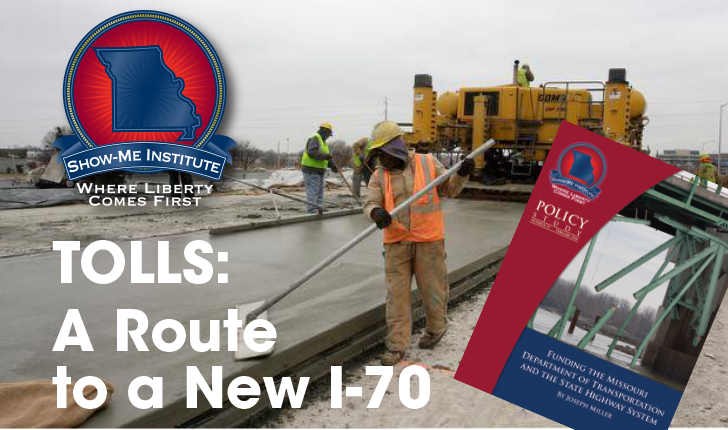
Last week, the Missouri Chamber of Commerce held its annual transportation conference in Jefferson City. Missouri state and national representatives, department of transportation officials, and private sector spokespersons were in attendance to talk about the future of Missouri’s transportation infrastructure. While topics varied, this year (as in previous years) the focus was on funding the Missouri Department of Transportation (MoDOT) and the state highway system.

Hopes are high that this year the legislature will take concrete action on MoDOT funding. Speakers talked about how SB 623, which would increase the state’s fuel tax (1.5 cents regular and 3.5 cents diesel) had already been voted unanimously out of committee. The dire predictions of the last two years, namely that MoDOT would fail to maintain the highway system in its present condition, took a back seat to new discussion on how MoDOT might rebuild I-70 and whether MoDOT might bring back its cost-share program to help local transportation initiatives.

With I-70, most speakers emphasized the fact that Missouri has one of a few slots in a federal pilot program that allows tolling on existing interstate highways. But with passage of the FAST Act, Missouri now has a limited time (22 months) to “use it [the slot] or lose it,” meaning the slot could be taken away and given to another state. A representative of Macquarie Infrastructure Corporation, an international infrastructure investment group, discussed how public-private partnerships could be an option for major infrastructure financing and operation. Macquarie’s most famous (or infamous) acquisition is the Indiana Toll Road, which, following its privatization promptly went bankrupt. The Macquarie representative pointed out how the transfer of toll road traffic risk to private investors greatly benefited Indiana residents, which we’ve written about before.

The general focus on the fuel tax and tolling, both user fees, as solutions for MoDOT’s funding problems, is a welcome change from a just two years ago. At that time both options were barely mentioned as officials drove for a transportation sales tax. But there were exceptions to this salutary trend. A representative of the state’s gas station lobbying group discussed a plan to fund highways with increased cigarette taxes. There seems to be no logical connection between smoking and highway maintenance expenses. When questioned why smokers should be targeted for road funding, the representative responded that the tax was likely to go up anyway and that roads were a good place to spend money. We would point out that there is no reason why cigarette taxes must increase. In addition, one could imagine fairer ways to spend any such money (like, say, health care or addiction treatment).

Funding talk was only part of the conference, and we will discuss some of the other topics, such as ridesharing, port development, and highway safety, in future writing.

Support Us

The work of the Show-Me Institute would not be possible without the generous support of people who are inspired by the vision of liberty and free enterprise. We hope you will join our efforts and become a Show-Me Institute sponsor.

Donate
Man on Horse Charging