City’s “NGA for Millennials” Pitch Rings Hollow

Saint Louis is trying desperately to keep the National Geospatial Intelligence Agency (NGA) within city limits. The federal spy agency is looking for more space and is considering options in Saint Louis City, Saint Louis County, and Saint Clair County, Illinois. The sites in Saint Clair County (near Scott Airforce Base) and in North Saint Louis City are considered the strongest contenders.

We’ve talked before about how Saint Louis City’s attitudes toward non-city alternatives for the NGA expose local leadership’s fair-weather regionalism. After all, no matter what happens, NGA jobs are staying in the region and the area’s economy should remain unaffected. But in a bid to “redevelop” a part of North Saint Louis and keep the earnings tax revenue the NGA currently generates, Saint Louis City is preparing to pull out all the stops.

Saint Clair County is offering a low-cost, green field option on the north end of Scott Air Force base to the NGA, with the state of Illinois preparing to throw in $116 million in infrastructure improvements for the site. Saint Louis City’s original offer was a North City site at a cost $14 million, with $120 million in assistance from the state of Missouri. Now, Saint Louis will waive the $14-million cost, which was supposed to recoup the city’s expenses for preparing the site. Such costs will have to be pushed onto Missouri residents. Additionally, not to be outdone by Illinois’s infrastructure improvements, Saint Louis is throwing a MetroLink expansion into the deal as well. Strangely, Saint Louis has not put forward a solid plan for how it would fund a new billion-dollar-plus light rail line.

While city hall’s financial/infrastructure incentives may seem a little half-baked, they’re nothing compared to its rhetoric. Apparently, according to Saint Louis’s leadership, the city should get the NGA because millennials like to live and work downtown, among other lazy generalizations about an entire generation of Americans. One official stated that, “The days when talented young people wanted to commute 25, 35, 45 miles are over.” An interesting statement, because, since millennials have entered the workforce, the percentage of workers commuting longer than 25 minutes has regularly increased while the share of workers commuting less than 15 minutes has decreased:
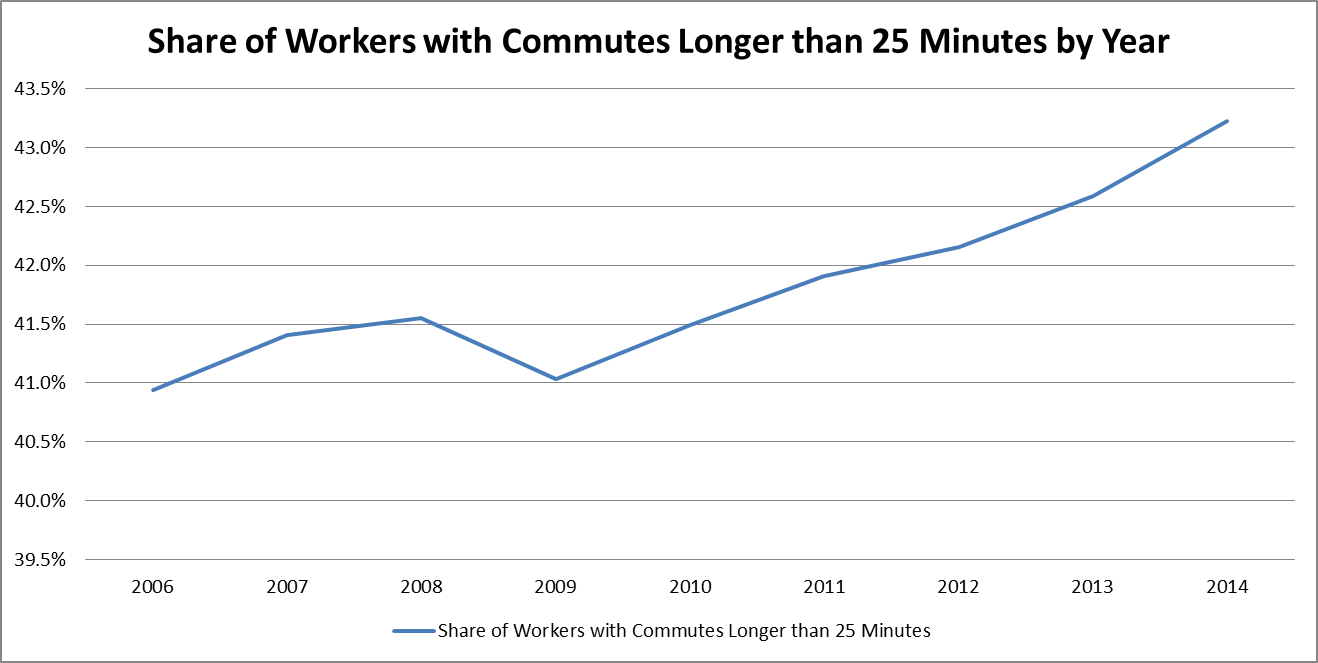
Chart: Share of workers with commute times 25 min, by year

This is just another example of how the generation dubbed “millennials” is, largely, much like the generations that preceded them in terms of living, working, and commuting. And city hall’s statements appear to be typical of local government officials using generational stereotypes to justify the types of policies they (not millennials themselves) have pursued for decades.

What’s more, even if millennials are everything that Saint Louis City leaders hope they are (and want to live downtown and take public transportation to work), the existing MetroLink already goes to Scott Airforce Base, where the NGA could be. Millennials could, if the Illinois site were chosen, live on Washington Avenue and ride the train to work. That certainly sounds easier than flattening a large section of North Saint Louis and spending billions to expand the MetroLink. Given the fact the city’s plan would turn dozens of families out of their homes, wouldn’t that be a fairer solution as well?


Are Rural Highways a Burden on MoDOT?

Many of Missouri’s lightly traveled letter routes are managed as part of the state highway system. As this video explains, giving them to county or local governments would help alleviate MoDOT’s funding problems.

For a thorough analysis of the current state of Missouri's highway system and the challenges it faces in the near future, check out Joseph Miller's new Policy Study, Funding the Missouri Department of Transportation and the State Highway System.

Kansas City Deep in Debt

Back in 2013, when we examined Kansas City’s spending relative to other regional peer cities, what we found wasn’t good: Kansas City spends more than most of its peers per capita, both in total spending and in city administration.

Kansas City borrows a lot, too. We spend more per capita on servicing our debt than every peer city we examined except St. Louis (the other peer cities we looked at were Tulsa, Oklahoma City, Omaha, Indianapolis, Denver, and Louisville). Because cities with higher incomes are better able to handle debt, we also looked at the city income-to-debt ratio. The results weren’t flattering. Kansas Citians earn $5.28 in income for every $1 of debt the city carries. Louisville and Tulsa had much better ratios, ($35.92 and $17.66 for every $1 of city debt, respectively).

The City borrows money for lots of things. For example, a few years ago the city borrowed $10 million from the airport just to cover the costs of TIF commitments. Kansas City issued bonds to help pay down its debts for the Power & Light District; this reduced annual payments in the short term, but increased the total amount of the debt. As a result of existing debt, the city cannot pay for basic services such as tearing down dangerous homes—and so it must borrow again to generate the $10 million needed.

Despite lofty city rhetoric against payday loans, we seem to be managing city funds using a similar model. Even the Mayor’s own Citizen’s Commission on Municipal Revenue reported in 2012 that the city’s debt ratios, among other things, “raise red flags.” Their report found that Kansas City has debt levels higher than all the peer cities it considered.

Right before Detroit declared bankruptcy it was borrowing money to cover employee bonuses. Kansas City hasn’t gotten to that point yet, but things are not looking up. Is this any way to run a city?

Kansas City’s Taxes Aren’t “Relatively Low”

Last week our friend Dave Helling at the Kansas City Star wrote about the upcoming earnings tax fight, and on many points we actually agree. The city does waste money on all sorts of tax incentives and city-backed projects. The city does "[fail] miserably on the fairness index — relying far too much on flat sales and income tax rates that hurt the poor." And as Helling observes, other cities that don't have an earnings tax obviously have their own fire and police departments, so to argue that public safety will suffer without this regressive tax is awfully deceptive, to say the least.

But where Dave and I part ways is on his statement that "Kansas City’s tax burden is relatively low." Sure, folks can look at local taxes in different ways and come to differing judgments. But I have a hard time believing most people would look at how, and how much, Kansas City takes from its residents and say that KC's tax burden isn't so bad.

For my part, I would judge Kansas City's tax burdens like I judge the state's—based on its income, sales, and property taxes. Most cities don't have an earnings tax at all, meaning that relative to Kansas City's peers its earnings tax is way above average. Kansas City's sales taxes are prodigious, too, with rates that exceed 10% in many communities. Our sales taxes are so high that last year we had the 15th highest sales tax rates of America's 50 largest cities. That isn't relatively low, either; relatively, that's high. And while property taxes are often difficult to compare, the Brookings Institution found in 2013 that Jackson, Platte, Clay, and Cass Counties all were well above average when it came to property taxes paid and property taxes paid relative to home value.

Kansas City's taxes aren't low at all; in fact, they're quite high.

Dave's political judgment may be right, of course: Kansas City's earnings tax may well be renewed because residents like the idea of other people paying for the city's services. But while the earnings tax shares its misery across jurisdictional lines, misery shared is not misery solved. Rather than try to export our high tax problems, we should be trying to reduce them. Only then can we ever really become a "relatively low tax city."

Why Is Saint Louis Using Eminent Domain “On Spec”?

What would you do if you learned that the government might take your home sometime in the next few months? They haven’t made up their mind just yet, but they’re already putting you through the preliminary steps of eminent domain, excavating next to your home, and blocking a grocery store from setting up shop in your neighborhood. Gustavo Rendon doesn’t have to wonder; this is how his family and neighbors have lived for the past year.

As reported earlier, St. Louis officials are considering using eminent domain to clear out a neighborhood on the north side. They’ve begun eminent domain proceedings, but are waiting on the National Geospatial-Intelligence Agency (NGA), the federal agency they’re clearing the land for, to decide whether it even wants to relocate to North St. Louis. Is it worth it putting property owners in limbo like this for a development project that might not even happen?

Alderwoman Sharon Tyus doesn’t think so. Tyus is not opposed to the use of eminent domain, but when it comes to using eminent domain on homeowner occupied land, she says “you’ve got to really step lightly.”

In this case, the need for eminent domain is in question because there are three other tracts of land in the region where NGA might choose to relocate instead of Gustavo’s neighborhood. Tyus believes one tract, right by Scott Airforce Base, makes the most sense. “It’s got everything. I think it’s a no-brainer.”

“I’m not trying to lose business for the city.” Tyus told me. “I just don’t think you need to decimate a neighborhood.”

Homeowners like Gustavo and Joyce Cooks don’t think you need to destroy a neighborhood either. “They say they’re trying to revitalize the community,” Gustavo tells me, commenting on the irony of the situation. “They’re killing the community.”

The Kids Are Alright

Mathematica public policy research just released a high-quality, rigorous evaluation of the Ewing Marion Kauffman charter school in Kansas City. The results are out of sight.

From the report:

  • In Math, after 3 years in the school, students have learned 1.35 years more material than their peers, moving on average from the 36th percentile to the 58th percentile in achievement.  Those gains represent 57 percent of the gap between white and black students in Kansas City.
  • In reading, after 3 years in the school, students have learned 1.29 years more material than their peers, moving on average from the 39th percentile to the 55th percentile in achievement.  Those gains represent 45 percent of the gap between white and black students in Kansas City.
  • The results for the Kauffman school are better than the average results for the much-vaunted Boston and New York City charter schools as well as the successful KIPP charter school network.

This is great news, and it’s not like the school is cherry-picking some privileged subset of kids.  Eighty-six percent of the students at the school qualify for free or reduced lunch (compared to a KCPS average of 92%). Seventy-nine percent of the students are black (compared to 59 percent in KCPS). Twenty percent had even been suspended at least once by 4th grade (compared to 17 percent in KCPS). 

The Kauffman school puts to lie the notion that the black kids of Kansas City cannot learn. They can. What we need to do is work to create more schools like Kauffman, and allow charter schools like Kauffman the freedom to operate outside of the narrow KCPS district boundaries to give our children and their families more and better options city-wide.

The Cost of Inefficiency in Kansas City

Woody Cozad on Ruckus last Thursday talked about how poorly Kansas City government is managed. While most people are still learning how much our leaders like to divert tax money to wealthy developers to build in nice neighborhoods, fewer people might be aware of the cumulative impact.

In his remarks, Cozad compared Kansas City to Indianapolis. According to a case study written by The Show-Me Institute’s Michael Rathbone, Indianapolis is similar to Kansas City in education, median household income and poverty levels. Indianapolis has about twice the population of Kansas City and is just a little larger than Kansas City in total city area. (The study also compared us to Tulsa, Denver, Oklahoma City, Omaha, St. Louis, and Louisville.)

Despite the larger population and larger geographical area than Kansas City, Indianapolis appears to be run much more efficiently. Their total government spending per capita is much lower than Kansas City’s, $1.411 to our $2,354. They spend much less on city administration per capita and less for about every other category the paper examined, including public safety, public services, culture and recreation and capital outlays. The Mayor’s own Citizen’s Commission on Municipal Revenue reported in 2012 that Kansas City has a higher number of employees per capita than most other cities it considered.

If Kansas City leaders were able to bring total spending per capita ($2,354.05) just halfway down to what Indianapolis pays ($1,411.64), it would save us $220 million each year, almost exactly the amount the earnings tax provides. They don’t have to match Indianapolis—or the even more efficiently run Tulsa, Oklahoma City, Omaha or Louisville—just get us hallway there.

Even if Kansas City just lowered its per capita city administration spending from its current $210.59 down to the level of Omaha ($109.57) the city would save $46 million per year. We’d save $78 million per year if we reduced it to what Indianapolis spends ($43.47).

Instead, our leaders prefer to dig in their heels and offer only scare tactics about cutting public safety spending. Don't taxpayers deserve better?

Support Us

The work of the Show-Me Institute would not be possible without the generous support of people who are inspired by the vision of liberty and free enterprise. We hope you will join our efforts and become a Show-Me Institute sponsor.

Donate
Man on Horse Charging