

Rural school districts share many of the challenges that face urban and suburban districts: recruiting good teachers, offering a broad range of courses for students, and securing adequate funding. However, rural districts also operate under the unique constraints that come with relatively small student populations spread over large geographic areas. This essay examines the difficulties rural districts must contend with and also looks at innovative responses—some of them already in use in other states—that can help rural schools provide a high-quality education to their students. Click the link below to read the entire essay.
The Great Urban School District That Wasn’t, but May Be Soon

What if I told you that you could have access to nearly unlimited resources, the counsel of top experts, and a direct path to implementing your plans. Could you create a top-notch urban school district?
This is, for all intents and purposes, the deal that Judge Russell Clark offered to those who wanted to reform the Kansas City, Missouri, School District starting in the mid-1980s. He implemented policy recommendations by fiat. He raised the property taxes of the residents of the school district without allowing them to vote on it. He required the state to contribute hundreds of millions of dollars to fund new programming. What the plaintiffs in Missouri v. Jenkins, wanted, they got.
Well, except for one thing: a school district that met the needs of their children.
As Joshua Dunn points out in Complex Justice, an engrossing history of the court case, Judge Clark was hemmed in. Kansas City’s geographic peculiarities have it spread across two states, and families of means have always been able to move to the green, suburban pastures of Johnson County, Kansas. At the same time, the U.S. Supreme Court had handed down the Milliken decision, which forbade judges from requiring actions from suburban districts to alleviate segregation, essentially boxing in the district and those hoping to reform it.
So Judge Clark started cutting checks. Experts were called in, surveys were administered, and program after program popped up. Slavic studies? Can do. A model UN with simultaneous translation? Sounds great. An Olympic-quality swimming and diving facility? Whatever you think will make the school district work.
Kansas City in the early 1990s was the apogee of what Rick Hess and I describe in our new volume, Educational Entrepreneurship Today, as the “system” approach to school reform. It is marked by careful planning, alignment, and coordination, all driven by the wisdom of experts and implemented by clear-eyed technocrats—or at least that’s how it is supposed to work. Kansas City shows, even with a boatload of money and a judge who can implement programs with the stroke of a pen, just how hard it is to pull that off.
What were the results? When Judge Dean Whipple eventually dismissed the case, 20 years after it began and after Clark himself had retired, he summed it up well, writing, “Despite the expenditure of vast sums, the prolonged oversight of a federal court and its appointees, the efforts of multiple parties, and the passage of forty years since the end of official de jure segregation in Kansas City, Missouri, the KCMSD still struggles to provide an adequate education to its pupils.”
I grew up in Kansas City during this time, so it’s no surprise that I have a different view of how to improve the education system. Rather than looking for the grand solution or trying to impose “best practices” on every school and classroom, I favor a more decentralized approach marked by experimentation, trial and error, and smaller entrepreneurial organizations working to solve the problems that are right in front of them.
Fortunately for residents of Crown Town (sorry—we’re still basking in the glow of last year’s World Series win and will be for some time now), this more decentralized approach has been adopted to a large degree, and some seeds for future success have been planted. As the court case wound down, Kansas City opened its doors to charter schools.
Today, according to the National Alliance for Public Charter Schools, the Kansas City Missouri, School District has the 5th-highest percentage of its students in charter schools, at 41%. And it appears that the market share will only grow in the future.
It has not been all roses. Several charter schools have failed, and some have failed spectacularly. However, a loosely aligned network of schools is gradually emerging in Kansas City and meeting with success. Recently, the public policy research firm Mathematica released an evaluation of the Ewing Marion Kaufmann School that showed incredible gains from its students. French language immersion school Academie Lafayette has a waiting list over a hundred students long. The Crossroads Academy, a popular urban charter school that was bursting at the seams, is opening new campuses, and the Citizens of the World network is coming to Kansas City after a group of enterprising parents issued their own RFP to charter organizations to attract a school operator.
Is change happening fast enough? Of course not. Will all of these schools meet with success? Maybe not. But given the backdrop they are working against, they are beating the odds. What’s more, if one school fails, the damage can be contained. If a whole district falls into disarray, it can take a city down with it.
The lesson from Kansas City for the rest of the nation is one of humility. We often don’t know what we don’t know, and are overconfident that our one great idea is the silver bullet can turn things around if embraced by every teacher or every school. We think that we can impose our views and shape the behaviors of people by administrative diktat, even when the people we’re working with deeply disagree with us about the proper course of action. The world doesn’t work that way, and we must keep that in mind as we chart a path forward.
When Unions Bargain for Lower Pay

Minimum wage laws price-low skilled workers out of the workforce. They hurt many of the people they’re intended to help. But did you know that the unions representing low-skilled workers are among the biggest special interests behind minimum wage legislation? How do unions benefit from a policy that kills jobs?
In California, where unions such as SEIU and Unite Here successfully pushed through a $15-dollar minimum wage law, the very same unions are seeing a backlash after workers discover they’re left out of the deal. It turns out these unions also pushed through exemptions to the minimum wage for unionized workers. Now businesses have a choice of paying $15 an hour for a nonunion worker or about $10 an hour for a union worker. A clear incentive to buy union labor.
Needless to say, workers feel betrayed. Alicia Yale, 42, a waitress at a hotel in Los Angeles and a mother of two children, is critical of the union’s policy.
"Why is it more of a benefit to be in a union? The union isn't really doing anything for us," she told the LA Times. "It's completely upside-down. They want to pay us less than the minimum wage… We should get the raise just like everybody else does."
From a union executive’s position, advocating lower wages for union workers may make a lot of sense. True, your members get paid less, but if the end result is more union workers, that will translate to more union dues.
Here in Missouri, union money is still going to the $15 minimum wage campaign. One of their slogans is “$15 and a union.” Union workers who are part of their campaign might want to ask their union’s executives for some clarification: “Will I be cut out of this deal, like union members in California were?”
Debt, Airports, and Kansas City

With Kansas City considering new terminal plans for Kansas City International Airport (MCI), it’s a good time to revisit some basic tenets of terminal finance.
There are good reasons to build new airport terminals, whether at MCI or any other airport. It may be that continuing to maintain and operate existing buildings is just too expensive compared to a modern replacement, especially given possible service upgrades. Many airports also build new terminals to accommodate increased flights or different carriers that existing terminals cannot.
However, the cost of any terminal plan needs to be taken into consideration. If an airport like MCI takes on too much debt, the results can be higher prices (for parking, car rentals, etc.) and fewer flight options for residents. Right now, MCI is in a good financial position, and has a relatively low debt load for an airport of its size. That allows MCI to offer low fees to airlines and moderate prices for terminal services, and to borrow cheaply. As a counterexample, consider the most indebted of MCI’s peers, San Jose International Airport (SJC). After completing a $1.3 billion new terminal a couple years ago, SJC struggles to keep airline costs low so it does not lose service. Doing so is causing SJC to burn through reserves at a rate of $30 million per year, which is not sustainable. If SJC cannot significantly increase revenue, San Jose may have to subsidize the airport’s debt through the city’s general fund.
If MCI had gone forward with the erstwhile “New Terminal Plan” (priced at $1.2 billion) its debt level (and debt payments) would have become the highest among its peers, including San Jose:
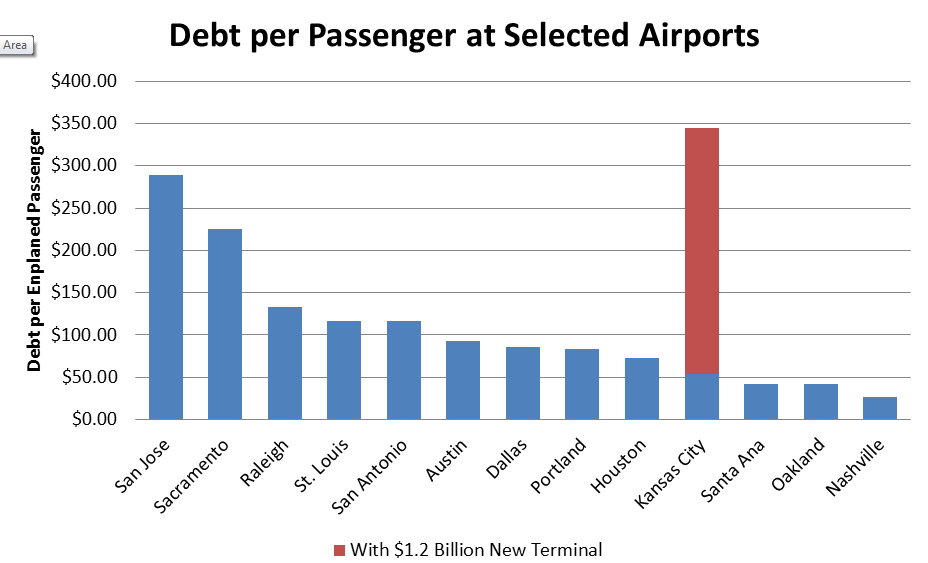
This would have been a risky move for MCI and Kansas City residents. Unfortunately, despite our objections and common sense, some in Kansas City’s leadership seem to think that costs do not matter at airports, and that MCI can simply pass extra costs onto airlines and travelers without consequence.
Kansas City International Airport may be better off with a new terminal. The city’s aviation department may put forward a plan that makes sense for travelers and the airport’s finances. Our main criticism over the late “New Terminal Plan” was that because of the $1.2 billion price tag and the fact that the plan would have resulted in less capacity, the proposal seemed more about civic ego than helping residents get good flights. We hope any new plan won’t have the same problem.
Rural Students Could Benefit from Charter Schools, Too

St. Louis and Kansas City have pioneered charter schools in Missouri, but state law does not allow this school choice option in rural towns. Changing Missouri statute to allow charters across the state would expand school choice opportunities for rural students.
Essay: Slow Growth in Saint Louis and Kansas City Is Holding Missouri Back
The economic health of Missouri is tightly bound to the fortunes of Saint Louis and Kansas City, as these two metropolitan areas account for over half of the state’s output. Unfortunately, the performance of both cities has been dismal in the 21st century, and the predictable result is that growth statewide has been poor as well. This essay examines growth not only in Saint Louis and Kansas City, but also in the state’s smaller metropolitan areas and rural areas, comparing them to counterparts nationwide. Although there have been pockets of economic vitality throughout the state, the two major metro areas have generated a drag on state ouput that has left Missouri as one of the slowest growing states in the nation. Click on the link below to read the entire essay.
Listen: Andy Wilson Talks Slow Growth In Missouri on KWTO
SMI's Andy Wilson discusses why growth in Missouri has stalled, and you won't believe who's responsible.
Aired: 4-12-16 on KWTO, Springfield, Mo.
Patrick Tuohey on Ruckus
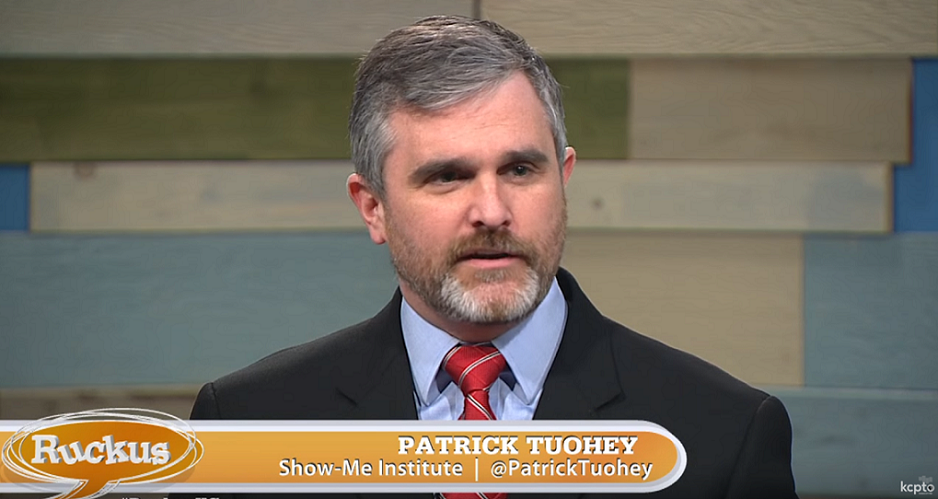
On Thursday, April 7, the Show-Me Institute's Patrick Tuohey appeared on Kansas City Public Television's Ruckus to discuss the results of the earnings tax, Steve Rose’s concerns for the future of Johnson County, and other issues. Click on the link to watch the entire show.
Even under Fuel Tax Increase, Missouri Taxes Would Still Be Below Average
Recently, the Missouri Senate approved a 5.9-cent fuel tax increase that, should it pass the House, would go before voters in the fall. If voters accept the proposal, Missouri’s fuel taxes will increase from 17.3 cents per gallon to 23.2 cents per gallon. As we’ve stated many times before, Missouri currently has a comparatively low fuel tax, fifth-lowest in the nation for regular fuel and fourth-lowest for diesel fuel. So where would the proposed increase in the fuel tax place Missouri?
The answer is that Missouri would still have a fuel tax well below the national average. Some news sources have put average state fuel tax at 20.88 cents per gallon, but this ignores the additional taxes many states (but not Missouri) place on fuel. For instance, Illinois’s fuel excise tax is only 19 cents per gallon, but its additional taxes add on 11 cents per gallon. Often, these additional taxes are sales taxes whose per-gallon amount fluctuates with gas prices. When these taxes are accounted for, the average state tax rate for a gallon of regular gas comes to 29.63 cents, with diesel at 29.33 cents.
If Missouri increases its fuel taxes by 5.9 cents (and the price of fuel holds steady), Missouri would have the 17th-lowest regular fuel tax in the nation and the 16th-lowest diesel fuel tax. Our regular fuel tax would still be cheaper than those of Kansas (24.03 cents), Iowa (32 cents), Illinois (30.18 cents), Nebraska (27.7 cents) and Kentucky (26 cents). We would become a more expensive state for gas than Arkansas (21.8 cents), Oklahoma (17 cents), and Tennessee (21.4 cents).
Whether or not voters are willing to increase fuel taxes in Missouri at all is an open question. However, even under the proposed increase, Missouri would still be a relatively cheap place to fill up, both nationally and in our region.
