Rams Move Exposes Broken Policymaking Process in Saint Louis

Think back to December, 2014, not long after the tragic events in Ferguson. Everyone had an opinion about what was wrong with the Saint Louis area, what could turn the city around, and where to invest. Who thought that our biggest problem was whether or not we had enough sports teams? Did anyone suggest that our first priority, both politically and fiscally, should be an improved NFL facility? Of course not. Still, any objective observer would have to conclude that the push to build a new stadium was the regional leadership’s main focus in 2015.

Consider what that focus, mostly from the Governor’s and Mayor’s offices, accomplished. The plan to spend some $400 million on another stadium in downtown Saint Louis faced significant opposition. Most state legislators were not in favor of state support for the plan. Both the city and county had ordinances requiring votes before public money could be used on a stadium, and the public’s support was anything but guaranteed. The Saint Louis City Board of Aldermen was divided.

But that didn’t stop the committed leadership. The governor and the RSA moved to unilaterally extend state support, cutting out the antagonistic legislature. The RSA sued the city and succeeded in getting the ordinance requiring a public vote struck down. When the county executive said they’d have a vote with or without an ordinance, the Governor’s stadium task force dropped Saint Louis County out of the funding scheme. After lengthy negotiations, the Saint Louis City Board of Aldermen signed off on the stadium financing plan.

The only obstacle stadium backers did not overcome was the resolve of Rams’ ownership to move the team, which was ultimately decisive. If Saint Louis’s regional leadership had had their way, taxpayers would be handing hundreds of millions of dollars to Stan Kroenke. The only thing that saved Saint Louis residents from making a terrible investment of public dollars were the votes of thirty NFL team owners.

The “accomplishments” of the stadium task force expose what’s broken in Saint Louis regional governance. Common-sense reforms, like simplifying the city’s business code, languish in the Board of Aldermen. The sewer system is so out of date that city streets have a habit of collapsing. Fire and police departments are so broke they are using duct tape to fix equipment. No one has answers for a continuing lack of safety throughout the metropolitan area. With these problems, there is little will to push through change, and there is never enough money.

But when the NFL might leave town, suddenly regional leaders found $400 million between the seat cushions for yet another big-bang development project. And the political will was there too, no matter how the public felt about it—and regardless of the sad history of similar projects in the city, and all the economic evidence saying it was a bad idea. That’s how the region’s policymaking process played out, with misplaced priorities and half-hearted respect for the democratic process. With that kind of leadership, is it any wonder Saint Louis has a lagging economy?

Empowerment Scholarship Accounts: How Parents Could Spend Funds

Recently, I wrote about a proposed law that could expand educational opportunities for students with disabilities. The Empowerment Scholarship Account (ESA) program would allow parents who have children with disabilities to customize their child’s learning.

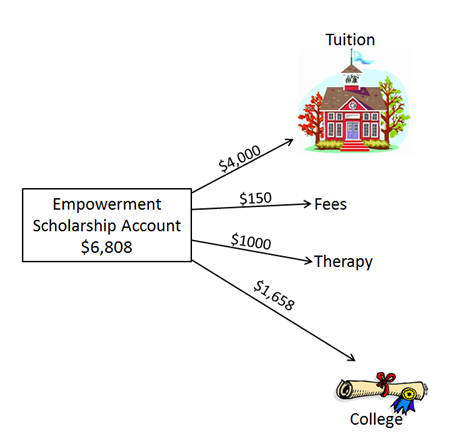
Five states have adopted ESA programs, and more than 7,000 students currently have access to ESAs in Arizona, Florida, and Mississippi. Similar to the programs in other states, Missouri’s program would allow parents to spend ESA funds on services like private school tuition, tutoring, online courses, textbooks, curriculum, and education therapies. The graphic above shows how parents wanting to customize a kindergarten year for a child with autism might choose to spend the ESA funds that would be available to them under the proposed program.

A parent might spend $150 on registration and application fees, $5,000 on a year’s worth of tuition, and $1,000 on therapies, namely behavioral interventions, or arts classes geared toward children with disabilities. In this case, that would leave $658 in the account. When the child graduated from high school, the $658 plus other accrued funds could be directed toward college or other post-secondary programs.

In our current public school system, parents must fight to access the educational services that fit their child’s needs. Organizations like Missouri Special Education Advocates and MPACT provide advocacy and parent training services that help children reach their full potential in the traditional public school system. An ESA program turns a system where parents must fight for a limited number of services into a child-centered system where services reflect a child’s unique abilities.

The Demolition Option in Kansas City

Kansas City Policy Police Chief Darryl Forté has an idea. According to The Star, Forté has suggested “reallocating some money earmarked for hiring extra police officers toward demolishing abandoned properties in crime-ridden neighborhoods.” Large scale demolition is not a new or controversial idea. The same day the Star reported this, Bloomberg Business published a piece about other cities that are spending money to tear things down. In it, Maryland Governor Larry Hogan said he would spend $75 million to tear down 4,000 vacant houses. “Fixing what is broken in Baltimore requires that we address the sea of abandoned, dilapidated buildings that are infecting entire neighborhoods,” he said.
 
Back in Kansas City, Councilwoman Alissia Canady agrees,
 
“That is a great indication of [Forté’s] understanding of what the real underlying issues are with crime, and to the extent he can minimize the areas where criminals like to take over,” said Canady, who is chairwoman of the council’s Neighborhoods and Public Safety Committee. “Most of the violent crimes occur in these blighted areas.”
 
The blight isn’t due to absentee landlords, either. If you visit the website for the Kansas City Land Bank, you will see that the owner of the most blighted land in Kansas City is… Kansas City. The City does a poor job of maintaining the properties, from cutting the grass to removing trash and eventually tearing them down. As a result, the neighbors suffer the consequences of City neglect, which include not just crime and declining home values, but also health. City Manager Troy Schulte says, “the city had 875 dangerous buildings on its list and estimated it would take $10 million to eliminate them.” 

It would be a shame if this money came from the police department amidst a spike in Kansas City murders. Where else could we find the money?

  • Perhaps the city could sell the land it is considering using for the convention hotel. After all, that is city-owned land that is also blighted. And according to The Star, it’s worth $13 million. The Pitch says $4.5 million. Either way its a good start. And the city likely owns all sorts of valuable land that it is doing nothing with.
  • The city could halt its awful idea to spend $12 million in taxpayer funds to tear down and rebuild a grocery store within 3 miles of at least two other grocery stores.
  • Schulte is under order from the Council to find $18 million for the so-called Jazz District. Maybe tearing down “dangerous” buildings is more important.
  • We could stop the streetcar project altogether on the grounds that protecting the health and well-being of thousands of families on the east side is more important than a 2.2 mile streetcar to nowhere.


MO Money, MO Problems for MoDOT Funding

MoDOT’s funding future is certainly looking brighter these days. The department’s user-funding base is, at long last, providing more revenue. Since 2013, motor vehicle sales tax revenue increased by more than 10% and license fee revenue is up by 2.6%. Even state fuel tax revenue, which many feared was entering terminal decline, is on the upswing. In the last year, MoDOT’s highway user revenues increased by a total of $27 million. For all this we can probably thank a better economy and lower fuel prices (an average price of $1.66 per regular gallon as of 1/11/2016). Fears of an imminent funding crisis have, for now, subsided. As an added bonus, the federal government passed the FAST Act late last year, opening up the possibility of increased federal funding for MoDOT.

However, in an ironic twist, the increased federal support promised under the FAST Act could once again put Missouri in a bind. As we’ve discussed before, the federal government gives highway funding to states in the form of individual project grants, not as a lump sum. This means that for MoDOT to get federal money for highways, it needs to spend state money. Thus, increased federal support through the FAST Act requires increased state spending.

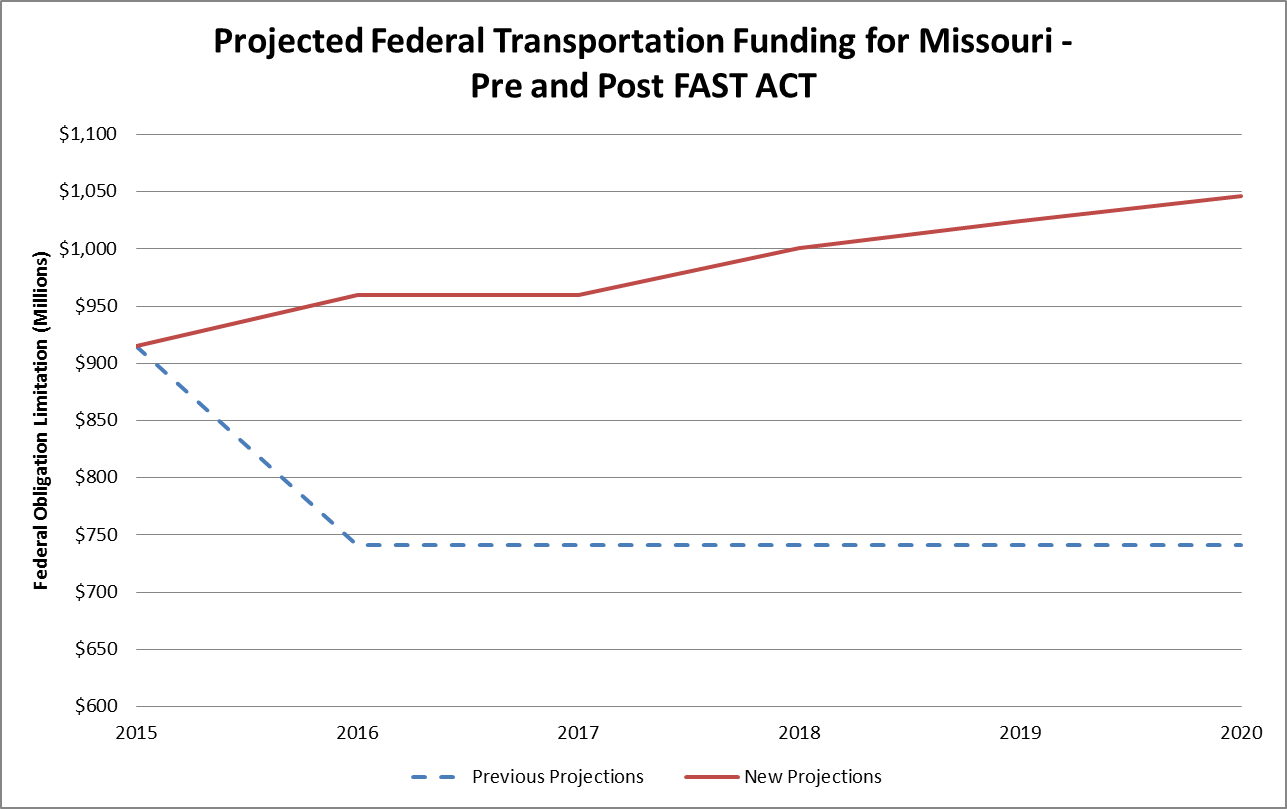
Back in early 2014, MoDOT officials predicted decreased federal support (of 19% in 2016), not a steady increase, as is now expected (see the chart above). While a decrease in federal dollars was feared, it also meant less revenue would be needed to maintain state matching funds. Even so, MoDOT officials at the time predicted they would not have the funds necessary by 2020.

With more federal funding available, MoDOT’s situation today is similar to that in in 2014—left wondering whether it will be able to match all federal dollars in the coming years. The key difference is that in 2014, the loss in federal funds would have meant the MoDOT would not have had the funds to maintain the state highway system. Now, it would mean the state was not taking advantage of all federal funding that will become available (which would then be redistributed to other states). Better problem.

Furthermore, as we’ve stated before, nearly all major highway projects receive a $4 to $1 federal to local match, meaning that it does not take much increased state revenue to match significant federal dollars. For example, the dollar gap between pre– and post–FAST Act projections should reach $305 million by 2020. MoDOT would need to spend $76 million in additional state-based revenue to cover that gap.

How will MoDOT cope? The department is already using creative accounting to get federal dollars for projects that were previously ineligible. The state legislature is also looking to shore-up the department’s user-funding base through increased fuel taxes and the possible introduction in tolling. If policymakers can focus on fair and economically sound solutions, Missouri should be able to capitalize on the better funding environment for transportation. 

Regional Leaders Should Keep Their Word over Stadium Plan

It’s official. The Rams are leaving Saint Louis. Residents might have disagreed over whether to spend public money on a stadium to keep them here, but no one wanted the region to lose an NFL team. However, while a lot of frustration has been directed toward Rams ownership and the NFL, including accusations of broken promises, we should remember that Saint Louis regional and state officials made their own promises over the past year regarding the riverfront stadium plan, and residents should make sure that those promises are kept.

First, after the Regional Convention and Sports Complex Authority (RSA) got a judge to throw out the city’s ordinance requiring a vote before public money could go to a stadium, the mayor’s office promised that city officials and the Board of Aldermen would craft a new, legally defensible ordinance in the same spirit. The mayor’s office claimed this couldn’t be done for the riverfront stadium, because time was of the essence. Now the Rams are moving, and there would appear to be plenty of time for ordinance-writing.

Second, at the state level, most legislators were indignant that the governor and the RSA would extend bonds without their approval. Senate leadership threatened to withhold bond payments for a new stadium. They claimed that the RSA was not created with the intent of becoming a permanent stadium-building authority. Now the state legislature has time to close that loophole, assuming that their opposition was more than grandstanding.

Finally, just about every public official and the leadership of the governor’s stadium task force told the public that if there is no commitment from an NFL team, there will not be a stadium. Last time Saint Louis lost a team, the city built a stadium on spec. After failing to land an expansion team, the city and state scrambled to lure an existing team—which turned out to be the Rams—to Saint Louis. To lure them, the region signed the terrible lease that is the cause of our present troubles. Let’s not repeat past mistakes. The RSA has already spent more than $16 million of public money (equivalent to about two years of maintenance on the Dome) planning a stadium (and suing the city) for a Rams organization that was not interested in staying here. It’s not time for the regional leaders to try to buy another football team or build a soccer stadium. It’s time to stop.

The criticism being leveled at the NFL and Stan Kroenke at this moment is understandable. But it is worth remembering that Mr. Kroenke did not attempt to extort money from Saint Louis. He did not ask for a publicly funded stadium. He did not ignore state legislators, cut the county out of the funding scheme, threaten to use eminent domain, or throw out the city’s vote. He did not ask us to grovel. We did it to ourselves. Now it’s time for policymakers to follow through on their promises and make sure this does not happen again. 

Missouri Is Leaving Its African-American Students Behind


There’s no other way to put it: Missouri schools simply aren’t giving African-American students a chance.

This was made particularly clear to me last month, when the US Chamber of Commerce Foundation released The Path Forward: Improving Educational Opportunities for African-American Students. I was fortunate to have the opportunity to help collect and analyze the data for the report, and I attended the launch event co-sponsored by the Chamber and the NAACP in Washington, DC.

The Path Forward broke down African-American student performance state by state. The results for Missouri were beyond disheartening:

·         On the 2015 National Assessment for Educational Progress, only 15 percent of Missouri’s African-American 4th graders were deemed proficient in reading and only 15 percent were proficient in math.

·         By the time they got to 8th grade it was even worse, with only 14 percent of African-American students proficient in reading and only 11 percent proficient in math.

·         While the graduation rate stood at 72 percent, only 6 percent of African-American students scored college-ready in all four tested subjects on the ACT.

·         Only 2.7 percent of African-American students graduated having passed at least one AP test during their time in high school. That was the third-worst rate in the nation.

There are over 151,000 African-American students in the state’s K-12 schools—16.5 percent of the overall student population. Our state will never reach its potential if that many students are failed by our education system.

So what can we do?

First, we have to break down the barriers between African-American students and quality schools. Right now, tens of thousands of students are trapped in low-quality schools because of where they live. Several of the small, almost entirely African-American districts of St. Louis County have only one high school. If students are not being served there, they have nowhere else to go. Elsewhere in the state, the geographic assignment of schooling often requires African-American students to attend schools that do not meet their needs. By allowing students to enroll across district lines—or even better, by allowing independent charter schools to open and draw students from across district boundaries—the link between where a child lives and where he or she goes to school can be severed.

Second, we have to engage the whole community in creating quality educational environments for African-American students. Statistics like those above remind us that this is an all-hands-on-deck crisis. Granting funding flexibility for students to attend the school that best serves them, regardless of whether it is a public or private school, would encourage churches, nonprofits, and other social organizations to get involved in schooling and reach out to children in need.

Third, we have to push for higher, not lower, expectations for African-American students. In the No Child Left Behind era, schools have been judged based on how well they meet basic targets of proficiency or how well they do at getting students to graduate from high school. Clearly, these are important stepping stones on the way to a well-rounded education, but they are far from sufficient. Passing AP tests, scoring well on college entrance exams and thus not needing remediation, and other more advanced indicators need to be part of the suite of metrics we use to judge student, school, and district success.

The Missouri Constitution calls for the state to fund and support a system of schools because knowledge and intelligence are “essential to the preservation of the rights and liberties of the people.” An education system that fails to educate a large swath of our students is a threat to our rights and liberties, and fixing it should be a priority of our leaders.

Greater Transparency Would Be Good for Mizzou

Tensions are still simmering following this fall’s student (and faculty) protests at the University of Missouri. Without venturing into the debate on the merits of the protestors’ claims, it is clear that the leadership lost the run of the school. Controversy is going to be a part of any university; young, idealistic students (and the professors who help incubate that idealism) will always clash with administrators. Important issues will be debated, and protests will be held. ‘Twas ever thus.

Universities have to be able to weather these events, though; otherwise, nothing will ever get done. It’s clear that the recent turmoil was more than the administration could overcome. Much ink was spilled in the post-mortem of the Wolf presidency, but I prefer to look to the future rather than dwelling on the past. I’m more interested in what we can do to improve Mizzou as the university moves forward.

That’s why I was heartened to see a legislative effort to promote greater transparency in the university system. Taxpayers and citizens have a vested interest in the university, and they can’t know if their hard-earned dollars are going to productive ends if they don’t know how those dollars are being spent. Louis Brandeis had it right—sunlight is the best disinfectant—and illuminating the inner workings of the university system can empower citizens to influence how the system is run.

The reform efforts have two central planks (available here and here). The first calls for the Missouri state auditor to complete a comprehensive audit of the university every year. The people of Missouri (many of whom will never have a child set foot on Mizzou’s campus) fund the university system to the tune of half a billion dollars every year. Is it going to fund research on Twilight fans, or is it being used to put more microscopes in the chemistry lab? Right now, we don’t know, and we should.

The second reform requires all instructors to put their syllabi and course reading lists online. Now, it’s not as if these documents are top secret today, but in the past when citizens and researchers have asked for access to syllabi to find out what students were being taught, Missouri universities have stonewalled them. Again, taxpayers have a right to know what they are paying for, and they should not have to pull teeth to find out what is actually being taught in the university’s classrooms.

The University of Missouri system is an important part of the fabric of our state. Not only does it instruct tens of thousands of our students every year, but it also serves as the locus of important research, debate, and discussion. A thriving Mizzou is good for Missouri, and greater transparency will strengthen the university and give Missouri citizens greater confidence that their tax dollars are going to fund important work.

Open Boundaries Would Allow More Students to Receive “Tough Love” at North Side

Students in St. Louis have more options today than ever before. From magnet schools to charter schools, students can choose between college prep schools, ROTC programs, or even schools for the arts. Of course, there is still concern about quality in some of these schools. Nevertheless, the market seems to be moving in the right direction. Yet, just over the district boundaries, in poverty-stricken school districts like Normandy and Riverview Gardens, students have few if any choices. There are no magnet schools and there are no charter schools.

Charter schools could open in these districts, but the low district enrollments ( 3,481 in Normandy and 5,143 in Riverview Gardens) make it unlikely. That could change if charter schools were allowed to enroll students across district boundaries.  It would also enable these disadvantaged students to access the existing charter schools in St. Louis—schools like North Side Community School. 

Show-Me’s Brittany Wagner has written about the school before, noting that it is only a five-minute drive from the struggling Normandy Schools Collaborative. Recently, the St. Louis American had some nice things to say about the school:

About 10 percent of the families are homeless, and many of the heads of households are struggling young parents or grandparents, said Muriel Smith, the school’s director of development. Despite all these factors that could be seen as setbacks, she said students are performing higher than many other schools in the city – especially those with similar demographics.

Sixty-five percent of children at North Side scored proficient or better in both English and math on state standardized tests in 2015, according to results released in August.

“A lot schools think that kids in these neighborhoods can’t really learn because they have so much going on at home,” Smith said. “But our scores and kids prove that that’s possible. We set expectations for our students and our parents to make sure that they are going to be successful.”

Those scores obviously don’t come easy. The second through fifth graders arrive at school at 8:15 a.m. and leave at 4:45 p.m. – an eight-hour day, and the school schedule is year round. Pre-K through first-grade students have a seven-hour day.


The newspaper chalked a lot of the school’s success up to the “tough love” system implemented by the charter school’s principal.  Allowing students to cross district boundaries to attend charter schools would enable more students to share in the success of North Side, and it would provide options for students who currently have none. With the Normandy Schools Collaborative continuing to struggle, now certainly seems like a good time for some tough love. 

On Rams Relocation, Saint Louis Media Is as Fickle as Stan Kroenke

We recently discussed how the Rams, and by extension the Rams’ owner Stan Kroenke, just slammed the Saint Louis metropolitan area to help make the case for moving the Rams. Now seems like a good time for city leadership and media to take a long look at why Saint Louis is in this position, and to reevaluate the merits of promising hundreds of millions of public dollars to a fickle billionaire. Instead, unfortunately, just about every civic leader and media source is focusing on blasting Kroenke for being a callous businessman (if not worse). A tough day for the man the Post-Dispatch once hailed as the new “Stan the Man.”

No joke. The Saint Louis media was not always as harsh on the Kroenke as they are now. Back when he was part of a task force to get an NFL team in the early 90s, many in the Saint Louis press tried their best to praise Kroenke. When he was pushing for an expansion team, Kroneke’s now-derided woodenness was described thusly:

He seems to be that rare individual who is comfortable with himself, and that makes us feel comfortable with him. After all the recent noise pollution, Kroenke's confident, understated manner is pleasing to the ears.

The very act of finding Kroenke, a Missouri native prepared to shell out tens of millions to attract a new team, was praised as a deft maneuver. Any possible faults were then overlooked . . . because football. As one Post-Dispatch writer put it:

"He wants to buy us a football team," I said to my kids. "He wants to bring the Lambs to St. Louis. I sure like him."

When Saint Louis finally bought the Rams, Kroenke was hailed as a victorious warrior. When the NFL voted (21 to 3) to block the Rams’ move to Saint Louis, the newspapers eagerly (and now very ironically) lapped up Kroenke’s promise to get the team here anyway, with litigation if necessary. After enough side deals were cut and the lease, now universally derided, was inked, the Post-Dispatch praised Kroenke as a “quiet source of steady strength.” The praise was so lavish that when the Cardinals faced an ownership crisis in 1995, Post-Dispatch columnist Bernie Miklasz wrote:

The good news is that maybe Cardinals fans will get what they deserve, when all of the brokering is completed: a caring, interactive owner. That person is out there. (HELLO, STAN KROENKE?)

If Saint Louis’s media had spent less time heaping praise on any attempt to get an NFL team, and more time looking critically at of the final deal’s merits, maybe we wouldn’t be in the mess we’re in now. 


Support Us

The work of the Show-Me Institute would not be possible without the generous support of people who are inspired by the vision of liberty and free enterprise. We hope you will join our efforts and become a Show-Me Institute sponsor.

Donate
Man on Horse Charging