
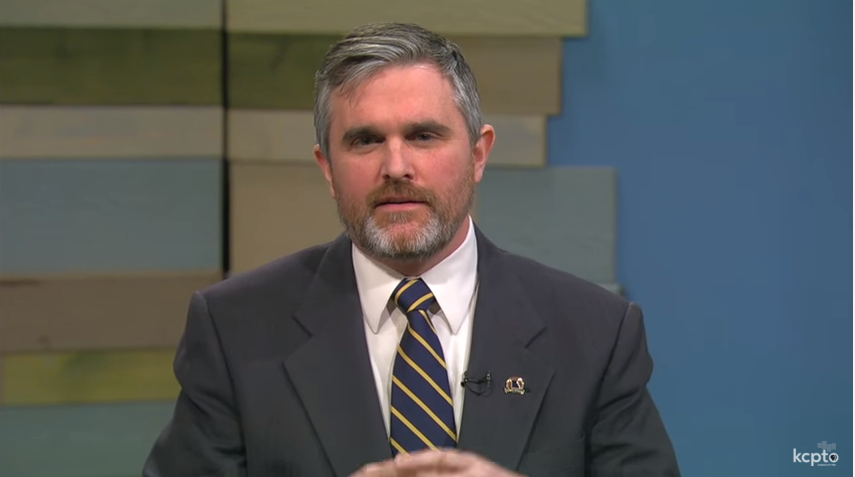
The Show-Me Institute's Patrick Tuohey appeared on Ruckus on February 18 to discuss education spending in Kansas, the earnings tax in Missouri, and the Kansas City convention hotel lawsuit. Click the link above to see the entire program.
Fueling MoDOT: Higher Gas Taxes?

In Missouri, a small tax increase would have drivers pay a little more for roads, and could head off proposals that would force all Missourians to subsidize driving. Click on the link above to see the video.
For a thorough analysis of the current state of Missouri's highway system and the challenges it faces in the near future, check out Joseph Miller's new Policy Study, Funding the Missouri Department of Transportation and the State Highway System.
Exactly How Many State Senators Plan to Immediately Become Lobbyists?

I ask the question because after listening to last week's State Senate debate on HB 1979, it seems glaringly obvious that there's a contingent of lawmakers planning to jump right back into the influence-peddling business once they leave office—this time for some of the interests lobbying them today. The apparently contentious issue is a reform that would require legislators to wait a period of a year or more before they can turn around and lobby their former colleagues. That reform is reasonable; taxpayers deserve clear assurances that their representative's loyalties are not unduly divided between their taxpayer employer today and a representative's potential lobbyist employer tomorrow. Stopping the revolving door of legislators turned lobbyists isn't about "career barriers" to legislators, as was argued repeatedly last week. It's about good governance.
So: How many Senators, charged with working for the public interest today, intend to seamlessly curry favor with their former colleagues on someone else's behalf immediately after leaving office? The public deserves to know.
Should Saint Louis Raise Property Taxes for Public Schools?

What do you call nearly $15,000 per pupil? If you’re the Saint Louis Public School System, you call it “not enough.” In April, the school district will ask voters to approve a 75-cent property tax increase. According to the St. Louis Post-Dispatch, the increase would generate an additional $27.8 million for the school district.
I wanted to take a moment to put this tax increase into perspective. According to data from the Department of Elementary and Secondary Education, the average tax rate ceiling for school districts in Missouri was $3.70 per $100 of assessed valuation in 2015. Regionally, however, property tax rates are considerably higher. The average tax rate for Saint Louis County school districts is $4.528. On top of that, county residents pay an additional $1.2609 per $100 of assessed valuation for the special school district. This brings the county average up to $5.788.
The table that follows shows how Saint Louis’ school property tax rate would stack up to Saint Louis County school districts. For county districts, I combine both district and special school district rates.
|
School District |
Property Tax Rate Ceiling |
|
Affton |
6.6905 |
|
Webster Groves |
6.6637 |
|
Jennings |
6.6438 |
|
Ferguson-Florissant |
6.6089 |
|
Hazelwood |
6.6076 |
|
Pattonville |
6.5654 |
|
Normandy |
5.9209 |
|
Valley Park |
5.9109 |
|
Brentwood |
5.9087 |
|
University City |
5.812 |
|
Maplewood-Richmond Heights |
5.6831 |
|
Hancock Place |
5.6704 |
|
Bayless |
5.618 |
|
Ritenour |
5.6173 |
|
Riverview Gardens |
5.5677 |
|
Kirkwood |
5.4831 |
|
Parkway |
5.3671 |
|
Rockwood |
5.3049 |
|
Lindbergh |
5.0709 |
|
Clayton |
5.0331 |
|
Mehlville |
5.0108 |
|
Ladue |
4.5933 |
|
St. Louis |
4.5000 |
As has been written on this blog before, Saint Louis could do other proactive things to address the budget crisis, such as selling vacant school buildings. And as Joseph Miller has pointed out, the city could help the district out a little by ending its flagrant TIF and tax abatement policies. Nevertheless, it is certainly within the right of the school district to seek a property tax increase. If this one passes, Saint Louis will still have the lowest school taxes in the area.
Kansas City Star: Do As We Say, Not As We Do

The Kansas City Star has a fever, and the only cure is more anti-tax cut blogs. This time the Star's editorial board takes aim at a proposal that would extend 2014's tax cuts and, among other things, would decrease Missouri's top income tax rate from 5.5% to 5%. The reform package would be a modest but essential update to the tax code. Missouri has been stranded on first base on tax policy for decades now; it's long past time state legislators got the line moving again on economic growth.
What makes the Star's prolific blogging against tax cuts so unseemly is that the newspaper is already a tax cut beneficiary—it's just that their cuts have been made only for them. Notably, the newspaper enjoys a tax abatement at its printing facility—one that should have expired last year. Instead, after playing nice with City Hall, the Star now gets hundreds of thousands of dollars each year in what the paper self-described as "tax relief."
Yes, the editorialists at the Star should feel a twinge of shame every time they bash tax cuts in Kansas City, and attempt to deny tax relief to others.
Meet the Teacher Who Gets Paid Like a Pro Athlete
Education blogger Joanne Jacobs flagged a fascinating story on Udemy, an online course provider that offers classes on subjects ranging from playing the guitar to web development. Just this month, they announced their 10 millionth user. Classes are generally inexpensive (less than $250) and are uploaded to the platform by instructors who then get a cut of the revenue.
The eye-popping fact is that the creator of the most popular course has earned $6.8 million for his efforts. Yep, you read that right: $6.8 million. His name is Rob Percival, and he is a British former high school teacher. As TIME points out, he is the exception, not the rule, but he does show the opportunity available for people to take advantage of this new platform.
How often have you heard that we should pay teachers like professional athletes or movie stars? Well, it turns out that we can, if we break down the barriers that have prevented teachers from reaching as many students as possible. Sure, it’s not for everyone. But for the creative course developer, or the working professional rounding out her skill set to make herself more marketable, or the college student looking to learn material without getting up to his eyeballs in debt, it is an incredible opportunity, and one we should celebrate.
Financial Disclosure Provision in Paycheck Protection Bill is Toothless
The House passed a paycheck protection bill on Thursday. The idea behind it—that a worker should be able to choose whether or not to support the politics of his or her union—is commendable. If this bill makes it through the legislative process, it will be a good thing for the public employees covered by the bill.
However, I would like to raise an issue with the language of the bill. The bill includes a financial disclosure provision that appears to require some government unions (fire and police unions are excluded) to make the same sorts of financial disclosures the private sector unions already have to make. As the bill is currently written, these financial disclosures lack teeth.
- For one, a worker has to request the union’s financials in order to access them. This could paint a target on the back of any whistleblower who wanted to report irregularities in the way union executives are recording their finances.
- Secondly, the financial information doesn’t have to be reported to any government agency or made publicly available. Private sector unions have had to make public financial filings with the government for decades. Why should public sector unions be less transparent than private sector unions? And shouldn’t the public have a right to know how government unions are spending taxpayer funded dues?
- Finally, the bill is written in such a way that government union executives can shred their financial documents after five years. Who benefits from this?
Make no mistake: requiring unions to make their financial information available to their members is a good idea. But the financial disclosure provisions in the paycheck protection bill need to be changed, if they are to be worth anything.
***
To underscore the need for financial disclosures, I have included a link (below) showing a list of dozens of federal embezzlement charges brought against the Communication Workers of America (CWA) executives over the past few years. CWA represents some of Missouri’s state employees, and its leadership is vehemently opposed to having to make meaningful financial filings.
https://www.unionfacts.com/olmscrime/Communications_Workers_of_America/embezzlement_charges
Jones Dome Headed for Demolition?
We’ve talked about the fate of the Edward Jones Dome many times on this blog. When the city was planning a new riverfront stadium to keep the Rams, the St. Louis Convention and Visitors Commission (CVC) often talked about how having the football team out of the Dome might be a boon for conventions. The football season made scheduling other events at the Dome difficult or impossible during the season. When the Rams left for Los Angeles, talk of the convention center’s future started almost immediately.
But now that future might not include the Dome. It seems that some members of the CVC think the Dome is more of a liability than an asset, and demolishing it may be the best option moving forward.
Readers of this blog will not be surprised at the sudden reversal in attitude toward the now-empty Dome. Just last week, we noted:
In 2015, only nine conventions had more than 10,000 participants (accounting for 80,000 room nights). The CVC often blames the NFL schedule for holding down the number of conventions the city can compete for, but in the six months when no games were held at the Dome, nine large conventions was a far cry from busy.
Some members of the CVC are apparently coming around to our position on the ability of Dome to attract many new conventions. They point out that the Dome is outdated compared to new competition from other regional convention centers in Denver and Nashville. The most poignant criticism was from the president of the CVC, who the Post-Dispatch reports as saying, “The Dome itself is too high—it feels like a stadium, not convention space.”
The idea of demolishing part or the entire Dome may prove politically or financially unfeasible. However, it’s becoming clear that the Dome is not much better at attracting large conventions that it has been at attracting Stan Kroenke. Twenty years after that stadium opened as a stadium/convention center, it is functionally obsolete for both purposes.
When Dome advocates pushed for state funding more than 20 years ago, they told the state legislature that we couldn’t afford not to build the stadium. Now, it seems like we really could have.
Geri’s Story: Holding Unions Accountable
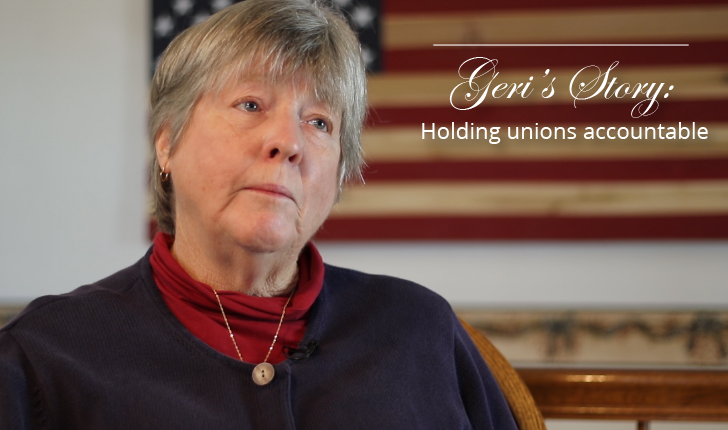
Geri Thwing works as a school bus driver. She also pays for representation by a union that she feels doesn’t do a whole lot for her. Most of the time when you decide you don’t want or need a service you’re paying for, you can choose to stop paying and no longer receive that service. Geri doesn’t have that option—her union requires her to pay dues as a condition of employment.
Geri’s father and husband were both union members. And she was initially fine with joining. But now she wants out.
Geri’s situation is worsened by the fact that she has a moral objection to many of the activities of her union. Her union, the International Brotherhood of Teamsters, spends heavily on politics. According to the Washington Times, they spent $5.9 million on lobbying and campaign contributions in 2014 alone. “It breaks my heart,” she told me.
Geri called her local’s business agent to ask about the political spending. She says it didn’t help anything. I also called Geri’s local to ask about their stance on forcing people to join the union. I’m still waiting for a call back.
Thousands of Missourians are in Geri’s situation—forced to pay for a union’s services while skeptical that the union is actually doing anything for them. Giving workers the freedom to opt out of a union is one way to hold a union accountable. Giving workers a regular secret ballot vote on whether to keep their union is another way to make union executives listen to the concerns of the people they represent.
I had the opportunity to interview Geri; the video is available via the link above.
