After Melissa Click, Higher Ed Reforms Must Stay on Course

News broke late last week that embattled Mizzou professor Melissa Click has been fired from her job by the state's Board of Curators. You'll remember that Click was the teacher who demanded "muscle" against a student during last year's student protests, and who was caught in recently-released body cam footage verbally assaulting law enforcement earlier that fall. 

Click may appeal the Board's decision, but whatever the outcome there, Click's case was always very separate from the important policy issues her behavior brought into focus. Policymakers should recognize that Click is a symptom of the broken campus culture at Mizzou, not the cause of it. Accordingly, legislators should not take their eyes off the reform ball that's already started rolling this session. 

Melissa Click represented problems that have institutionally bedeviled the University for years, and her departure should signal not just the end of her tenure, but the beginning of a round of higher ed reforms that taxpayers can be proud of. After all of the embarrassments Mizzou brought to the state last year, that would be a welcome change of pace.

Bridge Tolls Ready for a Comeback?

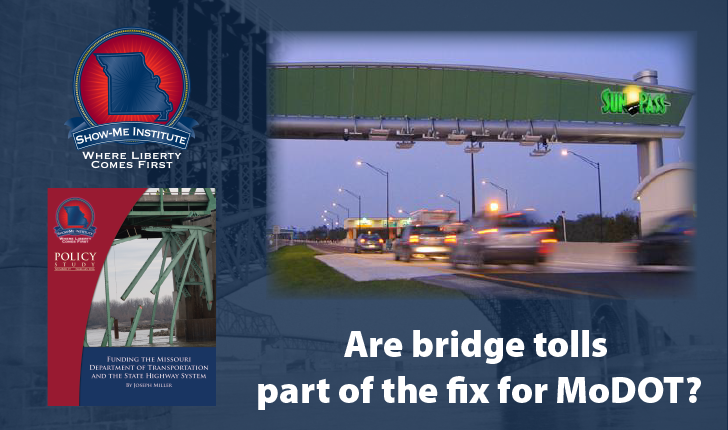
Many of the bridges from Illinois into St. Louis were once toll bridges. Maybe Missouri should bring back bridge tolls to help fund its transportation needs. Click on the link above to see the video.

For a thorough analysis of the current state of Missouri's highway system and the challenges it faces in the near future, check out Joseph Miller's new Policy Study, Funding the Missouri Department of Transportation and the State Highway System.

Kansas City Prioritizes Transportation Few Use

Kansas City residents rely on well-functioning transportation for virtually every aspect of their lifestyle, from getting to work to spending a night on the town. But to keep the transportation system working, the Kansas City region needs to make regular investments. Unfortunately, the most recent plan for transportation spending in the Kansas City area shows a troubling disconnect between the infrastructure taxpayers actually use and where city leaders want to put taxpayers’ money.

Not all transportation modes are of equal importance in the Kansas City area. The region’s dispersed population and employment mean that most residents use highways and streets to commute. In Jackson, Clay, and Platte Counties, more than 90% of commuters drove to get to work (according to U.S. Census data from 2009 to 2013). The next most popular form of getting to work is actually just not going anywhere (that is, working at home). Aside from commuting, much of the metro area’s freight traffic uses the highways, and the region’s bus networks also make use of city streets.

Highways and streets are indisputably the most-used part of Kansas City’s transportation network. The only rival for importance may be the freight rail network, as Kansas City is the nation’s second largest freight rail hub. That might lead one to predict that most of the spending in the Kansas City area’s Transportation Improvement Program from 2016–2020, which includes, “. . . all federally funded surface transportation projects and all regionally significant surface transportation projects planned for the Kansas City metro area during federal fiscal years 2016–2020,” would be for highways and streets. That prediction would be wrong.

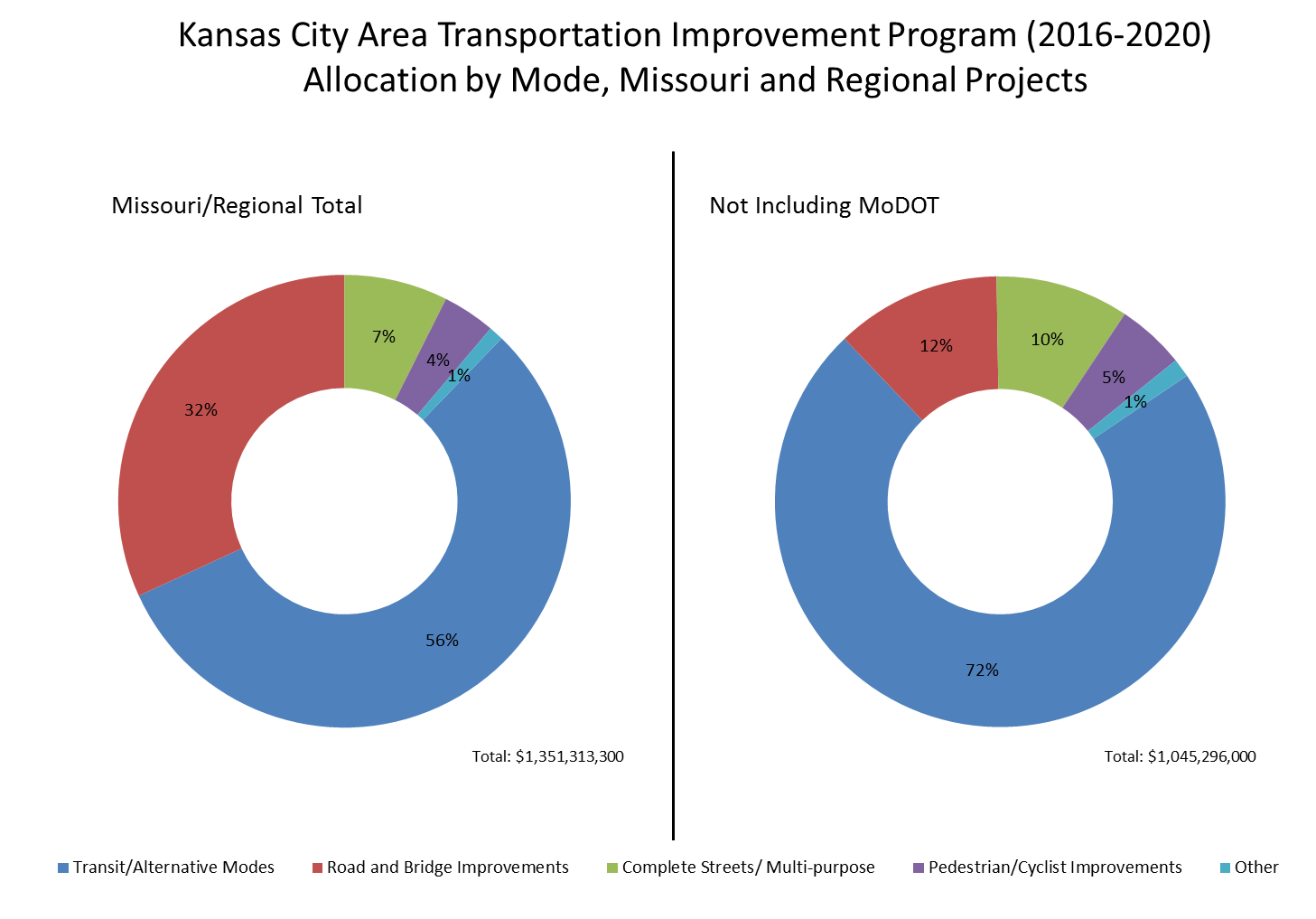
In reality, 56% of all regional and Missouri-side spending ($1.35 billion) will be for public transportation projects like the bus system and the streetcar. Road and bridge projects only get 32% of the pie, with “complete streets” and pedestrian/bike projects combining for around 11% of spending. These numbers, if anything, overestimate Kansas City’s commitment to road and bridge investments, because the vast majority of spending on roads comes from the Missouri Department of Transportation (MoDOT), which is tasked with maintaining the state network, whatever the ideological bent of Kansas City regional planners. MoDOT does not handle non-state highway projects. 

Spending allocation: KC area transportation improvement program

If we take MoDOT out of the equation, only about 12 percent of the region's spending ($124 million) is going to roads and bridges. That’s only slightly more than is going to the streetcar starter line, which supporters admit is not really about transportation at all. Seventy-two percent of non-MoDOT transportation spending is going to transit, which, as of 2014, accounted for less than 2 percent of the regions commuters.

How long can Kansas City leaders go on ignoring the transportation modes everyone relies on while lavishing funds on modes few people use if they still expect to have a functioning system? 

Seattle’s Minimum Wage Experience A Cautionary Tale

When the price of a thing goes up, people buy less of it. We experience this every day when buying groceries, gasoline or anything else. So why are people surprised when it applies to the labor market?

We at the Show-Me Institute have written about the negative effect of increases to the minimum wage for some time. (You can read some of it here and here and here.) We were saddened but not surprised to learn that in Seattle, the increased minimum wage is decreasing employment while increasing unemployment and joblessness. One author wrote,

Early evidence from the Bureau of Labor Statistics (BLS) on Seattle’s monthly employment, the number of unemployed workers, and the city’s unemployment rate through December 2015 suggest that since last April when the first minimum wage hike took effect: a) the city’s employment has fallen by more than 11,000, b) the number of unemployed workers has risen by nearly 5,000, and c) the city’s jobless rate has increased by more than 1 percentage point (all based on BLS’s “not seasonally adjusted basis”). Those figures are based on employment data for the city of Seattle only (not the Seattle MSA or MD), and are available from the BLS website here (data are “not seasonally adjusted”).
 
Especially relevant to Kansas City is that the data also shows the suburbs of Seattle, where no wage hike took effect, have seen an increase in jobs. Had Kansas City chosen the same path, we likely would have seen the same results: jobs moving outside the city to where labor was cheaper.

Millennials Moving Out

My colleague Joe Miller has written much about the idea that millennials are flocking to urban areas. This is important because, at least in Kansas City, city officials hold up the prospect of attracting millennials as the reason for their downtown spending spree on luxury apartments, hotels, and streetcars. Miller has pointed out that at best, the research on millennials eschewing cars and preferring urban life is mixed.

On Thursday, American Public Media broadcast a story on NPR suggesting that millennials aren't that different from previous generations at all. 

But while we often think of millennials as a generation living in gentrifying neighborhoods in urban centers, 49 percent of millennial homebuyers are in fact moving to the suburbs, according to the [National Association of Realtors]. They are moving out of the city and away from the urban living culture with which they are closely associated.
 
Furthermore, the degree to which they ever diverged from previous generations' behaviors was a function of the economy, not some inherent difference in their makeup:
 
Part of the reason for that trend may be that some millennials waited longer to purchase their first homes, because of the soured economy, and may already have one small child and a second on the way. For those who themselves grew up in the suburbs and still have family there, [Chicago realtor Tommy] Choi said the decision to buy in the suburbs is an easier one. They often move back near their childhood neighborhoods…
 
"[Millennials] are growing up," said [NAR managing director Jessica] Lautz. And they are following in much of the same patterns of previous generations. "They are becoming homebuyers. They are saving. They are getting married. They are having kids. Much like all of us have done in past generations."
 
If Kansas City wants to grow its population, it needs to be a more attractive place to live and work for people of every age and race. This means focusing on spending efficiently on basic city services such as infrastructure, neighborhoods, and schools rather than diverting funds to big projects and praying for miracles.

Driving in Missouri Accelerating

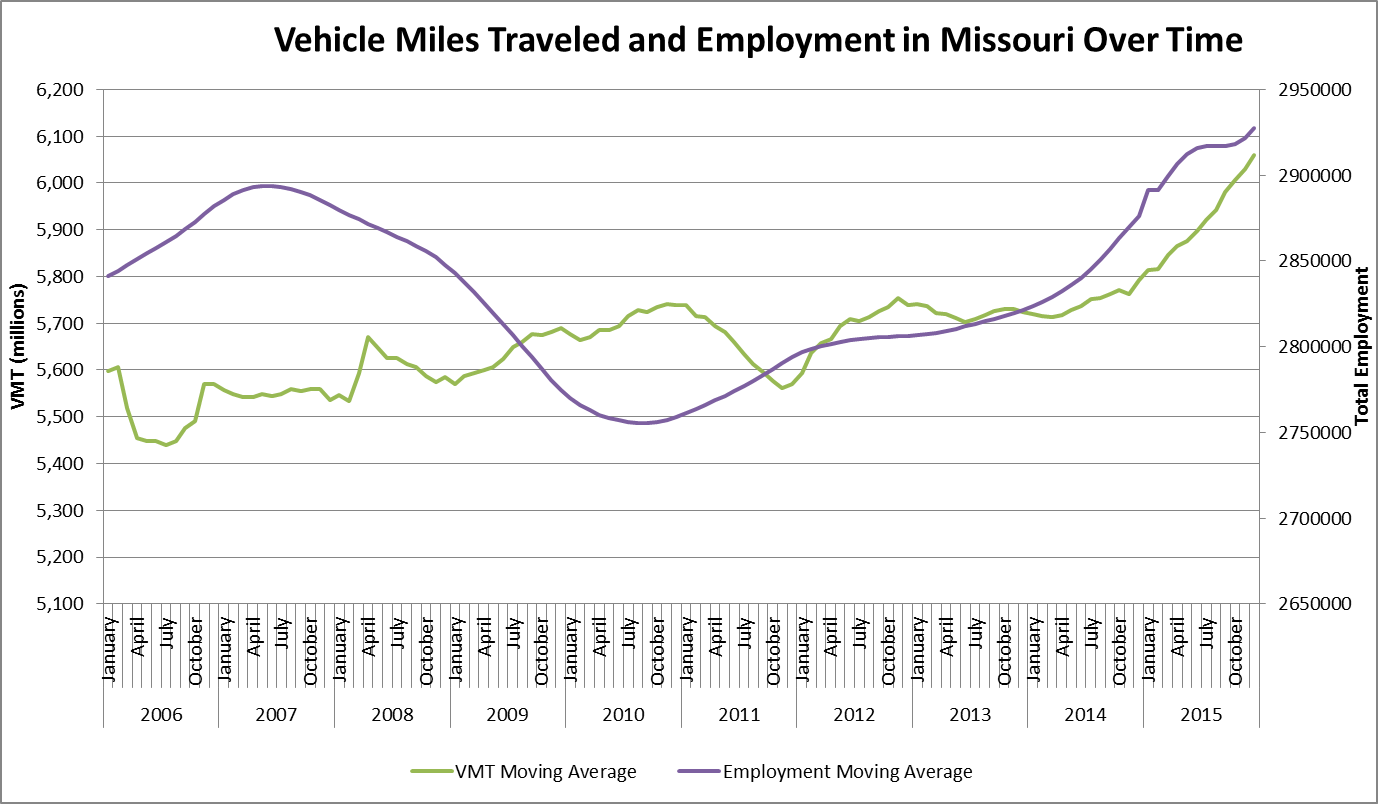
Over the last couple years, we’ve been following transportation trends on this blog. One metric we’ve kept our eye on is vehicle miles traveled (VMT) on Missouri’s roads, a proxy for the state’s overall demand for driving and highways. The latest federal data shows that not only are Missourians driving more than ever, but also that the rate of growth is accelerating.

After the recession in 2009, growth in traffic on Missouri’s highways slowed to a crawl and actually declined in urban areas. This led to some who were ideologically opposed to personal vehicle use and highway construction to claim that residents were abandoning their cars for public transportation or live/work communities. This point of view is still echoed by transit activists, and even the Missouri Department of Transportation (MoDOT) wrote this assumption into their planning in 2013.

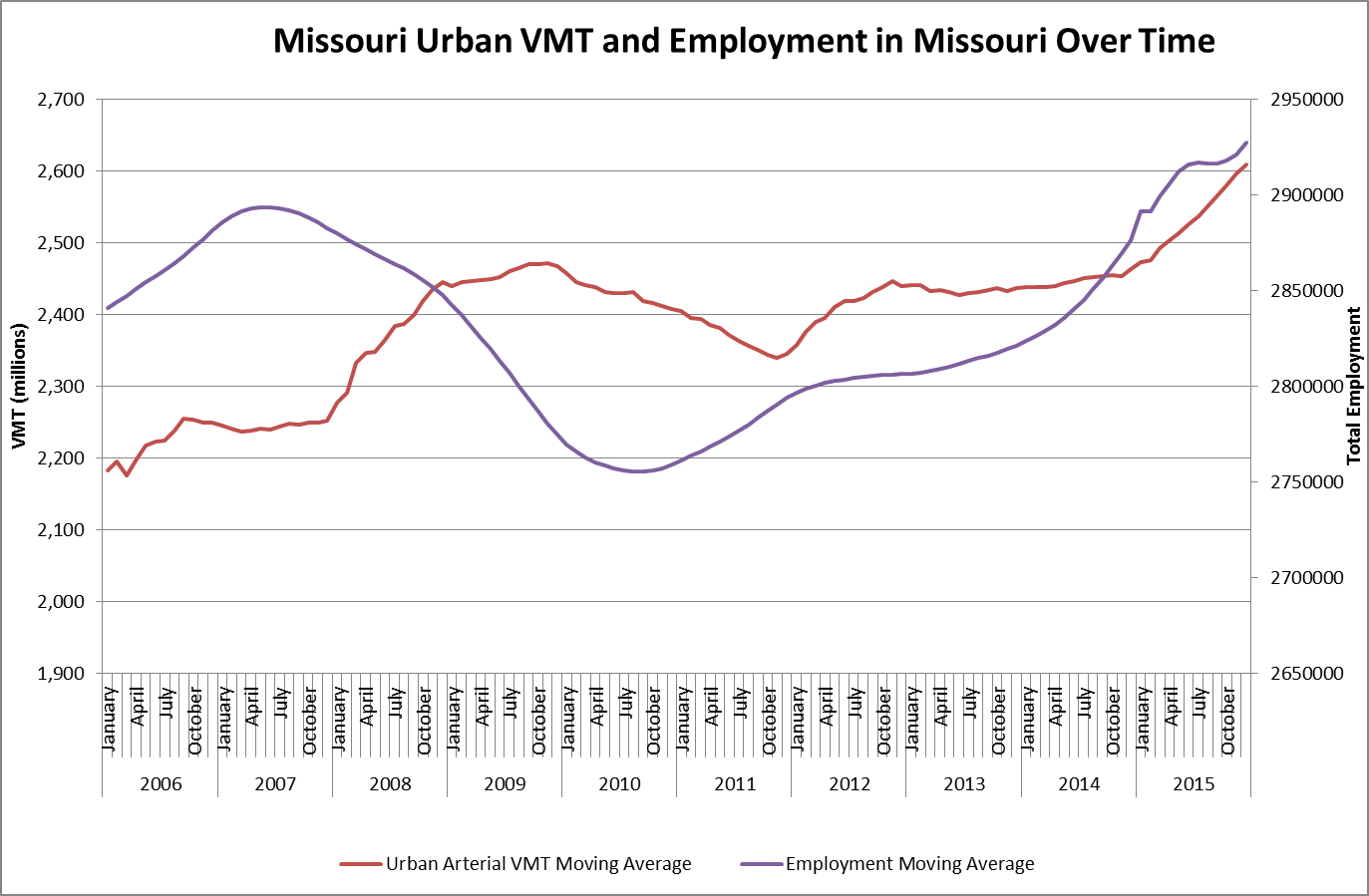
But subsequent driving data has contradicted these assumptions (or hopes). As we’ve pointed out in other blogs, public transportation use in Missouri’s major cities is essentially flat, and does not indicate a demand-side sea change. And when the state’s employment level began to grow in 2012, driving (VMT) grew as well. Missouri’s roads were seeing more driving than ever in 2014, and the trend accelerated in 2015. Over the course of last year, total VMT in the state grew 4.6%, and driving on urban roads grew by 6%. The following charts show the trend:

Graph of vehicle miles traveled--Missouri

Graph of vehicle miles traveled vs employment--urban MO areas

Whether the acceleration in driving has to do with lower fuel prices or an improving economy makes little difference. The long-term trend in Missouri’s VMT has been growth, with recession numbers looking ever more like an aberration, not a harbinger of things to come. This has implications for future infrastructure needs in the state, which policymakers ignore at Missouri’s peril. 

Kansas City Star Worried over “Bullying” from Uber, Lyft

The Missouri legislature is currently considering statewide regulation for ridesharing companies, like Uber and Lyft, which would pre-empt local regulations in cities like Saint Louis and Kansas City. Most states now have these state regulations, including all of Missouri’s neighbors save Iowa. But for some local policymakers, and media outlets like the Kansas City Star, these regulations are bullying from Uber and Lyft that rob cities of tax revenue. These criticisms miss the mark entirely.

Let’s consider the charge of bullying. Companies like Uber and Lyft have bargained hard with local regulators, trying to get rules changed to fit their business model. But let’s not forget how for-hire vehicles were regulated in Kansas City and St. Louis before these companies came along. Regulatory bodies (often representing existing taxi companies) capped the supply of cabs, fixed pricing, limited business practices, and stifled innovation. When Uber and Lyft tried to enter these markets a couple of years ago, regulators and taxi representatives fought over every inch of regulation, and the fight continues in Saint Louis. That foot-dragging is what prompted efforts to regulate these companies at the state (rather than the local) level. So who are the bullies? The regulators who micromanaged the entire taxi market for generations, or Uber and Lyft?

Now let’s talk about tax revenue. Under the current regulations, ridesharing drivers would not have to pay local earnings taxes in Kansas City and Saint Louis simply for picking up passengers there. According to one Kanas City Star author, Uber will be using city streets but not paying for them. First of all, provisions in these bills don’t specifically target the earnings tax; they prohibit municipalities from charging any kind of special tax on ridesharing companies, which happens. And second, the idea that streets would be starved of funding because of earnings-tax losses just isn’t credible. Kansas City has long treated street maintenance as the red-headed stepchild of the budget-making process, with only 3% of the city’s funding going to streets. In fact, in the upcoming budget, the tax-incentive budget is equivalent to the streets’ capital budget. When we consider that this includes both federal and state fuel tax support, and that many Uber and Lyft drivers are Kansas City residents who pay other taxes, the idea that we need to kill regulatory reform to give Kansas City a larger cut seems a bit much. Any increased tax revenue would be more likely to go the Kansas City Area Transportation Authority than to streets.

Companies like Uber and Lyft are pushing for long-overdue reform in cities across the country. And unlike their opponents, they aren’t seeking to outlaw their competition—only to run their businesses their way. They only have political clout because residents in Missouri see the great benefit of these services and want to use them. If newspaper columnists or policymakers don’t like Uber’s business model, they don’t have to drive for Uber and they don’t have to ride Uber. But they shouldn’t be allowed to make that decision for the rest of us, or empower those who would. 

Hail to the Chiefs? City Includes Arrowhead on List of Urban Core Successes

After a recent KCPT documentary on urban neglect made waves across the region, supporters of the earnings tax are eager to counter claims that the city's east side neighborhood has been, well, neglected over the years. Kansas City Mayor Sly James is no exception. In a recent blog post, the Mayor stressed that
 
Since 2011, over $2.5 billion in major developments, ranging from housing and commercial real estate to infrastructure and capital improvements have been approved, broken ground or been completed just in the area east of Troost, south of the river, and north of 63rd Street.
 
Attached to the post is a document listing projects that have taken place in the region the mayor defined. Some of the projects listed dealing with infrastructure were at least arguably meritorious. Others, including the boondoggle Citadel project, clearly weren't . . . but were nonetheless included in the city's strange parade of apparent economic successes. 
 
Yet the single largest spending item on the list overshadowed all the rest, punctuated by its $375 million price tag. That item: the Arrowhead Stadium upgrades. 
 
We first have to highlight the dubious argument that publicly underwriting professional sports is good economic policy. It's not. But beyond that, is Kansas City actually arguing that giving piles of money to wealthy professional sports team owners is a win for long-neglected communities in the urban core? Is the Truman Sports complex even inside the commonly understood boundaries that define the urban East Side neighborhood and its struggles? City officials might point to the minority-owned business hiring targets of the project and the indirect impact they could have had on the corridor around Troost, but the argument that Arrowhead's corporate welfare trickled down to East Side residents is very thin gruel for this long-suffering community.
 
The blog concludes with the following:
 
To the people I serve who live in our city’s eastern neighborhoods, the city hasn’t forgotten about you. I haven’t forgotten about you. Far from it. We’re going to do a better job of telling you about all things going on in your neighborhoods.
 
Fact is, the residents in the urban core know exactly what is going on in their neighborhoods, and it has nothing to do with the quality of the luxury boxes at Arrowhead. What members of the community need is leadership that huddles with residents and drives policies that deliver basic city services effectively and efficiently to the people who need them every day. Instead, all too often the city throws Hail-Mary policy passes long after the rout is on.
 
By that point it's too little and, unfortunately, too late. Our residents deserve better than to endure that kind of play calling year after year.

Bombardier’s Troubles Continue As Company Lays Off 7000

Back in November we updated readers on the case of Bombardier, a company that in 2008 sought millions in state tax incentives to move some of its Canadian operations to Missouri. In the end the company didn’t make the jump to the Show-Me State but did receive millions in incentives from Canada, Britain, and Quebec. Last year we found out that Bombardier needed a billion dollar bailout to keep the company going; this year, we found out that wasn’t all it needed.

Bombardier, the Canadian transportation company, said on Wednesday that it would lay off about 7,000 employees over the next two years, as it struggles to find buyers for a new series of planes that for the first time put it in direct competition with the aviation giants Boeing and Airbus….

While the Air Canada sale provided important help for the CSeries, sales of the aircraft remain below levels that analysts generally view as assuring the project’s success. Including the 45 planes for Air Canada, Bombardier now has 288 firm orders.

Making money in business is never a certainty, and yet time and again state and local officials seem to think they have a special insight for picking moneymakers when they don’t. Whether you’re talking about developing a hotel, a stadium, an airport, or something else, the incentives of politicans often diverge greatly from the long-term interests of the communities they’re supposed to represent. It’s fun to cut the ribbon at a groundbreaking and get your picture taken with a hard hat on, but who ends up with the bearing the burden when an incentivized business goes belly-up? Taxpayers, that’s who.

Fortunately, it wasn’t Missouri’s taxpayers who paid the price when Bombardier’s incentive-addled business plans crash-landed, and state officials should learn from having dodged that bullet. Rather than riskily cutting deals with a select few, policymakers should invest in every family and business in the state by simply lowering everyone’s taxes

Support Us

The work of the Show-Me Institute would not be possible without the generous support of people who are inspired by the vision of liberty and free enterprise. We hope you will join our efforts and become a Show-Me Institute sponsor.

Donate
Man on Horse Charging