Debt, Airports, and Kansas City

With Kansas City considering new terminal plans for Kansas City International Airport (MCI), it’s a good time to revisit some basic tenets of terminal finance.

There are good reasons to build new airport terminals, whether at MCI or any other airport. It may be that continuing to maintain and operate existing buildings is just too expensive compared to a modern replacement, especially given possible service upgrades. Many airports also build new terminals to accommodate increased flights or different carriers that existing terminals cannot.

However, the cost of any terminal plan needs to be taken into consideration. If an airport like MCI takes on too much debt, the results can be higher prices (for parking, car rentals, etc.) and fewer flight options for residents. Right now, MCI is in a good financial position, and has a relatively low debt load for an airport of its size. That allows MCI to offer low fees to airlines and moderate prices for terminal services, and to borrow cheaply. As a counterexample, consider the most indebted of MCI’s peers, San Jose International Airport (SJC).  After completing a $1.3 billion new terminal a couple years ago, SJC struggles to keep airline costs low so it does not lose service.  Doing so is causing SJC to burn through reserves at a rate of $30 million per year, which is not sustainable. If SJC cannot significantly increase revenue, San Jose may have to subsidize the airport’s debt through the city’s general fund.

If MCI had gone forward with the erstwhile “New Terminal Plan” (priced at $1.2 billion) its debt level (and debt payments) would have become the highest among its peers, including San Jose:
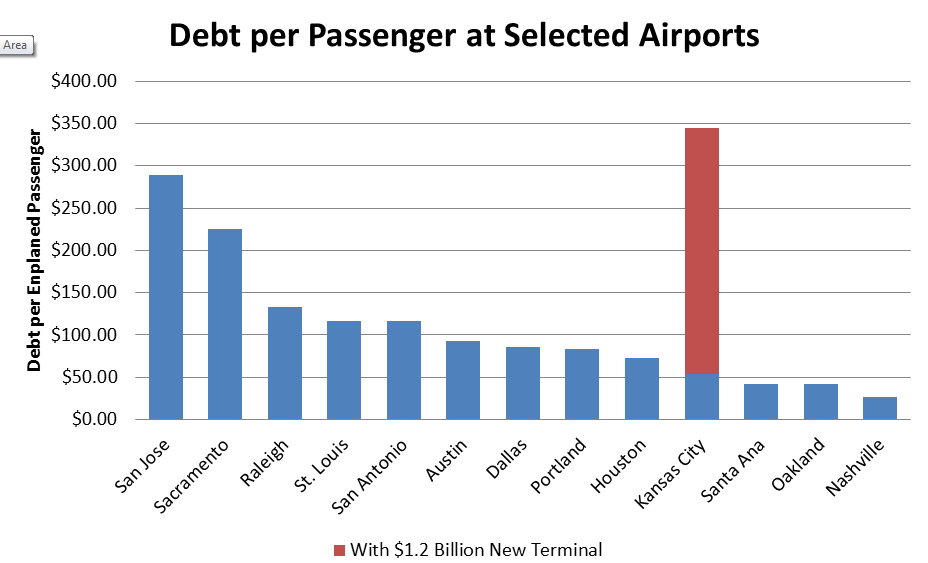
This would have been a risky move for MCI and Kansas City residents. Unfortunately, despite our objections and common sense, some in Kansas City’s leadership seem to think that costs do not matter at airports, and that MCI can simply pass extra costs onto airlines and travelers without consequence.

Kansas City International Airport may be better off with a new terminal. The city’s aviation department may put forward a plan that makes sense for travelers and the airport’s finances. Our main criticism over the late “New Terminal Plan” was that because of the $1.2 billion price tag and the fact that the plan would have resulted in less capacity, the proposal seemed more about civic ego than helping residents get good flights. We hope any new plan won’t have the same problem.


Essay: Slow Growth in Saint Louis and Kansas City Is Holding Missouri Back

The economic health of Missouri is tightly bound to the fortunes of Saint Louis and Kansas City, as these two metropolitan areas account for over half of the state’s output. Unfortunately, the performance of both cities has been dismal in the 21st century, and the predictable result is that growth statewide has been poor as well. This essay examines growth not only in Saint Louis and Kansas City, but also in the state’s smaller metropolitan areas and rural areas, comparing them to counterparts nationwide. Although there have been pockets of economic vitality throughout the state, the two major metro areas have generated a drag on state ouput that has left Missouri as one of the slowest growing states in the nation. Click on the link below to read the entire essay.

Even under Fuel Tax Increase, Missouri Taxes Would Still Be Below Average

Recently, the Missouri Senate approved a 5.9-cent fuel tax increase that, should it pass the House, would go before voters in the fall. If voters accept the proposal, Missouri’s fuel taxes will increase from 17.3 cents per gallon to 23.2 cents per gallon. As we’ve stated many times before, Missouri currently has a comparatively low fuel tax, fifth-lowest in the nation for regular fuel and fourth-lowest for diesel fuel. So where would the proposed increase in the fuel tax place Missouri?

The answer is that Missouri would still have a fuel tax well below the national average. Some news sources have put average state fuel tax at 20.88 cents per gallon, but this ignores the additional taxes many states (but not Missouri) place on fuel. For instance, Illinois’s fuel excise tax is only 19 cents per gallon, but its additional taxes add on 11 cents per gallon. Often, these additional taxes are sales taxes whose per-gallon amount fluctuates with gas prices. When these taxes are accounted for, the average state tax rate for a gallon of regular gas comes to 29.63 cents, with diesel at 29.33 cents.

If Missouri increases its fuel taxes by 5.9 cents (and the price of fuel holds steady), Missouri would have the 17th-lowest regular fuel tax in the nation and the 16th-lowest diesel fuel tax. Our regular fuel tax would still be cheaper than those of Kansas (24.03 cents), Iowa (32 cents), Illinois (30.18 cents), Nebraska (27.7 cents) and Kentucky (26 cents). We would become a more expensive state for gas than Arkansas (21.8 cents), Oklahoma (17 cents), and Tennessee (21.4 cents). 

Whether or not voters are willing to increase fuel taxes in Missouri at all is an open question. However, even under the proposed increase, Missouri would still be a relatively cheap place to fill up, both nationally and in our region. 

As Expected, KC Renews Its Earnings Tax

For the second time in five years, Kansas City has voted to retain its earnings tax by a substantial majority. While disappointing, this result was unsurprising; after all, city residents renewed the tax by a 78% to 22% vote in 2011, and this year's margin was comparable to that one. Under Missouri law, Kansas City will reconsider the renewal question again in 2021 and every five years thereafter. Given the tax's destructiveness, that's an altogether appropriate and necessary interval.

Obviously, Tuesday's results were mostly bad news for the reform side, but one largely overlooked detail was that the number of votes in favor of the tax dropped significantly since the last vote. In 2011, nearly 57,000 Kansas Citians cast ballots in favor of the earnings tax; in 2016, that figure dropped by nearly a third to just over 39,000 votes in favor, with turnout down significantly overall. That wasn't a statewide trend, either; turnout in St. Louis, which also voted on the earnings tax on Tuesday, actually rose by several thousand votes compared to 2011. 

Regardless, the tax and spending reform discussion for Missouri's largest city will of course continue. That's because the earnings tax hurts Kansas City and the people in it. And thanks to the earnings tax debate, Kansas City is finally being forced to take a hard look at its TIF policies and how it delivers public services to all Kansas Citians—especially those on the East Side.

I hope that city leaders will move away from the tax sooner rather than later; it's the right thing to do for the city, and the region.

Summer Internships

The Show-Me Institute is pleased to offer internship opportunities for Summer 2016.
 
  • Internships are open to current undergraduate and graduate students, as well as recent graduates.
  • Internships last approximately ten weeks. The exact starting and ending dates are flexible, but we anticipate that each internship will run from June 6 until August 12.
  • Summer interns will work a full-time schedule (9 a.m.-5 p.m.).
  • Interns will be involved in many aspects of the Institute’s operations. Interns will work closely with senior staff on a wide variety of projects. They can expect greater responsibility and personal attention than they would receive at larger organizations.
  • Interns will assist staff members with a variety of tasks. These may include researching public policy topics, organizing events, and writing and editing op-eds, newsletters, studies, and other documents. Some administrative and clerical tasks also will be required.
  • Policy internships as well as communications and development internships are available.
  • A Show-Me Institute internship is an excellent opportunity to improve your research and writing skills. Each intern will produce regular blog posts and an op-ed on a public policy topic of interest to him or her. Each intern will receive feedback and assistance from SMI staff members throughout the process.
  • All internships are at the Show-Me Institute’s offices in Saint Louis, Missouri, and Kansas City, Missouri.
  • Interns will be paid on an hourly basis.

Those wishing to be considered for an internship should submit the application (click here) and the requested supporting materials. The deadline for applications is May 13, 2016. However, we will begin conducting interviews as applications are received. Applicants can expect a decision in late May.


Learning from Our Mistakes: A Funding Formula Cap

In my youth, I made some irresponsible financial decisions. The first thing I purchased on a credit card was a tennis racket; I don’t even play tennis. Then, of course, there was the college spring break trip to Panama City that was put on the credit card. Now, a decade later, I’m still paying for many of those unsound fiscal decisions. It may sound strange, but in many ways Missouri’s education funding system is in the same boat—decisions made long ago continue to plague us today.

After Missouri’s school funding system was challenged in the courts, lawmakers went to work and put in place a new school funding formula in 2005. The plan was to phase in the new, more expensive formula over a number of years. Lawmakers realized that the formula could potentially grow at a rate that made it impossible to fully fund, so they put in place a cap. The cap restricted growth to five percent over a two-year period.

In 2009, while the formula was still in its youth, lawmakers removed the cap, allowing the state’s obligations to grow at a rapid pace. Lawmakers were expecting a financial boon from lottery proceeds—which, of course, didn’t pan out. At the same time, Missouri and the rest of the country experienced one of the largest economic downturns in recent memory.

Today, our foundation formula for public schools is underfunded by roughly $500 million. This shortfall can be tied directly to the legislature’s unsound fiscal decision to remove the cap, along with the Great Recession of 2009.

 Some might scoff at what I’m suggesting. They’ll say, “The problem is that the legislature just needs to value education more and put more money into the formula.” There is just one problem with that. Believe it or not, more funding actually exacerbates the problem. Let me explain.

When I make a payment on my credit card debt, the next month’s payment is lower. However, when lawmakers increase funding for the foundation formula, it triggers an increase in the funding that will be required for the next go-round. This occurs because the formula is updated bi-annually based on how much a select group of districts spend per pupil.  The legislature gives districts more money, the formula gets recalculated based on this new spending, and the target moves ever upward.    

We have created a vicious circle in which more spending begets more spending.

Now, the legislature is considering reinstating the five-percent cap. This would not necessarily fix the perpetually increasing funding cycle, but it would slow it down. It would make it more feasible for lawmakers to fully fund the foundation formula.

We all make unwise financial decisions from time to time. The key is to learn from our mistakes and correct them. I stopped buying things, especially things like tennis rackets, with credit cards. Some lawmakers have realized that removing the cap has created an untenable situation where we will never be able to fully fund the foundation formula for public schools. Reinstating the cap is one step toward fixing that problem. 

Support Us

The work of the Show-Me Institute would not be possible without the generous support of people who are inspired by the vision of liberty and free enterprise. We hope you will join our efforts and become a Show-Me Institute sponsor.

Donate
Man on Horse Charging