Making Sure Municipal Courts Are Not Tax Collectors

In recent sessions, the Missouri State Legislature has made great strides toward reducing the perverse incentives and effects of taxation by citation—the practice of using court-assessed fines and fees as a source of municipal operating revenue. Just last year the legislature passed, and Governor Nixon signed, SB 5, which strengthened and expanded protections against such practices.

However, last March a Cole County judge invalidated much of SB5, ruling that several of its most important provisions were unconstitutional. Although the decision will be appealed, it has jeopardized the protections that SB 5 had provided to Missourians.

Regardless of the fate of SB5, concern about court fines and fees should extend beyond traffic tickets and percentages of budgets. State Senator Eric Schmitt (the sponsor of SB5) sponsored legislation in the recently completed session to extend the protections against taxation by citation.

SB 572 (passed by the legislature this session) lowers and caps fines applicable to both municipal traffic and ordinance violations and adds municipal ordinance violations to the calculation of the 20% municipal revenue cap allowed to come from municipal fines and fees.

The use of taxation by citation in any form invites unpredictability and conflicts of interest among the courts and law enforcers. For the benefit of government and the people of Missouri, tax policies should be set so that revenue is reasonably stable and predictable.

The first step to solving any problem is admitting that one could exist. The legislature has recognized that funding municipalities using traffic fine collections, and now municipal ordinance violations, is bad policy—and that’s a great start. The next step is to fully address taxation by citation in all its forms.

Saint Louis’s Central Business District: The Heart of What?

Last week, a murder a few blocks from the Saint Louis Convention Center turned attention toward both the safety and overall vitality of Saint Louis’s Central Business District (CBD), the borders of which can be found here. The public outcry against crime was immediate. Missy Kelly, head of Downtown STL (a quasi-governmental body that promotes the CBD), released a statement saying:

“The entire region should be outraged by this because what happens in the central business district, the economic engine and heart of the St. Louis region affects us all. It affects our national reputation. It affects what businesses consider St. Louis when exploring options for their headquarters. Most importantly, it affects each of our families. Downtown St. Louis is the region’s Downtown. We all own it. We all deserve to feel safe visiting the many assets that can only be found in the heart of our city.”

Of course, violent crime is nothing new to Saint Louis, and downtown is far from the most dangerous neighborhood in the city. However, safety problems in the CBD tend to generate much more response than similar crimes in other areas do. Saint Louis leaders are eager to defend the “heart” of Saint Louis, and to call on the whole region to support the downtown.

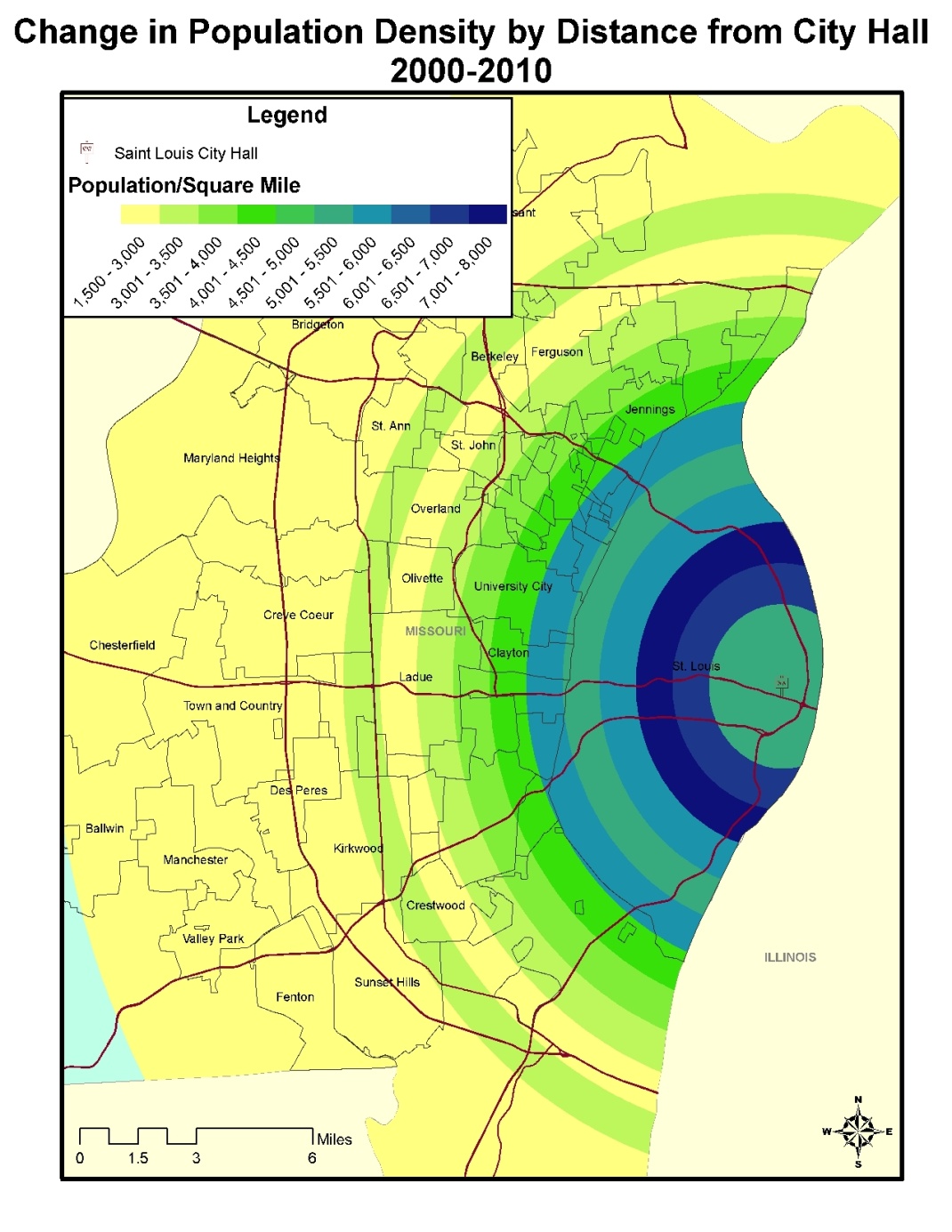
But what exactly is Saint Louis’s CBD the heart of? Certainly not the region’s population. As we’ve written before, Saint Louis’s downtown actually has a lower population density than areas farther away from the core, like the Central West End. Furthermore, the region’s population is extremely dispersed, with large sections of the population living more than 20 miles from city hall. The Saint Louis metropolitan area is region with more than 2.8 million residents, only a few thousand of whom live downtown:

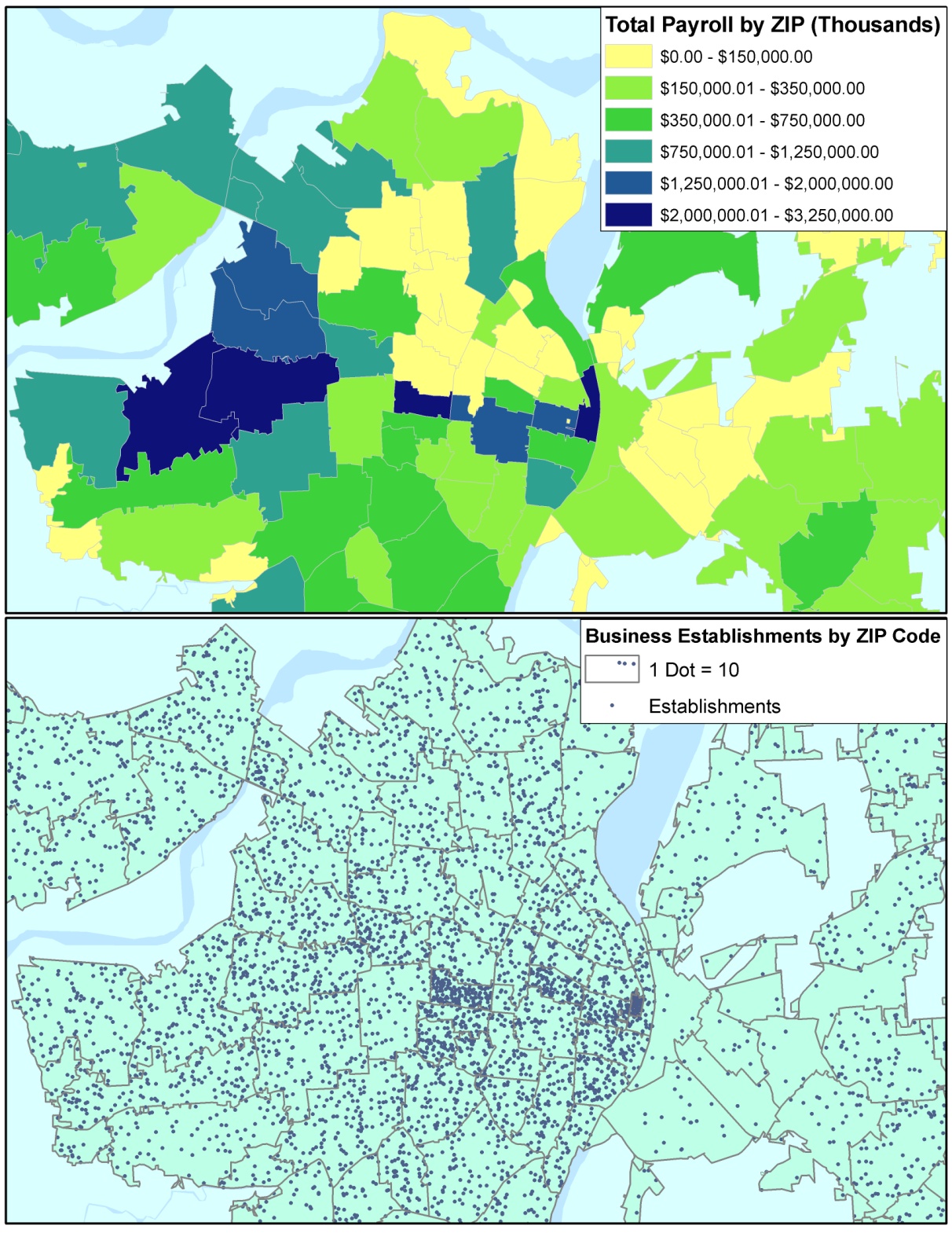
What of the CBD’s status as the business heart, or the economic engine, of Saint Louis? Today, less than 1% of the region’s annual payroll comes from businesses in the CBD. If we look at the zip codes that contain Saint Louis’s CBD, we find that areas in Saint Louis County, specifically Chesterfield and Creve Coeur, contain more businesses, contain more employees, and generate higher payroll than downtown. Looking at the maps below, we don’t see an economically dominant CBD surrounded by bedroom communities; instead we find dispersed areas of high employment. These areas include a broad central corridor that contains the CBD (but also Clayton and the Central West End) and a highly productive corridor in West County along I-270 that has more businesses and higher payrolls. The Saint Louis economy is so geographically dispersed that it might be difficult for a person not familiar with the region to locate downtown from economic data alone:

What of culture? The Saint Louis CBD has the Arch grounds. It also has the Scottrade Center, museums, libraries, theatres, and a sculpture garden. And of course, it has Busch Stadium, home to the Saint Louis Cardinals. For decades, the Saint Louis region as whole has poured tax money into amenities downtown, from the Dome formerly known as Edward Jones to the Arch grounds. Even as population and business activity left downtown, very few publicly funded civic projects were considered for any area but downtown (Forest Park being a notable exception). If public monuments, sports stadiums, and astro-turfed urbanism are all there is to culture, certainly downtown is unrivaled.

Whether or not Saint Louis’s downtown is truly its cultural heart, the region is undeniably diverse and dispersed. People live all over and work all over the map. To look at the region realistically (and plan for it effectively), we have to understand that St. Louis’s CBD is just one neighborhood among many, and we need to stop pretending that it has the economic and demographic dominance it did at the turn of the 20th century. Whether the problem is crime or economic growth, we’re unlikely to find a way forward when we can’t admit where we are.

Evaluating the Kansas City Streetcar

The Kansas City Streetcar opened to glowing and effusive praise from local media, some of it embarrassingly fawning. After all the media hoopla, supporters were eager to push for a $250 million streetcar expansion. Then came week three.

While the streetcar had problems in the first few days of ridership, none garnered as much media attention as its derailment on May 23. Two days later, service was halted due to electrical concerns. On May 26 the streetcar was hit by a car at an intersection, halting service. Even supporters admit it was a bad week.

What are we to make of it? What is a reasonable expectation of downtime for a streetcar system? According to the 2014 National Transit Database, streetcars run about 95 percent of their scheduled vehicle miles. That sounds impressive until you realize that it is the lowest performance percentage of any rail transit. Nationally, systems such as commuter rail, heavy rail, and light rail run at 105.2%, 97.3% and 98.9% of scheduled vehicle miles, respectively.

All totaled, metro buses run 102.8 percent of scheduled vehicle miles. In Kansas City, the KCATA runs 99.8 percent for both metro buses and bus rapid transit such as the MAX lines.

The difference between 95 percent for street cars and 102.8 percent for buses may seem small enough, until you consider the costs of each. My colleague Joe Miller wrote of the rejected 2014 streetcar expansion that Kansas City could buy 100 additional buses for the same cost of expanding the streetcar system 7.6 miles.

As Kansas Citians consider efforts to expand the streetcar line, hard data like transit costs and performance need to take precedence over feel-good puff pieces. That’s the only way to promote good public policy.

Session Notes: Ethics Reforms Get A Boost

Despite a few flabbergasting legislative moments that threatened to blow it all up, Missouri's General Assembly eventually did pass a basket of important ethics reforms. Notably, a pair of the reforms dealt with the manner in which campaign funds could be spent by former legislators and the manner in which legislators could be campaign consultants for one another. Both of these proposals represented reasonable and substantive reforms, and I'm glad they passed.

But perhaps the most important ethics reform enacted this session was the legislator-to-lobbyist cooling off period, sometimes called the "revolving door" law. Similar to a non-compete agreement for elected officials, the law requires that legislators wait six months after their term ends before they can start lobbying their former colleagues on someone else's dime. Even if that general practice wasn't already the law in most states, it's simply good policy to make sure folks in public office have unambiguously undivided loyalty to their constituents. Forcing a break between a policymaker's public service and possible private lobbying helps to accomplish that end.

Congratulations to the General Assembly for making ethics reform a matter of primary importance in 2016… and following through on it. The legislature, and the state, will be all the better for it.

Some School Finance Common Sense from Deep in the Heart of Texas

Last week, the Supreme Court of Texas handed down its decision in a case challenging the constitutionality of the Lone Star State’s school funding system. (I filed an Amicus Curae letter in the case that can be found here).

The Supreme Court unanimously ruled that the state’s funding system was, in fact, constitutional, and the decision, written by Chief Justice and twitter fiend Don Willet goes into great length explaining why. Giving the funding case pending in Kansas and the perpetual threats that are levied at Missouri’s funding system, Justice Willet’s opinion is well worth reading.

On page two, Chief Justice Willet writes (emphasis mine):

But  our  judicial  responsibility  is  not  to  second-guess  or  micromanage  Texas  education  policy or  to  issue  edicts  from  on  high  increasing  financial  inputs  in  hopes  of  increasing  educational  outputs. There  doubtless  exist  innovative  reform  measures  to  make Texas  schools  more accountable  and efficient, both quantitatively and qualitatively. Judicial review, however, does not license second guessing the political branches’ policy choices, or substituting the wisdom of nine judges for that of 181 lawmakers. Our role is much more limited, as is our holding: Despite the imperfections of the current school funding regime, it meets minimum constitutional requirements.”

Advocates often want to replace the legislative process and the decisions of our duly elected representatives with the opinions of judges. They want the court to tell the legislature how much to spend and to force them to spend it. This is terribly problematic. If courts are going to tell the state how much money they have to spend per pupil, what is the point of even having a legislature?

Chief Justice Willet was just getting warmed up. He continues later (again, emphasis mine):

“Second,  the  trial  court’s  “fact”  findings  as  to  the  specific  amount  of  funding  needed  to achieve a general diffusion of knowledge are, we think, beyond the current state of science in this field. We have warned that in school finance cases where we must decide constitutional questions, the trial court’s findings play a “limited role.”   This case demonstrates why.  To determine as a matter of fact that specific funding levels are required to achieve the constitutional threshold of a general  diffusion  of  knowledge,  a  court  not  only  must find  that  a  cost-quality  relationship  exists,  but also must assign  specific  quantitative measures to  that  relationship…We have never sanctioned a trial court’s ordering the Legislature  to  spend  a  specific  amount of money  on the  schools  to  achieve  constitutional  adequacy, as  doing  so  would deprive  the  Legislature  of  the  broad  discretion  the  Constitution provides  for  such inherently political decisions.”

Even if we wanted to give judges the power to set spending levels, we do not know how much it costs to educate a child adequately—in Texas, in Missouri, or anywhere else.  There is absolutely no guarantee that spending X amount of dollars will yield Y level of student achievement.  As a result, we rely on our elected representatives to determine how much money we should spend on our schools, and how to spend it. They have to make the difficult tradeoffs between dollars going to schools and to healthcare, to roads and to prisons.

The Texas Supreme Court made the right decision. The legislature has the power to set funding levels where they think they should be and are empowered to make the difficult tradeoffs between the various causes that the state supports. Not everyone will agree with the decisions the legislature makes, but that’s why we have elections.

Session Notes: Obamacare’s Medicaid Expansion Fails Again

With the 2016 legislative session behind them, Missouri's legislature has once again rejected Obamacare's Medicaid expansion. Had it passed, the program would have added thousands of able-bodied, childless adults living above the poverty line to Missouri's welfare rolls, with the state picking up an increasing share of the cost in the years ahead. 

The legislature was right to reject the Medicaid expansion for a number of reasons—among them, the program's patient access and health outcome problems and its soaring cost to taxpayers. But one of the most important arguments against expanding welfare to the unimpoverished was captured by Ronald Reagan in testimony to Congress nearly 50 years ago. Reagan's admonition that "[w]e should measure welfare's success by how many people leave welfare, not by how many more are added" is probably the best-recognized line from that speech. But I'd like to quote another sentence that is at least as important:

It doesn't seem right to reduce a man's take-home pay with taxes and then send him a government dole which robs him of the feeling of accomplishment and dignity which comes from providing for his family by his own efforts.

It's a bad idea to create a new class of welfare recipients and graft them into a broken program like Medicaid, but it is an especially bad idea to substantively change the standard for who is supposed to be receiving welfare to begin with. Medicaid is broken, but even if it weren't, government shouldn't be freshly yoking millions of able-bodied Americans to the welfare state. 

Reform-minded free marketeers should look for ways to empower workers and widen their opportunities. Unfortunately, in too many ways, the "Affordable Care Act" does precisely the opposite. Congratulations to the legislature for holding firm against Obamacare.

Uber Under Threat in Saint Louis

The Metropolitan Taxicab Commission (MTC), which regulates for-hire vehicles (mainly taxis) in Saint Louis City and County, has attempted to put the brakes on ridesharing options since Lyft (an Uber competitor) tried to enter the local market in 2014. While pressure from local governments prompted the MTC to make reforms, talks between ridesharing companies and the MTC broke down completely in the summer of 2015. Uber simply went forward offering its services to the region’s residents, flouting the rules of the MTC.

In the past, when companies or individuals violated MTC policies, police in Saint Louis City and County enforced the commission’s rulings by ticketing drivers. That is, after all, how the region responded to Lyft in 2014. However, Saint Louis City has flatly refused to use its police to block Uber, and police in Saint Louis County haven’t done much either. While the MTC could have used its very limited law enforcement capacity to attack Uber in 2015, the commission found itself in the midst of a public relations nightmare, with the state legislature seemingly ready to step in and completely overhaul the MTC. As a result, Uber now operates in Saint Louis, the police do nothing, and the MTC (while reiterating that Uber is acting illegally) keeps its head down.

 Now that the state legislature has failed either to reform the MTC or implement statewide ridesharing regulations, and with the unprofessionalism of MTC commissioners fading into memory, the taxi commission is reportedly planning to remind everyone who runs this town. As the Riverfront Times reports, the commission will begin seeking out UberX drivers and citing them for operating without a commission license. If such an act does not prompt Uber to shut down its services in the region altogether, it may seriously diminish the number of people willing drive for the company.

Whether or not the MTC will follow through on its threats is an open question. But what Saint Louisans should recognize by this time is that Uber, operating outside the regulatory framework of the MTC, has provided an innovative new service for all Saint Louis residents for almost a year. Where is the evidence that Uber is dangerous? Where are the market failures that the MTC needs to correct? From what we’ve seen so far, it seems that the ridesharing market operates just fine without the MTC.       

Know-it-all Government Undermines Growth and Jobs

With strict new rules mandating overtime pay for aspiring professionals and others in mid-level managerial positions, the Obama administration is asking employers to hang out a sign that says, in effect: “We don’t want any go-getters around here. You are strictly forbidden to make any special efforts for this company on unpaid time.”

The U.S. Labor Department has extended mandatory overtime pay to more than four million white-collar workers, including some 100,000 workers in Missouri. A new ruling from the department more than doubles the weekly threshold for salaried workers exempt from overtime pay to $913 a week (or $47,476 a year), and it requires employers to pay time and a half to employees at or below the threshold for any week in which they work more than 40 hours.

With five hours of overtime pay, a salaried worker at the threshold level will go from making $913 in a week to $1,172.

That may sound good, but it reflects a fundamental lack of understanding of what leads to wage and job growth and upward mobility for workers. It sets a new high-water mark in government meddling in other people’s business—or businesses.

As the CEO of one restaurant chain points out, the new ruling will demote thousands of mid-level managers into “glorified crew members” whose overriding incentive is to log more time rather than get results and be rewarded with bonuses and promotions.

In calling for cumbersome timekeeping systems that will rein in those who see showing initiative and always doing more than the required minimum as a ticket to success, the new ruling restricts the freedom and flexibility of employers and a large portion of their front-line managers to come to mutually beneficial agreements on compensation and working hours.

Other unfortunate side-effects will also follow. According to a National Retail Federation study, the rule will cause employers to move about a third of salaried retail and restaurant workers to hourly status. Further, it will lead to reduced hours for many of those workers and a shift to hiring more temps.

The idea that government can force businesses to take money out of profits in order to pay more to different classes of workers is itself delusional. To force any business to pay more to a worker than his or her value to the enterprise is to ensure that the business will do its best to keep employment of such workers at an absolute minimum. Unlike governments, companies that can’t make money are unable to expand, and are subject to extinction. That is especially true for low-margin, hypercompetitive businesses such as hotels, restaurants, and retailing that have been especially critical of the ruling.

The White House is saying that millions of salaried workers will get a raise under the new overtime rule. However, according to the Federation of Independent Businesses, that is contradicted by the Labor Department’s forecasts of a decline in average pay rates of newly covered salaried workers of about 5.3% in 2017.

To paraphrase Churchill, the Obama administration’s plan to order up a raise for middle-class Americans through an administrative edict is as foolish as the man who stands in a bucket and expects to lift himself up by pulling on the handle.

In fact, the administration’s plan is worse than that. At least the man who pulls on the bucket handle does not descend to a lower level. But that is exactly what will happen through the ministrations of our know-it-all government.

Support Us

The work of the Show-Me Institute would not be possible without the generous support of people who are inspired by the vision of liberty and free enterprise. We hope you will join our efforts and become a Show-Me Institute sponsor.

Donate
Man on Horse Charging