The Saint Louis City Earnings Tax: Lifeline or Noose?

On April 2, Show-Me Institute Fellow and Senior Writer Andrew B. Wilson gave a speech on the Earnings Tax to the Missouri Progressive Action Group at the Saint Louis County Library. These were his prepared remarks.

On Tuesday, April 5, Saint Louis voters will decide whether to extend the city’s 1 percent earnings tax for five more years.

Without a doubt, this is a hugely important decision.

In inviting me to talk to you, Ron Zager (co-chairman of the Missouri Progressive Action Group), asked that I begin by presenting both sides of the argument—for and against the earnings tax .

I am happy to do so. It makes for an interesting—and even a startling—contrast.

Supporters cite three principal reasons for extending the earnings tax:

  1. It is simple, fair, and easy to collect. Businesses withhold $1 out of every $100 from the paychecks of all of their employees and pay it directly to the city. They also pay a 1 percent tax on their net profits.
  2. It brings in a lot of revenue—almost as much as the combined receipts from the city’s property, sales, and utility taxes. It provides a third of the city’s General Revenue Fund, used to support fire, police, courts, streets, parks, recreation, and other day-to-day city services.
  3. A large portion of this revenue is like manna from heaven. People who commute into Saint Louis from the surrounding suburbs account for more than half of the city’s annual earnings tax receipts of about $160 million. And why not? The high-earning commuters are significant consumers of city services, swelling the daytime population of the city by about 35 percent.

To sum up the case in favor of retention: The earnings tax is critical to the continued functioning of city and the continued provision of police and other services to a population that includes a high proportion of low-income residents. It is a real lifeline. The city would be in danger of going bankrupt without it.

Opponents have three main reasons of their own for eliminating or phasing out the earnings tax:

  1. It encourages people and businesses to move out of the city.
  2. It also encourages an ongoing merry-go-round of tax carve-outs and special favors for large and well-known firms. The city does not extend the same benefits to thousands of smaller businesses, which take care of most of the daily needs of people who live in the city, such as the neighborhood grocer, cleaners, pharmacist, or auto repair shop.
  3. Though not a regressive tax (applying the same 1 percent to people at all income levels), it is a cruel one. Unlike federal and state income taxes, there is no exemption from the city earning tax for working people at or below the poverty line. The tax hits the first dollar of income even from the lowest-paying jobs. A still greater problem is the narrowing of job opportunities in parts of the city experiencing a rapid out-migration of people and the closure of many small businesses.

The minuses are really the flip side of the pluses I have just mentioned.

Yes, the earning tax is easy to collect, but it is also easy to avoid. As a business owner, you can avoid the tax on your net profits simply by moving your business to the suburbs—anywhere outside the city. There is no earnings tax in Clayton, here in Frontenac, or anywhere else in Saint Louis County and other surrounding counties and municipalities. If you did move your business, many or even most of your employees who already live in the county would, out of their own self-interest, applaud your decision. And others who live in the city would be given a reason to move to the county.

Yes, the earnings tax pays many big bills for the city. By the same token, it provides a strong incentive for individuals and businesses—who have bills of their own to pay—to relocate in order to avoid the tax.

By collecting more than half of earning tax revenue from commuters, the city is (inadvertently) making a powerful argument for downtown-based law firms and other businesses with a large number of highly paid employees to take flight—for both economic and personal reasons. At one stroke a firm can give many of its officers and employees an instant 1 percent raise while sparing them the bother of a long commute. So what can the city do to prevent such businesses from moving?

If you are the sitting mayor or other high-ranking city official, here’s the answer: Offer big potential flight risks all kinds of tax breaks and other incentives to stay downtown. Find ways to abate property taxes to keep prestigious firms from leaving downtown. Waive the half-percent payroll tax (separate from the earnings tax) for large employers such as Anthem and Wells Fargo. And lobby the state for more handouts.

But of course, given your obsession with preserving earning tax receipts, you do that only for the big guys and you forget all about the little guys who are so numerous (even in decline) that you know little or nothing about them.

A classic example of how this works can be taken from 2011, when Stifel Financial Corp., which has had its corporate headquarters in downtown Saint Louis since 1890, announced plans to buy its downtown office building and expand its workforce in the city by a couple hundred people. Mayor Francis Slay called it “tremendous news for the future of downtown.” He also helped Stifel get some $17 million in public financing for the purchase and renovation of the building.

Why would a large and successful financial firm need help in feathering its own nest? Ron Kruszewski, Stifel’s CEO, said it all: “There’s very little investment going on right now without some incentives.”

That prompted Bill McClellan of the St. Louis Post-Dispatch to comment in one of his columns: “When liberals like me argue for comprehensive health care, critics call us socialists. But when businesspeople demand public money to underwrite their projects, hardly anyone says anything.”

(I’ll take issue with McClellan on one point here: There is at least one institution that has fiercely and consistently opposed all forms of corporate welfare and crony capitalism, whether it is providing public funds for new corporate headquarters, public funds for professional sports stadiums, or any other kind of commercial development. That is the Show-Me Institute.)

To sum up the minuses: the earnings tax is a tax on work and enterprise, and when you tax something, you get less of it. In this case that means fewer jobs and less growth. The earnings tax has also encouraged unfair and unwise favoritism in tax practices—decisions made up on the fly to keep big-name businesses from bolting to the county. It’s time for a long look at Saint Louis city government—how it is financed and, more fundamentally, how it thinks.

Let us take a moment to consider decade-to-decade changes in the relative importance of Saint Louis among major cities in the United States over a long period of time—both before and after the introduction of the earnings tax in 1954.

According to census data, the last time Saint Louis moved upward in the ranks of U.S. cities was in the 1890s. The population grew from 452,000 people at the beginning of the decade to 575,000 in 1900, and Saint Louis moved from being the 5th largest city in the country to the 4th (behind New York, Chicago, and Philadelphia).

Of course, that was just prior to the Saint Louis World’s Fair. In that same amazing year of 1904, Saint Louis also hosted the world’s third modern Olympics—following the 1900 Olympics in Paris and the 1896 Olympics in Athens.

Saint Louis held onto 4th place until the 1920 census, when it was overtaken by Detroit and Cleveland, dropping to 6th. It was passed by Los Angeles in 1930 and Baltimore in 1940, falling to 8th. It remained in that spot in the 1950 census—when the city’s population hit an all-time peak of 857,000.

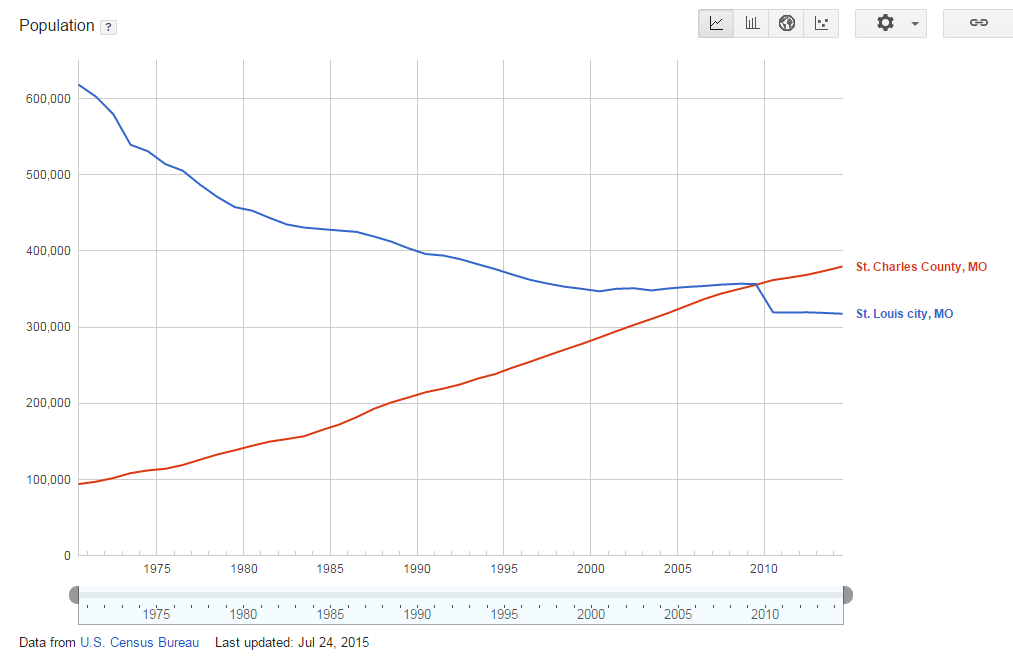
At that point the city’s population went into a steep decline that continues to this day. Since 1950, its population has dropped from close to 900,000 to a little more than 300,000—discarding almost two-thirds of its human body weight—and Saint Louis has gone from being the 8th-largest city in the country down to the 60th, behind such places as Tulsa, Oklahoma, and Wichita, Kansas.

It would be absurd to place all or even most the blame for this decline on the earnings tax. It would be equally absurd to deny that the earnings tax has made a significant contribution to the depopulation of the city and the growth of surrounding areas.

For one thing, we know that downtown Saint Louis no longer rules the roost as the unchallenged commercial center of the Saint Louis region. Clayton has become a strong second center, and other places around the county are also filled with offices and business enterprises. It is only in Saint Louis City that you find acres and acres of abandoned houses, deserted storefronts, and boarded-up factories.

Here’s a statistic that may surprise you: There are now more people who commute into Saint Louis County . . . both from the city and from Saint Charles and other counties . . . than there are people who commute into the city from the county or other jurisdictions. There are 236,000 people commuting into the county versus 172,000 commuting into the city, according to recent census data.

Somehow, Clayton and other municipalities receiving this great daily influx of commuters have been able to handle it . . . without instituting an earnings tax or having everything from the streets to public safety fall to pieces. Why is it any different for the city of Saint Louis? Why is the city unable to cope without taxing the earnings of people who come there to work?

Let’s turn then to the question of whether it is possible to phase out the earnings tax without throwing the city into bankruptcy and fulfilling the worst predictions.

Bear in mind that the proposal on Tuesday’s ballot in the city calls for phasing out the earnings tax over 10 years—whittling away at a $160 million funding gap that would occur in the year 2026 through spending cuts or revenue enhancements averaging $16 million a year between now and then.

Is $16 million a year too tall a mountain to climb? Somehow, in the city’s desperate efforts in recent months to persuade the Rams and the NFL to keep the team in Saint Louis, the city funneled $16 million through the Saint Louis Convention & Visitors Center Commission to pay legal fees and other expenses in what turned out to be a losing effort.

Before that, Mayor Slay and Missouri Gov. Jay Nixon were prepared to raise about $400 million to pay for a large portion of the cost of building a new downtown stadium for the Rams. That alone would have equaled the revenues from the earnings tax over a two-and-a-half-year period.

If almost any large business you can imagine were to lose customers year after year—eventually losing more than half of its business base—you would expect it to downsize drastically, if not go out of business.

Why is it—despite the steady, continuing loss in population—that the city’s budget continues to grow, if only slowly, from one year to the next, with few if any large reductions in its workforce?

Faced with such questions, city officials typically shift the focus to public safety, saying they need more rather than fewer police and firemen. Public safety accounts for a little over half of general funds expenditures. Why, then, is it so hard to trim the other expenditures that make up about 45 percent of the budget?

There are other ways that the city can either cut expenditures or raise revenues besides the shock of instituting sudden and drastic increases in property or sales taxes. It could raise hefty sums of money by privatizing assets such as the airport or the water system.

It could also make a serious effort to raise some revenue from its large nonprofit institutions. As Post-Dispatch business columnist David Nicklaus pointed out in a recent article:

These universities and hospitals depend on city service but don’t pay property taxes. Boston and other cities have negotiated payments from their big nonprofits; Saint Louis could try to do the same. Eliminating the 1 percent earnings tax should make it easier for these institutions to attract and retain employees; wouldn’t they pay something to make the tax go away?

But none of those things is going to happen without a fundamental change in thinking on the part of city officials who have come to look upon the earnings tax as the sine qua non of Saint Louis city governance.

Following the last election, when voters re-approved the earnings tax, city officials heaved a sigh of relief, agreed that the tax did indeed put the city at a competitive disadvantage, and promised to study alternatives. That was five years ago. And since then they have done nothing.

Maybe if the vote is closer this time, they will begin to think differently. But maybe not. Maybe they will just go on hoping for miracles while continuing to pursue policies that have contributed the city’s decline and fall from the heights it once occupied as a great American city.

Who Really Wins or Loses with NGA Deal?

City politicians are happy this week: nothing has to change. The NGA announced that Saint Louis was their preferred location for their new campus. A few dozen families will be kicked out of their homes to make room for the NGA, but the people in charge can avoid another embarrassing relocation away from the city, like with the Rams or Hardee’s.

As with any action from the Saint Louis city government, there are winners and losers. The obvious winner here is the land developer behind the NorthSide Regeneration project, which will get what amounts to a bailout with this deal. The city as a whole? Saint Louis will pay for the land it will turn over (at no charge) to the NGA. Because the NGA was already located in Saint Louis, the effect on the city economy will be minimal. The NGA may add more jobs, but nothing that one could expect to reverse Saint Louis’s long decline.

Population graph: Saint Louis City vs. Saint Charles County

The families who will be forced out of their homes are the ones losing out. They face an uncertain future, and if the NGA’s decision is finalized, they’ll need to navigate the eminent domain process and find new places to live.

In Saint Louis, political officials seem to prefer looking for shortcuts to development and lack enthusiasm for pursuing the hard but boring path to civic success: low taxes, a level economic playing field, and quality essential services. Meanwhile, those without political connections or wealth are swept aside.

Will things ever change for this city?

The Beam in the Star’s Eye

On Tuesday, The Kansas City Star published an editorial about the level of funding for mental health services in Kansas, concluding:

Under the poor leadership of Gov. Sam Brownback and the Republican-controlled Legislature, Kansas has severe funding problems brought on by irresponsible tax cuts. But for the sake of Kansans with severe mental health needs, lawmakers should plug the financial holes so the state hospitals can provide good security and services.

This is at least the second time the Star has examined the topic, having done so last summer as well. Our response now is the same as it was when the Star was seeking a tax abatement extension that it was eventually granted:

The Star is asking to extend for 15 years the tax abatement on its downtown printing press. As a result, the Community Mental Health Levy in Jackson County, Missouri, will be denied $245,000 over 15 years. That is a quarter-million tax dollars from the Star's single property.

The Show-Me Institute welcomes any discussion of policies surrounding taxation and government spending. But it seems disingenuous for the Star to criticize tax cuts in Kansas when it seeks them for itself in Missouri.

Report: Saint Louis, Kansas City *Not* Among Most Cost-Friendly Cities for Business

Recently, the Post-Dispatch prominently published an article claiming that, “St. Louis is among the top 10 most cost-friendly cities to do business in the country.” The article’s source was a study by KPMG, which ranks more 70 cities by business costs (lower index being better). The only problem is that, if one follows the links in the Post-Dispatch article, they’ll find that Saint Louis is certainly not one of the most cost-friendly cities for business.

Far from it. Of the 77 U.S. cities that KPMG ranked (which was not exhaustive of all major metros), Saint Louis ranked 45th and Kansas City ranked 46th. Among the cities cheaper than Saint Louis (and Kansas City) are regional competitors like Nashville, Omaha, Cincinnati, Memphis, Indianapolis, Cleveland, and Oklahoma City, to name a few. Worse yet, Saint Louis was more expensive than all 18 Southeastern cities KPMG looked at, from Atlanta to New Orleans.


Rank

Metro Area

Region

Cost Index

1

Charlottetown, PE

New England

83.9

2

Shreveport, LA

Southeast

91.7

3

Youngstown, OH

Northeast

92.5

4

Baton Rouge, LA

Southeast

92.8

5

Savannah, GA

Southeast

93.1

6

New Orleans, LA

Southeast

93.1

7

Lexington, KY

Northeast

93.2

8

Little Rock, AR

Southeast

93.3

9

Gulfport-Biloxi, MS

Southeast

93.3

10

Jackson, MS

Southeast

93.3

11

Montgomery, AL

Southeast

93.4

12

Mobile, AL

Southeast

93.7

13

Charleston, WV

Northeast

93.8

14

Nashville, TN

Southeast

93.8

15

Cedar Rapids, IA

Midwest

93.8

16

Omaha, NE

Midwest

93.9

17

Cincinnati, OH

Northeast

94

18

Sioux Falls, SD

Midwest

94.1

19

Fargo, ND

Midwest

94.3

20

Boise, ID

Pacific

94.3

21

Memphis, TN

Southeast

94.4

22

Orlando, FL

Southeast

94.4

23

Albuquerque, NM

Midwest

94.4

24

Billings, MT

Midwest

94.4

25

Spartanburg, SC

Southeast

94.5

26

Indianapolis

Northeast

94.6

27

Cleveland, OH

Northeast

94.6

28

Tampa, FL

Southeast

94.6

29

Cheyenne, WY

Midwest

94.6

30

Saginaw, MI

Northeast

94.7

31

San Antonio, TX

Midwest

94.7

32

Wichita, KS

Midwest

94.7

33

Oklahoma City, OK

Midwest

94.7

34

Bangor, ME

New England

94.8

35

Champaign-Urbana, IL

Midwest

94.8

36

Beaumont, TX

Midwest

94.9

37

Salt Lake City, UT

Midwest

95

38

Raleigh, NC

Southeast

95.1

39

Atlanta, GA

Southeast

95.1

40

Charlotte, NC

Southeast

95.2

41

Miami, FL

Southeast

95.4

42

Richmond, VA

Northeast

95.5

43

Madison, WI

Midwest

95.7

44

Spokane, WA

Pacific

96

45

St. Louis, MO

Midwest

96.1

46

Kansas City, MO

Midwest

96.2

47

Phoenix, AZ

Midwest

96.2

48

Austin, TX

Midwest

96.2

49

Dallas-Fort Worth, TX

Midwest

96.2

50

Baltimore, MD

Northeast

96.5

51

Providence, RI

New England

96.7

52

Detroit, MI

Northeast

96.8

53

Minneapolis, MN

Midwest

96.8

54

Burlington, VT

New England

96.9

55

Pittsburgh

Northeast

97

56

Manchester, NH

New England

97.2

57

Houston, TX

Midwest

97.6

58

Portland, OR

Pacific

97.6

59

Wilmington, DE

Northeast

97.7

60

Denver, CO

Midwest

97.8

61

Las Vegas, NV

Pacific

98

62

Hartford, CT

New England

98.2

63

Rochester, NY

Northeast

98.3

64

Chicago, IL

Midwest

98.3

65

Sacramento, CA

Pacific

98.5

66

Riverside-San Bernardino, CA

Pacific

98.5

67

Metro DC

Northeast

99.4

68

Philadelphia

Northeast

99.8

69

San Diego, CA

Pacific

99.9

70

Seattle, WA

Pacific

100.8

71

Los Angeles, CA

Pacific

100.8

72

Boston, MA

New England

101.2

73

Trenton, NJ

Northeast

101.8

74

Honolulu, HI

Pacific

103.9

75

San Francisco, CA

Pacific

104.5

76

New York City, NY

Northeast

104.7

77

Anchorage, AK

Pacific

108.1

So where did the Post-Dispatch get a top ten ranking for Saint Louis? If we only consider regions with populations greater than two million (of which KPMG ranked 31), Saint Louis is the 9th cheapest. I will leave it to the readers of this blog to decide if Saint Louis should pat itself on back for being cheaper than New York, Los Angeles, and Chicago, when it has higher costs for businesses than Nashville, Memphis, and just about every other regional competitor. But if we do decide to use population as criteria, it seems more justified to look at metros with populations similar to those of Saint Louis and Kansas City (between two and three million residents). When we do that, Saint Louis is 7th and Kansas City is 8th out of 14 such cities. That seems awfully middling.

That’s probably why, if one reads the study that the Post-Dispatch reports on, they’ll find that it does not claim that Saint Louis is among the most competitive cities in the country. KPMG didn’t even break down cities by population in the study, choosing instead to do so by region.  The Post-Dispatch story (while citing the study) is actually based on an ancillary KPMG press release, which lauds Cincinnati, and is careful to note context.

Titling an article “St. Louis among most cost-competitive cities for business, report says” when the report in question says no such thing is a questionable decision for a newspaper of record. But this is not just a problem with the headline. The article itself is equally misleading, and it was not a headline writer who placed this story front and center on the Post-Dispatch’s website less than a week before a vote on multiple tax issues (where the city’s business climate is an issue). 

Rams Park: A Case Study of Professional-Sports Welfare in Saint Louis

As we discussed last week, Saint Louis may be forced to turn over a $19 million practice facility to the Rams for one dollar, despite the fact that the team decamped for Los Angeles. That’s because the city agreed, as part of an ill-conceived deal to get the football team to move to Saint Louis in 1995, to give the Rams a purchase option on the practice facilities known as Rams Park (located in Earth City).  The angle of a callous NFL team extracting a parting real estate gift from a jilted city is compelling, and most news reports stopped there. But the full story of the how Rams Park got built is even worse for Saint Louis, and illuminates why cities often fail to reap hoped-for tax benefits from pro sports.

During the negotiations to lure the Rams to Saint Louis in the 1990s, Saint Louis agreed to spend $15 million on practice facilities for the Rams. As part of the agreement, the St Louis Regional Convention and Sports Complex Authority (RSA) would retain ownership, allowing the Rams to avoid any property taxes, but would lease the property back to Rams at a low rate ($25,000 per year).

When time came to build the practice facilities, the city did not have the wherewithal (or perhaps the stomach) to fund the entire project. The city agreed to pay $5 million, Saint Louis County paid another $5 million, and a private organization called Fans Inc. put up $2.5 million. The Rams covered the rest. The city’s $5 million contribution came from diverted amusement tax revenue, while the county’s support came from hotel/motel taxes.

One might think that the city came out ahead in the final deal, avoiding paying everything it initially said it would and pushing at least some cost off on the Rams. But it didn’t work out that way. The Rams organization claimed the city owed it money for not covering the entire cost of the practice facility. That charge, along with a penalty for failing to finish the (entirely publicly funded) Dome on time, totaled $13 million. The Rams agreed that they would drop their claim if the city took on the task of suing the NFL over the $29 million relocation fee the NFL had charged the Rams for leaving Los Angeles. If the city won, it would have had to split the proceeds with the Rams 50/50 (despite the fact that Saint Louis, and not the Rams, had covered the relocation fee). The city lost the case.

To sum up the story of Rams Park: the city and county paid $10 million up front, and agreed to pursue (and pay for) a losing court case against the NFL. They then leased Rams Park, likely at a loss, to the Rams for twenty years. All of this money came from local tax revenue—revenue that was supposed to offset the costs of other parts of this sweetheart deal. The Rams, despite paying little/nothing for its fields and getting shielded from as many taxes as possible, may now get Rams Park (valued at $19 million) for one dollar.

When the city hall discusses what pro football cost Saint Louis and what tax dollars it generated, Rams Park rarely figures.  But it should be a lesson for local residents, because side deals like these make sports franchises more expensive than people realize, and make less tax gains less lucrative than backers hope.

Is Missouri’s A-Plus Program a Model for the Nation?

The bar for being an exemplary government program must be pretty low these days. Last week at a meeting in Ashland, Missouri, Senator Claire McCaskill described Missouri’s A+ Scholarship Program as a “bright shining light in Missouri higher education” and offered it as a model for higher education reform nationwide.  If it becomes that, students and taxpayers nationwide are in trouble.

The A-Plus program currently grants over 13,000 scholarships to Missouri community college students.  To be eligible, students need to attend a community college or vocational school, must have graduated from a Missouri high school with at least a 2.5 GPA and 95% attendance, and have completed at least 50 hours of community service.  The cost for the program in 2014–15 was more than $33 million.

At slightly more than $2,500 per student, this may seem like a good deal, until we see exactly what we are getting for our money. A forthcoming study in the Journal of Higher Education by scholars at the University of Missouri, for example, finds the A+ program increased “two-year college-going rates by 5.3 percentage points.” This gain, however, was nearly offset by a 3.8 percentage point decline in the number of students attending four-year institutions.  While this is not entirely bad, it is a far cry from a “bright shining light.” If the goal is to get more students into college, we are not seeing much bang for our buck.

There is no question that college costs have been spiraling out of control.  According to the College Board, the cost of public, two-year college has more than tripled in inflation-adjusted dollars since 1975. It has almost quadrupled at public four-year colleges. Middle class families are feeling the squeeze. They want their children to get good jobs, which increasingly require a college degree, but cannot afford the skyrocketing prices. 

Some politicians are tapping into those fears and proposing plans, like the A+ scholarship, that would make some or all of college “free.”  But here is the dirty little secret about “free college” plans. They don’t actually make college free. They simply shift who pays for it.

We have a college cost problem. Just changing who pays that cost doesn’t make it any less of a problem.  We should be talking about ways to rein in the cost of college, like promoting greater transparency of results and breaking up the accreditation cartel that keeps out new, lower-cost providers. We should also make universities that accept public scholarship dollars have some skin in the game, and require them to pay the state back some portion of those dollars if students do not succeed.  Andrew Kelly at the Center on Higher Education Reform at the American Enterprise Institute has written volumes on how to accomplish this.

These reforms would actually help drive down the cost of college and help the state strategically use its scholarship dollars to promote real student success.  That, not revolving-payer shell games, is what we can do if we really want to help our students.

The goals of Missouri’s A+ program are certainly commendable, but that does not make the program a model for the nation. We’re not even confident that is the right model for Missouri. 

A Big Step Backwards for Municipal Reform in Saint Louis County

Last year, Missouri passed legislation restricting the ability of cities to rely on fines and fees to run their local governments. That legislation, known as SB 5, restricted fines and fees to 20% of general revenue for cities across the state, and to 12.5% of general revenue for cities in Saint Louis County. These provisions tightened restrictions originally put in place in the ‘90s with the Macks Creek law, but, critically, SB 5 included monitoring and enforcement mechanisms the older legislation lacked. Unfortunately, the achievements of SB 5 are now in jeopardy, following the ruling of a Cole County judge.

Many municipal leaders in Saint Louis County are opposed to SB 5, especially those officials from cities who heavily rely on fines (traffic and otherwise) for revenue. They sued the state over SB 5, claiming the provisions limiting Saint Louis County’s municipalities’ ability to collect fines and fees to 12.5% of general revenue constituted a “special law,” because elsewhere in the state the limit is 20%. Despite the fact that laws tailored to individual counties are passed all the time (think the provisions restricting floodplain tax incentives in only Saint Charles County) the judge in this case found SB 5’s fine limits unconstitutional. The judge also ruled that law’s reporting requirements and policing standards were unfunded mandates, and thus also unconstitutional. For all intents and purposes, much of SB 5 is gutted.

This is a disappointing outcome for those hoping that the state’s actions last year might rein in those small cities keeping themselves afloat by turning law enforcement into tax collection. On a hopeful note, the state plans to appeal, and the governor indicated a willingness to work with the legislature on a bill that will pass constitutional muster. 

Support Us

The work of the Show-Me Institute would not be possible without the generous support of people who are inspired by the vision of liberty and free enterprise. We hope you will join our efforts and become a Show-Me Institute sponsor.

Donate
Man on Horse Charging