Even under Fuel Tax Increase, Missouri Taxes Would Still Be Below Average

Recently, the Missouri Senate approved a 5.9-cent fuel tax increase that, should it pass the House, would go before voters in the fall. If voters accept the proposal, Missouri’s fuel taxes will increase from 17.3 cents per gallon to 23.2 cents per gallon. As we’ve stated many times before, Missouri currently has a comparatively low fuel tax, fifth-lowest in the nation for regular fuel and fourth-lowest for diesel fuel. So where would the proposed increase in the fuel tax place Missouri?

The answer is that Missouri would still have a fuel tax well below the national average. Some news sources have put average state fuel tax at 20.88 cents per gallon, but this ignores the additional taxes many states (but not Missouri) place on fuel. For instance, Illinois’s fuel excise tax is only 19 cents per gallon, but its additional taxes add on 11 cents per gallon. Often, these additional taxes are sales taxes whose per-gallon amount fluctuates with gas prices. When these taxes are accounted for, the average state tax rate for a gallon of regular gas comes to 29.63 cents, with diesel at 29.33 cents.

If Missouri increases its fuel taxes by 5.9 cents (and the price of fuel holds steady), Missouri would have the 17th-lowest regular fuel tax in the nation and the 16th-lowest diesel fuel tax. Our regular fuel tax would still be cheaper than those of Kansas (24.03 cents), Iowa (32 cents), Illinois (30.18 cents), Nebraska (27.7 cents) and Kentucky (26 cents). We would become a more expensive state for gas than Arkansas (21.8 cents), Oklahoma (17 cents), and Tennessee (21.4 cents). 

Whether or not voters are willing to increase fuel taxes in Missouri at all is an open question. However, even under the proposed increase, Missouri would still be a relatively cheap place to fill up, both nationally and in our region. 

As Expected, KC Renews Its Earnings Tax

For the second time in five years, Kansas City has voted to retain its earnings tax by a substantial majority. While disappointing, this result was unsurprising; after all, city residents renewed the tax by a 78% to 22% vote in 2011, and this year's margin was comparable to that one. Under Missouri law, Kansas City will reconsider the renewal question again in 2021 and every five years thereafter. Given the tax's destructiveness, that's an altogether appropriate and necessary interval.

Obviously, Tuesday's results were mostly bad news for the reform side, but one largely overlooked detail was that the number of votes in favor of the tax dropped significantly since the last vote. In 2011, nearly 57,000 Kansas Citians cast ballots in favor of the earnings tax; in 2016, that figure dropped by nearly a third to just over 39,000 votes in favor, with turnout down significantly overall. That wasn't a statewide trend, either; turnout in St. Louis, which also voted on the earnings tax on Tuesday, actually rose by several thousand votes compared to 2011. 

Regardless, the tax and spending reform discussion for Missouri's largest city will of course continue. That's because the earnings tax hurts Kansas City and the people in it. And thanks to the earnings tax debate, Kansas City is finally being forced to take a hard look at its TIF policies and how it delivers public services to all Kansas Citians—especially those on the East Side.

I hope that city leaders will move away from the tax sooner rather than later; it's the right thing to do for the city, and the region.

Summer Internships

The Show-Me Institute is pleased to offer internship opportunities for Summer 2016.
 
  • Internships are open to current undergraduate and graduate students, as well as recent graduates.
  • Internships last approximately ten weeks. The exact starting and ending dates are flexible, but we anticipate that each internship will run from June 6 until August 12.
  • Summer interns will work a full-time schedule (9 a.m.-5 p.m.).
  • Interns will be involved in many aspects of the Institute’s operations. Interns will work closely with senior staff on a wide variety of projects. They can expect greater responsibility and personal attention than they would receive at larger organizations.
  • Interns will assist staff members with a variety of tasks. These may include researching public policy topics, organizing events, and writing and editing op-eds, newsletters, studies, and other documents. Some administrative and clerical tasks also will be required.
  • Policy internships as well as communications and development internships are available.
  • A Show-Me Institute internship is an excellent opportunity to improve your research and writing skills. Each intern will produce regular blog posts and an op-ed on a public policy topic of interest to him or her. Each intern will receive feedback and assistance from SMI staff members throughout the process.
  • All internships are at the Show-Me Institute’s offices in Saint Louis, Missouri, and Kansas City, Missouri.
  • Interns will be paid on an hourly basis.

Those wishing to be considered for an internship should submit the application (click here) and the requested supporting materials. The deadline for applications is May 13, 2016. However, we will begin conducting interviews as applications are received. Applicants can expect a decision in late May.


Learning from Our Mistakes: A Funding Formula Cap

In my youth, I made some irresponsible financial decisions. The first thing I purchased on a credit card was a tennis racket; I don’t even play tennis. Then, of course, there was the college spring break trip to Panama City that was put on the credit card. Now, a decade later, I’m still paying for many of those unsound fiscal decisions. It may sound strange, but in many ways Missouri’s education funding system is in the same boat—decisions made long ago continue to plague us today.

After Missouri’s school funding system was challenged in the courts, lawmakers went to work and put in place a new school funding formula in 2005. The plan was to phase in the new, more expensive formula over a number of years. Lawmakers realized that the formula could potentially grow at a rate that made it impossible to fully fund, so they put in place a cap. The cap restricted growth to five percent over a two-year period.

In 2009, while the formula was still in its youth, lawmakers removed the cap, allowing the state’s obligations to grow at a rapid pace. Lawmakers were expecting a financial boon from lottery proceeds—which, of course, didn’t pan out. At the same time, Missouri and the rest of the country experienced one of the largest economic downturns in recent memory.

Today, our foundation formula for public schools is underfunded by roughly $500 million. This shortfall can be tied directly to the legislature’s unsound fiscal decision to remove the cap, along with the Great Recession of 2009.

 Some might scoff at what I’m suggesting. They’ll say, “The problem is that the legislature just needs to value education more and put more money into the formula.” There is just one problem with that. Believe it or not, more funding actually exacerbates the problem. Let me explain.

When I make a payment on my credit card debt, the next month’s payment is lower. However, when lawmakers increase funding for the foundation formula, it triggers an increase in the funding that will be required for the next go-round. This occurs because the formula is updated bi-annually based on how much a select group of districts spend per pupil.  The legislature gives districts more money, the formula gets recalculated based on this new spending, and the target moves ever upward.    

We have created a vicious circle in which more spending begets more spending.

Now, the legislature is considering reinstating the five-percent cap. This would not necessarily fix the perpetually increasing funding cycle, but it would slow it down. It would make it more feasible for lawmakers to fully fund the foundation formula.

We all make unwise financial decisions from time to time. The key is to learn from our mistakes and correct them. I stopped buying things, especially things like tennis rackets, with credit cards. Some lawmakers have realized that removing the cap has created an untenable situation where we will never be able to fully fund the foundation formula for public schools. Reinstating the cap is one step toward fixing that problem. 

Tax Levy Election Results

Yesterday, school districts across the state asked their residents to increase property taxes to provide more funding for their schools.  Several weeks ago, we provided information sheets on these votes to help citizens make informed choices as to whether or not they thought their districts needed more money. 

The results were a mixed bag, with six issues passing and five failing. Here are the results:

Chillicothe R-II 37¢ per $100 in assessed value tax levy increase: PASSED

Columbia 65¢ per $100 in assessed value tax levy increase: PASSED

Laclede 49¢ per $100 in assessed value tax levy increase: PASSED

Niangua 93¢ per $100 in assessed value tax levy increase: FAILED

Maplewood-Richmond Heights 50¢ per $100 in assessed value tax levy increase: PASSED

Marshfield R-I 50¢ per $100 in assessed value tax levy increase: FAILED

Mexico 40¢ per $100 in assessed value tax levy increase: FAILED

Newburg R-II 96¢ per $100 in assessed value tax levy increase: FAILED

Ft. Zumwalt R-II 48¢ per $100 in assessed value tax levy increase: PASSED

Saint Louis City 75¢ per $100 in assessed value tax levy increase: PASSED

West Plains R-VII 95¢ per $100 in assessed value tax levy increase: FAILED

We also followed two other ballot issues. Here are the results from those:

Hickman Mills “No Tax Increase” Bond: PASSED

Ladue 38¢ per $100 in assessed value debt levy increase: PASSED

(I’ll check back on the results in the coming days to see if there are any changes.)

So what do we make of all of this?  A few thoughts:

  1. It appears that the largest of the tax levies (93¢ in Niangua, 95¢ in West Plains, and 96¢ in Newburg) failed. Those levies meant hundreds of additional dollars in taxation for property owners. Folks were clearly skeptical that so much money was necessary. 
  2. Urban and suburban districts’ measures fared better than those in rural areas. St. Louis, Columbia, and Maplewood-Richmond Heights’ levies all passed, as did the measures in Hickman Mills and Ladue.
  3. Saint Louis was able to simultaneously pass the earnings tax and a school tax levy. I think there is every reason to be concerned that this may continue to push people out of the city as they are asked to pay more and more to a city that hollows out its tax base via TIF and a school system that routinely fails to make the grade.

We’re going to stay on top of these tax levy issues. Be on the lookout for another round of analysis before the next slate of elections in November.

Want to Make College More Affordable? Stack Credentials.

“Is college worth it?” This question is being asked more and more as the cost of tuition continues to rise. During a recent presidential debate, it was stated that “welders make more than philosophers”; the implication was that those who go to trade schools often make more than those who earned a traditional college degree. While going to college is about more than just earning a paycheck, labor market outcomes are something we should consider.

Business leaders have voiced concerns over how unprepared recent graduates are to enter into the workforce, many of them citing the lack of applicable skills as a major problem. The Alabama Community College System projected that over the next year, 5,000 skilled worker jobs will need to be filled in southwest Alabama alone. 

Having recognized this problem, several states are backing programs that would allow students enrolled in vocational training programs to earn credentials at a faster rate, continue to build on those credentials, and keep them no matter where they move. They are considered portable and stackable. Portable in the sense that, as the McGraw-Hill Research Foundation notes, they are “trusted by employers and educational institutions throughout the country… they would be independently verified or accredited”; and “stackable” in the sense that they can be combined with each other to earn industry certifications or even associate’s or bachelor’s degrees.

An example of a portable credential is the National Career Readiness Certificate. This credential measures the test-taker’s ability to solve problems, think and read critically, and understand and use work-related text. The certificate is recognized in 42 states and can be used by employers to help predict an applicant’s ability to succeed in the workplace.

Virginia addressed the need for skilled workers in 2008 by creating the Virginia Career Pathways System. This system includes training programs like apprenticeships so students can earn credit toward a certificate or degree while also getting hands-on training.

Mississippi created a similar system in 2005 that has 4 levels of skills achievement. It starts with an Adult Basic Education Certificate, then moves on to a Manufacturing Skills Basic Certification. At the next level, students can choose the manufacturing skill they want to learn in depth and enroll in a program devoted to it. Finally, the industry knowledge they acquire can be used for college credits toward a degree.

Stackable credentials are more flexible than traditional degrees, appear more in tune with what employers want, and may be collected over time at a lower cost. They are a promising way to help students get the preparation they need to be successful in the job market.

Job Growth in Missouri: Depends on Where You Live

Missouri’s nonfarm employment growth over the past year significantly lags nearly every other state. The picture is somewhat brighter for several of Missouri’s metropolitan areas, however.

The Bureau of Labor Statistics’ recent data release (http://www.bls.gov/news.release/pdf/metro.pdf) allows us to compare job creation in Missouri to that in other states over the past year. Between January 2015 and January 2016 the number of employees on nonfarm payrolls in Missouri increased by only 0.7 percent. (The figures used in this report are based on non–seasonally adjusted data.) Though better than in the six states where employment numbers actually declined, Missouri’s job growth is much slower than that of most other states: Missouri ranks 38th in new nonfarm employment growth over the past year. And when compared with its neighbors, Missouri’s record of job growth is below average (1%), and notably worse than Tennessee (3.2%) and Arkansas (2.3%).

Missouri’s job growth was weak, but is this reflective of the metropolitan areas? The table below shows that, on average, jobs increased at a 1.6 percent rate across the eight metropolitan areas. The percent change in nonfarm employment ranges from a high of 4.6 percent in Columbia to a low of 0.5 percent in Cape Girardeau. In Kansas City and St. Louis, the two metropolitan areas that together account for about 85 percent of nonfarm employment in Missouri, job growth outpaced the rest of the state: In Kansas City nonfarm employment increased by 2 percent while in St. Louis it rose by 1.2 percent.

Area

Percent change in nonfarm payrolls

Missouri

0.7

Cape Girardeau

0.5

Columbia

4.6

Jefferson City

1.2

Joplin

0.3

Kansas City

2.0

St. Joseph

0.6

St. Louis

1.2

Springfield

2.4

Source: Bureau of Labor Statistics

Ridesharing Regulations Pass Missouri House

Recently, the Missouri House approved legislation that creates state-level regulations for ridesharing services like Uber and Lyft. The bill in question, HB 2330, would require ridesharing companies to provide insurance, pay permitting fees, and ensure certain consumer protections. It would also prohibit local governments from adding any additional restrictions on these companies.

We’ve written about ridesharing regulations in Missouri many times before, and we have submitted testimony on HB 2330 specifically. While state regulation of industries is not something the legislature should consider lightly, in the case of ridesharing, local government intransigence invites state-level intervention. For instance, in Saint Louis City and County, the Saint Louis Metropolitan Taxicab Commission has fought tooth and nail against the entry of Lyft and Uber. Far from embodying the ideal of local control, the commission, half of whose members are representatives of existing taxi companies, uses the state’s enabling legislation as an argument for why it cannot accommodate the entrance of ridesharing services.

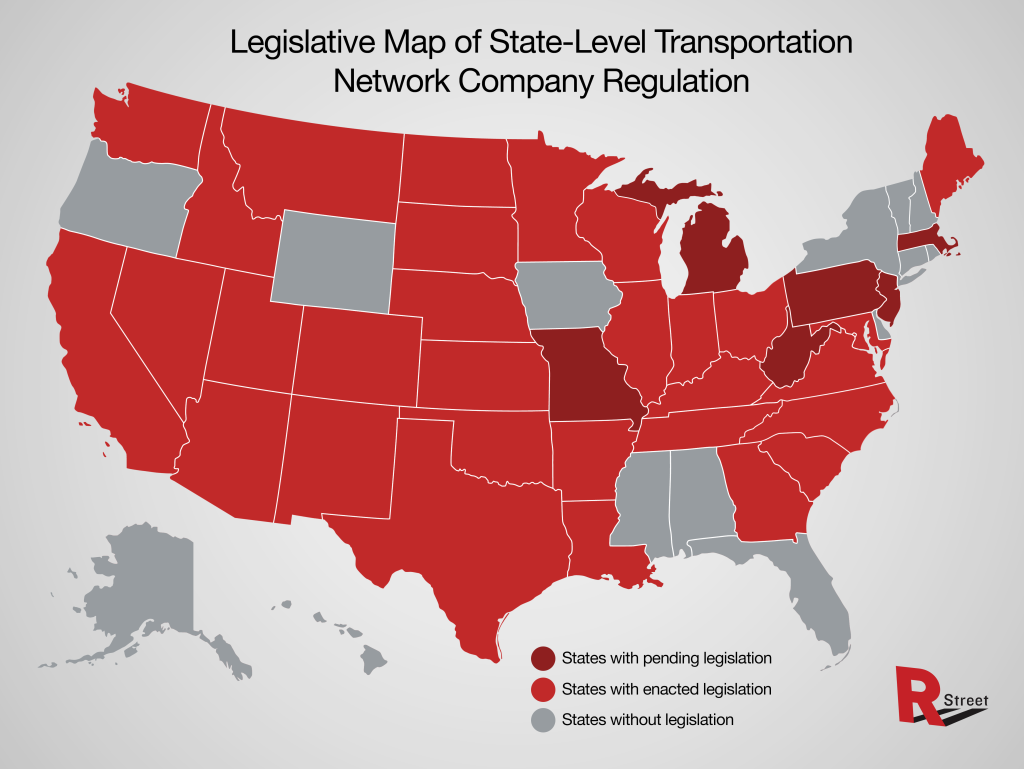
The problem of local regulatory bodies trying to block ridesharing companies is not limited to Saint Louis; it's a nationwide phenomenon. In response, 30 states (including all of Missouri’s neighbors save Iowa) have approved statewide ridesharing regulations similar to those proposed in HB 2330.

Map of ridesharing legislation by state

Ridesharing can provide increased services and employment opportunities in Missouri’s urban areas, and efforts to allow these types of companies to operate safely and effectively could benefit the entire state. Whether or not HB 2330 becomes law, Missouri cities should reform their ridesharing regulations.

Could a Fuel Tax Increase Get on the Ballot in Missouri?

Recently, the Missouri State Senate gave preliminary approval for a 5.9 cent fuel tax increase proposal to go before the voters this year. The bill in question, Senate Bill 623, originally proposed a 1.5-cent increase in the regular fuel tax and a 3.5-cent increase in the diesel fuel tax. That proposal would not have had to go before voters. The new proposal, which could raise an additional $165 million per year for the state highway system, gives Missourians a chance to accept or reject the idea of a fuel tax increase.

We’ve discussed fuel taxes on this blog many times before, and have made the case that it is a fair and sound method of funding state highways. Missouri has one of the lowest fuel taxes in the country, and even if voters approve the tax increase Missouri will still have a lower tax than Illinois, Kansas, and Iowa. However, given the increased revenue the Missouri Department of Transportation (MoDOT) has received in recent years, a 5.9-cent increase may be a bit high. Another less-appealing aspect of the proposal is that the tax increase would apply equally to regular and diesel fuel, even though a large truck does far more damage to roadways than a passenger vehicle. The bill is far from being passed and improvements can still be made, perhaps lowering the total amount of the proposed increase and reintroducing a higher rate for diesel fuel.

Should the Missouri Senate give the proposal final approval, the House would also have to pass the measure before it could go on the ballot in the fall.

To read more about funding MoDOT and State Highway System, read out new paper here.  

Support Us

The work of the Show-Me Institute would not be possible without the generous support of people who are inspired by the vision of liberty and free enterprise. We hope you will join our efforts and become a Show-Me Institute sponsor.

Donate
Man on Horse Charging