Missouri’s Recent Slow Growth Continues Trend

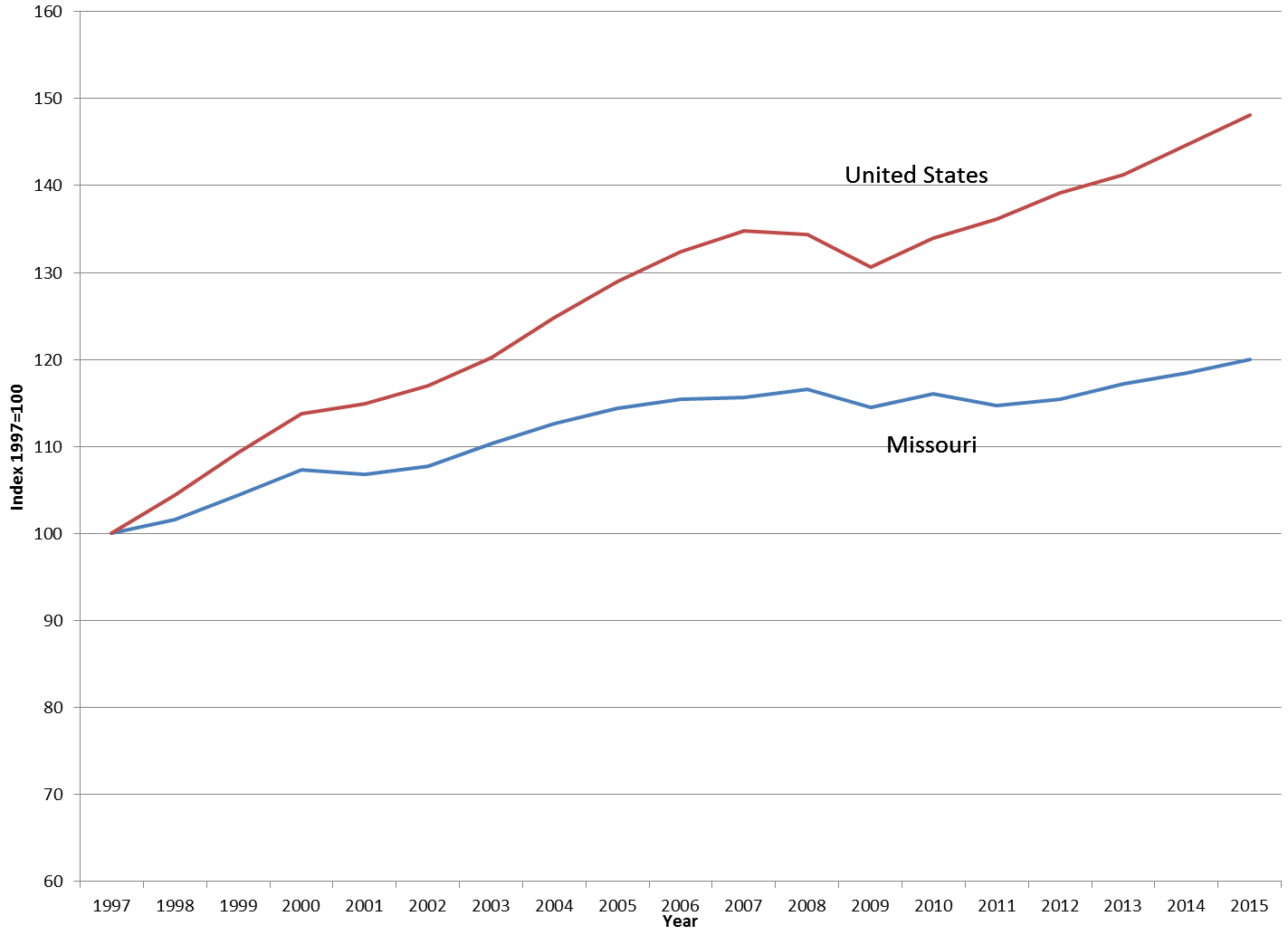
Recently released data on the output of goods and services showed that Missouri’s economy barely grew in 2015. While the U.S. economy expanded at a 2.4 percent rate last year, Missouri lagged behind, increasing at only a 1.3 percent rate.

The fact that Missouri’s economy is expanding at a much slower rate than the national economy is not new. To compare the pace of economic activity in Missouri and the United States over time, the chart above tracks the levels of output (real gross state and domestic product, respectively) over the past 20 years. So that the two series are comparable, each is indexed to its 1997 value.

The chart below shows that by 2015, output of the U.S. economy was about 50 percent higher than it was in 1997. In Missouri, however, output in 2015 was only about 20 percent higher. Not only did Missouri not expand as fast as the U.S. economy prior to the Great Recession of 2007–2009, but it also has not recovered nearly as much. Since 2010, the U.S. economy has grown by about 11 percent. Over this same period Missouri’s economy is just a little over three percent larger.
Missouri’s slow growth has many consequences, such as diminished opportunity for new jobs and a business environment that is not conducive to new start-up firms. The situation also has many causes, some of which stem from policy decisions, such as those related to taxes and education. The fact that Missouri is falling further behind should create some urgency in discovering causes and exploring some possible solutions.

Is the Streetcar a Development Magnet?

Those who have followed the expansion of streetcars in Kansas City and across the country will know that the primary argument for these “transportation” systems is, ironically, not transportation at all, but the idea that (for some nebulous reason) streetcars attract development. And streetcar proponents are never short of anecdotal evidence for this claim, from the oft-cited case of the Pearl District in Portland to business owners in Kansas City who attest to the importance of the streetcar in their decision making. However, when we examine the aggregate data in Kansas City, the case for streetcar-oriented development seems very weak.

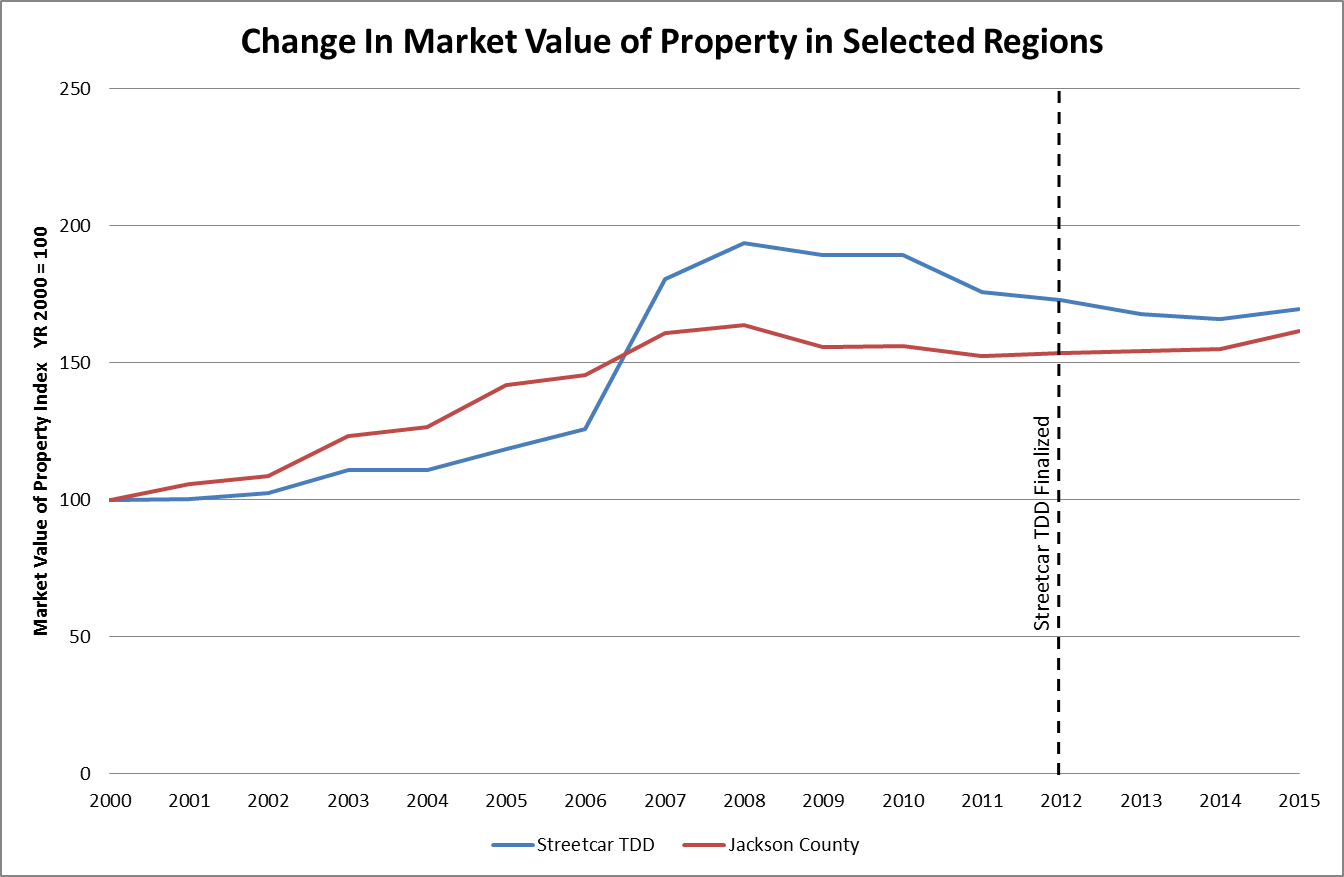
In making the case for expanding the streetcar, Kansas City officials have claimed that the streetcar (despite the fact that it only recently opened) has spurred development within the rail’s transportation development district (TDD). But the data on the market value of property within the TDD tell a different story. In fact, as the chart below shows, property values within the streetcar’s TDD follow largely the same trajectory as property values did in the county as a whole. According to data provided by Jackson County, market values grew in the early 2000s, fell during the recession, and began rising again in 2014. While the market value of property within the TDD has grown faster than values in Jackson County as a whole from 2000 to 2015, that growth occurred before the TDD’s creation, and is mainly due to the construction of the Power and Light District (which opened in 2007).

If we simply look at market values after the streetcar’s TDD was finalized in 2012, Jackson County as a whole performed better than the TDD. This directly contradicts the idea that the Kansas City Streetcar is boosting development downtown:

So why the disconnect between city hall’s streetcar rhetoric and the actual property data? Findings from the latest report from the Federal Transit Administration on streetcar development may shed some light on the situation:

Almost all [civic] representatives interviewed believed that streetcars positively affected the built environment, particularly in attracting new development or enhancing revitalization, although the degree of impact varies. Few systems, however, reported the types of ancillary changes in the built environment, such as reduced parking garage construction, increased pedestrian or bike lane investments, or explicit parking reductions that often are associated with light rail systems. Few, if any, streetcar system operators seek information on their impact on economic activity, although most interviewed consider economic-related questions to be vital and desire further research on this topic. [emphasis added]

Put another way, never let the truth get in the way of a good story.  

A Setback in the Fight against Blaine Amendments

Last week, a federal judge in Denver refused to expand the Douglas County school voucher program to include religious schools. The Colorado Supreme Court had barred religious schools from participating in the program, citing the state’s Blaine Amendment, and a group of families appealed to the federal government on first amendment grounds. They argued that to satisfy the U.S. Constitution, the program has to be neutral toward religion; that is, that families should be allowed to choose religious or non-religious options, so long as neither is given preference over the other.

This case is part of a broader effort around the country to eliminate Blaine Amendments, provisions placed into state constitutions (including Missouri’s) barring public aid to religious schools. Blaine Amendments are named after James G. Blaine, a U.S. Senator from Maine who in 1875 tried to amend the U.S. Constitution to stamp out public dollars flowing to “sectarian” schools.  At the time, there was a virulent strain of anti-Catholicism in America, and because “public” schools were actually nominally Protestant (they required students to read the King James Bible and sing Christian hymns) “sectarian” meant Catholic, and many wanted them stamped out.

Efforts by Catholics to make public schools more inclusive were met with resistance, most notably in events like the Philadelphia Bible Riots, which were sparked over allegations that schools in the City of Brotherly Love would allow Catholics students to read their own version of the Bible. In response, Catholics began to create their own schools, where they could impart their values on their children.  This, not surprisingly, angered the anti-Catholic bigots who did everything they could to shut these schools down.

Blaine was unsuccessful in his attempt to amend the U.S. Constitution, but was successful in getting states all around the country to put language in theirs. We live with the legacy of this bigotry today, as students look to states for support to attend private schools, many of which are religious.

Interestingly, a case out of Missouri has wound its way to the Supreme Court challenging these provisions (I wrote about it here a couple of months ago), but it is not clear how broad or narrow a decision in that case might be. It could strike down (or uphold) Blaine Amendments in total, or it could rule simply on certain practical applications that might not apply to private schools. It is possible that this Douglas County case could similarly make its way to the Supreme Court, so school choice advocates may have more than one bite at the Blaine Amendment apple.

Kansas City’s Crocodile Tears over Blight

After the events of Ferguson, when it was discovered that the city had been using fines and court fees to fund much of city government, legislators acted to restrict the practice. According to a February story in The Kansas City Star,

Sen. Eric Schmitt, a St. Louis County Republican, is sponsoring the legislation capping municipal court fines.

“We’re trying to prevent cities from using this as a revenue-generating opportunity and we’re trying to protect individuals who are primarily poor,” Schmitt told The Star. “People ought to obey the law, but we shouldn’t treat our citizens like ATMs.”

In a more recent story, the Star features various Jackson County and Kansas City leaders bristling at the idea of having court fines and fees reduced. Specifically they point to the impact this might have on addressing blight:

Deb Hermann, chief executive officer of Northland Neighborhoods Inc., said Kansas City is already planning to spend $10 million to tear down 800 dangerous buildings over the next two years, illustrating the level of blight in the city.

She said that for too many irresponsible property owners, $450 is just the cost of doing business.

“The city does not need to lose any tools it has to encourage people to take care of their properties,” she said.

Here is the problem: the City of Kansas City is the largest owner of blighted properties in the city. About 200 of the 800 dangerous vacant buildings that Kansas City is finally tearing down are its own. As several residents pointed out in the KCPT documentary, “Our Divided City,” the City can be quick to levy fines on private owners while letting their own properties languish.

This all reminds me of my father’s favorite example of chutzpah: a defendant convicted of killing his parents asking the court for leniency because he is an orphan.

No one should be surprised that local governments do not want the legislature restricting their ability to levy fines and fees. Claiming that they are motivated by addressing blight is just not supported by the facts. 

Is Kansas City’s “Food Desert” a Mirage?

A “food desert” is an urban area devoid of grocery stores—thought to affect the amount of fresh fruits and vegetables consumed by the urban poor. Twice in the past year we’ve discussed Kansas City’s effort to address an east side food desert by rebuilding a closed grocery store on Linwood Blvd. We argued first that having city government prop up an already-failed business venture is a bad idea. Then we pointed out that the cost of this misadventure had jumped considerably from $11 to $15 million. Now we learn that the problem that this expensive government program is meant to address may not even exist.

The US Department of Agriculture just released an article based on research that concluded that while earlier studies suggested that grocery store location mattered,

More recent studies—using new data with rich detail about food shopping behavior or better methods for understanding the underlying relationships between store access and diet—show that the effect of food store access on dietary quality may be limited.

The study found that regardless of income, people don’t necessarily shop for groceries at the stores closest to them. The study also indicated that food prices affect choices, which shouldn’t be surprising. The part that matters most for Kansas City is the section titled “Building New Supermarkets Is Not Enough.” In one study, researchers compared eating habits before and after a new supermarket opened; concluding,

residents who regularly used the new store had similar diets as residents who did not. The study also found that fruit and vegetable consumption decreased slightly in both neighborhoods.

A similar study of two neighborhoods in Philadelphia—one where a new supermarket opened in 2009 and a similar neighborhood without a new store—was published in 2014 by researchers at the London School of Hygiene and Tropical Medicine and Penn State University. Residents’ perceptions of food accessibility in the neighborhood with the new store improved relative to the control neighborhood, but consumption of fruits and vegetables did not improve.

The article concludes that “improving access to healthy foods” won’t have much impact. It suggests that more important factors might be product cost and available income for food. In those regards Kansas City is not doing well—we are a high tax city overall; often charging a higher tax rate in poorer neighborhoods. Kansas City’s profligate spending—despite the best intentions—is hurting its most vulnerable residents.

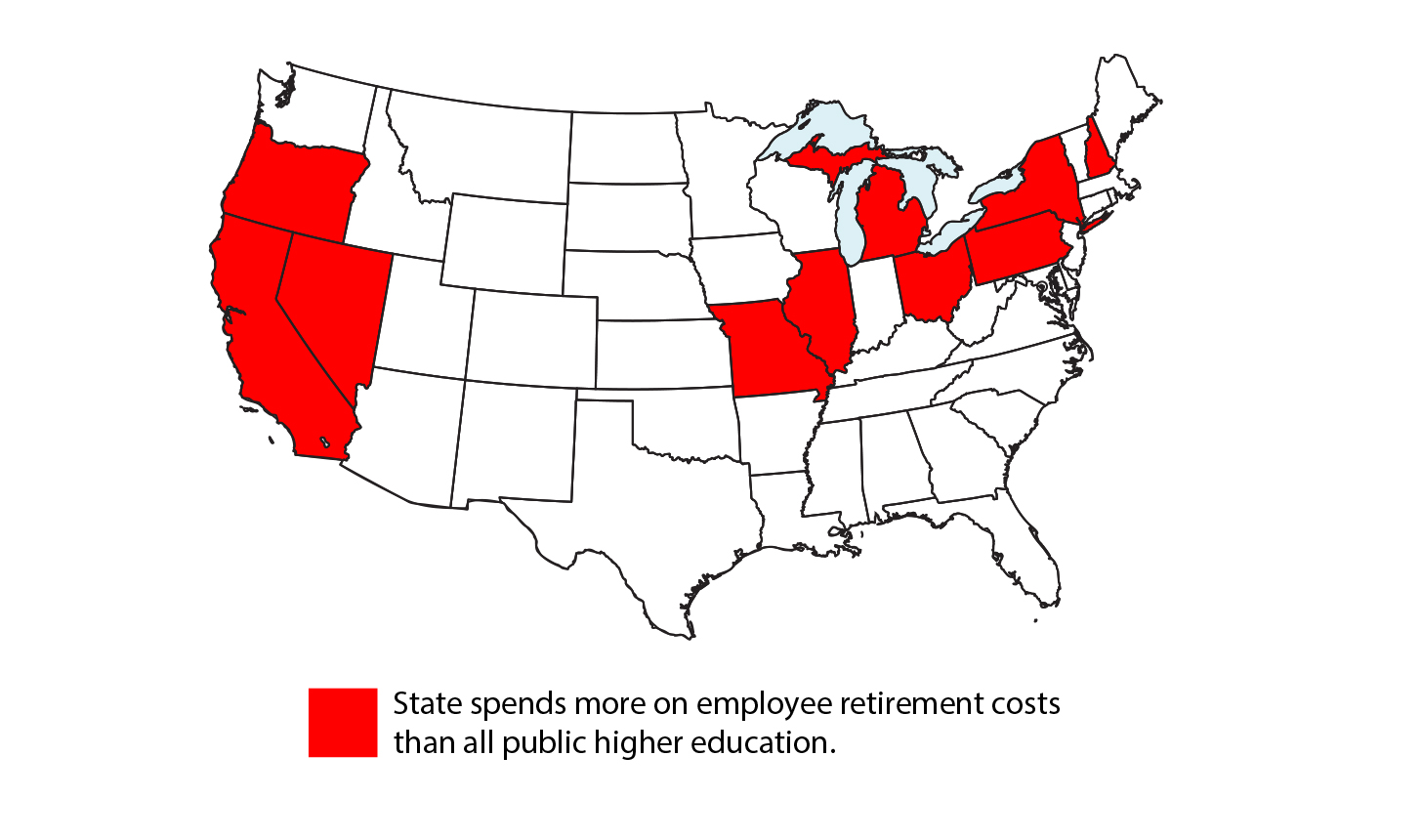
Missouri Spends More on Employee Retirement Costs than Higher Education

Recently on this blog, my colleague Mike McShane highlighted a fascinating post from Chad Aldeman of Bellwether Education Partners. Using data that include state and local contributions to pension plans and state spending on higher education, he computes which states are currently spending more on public employee retirement contributions than they are on colleges and universities. Missouri is one of ten states where retirement contributions surpass higher education spending. 

Some may look at this not as an indictment of our pension plans, but on how “little” we spend on higher education. Indeed, a few months ago, I sat in a meeting trying to figure out how the College of Education at the University of Missouri–St. Louis could cut costs. As the St. Louis Post-Dispatch has reported, the university is facing a serious budget crunch. While I examined the figures with a group of colleagues, one professor suggested that the real problem was declining state aid for higher education.

But let’s say we want to spend more on higher education. Where does that money come from? It doesn’t get created out of thin air. Given Missouri’s anemic economic growth, the available pie of state funds isn’t getting any larger. Any new funds for education will likely come either from another program or from taxpayers. The same can be said of rising pension costs. As we spend more on pensions, we will either have to cut back on funding to higher education and other services or we will have to take more from taxpayers. There is no magic third option; someone has to pay the piper.

As the Show-me Institute has highlighted many times, Missouri’s pension plans are a “looming crisis.” In a 2015 Show-Me Institute Policy Study, Andrew Biggs wrote:

Using standard actuarial valuation, Missouri plans are, on average, 78 percent funded and unfunded liabilities are slightly below $17 billion. Using a fair market approach, funding ratios lie between 41 and 52 percent and unfunded liabilities total from $57 to $89 billion.

In other words, our current obligations far surpass how much we have set aside in pension funds.

Unless Missouri changes how we structure our pension systems, we can expect our obligations to pension funds to grow. This will continue to put pressure on the state budget and will continue to divert spending from other government programs, such as higher education.

Missouri’s Pension System Must Change

When it comes to state pensions in Missouri and bad news, the hits just keep on coming.

Last week, Bellwether Education Partners reported that Missouri is one of only 10 states currently spending more on public employee retirement programs than on higher education. You read that right. We spend more on pensions for public employees than we do for all of our state’s public colleges and universities.

Just a few days later, the St. Louis Post-Dispatch reported that the state treasurer was revising downward the expected rates of return for the money in the state’s pensions systems to adjust to slower growth in the stock market. This means the funds themselves are even more underfunded than we thought and may need huge infusions of tax dollars to meet their obligations to the state’s workers.

Add this news to what we already know about pensions, and the full, dismal picture emerges. Remember, teachers in PSRS, the state’s main teacher pension system, must spend at least 28 years paying into the system before their retirement earnings will exceed what they contributed while working. Sixty-five percent of Missouri teachers will not hit that mark and will be net losers in the system. In addition, state pension funds are investing in increasingly risky investments in order to chase higher returns.

What more do we need to know before we push for change?

Most public employees in Missouri belong to what are known as defined-benefit pension plans.
These guarantee a pensioner a specific amount of money every year for the duration of their retirement. In most cases, the amount these plans pay out to retirees is not based on how much money an employee has contributed, but rather on a formula that only takes into account a few years of service. For teachers in PSRS, only the three highest consecutive years’ salaries are used in retirement calculations. This allows individuals who get large pay increases in the final years of their careers to draw considerably more than they ever contributed into the retirement system.

In order to keep the promises Missouri makes to public employees through these plans, the state will face mounting pension obligations. In a recent paper for the Show-Me Institute, Andrew Biggs, resident scholar at the American Enterprise Institute, calculated Missouri’s unfunded pension liabilities. Using standard methods from the Government Accounting Standards Board, the unfunded liabilities are nearly $17 billion.  Using more conservative estimates,  the unfunded liabilities total between $57 and $89 billion depending on the means of calculation.

As liabilities grow, state support for pensions will have to grow as well, and funding for pensions has to come from somewhere. It may come from other public programs, such as higher education, or it may come from taxpayers. The debts we are incurring now will limit our ability to invest in the future of our students and our state. That is a recipe for neither growth nor prosperity.

Collateral Damage of our Pension Systems

Here at the Show-Me Institute, we have harped, for years, on the unsustainability of Missouri’s pension system.  We do this for one simple reason: poorly administered funds hurt the people of our state. They hurt the teachers who have to log 28 years of service in order to get more out of the system than they put into it. They hurt young, mobile teachers who leave before vesting. They have the potential to hurt future retirees when they invest in risky assets that could affect their solvency when more of our baby boomer teachers retire and the bills come due.

We can add another group to that list as well: our institutions of higher education. Chad Aldeman of Bellwether Education Partners (which publishes the website teacherpensions.org) has a new blog out wherein he shows the 10 states that are now paying more into their retirement systems than into their institutions of higher education. It’s not a good list to be on, but Missouri is on it.

Aldeman sums it up well:

“What to make of this finding? That depends on your perspective, but over time, I suspect higher education budgets will continue to be squeezed in favor of pensions. On the retirement side, costs will likely continue to rise. Even amidst one of the longest and strongest bull markets in history, pension plans still haven't recovered, and if pension plans fail to hit their 8 percent investment targets every year, they will need taxpayers to continue bailing them out. Higher education will be one of the primary losers from this arrangement.”

The great economist Herbert Stein is known for the quotation “trends that can’t continue, won’t.”  The worrisome trend in our pension system can’t continue. Absent reform, it’s only a matter of time until it won’t.

(Data used for map are for FY 2014. Retirement data include state and local employer pension contributions. Data taken from http://crr.bc.edu/data/public-plans-database/pension. Higher education expenses include state general fund and “other state fund” contributions; see Table 12: http://www.nasbo.org/publications-data/state-expenditure-report

Support Us

The work of the Show-Me Institute would not be possible without the generous support of people who are inspired by the vision of liberty and free enterprise. We hope you will join our efforts and become a Show-Me Institute sponsor.

Donate
Man on Horse Charging