Democrats Like Vouchers More Than Republicans Do, and Other Findings from the 2016 Education Next Poll

Every year, the policy journal Education Next polls a representative sample of Americans about their views on education issues. Their 10th annual poll was just released this week and has several interesting data points.

A few highlights:

  1. 55% of Americans give their local public school an A or B grade, but only 25% of Americans give U.S. public schools as a whole an A or a B.
  2. Without prompting, 61% of Americans think that we should spend more on public schooling. When given the actual amount that their local school spends, that drops to 45%.
  3. Opinions on Common Core are evenly split, with 42% of Americans supporting it and 42% opposing.
  4. 28% of Americans support teacher tenure, and 54% oppose it.
  5. 69% of Americans support annual standardized testing of students

The first four findings didn’t really surprise me. The twin phenomena of liking your local school but disliking schools as a whole and thinking that your local school needs money until you’re told how much it spends have been documented by EdNext and others for years now.  The Common Core has been in freefall, so that wasn’t unexpected either.  Teacher tenure remains predictably unpopular.

I was surprised, though, at the durability of opinion on the value of standardized testing. Sixty-nine percent is strong support, and I would have thought with the unpopularity of the standards that many of the tests are based on that would have been a drag on opinion on the tests themselves. It looks like that isn’t the case!

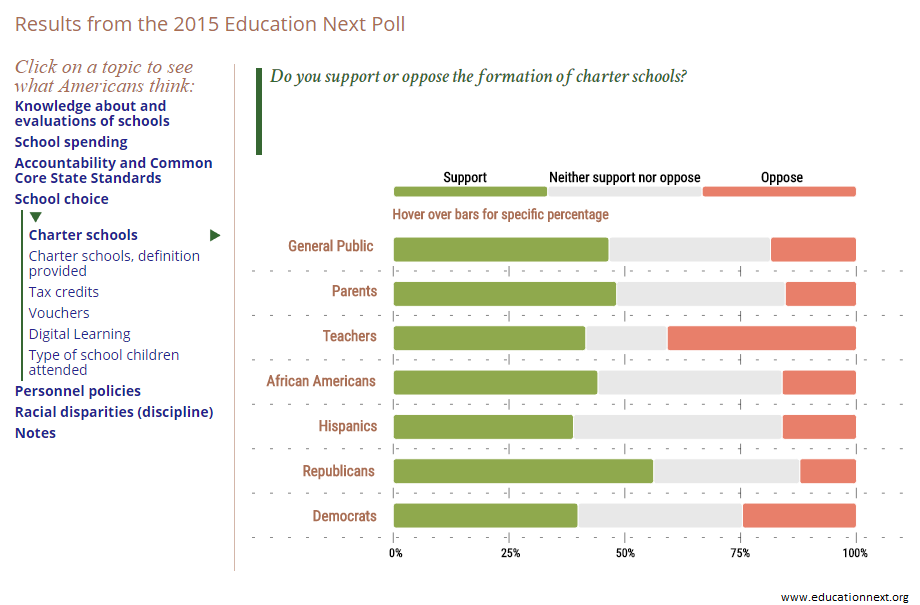
What interested me most as a school choice advocate was public opinion about school choice issues.  The poll asked questions about charter schools, vouchers, and tuition tax credits, and the findings might surprise you.

On charters, overall public opinion is 51% pro and 28% against. When observed by party affiliation, we see Republicans more likely to support charters (60% Pro and 21% Against) than Democrats (45% Pro and 33% Against).

Vouchers are, on average, less popular than charter schools, but interestingly, enjoy more support from Democrats than Republicans. Overall opinion (for a universal voucher program that all students would be eligible for) is 45% pro and 44% against with Democrats splitting 49% pro and 39% against and Republicans splitting 41% pro and 49% against.  When the question is asked about a voucher program targeted to low-income students, the program becomes even less popular, with overall opinion 37% pro and 48% against (with Democrats 42% pro and 43% against, and Republicans 31% pro and 54% against).

Finally, and perhaps most interestingly for those of us in a state with a Blaine Amendment, tax credit scholarships were more popular than either vouchers or charter schools. Fifty-three percent of Americans support tax credits while only 29% oppose them. The partisan split remains though, with Democrats supporting more than Republicans. Democrats split 57% pro and 26% against while Republicans split 49% pro and 33% against.

It is always good to take the nation’s temperature on issues of schooling. School choice supporters in particular should take a moment to reflect on these findings. Perhaps supporters (and opponents) aren’t who we think they are. 

 

Developer Reportedly Ends Project After LCRA Vote

Steve Foutch is a Kansas City real estate developer who, at least before today, was pursuing taxpayer support to build a new 104-unit apartment complex in the Crossroads District. According to the Kansas City Business Journal, Foutch wanted a 10-year 100% abatement from the Land Clearance For Redevelopment Authority (LCRA), but according to the Star, the developer said he had negotiated a deal with Jackson County to pursue a tax abatement of 100% for five years and of 63% for the following five. The LCRA recommended, and approved, the 100% abatement but reduced the second five years to a 50% abatement.

That cut was apparently enough to instantly scuttle the project.

Seconds after the LCRA unanimously voted to approved the abatement package, Foutch shook his head and stood up from the 17th floor boardroom at Town Pavilion, where the agency holds its meetings.

“We’re not going to do the project,” Foutch told LCRA commissioners.

“That’s your choice,” LCRA chairman Michael Duffy responded.

…After the meeting, Foutch said that the financing for his project was “razor thin” and that the package that the LCRA approved was insufficient to make financing for his project work. He added that if interest rates or capitalization rates move “even a decimal,” it would affect his project’s financing.

Let's be crystal clear here: Taxpayers gave Foutch most of what he wanted. And if your financing margin for error is "razor thin" for a mixed-use project that sells upscale apartments in a growing district, then the bank is telling you that it doesn't think your project is a good one for their money. That Foutch was willing to cut bait immediately when he couldn't get all the taxpayer money he wanted tells you that Foutch doesn't think the project is a great project for his money either.

It isn't the role of taxpayers to be the investors of first resort for developments like this. Foutch's snap reaction to the LCRA's verdict suggests taxpayers may be dodging a bullet here with the developer's withdrawal from the project. And if the project is somehow resurrected? It shouldn't receive a wooden nickel of taxpayer support.

Economic Impact Fallacies

David Martin over at The Pitch has a great piece about how the positive economic impacts of a Chiefs training camp in St. Joseph have failed to materialize. Residents were promised millions of dollars of revenue in return for taxpayer subsidies. Build it, they were told, and they will come.

They didn’t come. The expected money has not poured into St. Joseph, in part because the calculations used to make the promise to St. Joseph residents were flawed. Martin writes:

The convention bureau arrived at the $6.3 million economic-impact estimate by multiplying 40,000 (the number of fans who attended training camp, according to Missouri Western) by $158. The dollar figure was the average amount of money that surveyed visitors said they’d spent.

That, anyway, is how the convention bureau understood the math. But H2R [Market Research] officials, when asked about the visitor profile, told The Pitch that the average spending was per party, not per person.

The St. Joseph case is not isolated. Calculating economic impact for projects and events is fraught with errors and often with glaring flaws in the premise. Two years ago we wrote that the promised economic impact of hosting the Republican convention in Kansas City was likely overstated. In short, the number crunchers often base their estimates on the assumption that without the event in question, there would be no economic activity at all—that if we didn’t host the Republican Convention, the hotels and restaurants would be left empty. It’s not just projections for events that rely on such flawed reasoning; from stadiums to film tax credits, economic impact studies often miss the mark.

Sometimes the truth can only be known in retrospect, when we look back and compare promises to results, as Martin did in his piece. But by then the public’s money has already been invested and possibly lost. With this in mind, the public and policymakers alike should be more skeptical of economic impact claims.


No, Charter Schools Don’t Push Out Kids Who Are Too Hard To Teach

Last week, I offered a “Mythbusters”-style blog on the (mistaken) belief that charter schools suspend students at higher rates than traditional public schools do.

I wanted to follow up on that post with a quick addendum on a related issue that charter critics often raise in discussions about the discipline practices of charter schools. They often claim that the draconian discipline systems within charter schools are used to push out students who are lower performing or are too disruptive to handle. Like the myth of charter school suspensions, this one isn’t true either.

Now it is true that, on average, there are differences between charter schools and traditional public schools in terms of the types of students that they enroll. But careful research has yet to find evidence that charter schools actively push out low-performing students at rates higher than those of traditional public schools. Ron Zimmer of Vanderbilt and Cassandra Guarino at Indiana University, for example, analyzed data from an anonymous large urban school and found no evidence of pushing out low-achieving students. Marcus Winters similarly found no evidence that charter schools in New York disproportionately pushed out low-achieving students. It does appear that in Chicago, charter schools expel students at a higher rate than traditional public schools do, but in the nearly all-charter district in New Orleans the expulsion rate is lower than in the rest of the state, even though the students in New Orleans are more disadvantaged. These seemingly contradictory results are why we should value research with the appropriate statistical controls.

There is also little evidence that charter schools “skim” the best students from the public school system. In fact, a team of researchers also led by Ron Zimmer found no evidence in the seven locations they examined.

At best, proponents of these theories offer isolated anecdotes or decry the actions of a particular school or school network without asking if that school or network is representative of the system as a whole.

All of this research aside, I think there is an important conversation to be had about the value of discipline in and of itself. I would argue that we have to be open to the idea that that suspending more students actually makes for a better learning environment. We know that disruptive students have a huge (and I mean huge) negative effect on their peers. In some cases, suspending students might the only way around that. I hope that isn’t the case—but it very well could be. The autonomy of charter schools gives them the latitude to experiment with different discipline practices. Hopefully we can learn from their efforts and continue to improve student discipline practices.

The Charter School Discipline Problem that Isn’t

Mark Twain is credited with the saying, “It ain’t what you don’t know that gets you into trouble. It’s what you know for sure that just ain’t so.”

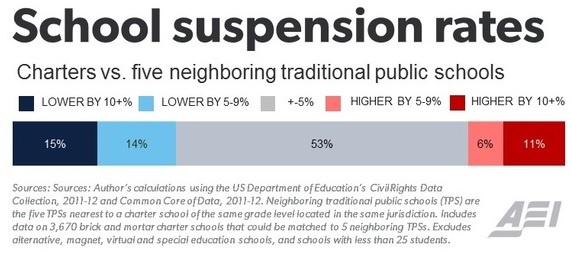
For years now, critics (and even some supporters) have known for sure that charter schools had harsher discipline policies than traditional public schools and suspended or expelled students at much higher rates. According to new research from Nat Malkus of the American Enterprise Institute, that just ain’t so.

Malkus used data on school suspension rates collected by the federal government to compare charter schools to the traditional public schools that surround them. As Malkin's graphic (above) shows, in most cases, there is no substantial difference in the rate of suspensions between traditional public schools and charter schools. In fact, while 17 percent of charter schools do see rates higher than neighboring public schools, 29 percent see rates that are significantly lower.

It’s time we put to bed the idea that charter schools are draconian institutions where the joy of learning is taken from students and where harsh punishment is meted out for the most minor of infractions. The data do not back that story up.

Unite the Region with a Sensible, Effective Transit Vision

In a recent Post-Dispatch column, Tony Messenger called for an ‘AND’ approach to transit planning in the St. Louis region. He thinks the region should collectively fund and pursue projects x and y, not either project x or y. In his view, that means regional leaders should unify behind efforts to expand MetroLink, St. Louis’s light rail system.

But the AND approach isn’t a simple matter of uniting the region for a common goal. Where MetroLink is concerned, the AND approach will benefit some at the expense of others. In more concrete terms: the City needs the County’s tax revenue if MetroLink expansion—in any direction—is going to be feasible. But the County has made clear it isn’t enthusiastic about funding the city’s favored north–south expansion. (Note: the County’s transit sales tax revenue is triple that of the City’s. See p. 67)

So, should the County and City just take their toys and go home? Of course not—the AND approach isn’t the problem. The problem is the goal the AND approach is supposed to achieve: a costly $2.2 billion expansion of the inefficient and underused MetroLink, which would mostly lie within City limits.

Recognizing this fact lifts the shroud of mystery surrounding regional infighting. MetroLink expansion is so expensive it would force the County to fund the bulk of a project that will primarily benefit the City. It’s so expensive that it creates an either/or approach to regional transit planning.

But what if, instead of an immensely expensive light-rail expansion that would require every tax dollar it could get its hands on, regional leaders invested in a system of bus-rapid-transit lines that could be constructed and operated at a fraction of the cost. That is, imagine a project that wouldn’t gobble up every last dollar the region has to offer, would actually serve regional transportation needs, and didn’t pit County against City.

If the region’s transit priorities were more in line with its resources, there might not be an either/or approach to transit in St. Louis. Messenger got things backwards: MetroLink expansion isn’t the victim of regionalism—it’s the cause of it.

So long as a costly MetroLink expansion is the goal, it doesn’t matter how well the region’s leaders get along. With the north–south expansion in particular, the City can win only at the expense of the County. That is an either/or approach. If leaders are to unite behind a transit plan, that plan will need to effectively serve all of the region’s residents at a price they are all willing to pay. 

Teacher Licensure Screens Will Not Improve Public Education

The problem with bad public policy is that it often sounds like good public policy. These ideas have enough of a rational basis for us to buy into them. Upon closer inspection, however, we realize that they aren’t what we had hoped for.

This lesson hit home with me as I was reading about the new certification requirements for public school teachers. Missouri has long had certification requirements. For instance, traditionally certified teachers must earn an education degree, and they have long been required to pass a content exam. Over the past few years, however, the Missouri Department of Elementary and Secondary Education (DESE) has revised many of the requirements, making it more difficult to become a teacher. Prospective teachers must take a personality inventory (which I’ve written about before), they must pass a more difficult content exam, and now they must also pass a performance assessment.

To many, these sound like good ideas because they are sprinkled with a bit of the truth. We want our public school teachers to be excellent. If we put these screens in place, we’ll get better teachers—or so the thinking goes. The problem is that while teacher licensure screens are an unproven way to improve teacher quality, they are a sure-fire way to shrink the teaching pool.

Take licensure exams, for instance. As I have shown in the journals Educational Policy and the Journal of School Choice: International Research and Reform, licensure exams are very loosely related to teacher effectiveness. Yes, people who do well on tests tend to be better teachers, on average, but there is considerable variation. In other words, some people who do well on a content exam are terrible teachers; while some who do poorly on a licensure exam are great teachers. Screens like this let in some bad teachers and keep out some good teachers.

In a recent working paper, “Can we simply raise the bar on teacher quality?” I show how simply making licensure exams harder will have a negligible impact on the overall quality of teachers in the field. Yet, as a result, we would reduce the number of teachers; further exacerbating teacher shortages. These shortages would do the most harm to disadvantaged schools attempting to compete for the limited supply of teachers.

Missouri’s newest test, the Missouri Pre-Service Teachers Assessment, seeks to move beyond testing only content knowledge. Here is a description of the test from the Southeast Missourian:

The first three parts of the exam are written, and the last has a video component, except in areas where shooting footage is difficult.

In the first part of the exam, student teachers are assessed on how well they know their students and the context of the school in which they’re teaching.

The second part tests them on how they plan to check whether their students have learned the information they taught.

In the third part…student teachers are judged on how they plan to teach their lessons, and the fourth part allows them to demonstrate how effective their approaches have been…

Once again we have put in place a policy that sounds like a good idea. In the end, however, it too will not likely have a positive impact on public education in Missouri.  The problem is that we simply cannot capture great teaching in one of these assessments. Think back to the best teacher you ever had. Would these exams make him or her stand out from his or her peers? Probably not. 

Licensure screens for teachers sound like good public policy, but they aren't. If we really cared about teacher quality, we’d be better off to open pathways into the profession, support teacher professional development, and get rid of bad teachers.  

Let Kansas City Be Kansas City

For our summer vacation, my daughters and I made a 4,000-mile trek through the desert southwest to San Diego and back. We drove through plenty of cities and towns, each very different from one another. Some were thriving, and some were struggling, but each had an independent identity. We saw the casinos of Las Vegas and the playful seals of La Jolla, California, and we stood on a corner in Winslow, Arizona. These places—both big and small—have their strengths, and they are playing to them.

What about us in Kansas City? To judge by city leadership, our biggest need is to look like other places—we are constantly mimicking other cities with convention hotels, streetcars, and entertainment districts.

In a speech at the KC Library in July 2015, (video here) professor Heywood Sanders discussed the folly of convention hotels and fielded a question about promoting Kansas City. The question-and-answer begins at about 49:49 and is worth hearing in its entirety, but in short he says:

Don’t do what everybody else is doing. Okay? Period.

There is an old saying that goes along those lines, “don’t think if you’re doing exactly the same thing that everyone else is doing except not quite as big or good or well, that it’s going to be any different.”

Unfortunately, that seems to be exactly what Kansas City is doing: building the same things that everyone else is building, except perhaps not as ambitious. Proponents of the Jazz District, for all its many challenges, at least want to promote something that is unique to Kansas City. Let’s think about what we have that no one else has, and promote that.

In the coming months, the Show-Me Institute will be talking more about what Kansas City has to offer. It’s a worthy discussion, and it ought to be the first step in promoting ourselves rather than simply engaging in municipal me-tooism.

Uber and Kansas City Go at It Again

Kansas City hasn’t been the friendliest place for ridesharing/transportation network companies (TNCs) like Uber and Lyft. Although regulators in the city of fountains haven’t been as bad as those in Philadelphia who compared Uber to ISIS, they still managed to receive a ‘D’ in terms of their friendliness to TNCs.

First, the city and TNCs got into a bit of a spat. (Listen to Mayor James’s thoughts here.) Then a compromise was reached, allowing TNCs to operate in the city. But now the terms of that compromise are coming up for review, and guess what? The city wants more control, and TNCs don’t want them to have it.

The major proposed changes to the City’s TNC ordinance include: (1) eliminating a 30-day orientation period and replacing it with a 30-day temporary permit; (2) forcing drivers to acquire additional insurance and increasing the company’s permitting fee from $45,000 to $70,000; and (3) handing all background-checking duties to the city.

  1. The Star and regulators have cast a 30-day orientation period—during which TNC drivers can operate without a city permit—as a loophole for “dangerous” and “undocumented” drivers to “overcharge passengers or do something much worse.” While these worries are likely overblown, simply replacing the orientation period with an issued-on-the-spot permit is unlikely to threaten TNCs’ ability to operate in the city. In fact, if this measure were implemented, Kansas City would still be one of the easiest places to start driving for a TNC (compared to, say, Dallas). If this change assuages the concerns of regulators at little to no cost, so be it.
  2. Requiring extra insurance and increasing the fees TNCs pay to the city are a different story. In short, the heavier insurance burden forces TNC drivers to carry the same insurance as taxi drivers. It requires insurance to cover incidents even when, for example. a TNC driver is involved in an accident while providing a ride but not working through the ridesharing app. This, in conjunction with higher city permitting fees, will place a significantly greater financial burden on drivers and will likely keep many from entering the market at all.
  3. Lastly, and most controversially, handing background-checking duties to the city’s preferred vendor over those contracted by TNCs is complicated. This proposed change would keep driver information centralized and thereby prevent unqualified drivers from going from one TNC to another. But it isn’t clear that the vendors TNCs currently use for background checks are any less thorough than the city’s preferred vendor. If it came down to just this change, Kansas City regulators should ask themselves: is conducting their own background checks worth driving Uber and Lyft out of town for good? Although officials have public safety in mind, as my former colleague Joseph Miller has argued, they should let riders assess the level of “risk” they are willing to take.

So, overall, and unsurprisingly, city regulators are vying for greater control in a market averse to red tape. Not all of the proposed changes are onerous, but many would put additional barriers between consumers and service providers. Perhaps city leaders will learn how to get out of the way this time around.

To learn more about the proposed ordinance changes, and to leave your comments, click here

Support Us

The work of the Show-Me Institute would not be possible without the generous support of people who are inspired by the vision of liberty and free enterprise. We hope you will join our efforts and become a Show-Me Institute sponsor.

Donate
Man on Horse Charging