Statewide MAP Results Are Out, and They Don’t Look Great

Do you remember the feeling you’d get as a student, when the teacher was handing back exams—especially when you weren’t optimistic about the grade you’d earned? It’s a feeling that must have been common in Missouri on Wednesday, when the Missouri Department of Elementary and Secondary Education released the statewide results of the Missouri Assessment Program’s 2016 administration.

Taken at face value, the numbers aren’t strong.

The table below shows the percentages of students who scored “proficient” or better in grades 3–8 in English Language Arts (ELA) and Mathematics.

Subject Grade 3 Grade 4 Grade 5 Grade 6 Grade 7 Grade 8
ELA 60.7% 63.2% 62.1% 58.4% 58.0% 59.2%
Math 52.1% 52.5% 46.4% 43.0% 42.5% 40.3%

In grades 5–8, fewer than half of students scored proficient or better in Math. At 63.2%, 4th-grade ELA is the highest single score, and that is still less than two-thirds of students.

So what does all of this mean? Well, it’s a bit complicated. This was the first year for the new MAP test and new cutoff scores for proficiency. Missouri developed a new test and set new expectations after jettisoning the Common Core–aligned Smarter Balanced Assessment, so it’s hard to put these numbers in context. Are these standards too high? Too low? Just right? It’s probably too soon to say.

One thing we can do is compare these results, at least for the 4th and 8th grades, the scores on the National Assessment for Educational Progress (NAEP), a test that is administered to a representative sample of students every two years. The following table shows the proficiency results from 2015.

Subject Grade 4 Grade 8
ELA 36% 36%
Math 38% 38%

NAEP is designed to set a higher standard than most state tests, but there is still a pretty large gap between what NAEP defines as proficient and what the MAP test does—that is, unless our students made huge gains in one year. Given the small likelihood of that, it looks like MAP might need to raise the bar.

All of that said, these numbers do create a baseline that subsequent years of assessments can be compared to. It will be interesting to see how they change over time.

2016 Friedman Day Policy Panel

James Shuls, Ph.D., moderated this panel discussion about school choice in Missouri. The panel included Melissa Brickey, Executive Director of De La Salle Middle School; Bill Kent, President of The Biome School; Ross Woolsey, Co-founder of North Side Community School; and Doug Thaman, Executive Director of the Missouri Charter Public School Association. The panel discussed the importance of educational options and the pending lawsuit that the St. Louis Public Schools has brought against public charter schools in St. Louis.
 

Taxpayers’ Subsidy Skepticism Is Warranted

The Kansas City Star published a piece last week about subsidized development and its opposition in the region. Perhaps unsurprisingly, the people who profit from taxpayer subsidies are worried that those of us who pay for those subsidies are unconvinced of their value. This is important because Kansas City spends or diverts away millions in taxpayer dollars on private development each year that then cannot be used for schools, police, or infrastructure such as roads and sewers.

Kansas City Councilman Scott Wagner worries that people need to be convinced of a particular project before moving ahead.

“Increasingly, the burden is falling on the developer to show residents that there will be a benefit for the area, that the ‘but for’ clause is real,” Wagner said. “If people don’t believe a financial need exists, it’s easy to fight it.”

Is this too much to ask? Should taxpayers just trust the Economic Development Corporation (EDC)—a nonprofit organization funded mostly from the fees assessed on the projects it recommends—to have the final say? Apparently, yes. According to one developer, the people just don’t know enough to have a worthwhile point of view,

Whitney Kerr Sr., a longstanding area real estate developer, fears an anti-development tide could thwart the city’s momentum. He worries that “people who have no knowledge of real estate economics” have become too empowered.

Clearly, Kerr and developers like him would prefer the people to just be quiet and keep forking over their tax dollars to the supposed real estate experts at City Hall. Remember, it was former Mayor Kay Barnes who actually said in 2006 of the Power and Light District,

"We're going to look like geniuses" in five or 10 years, Barnes said. The city is paying low interest rates for projects that are capable of paying off the debt, she added.
 

Quite the opposite, the District is a swirling financial black hole that will swallow up about $15 million from the general fund each year from now through 2040. And there is no evidence that the District has netted the city any additional businesses, jobs, or tax revenue. In fact, according to the Missouri Department of Revenue, projects in tax increment financing (TIF) districts regularly fail to meet their developers’ own job creation projections. The great cost and low return of these subsidies is the reason that states and localities have been reforming TIF across the country. California, which was the first state to adopt TIF in 1952, ended it altogether in 2012.

Popular opposition to these development subsidies isn’t a product of the people’s ignorance of real estate economics, but rather of their understanding. They don’t want to hand their money to Kerr and others for dubious development projects when the city cannot keep Westport from flooding in the rain.

As for Mr. Kerr and other apologists for the status quo, it is unlikely that they have read a lot of the economic research literature on but-for analysis, or else they would understand the public’s discomfort. As a public service, here is a link to a study conducted by the University of North Carolina-Chapel Hill on TIF in Chicago. Before complaining about the lack of “knowledge of real estate economics” in others, perhaps they should educate themselves.

On Government-Mandated Coffee Machines

Over at the Kansas City Star, Dave Helling comments on a raucous online debate about Kansas's LLC tax exemption—specifically, the misgivings of a Kansas business owner interviewed by the Star who, after Kansas's tax cuts, regrets that some of his income isn't taxed anymore. The businessman's detractors say that if he regrets having the money, he should donate it. But in a sympathetic analogy, Dave lays out a story about the potential perils of employees pooling money to buy an office coffee machine and how without forced giving, your morning Folger's would be hard to come by. As Dave puts it, unless everyone contributes the agreed amount for the coffee machine—presumably the office "tax"—then "the coffee pot remains on the store’s shelf."

But the Great Caffeine Shortage of 2016 (and 2015, and before) never really materialized in most of our offices. That's not because the government or some government-analog always provides the capital for coffee. Some of us make coffee ourselves and bring it to the job site in a thermos; others buy coffee on the way to work, or take a break mid-morning to get a pumpkin spice latte. (now available!) In fact, the coffee I drink at my office here on Troost is, more often than not, from my own coffee machine, which I brought to the break room and share with my coworkers.

I could demand that the Show-Me Institute provide me with "free" coffee and force everyone else to pay for it, and certainly there are office necessities and amenities that the Institute does underwrite. The point is, I wanted a certain kind of coffee, and I felt strongly enough that I didn't bother lobbying my employer for "shared sacrifice," but instead took care of that want myself—to the benefit of more than just myself. Not everything is best given from on high, including coffee. And somehow, some way, most of us have easy access to the stuff.

Of course Dave's office analogy for government has other limitations, too. First among them is that taxpayers don't work for the government. Taxpayers also cannot "switch" governments if we find ours unresponsive to our coffee demands—at least not to the extent, manner, and speed with which we can switch actual employers. Moreover, we can vote ourselves other peoples' money in government; I can't, by majority vote, requisition Patrick Tuohey's fancy-pants wallet and force him to pay for, say, a new coffee machine for the other 99% of us. 

You get my point.

Government has appropriate roles, and funding expenditures to carry out those roles is already fraught with all sorts of moral questions, because it requires taking money from people, even if it's against their will. But just because government can force other people to buy you a coffeemaker doesn't mean it should, and it is no virtue to publicly regret your good fortune as a means to force others to pay for your own priorities.

If you care about it, be an example to others and put your money where your mug is. And if you don't really care about it? Don't tell everyone else they owe you a latte.

Education Funding, Burger Flipping, and the Law of Diminishing Returns

Here’s a fun hypothetical. Imagine you own a burger joint, but you only have one grill, no one to work it, and a line out the door for your burgers. If you hire one burger flipper, you can make 10 burgers an hour. If you hire two more, you might get up to nearly 30 an hour. Why stop there? Let’s keep hiring more workers on that same grill and we’ll continue to make more burgers every hour, right?

Kind of.

At a certain point the grill gets cramped and workers elbow for space. The fourth or fifth flipper might increase burger output, but at a decreasing rate relative to the gain in burger production from the first or second hire. This is what is known in economics as the “Law of Diminishing Returns.”

Unfortunately, when it comes to education, this is a law that many don’t believe exists.

Last week, the Kansas Association of School Boards (KASB) released the State Education Report Card for 2016. In it, KASB ranks states, including Kansas and Missouri, on fifteen performance measures. It then compares that ranking to state spending per pupil. The Executive Director for KASB speaks to Kansas coming in at 29th for spending per pupil in 2014 and then elaborates,

In the long run, this threatens our ability to compete with other states economically for not just high-paying jobs, but almost any job.

Really? If the state doesn’t spend a few hundred more dollars per pupil it will set the entire economy back? This argument suggests that the more you spend, the better you’ll be—or the more flippers on the grill, the more burgers you’ll make.

As it turns out, the data they present offer a great example of the law of diminishing returns.

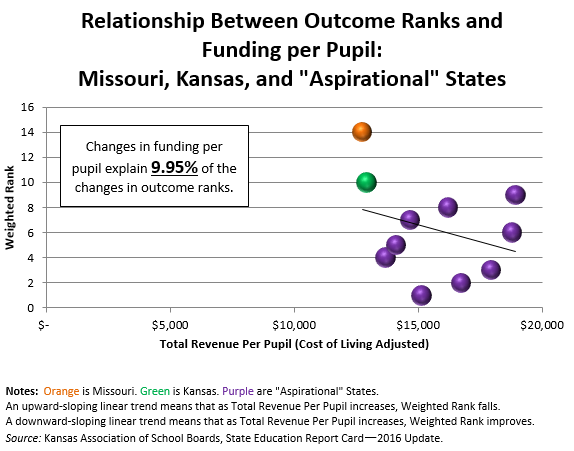
 In the chart below, I plotted funding per pupil on the horizontal axis and educational ranking on the vertical axis. Each point on this chart represents a state. I noted Missouri, Kansas, and states that KASB “aspire to be” on this chart. If the KASB’s diagnosis is accurate, then we would see a steep downward sloping line (or trend), because that would mean that an increase in education spending comes with a significant improvement in outcome rankings (lower-ranking numbers are better). The flatter the line/trend, the weaker the relationship between funding and outcome rank. This is a concept in statistics known as the coefficient of determination.

The line is pretty darn flat. In fact, education funding per pupil only explains about 10% of a state’s improvement in educational outcome rank.

So, what does this mean? Well, since 90% of the variation in state performance is determined by factors other than spending (a good example of which might be how that money is spent), we need to look beyond simply pumping more money into our schools if we want to improve those schools’ performance. School funding is subject to the law of diminishing returns. And I think now is a good time to go get a cheeseburger.

This Sandwich Costs $1,500 and Takes 6 Months to Make

No, I didn’t relinquish my title as Director of Education Policy at SMI to become the Institute’s new food critic, but the teacher in me loved this video series I recently stumbled across in which an enterprising YouTuber decided to make his own chicken sandwich from scratch.

And when I say from scratch, I mean, from scratch.

He harvests the vegetables, he kills (fair warning, graphically) the chicken, and he even evaporates his own salt from the ocean! Really, what he did was a millennial-focused version of I, Pencil, the famous free market lesson popularized by Nobel-Prize winning economist Milton Friedman in his Free to Choose television series.

In both videos, the incredible organizing capacity of the free market is brought into stark relief. If we didn’t trade with each other or specialize in raising chickens or harvesting vegetables, most of the modern conveniences we take for granted would be completely impossible.

We often like to talk about the power of the free market in macro terms, using it to explain why Myanmar is rising while Venezuela is falling. But the benefits of the free market are much more prosaic. From the writing utensils we use to the food we eat, the mutual cooperation that the free market enables is on full display, if we choose to see it. 

It’s a Simple Plan, and That’s Why We’re Worried

Tonight at 7pm the Chesterfield City Council will meet and open the floor to public comment regarding the construction and funding of a new ice facility.  Under consideration is the extension of a 3/8-cent sales tax in the Chesterfield Valley area to raise $10 million for the development, but there are a few questions that should be asked in order to better understand where the project currently stands.

The first of these questions should be whether there is enough market demand in the area to warrant the construction.  In June, Ballard*King & Associates performed a cursory market analysis that found “…the demand for ice time has not exceeded the supply which has resulted in creating a ‘buyers’ market.”  Increased access to hockey rinks is ideal for anyone interested in cheaper ice time, but should public funds go towards the construction of a facility that won’t be filling a void in demand, but would instead reallocate where spending takes place? 

It’s also important to know what the proposed sales tax revenue would be spent on:  Revenue generated from an extension of the current Chesterfield Valley TDD could be used only to fund transportation-related projects such as bridges, streets, parking lots, garages, etc.  According to a concept-level estimate for ice rinks, the total construction costs would be $26 million, but spending almost two-fifths of total construction costs on street renovations seems excessive.  A final cost estimate that specifies a particular site and project is crucial to help residents see exactly where their dollars would be going.

With the Hardee’s IcePlex set to close and be taken over by Topgolf, it’s completely understandable for residents to want a new ice rink close to home in the Valley.  All the same, if none of the information provided thus far goes beyond the conceptual level into specifics, more details may be needed before an informed decision can be made regarding funding a new project.

I will be presenting testimony (the full text of which is available by clicking on the link below) at tonight’s hearing.

Support Us

The work of the Show-Me Institute would not be possible without the generous support of people who are inspired by the vision of liberty and free enterprise. We hope you will join our efforts and become a Show-Me Institute sponsor.

Donate
Man on Horse Charging