“I Don’t Care What the Research Tells You”

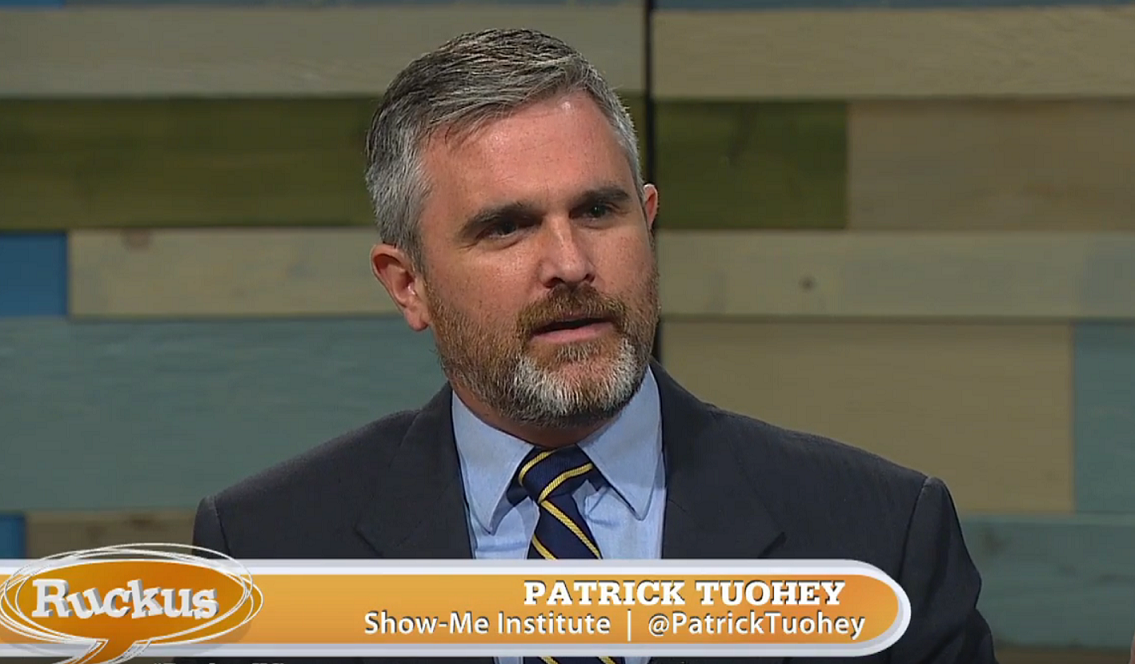
Is Kansas City getting an adequate return on its investment in economic development? We’re skeptical. The research says it is not. But one supporter of subsidized development just doesn’t care. Literally. Steve Rose tells us on KCPT’s Ruckus,I don’t care what the research tells you.” He then misidentifies the author of the study under discussion.

This shouldn’t be surprising. Much of the claims and the reporting on downtown development, the streetcar, TIF subsidies, and the like make the same mistake. They’re based on the assumption that a development that occurred after a subsidy occurred because of the subsidy. It’s a common logical fallacy, post hoc ergo propter hoc, (after therefore because of). And Kansas City is rife with it.

Consider the recent construction of a new Burns & McDonnell world headquarters building at Wornall and Bannister in Kansas City. In order to believe that economic development incentives were responsible for this project being undertaken, you have to believe that without taxpayer subsidies, Burns & Mac would never have developed the land, which sat on property adjacent to their existing headquarters and which their partner, VanTrust, already owned. Yet that is what we’re asked to believe.

Similarly, Rose and others point to the new buildings downtown and talk of a Renaissance. But the Power & Light District has not resulted in a net increase of jobs, businesses or tax revenue. H&R Block, whose building kicked off the downtown development binge, seems to be a study in obfuscation and failure. Not only is the streetcar a drain on resources, but according to Jackson County, the aggregate market value in the area around the streetcar is actually lower today than it was in 2012 and growing more slowly than the County as a whole.

The impacts of these investments are very real, resulting in the diversion of hundreds of millions in property tax revenue over the past decade away from taxing jurisdictions such as schools, libraries, and mental health funds, all of which are denied the money they need to operate. But the promised return on those investments never materializes.

As I told Rose when he said he didn’t care, if you don’t care about the research, we can’t have a discussion. Policies must demonstrate some sort of return: increased tax revenue, more jobs, an increase in population. Otherwise we’re just relying on the word of people who are lining up to take our money—and guess what they’re telling us? They want more, more, more.

Entrepreneurship in Missouri, Part 1: Techweek Masks Tough Times for Kansas City’s Entrepreneurs

Today is the final day of the Techweek conference in Kansas City. This week-long event fosters and promotes entrepreneurship and innovation, and it is considered one of the best festivals for entrepreneurship networking in the nation. In recent years, Kansas City has worked to position itself as a hub of entrepreneurship, and Techweek reinforces that image.

Unfortunately, during the other 51 weeks of the year, Kansas City (like the rest of Missouri) seems to be struggling in this regard. Since at least 2013, businesses in Kansas City have been taking a long look at whether they should remain in Missouri or move, in many cases across the border into Kansas. Greg Allen, President of Allen Financial Corporation in Kansas City, summed up the concerns facing these businesses nicely:

. . . one of the problems in the central city is we have an escalation of costs. . . . We need to be smarter about resources in the central city. We don’t need to be building more Power and Light districts.

Happily, as of this writing Allen’s company is still located in KC-MO, but as I show below, the data indicates that entrepreneurial activity is down in Kansas City and across the state since the recession ended.

A good way to measure the vitality of the entrepreneurial sector is to look at startups. Startups are the backbone of the economy, and they are the businesses we deal with every day in our local communities.

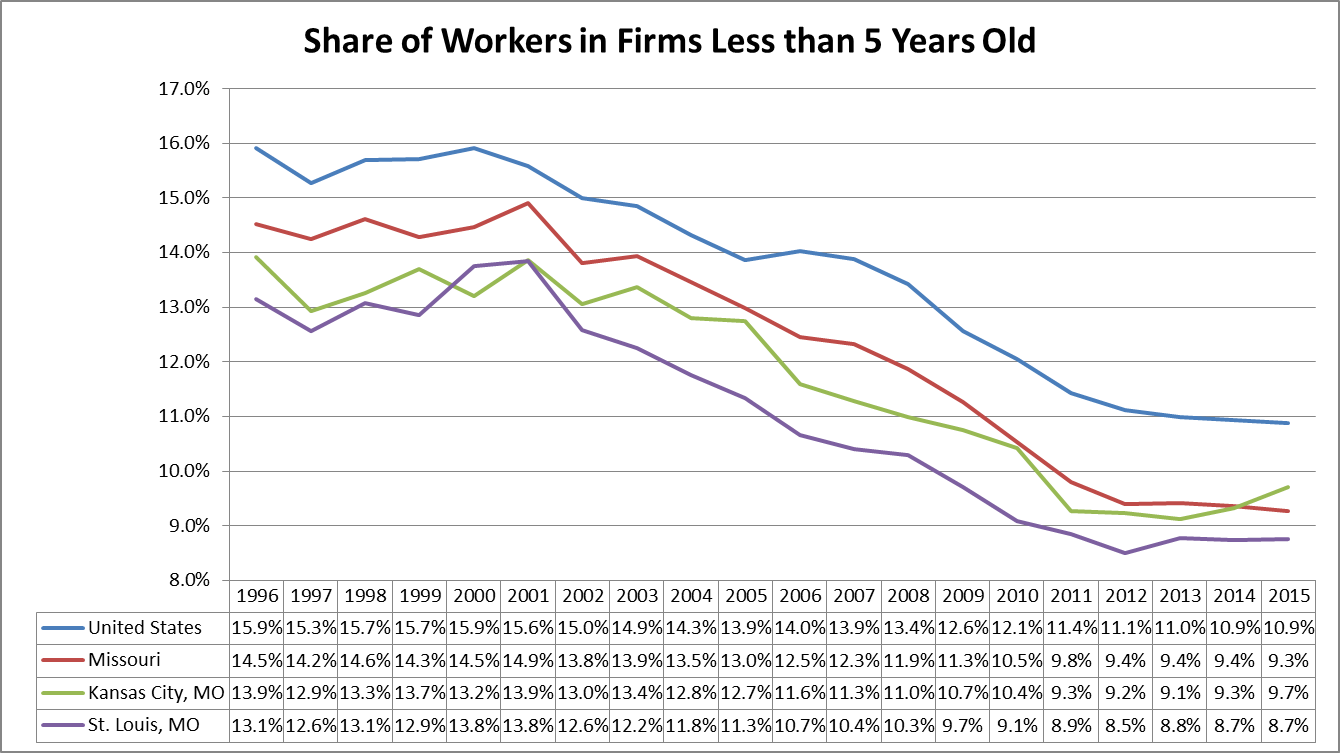
At the national level, the share of workers in firms less than 5 years old is now at 10.9%, the lowest it has been on record. The trend prevails in Missouri as well—the state now sits at 9.3%. A look at the table below shows that Missouri and its two largest population centers were growing with the U.S. average share until 2001. Since then, Missouri, has lost a larger percentage of its startup workers than the nation, and Kansas City and St. Louis have lost a larger percentage than Missouri. 

(Data from U.S. Census Bureau)


Startup firms aren’t necessarily the key to our economy—growth in long-established companies could conceivably make up for less-impressive results among startups. But if we aren’t comfortable relying on older businesses to revive our economy, it’s time to ask some questions about the environment in which Missouri’s startups operate.

We can start with an attempt to locate the problem geographically. Where in the state are we seeing the starkest drop in startup growth? Is it tied to one particular region, or are startups struggling across the state? Next week, I’ll examine entrepreneurism across Missouri’s major population centers in Part 2 of my “Entrepreneurship in Missouri” series. 

Public Information: If You Have to Ask, You Can’t Afford It. . . .

Here’s a rather uncontroversial idea: public information should be public. That is, information, records, and data collected and maintained by public entities should be open, accessible, and affordable. For example, if citizens want to know how their mayor spent public funds during a business trip, that information should be available upon request.

But some public entities don’t want their records and data to be open, accessible, and affordable. Or at least not when they can charge exorbitant fees for their data.

Show Me Institute analysts have written about instances when public agencies have tried to charge huge fees for public information. A recent case involved the University of Missouri asking for more than $80,000 for documents related to university researchers blinding and killing a half-dozen puppies.

I write this because we’ve come across two more instances (thankfully less grisly) of ridiculous fees being charged for public data.

The current culprits are Clay and Platte counties. I recently requested a simple data pull—one that would require an hour or two of time from a single clerk—and was told that it would cost me thousands of dollars. Clay County wanted $2,399 for the data, and Platte’s going rate was $1,263!

Yet Jackson County, just south of Clay and Platte counties, fulfilled an identical request for just $25. Clay and Platte counties don’t incur any more costs than Jackson County does in reproducing the data, so why do they charge 9500% and 5000% more, respectively?

The requested data is geospatial in nature (it’s about property values), and state law allows public entities to charge fees for it. Unfortunately, some public entities have used the law to impose massive and seemingly unnecessary fees on taxpayers in search of basic (and digitally available) information—information that should be easily accessible and affordable under Missouri’s Sunshine law..

There is no good reason why public entities should make nonconfidential, public information effectively inaccessible. If government is going to be accountable to residents and taxpayers, its data and records need to be readily available to those it serves. We’re grateful that Jackson County complied with the spirit of the open records laws and are hopeful that Clay and Platte counties will do the same. 


Counting Economic Development Jobs

H&R Block, which once messed up its own tax accounting, has a weird way of counting job growth. This may be the result of how eager Kansas City is to hand out taxpayer subsidies and how hesitant the city or state is to actually measure the result of the subsidy.

According to Missouri’s Department of Revenue, in 2015 H&R Block reported 2,211”new jobs” created at their Kansas City World Headquarters as a result of their TIF deal. A reasonable person might conclude that this means that there are 2,211 new jobs in addition to those that already existed, and those new jobs are the result of the taxpayer-subsidized construction. That does not appear to be the case. An April story in The Kansas City Star reports,

A year ago at this time, the company reported 90 staff cuts, mostly at its Kansas City headquarters, a result of business being down early in that year’s tax season. It had 2,200 full-time employees at the end of tax season a year ago. This round of layoffs leaves it with 1,735 full-time employees.

Block doesn’t have 2,211 “new jobs,” it has (or rather, had) 2,200 total jobs. It also claims to have retained none of the 1,493 jobs it projected it would retain. How these jobs are counted is a mystery. According to a Missouri Department of Economic Development official, the job numbers are, “self defined and self reported.” The Department of Revenue does not audit the claims. We don’t know how Block came up with their numbers. 

We looked around for other ways to measure job growth. HOK, the group that designed the Block building, report on their website that,

H&R Block’s headquarters consolidates 1,600 employees from six locations into a 17-story high-rise in downtown Kansas City.

From about 2006 through 2016 Block went from 1,600 employees to 1,735; a net gain of 135 “new jobs.” It’s likely that modest job growth would have happened without the shiny new building. Remember, taxpayers are forgoing 23 years of tax revenue, “covering 95 percent of the H&R Block headquarters project’s $308 million cost.”

That’s a lot of money to spend for a net gain of 135 jobs. Defenders of the Block deal may respond that the country has undergone a Great Recession and online tax filings have likely impacted Block’s business performance. This only underscores the reason why municipalities—led by elected officials who may have no background in investing—should not be betting taxpayer dollars in speculative developments.

Ten years after making a huge commitment of public funds, Kansas City is left with an underutilized building housing a business with anemic job growth. There are rumors that H&R Block may soon be sold to another company that could move it out of the city altogether, as happened with other subsidized companies Applebees and Freightquote. That is not an economic development track record of which anyone should be proud.

The Luxurious Intercontinental Hotel is Blighted?

For those trying to take Kansas City’s tax policy seriously, the discussion of blighting the luxurious InterContinental Hotel on Country Club Plaza isn’t making things any easier.

Blight, which is a legitimate and pervasive problem on the east side of Kansas City, is tragic. It scars communities, reduces property value and chases away private investment. The documentary “Our Divided City” demonstrates clearly the link between urban neglect, poverty, blight, and crime in Kansas City alone.

But Kansas City’s use of blight, particularly in the case of the InterContinental Hotel, doesn’t address those things. The Kansas City Star wrote that the hotel in question is seeking the blight designation so that it can create a community improvement district (CID) and collect a 1% tax. The hotel would keep the tax and use it to address “deteriorated bathroom finishes and ceilings, torn and badly stained carpets in heavily trafficked areas and guest rooms, and torn wall paper.” In short, the CID allows them to create and collect a tax that they don’t have to report as part of their basic rate. But it will still be charged to every customer—tacked on at the end of every bill like any other tax, even though the money will stay with the hotel. One Marriott general manager has said that if the InterContinental’s request is granted, other hotels will seek to follow suit. And why not? It’s an opportunity to charge customers an extra 1% more than the rates they advertise.

It's difficult enough to look at a hotel as opulent as the InterContinental and think blight. Now the hotel wants to charge customers an extra 1% that the city will never see, and call that a tax. Kansas Citians, along with those who visit the city and stay at the InterContinental, deserve better. The hand-wringing and nose-holding of the past is not sufficient. Kansas City needs a more open and fair tax policy.

Support Us

The work of the Show-Me Institute would not be possible without the generous support of people who are inspired by the vision of liberty and free enterprise. We hope you will join our efforts and become a Show-Me Institute sponsor.

Donate
Man on Horse Charging