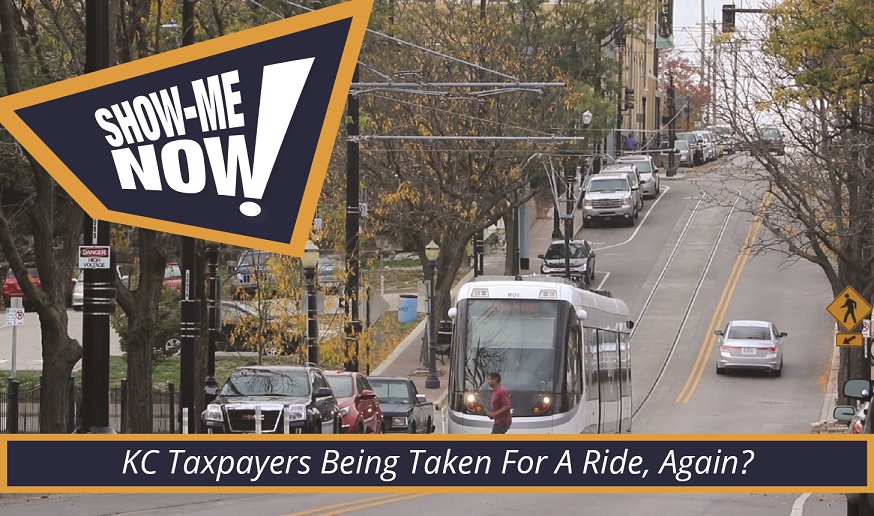
Kansas City’s aging infrastructure is in need of nearly $1 billion in upgrades, but streetcar advocates are pushing for a $250 million expansion line. Should a new streetcar line really be a top priority?

Kansas City’s aging infrastructure is in need of nearly $1 billion in upgrades, but streetcar advocates are pushing for a $250 million expansion line. Should a new streetcar line really be a top priority?
With the unexpected result of the Presidential election and big-ticket statewide races, I don’t blame you if you missed the result of the Amendment 3 initiative petition.
We here at the Show-Me Institute were very interested in Amendment 3 because the issue was so complex and multifaceted. From the funding mechanism (cigarette taxes) to the policy it would support (early childhood education) there was more to the question than met the eye.
Now the people of Missouri have spoken, and by a 60% to 40% margin (as of this moment), they soundly rejected Amendment 3.
There is much parsing of this election to be done, but I do want to offer a couple of quick reactions:
I don’t think we need to close the door on pre-K, though my colleague Emily Runge’s piece earlier this week has definitely caused me to temper enthusiasm for it (which I didn’t have a great deal of to begin with). We do need to think long and hard about how we structure it and pay for it. As we argued in 20 for 2020, a voucher-based system that puts students and parents in charge is the best way to structure pre-K if we’re going to do it, and we should be skeptical of any plan that does otherwise.
A decade ago business boomed as the Crestwood shopping center annually brought in more than $1 million in sales tax revenue for the city. Today the mall is closed, and the city says that without a property tax increase it will have to lay off staff, affecting public safety response times and infrastructure maintenance. Before authorizing a tax hike, voters should consider the totality of Crestwood’s tax policy.
Earlier this year Crestwood officials granted the owner of the former Crestwood Plaza $25 million in tax incentives to redevelop the 47-acre site into a mixed-use project (meaning office, retail, and residential space). Incentives such as these can hollow out a city’s tax base in cases where development would have taken place anyway, and research shows this is often the case. If the city is in a hole, why is it diverting its tax revenue to a developer?
This is exactly what Lindbergh School District officials are wondering. The district’s superintendent has spoken out against the use of public subsidies for the development, because the tax incentives awarded to the Crestwood shopping center project will result in the diversion of public dollars away from the schools.
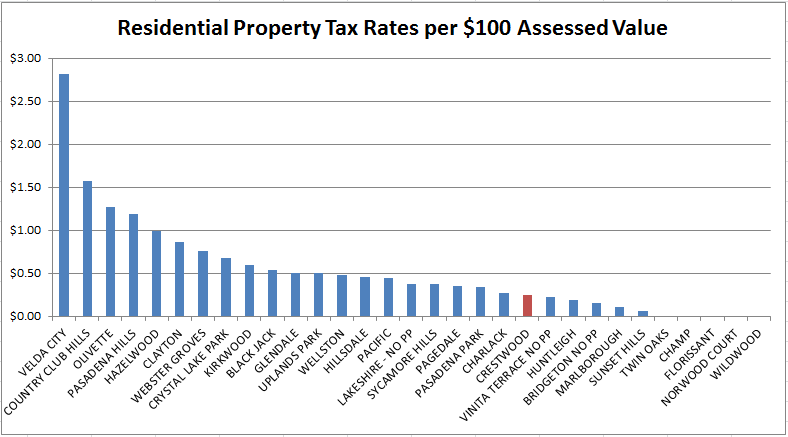
Raising the city’s property tax could also have adverse effects down the road. While not the only consideration, taxes are a variable taken into account when someone is deciding where to live. Crestwood’s residential property tax rate of $0.25 per $100 assessed value is fairly attractive compared to other Saint Louis County municipalities. This appears to be a competitive advantage for attracting residents that Crestwood would do well to maintain.
When residents of Crestwood are asked to what degree they would support a tax increase, perhaps they should ask if giving away millions of dollars to a developer—money that might otherwise be spent on fundamental city services—is the wisest use of the city’s funds.
Over the last couple of weeks, I’ve had the chance to talk about my paper Amendment 3: The Good, The Bad, and the Ugly on the airwaves and in person all across the state.
Many people have been drawn to the discussion because of the unique political situation surrounding Amendment 3. It is a cigarette tax designed to fund pre-K education that is supported by tobacco companies and opposed by the American Cancer Society Cancer Action Network. How can you not be interested by that?
But let’s cut through the fog. Politics are interesting and might get folks hooked, but ultimately it’s the policy that should concern us.
Backers have some solid reasons to support the proposal. Funds will be made available to both public and private providers, which would, in theory, provide a wider set of options than if funding was restricted solely to traditional public schools. Additionally, the drafters of the Amendment have taken steps to try and insulate the program from the forces of the educational status quo by requiring funds generated by the tax to be kept separate from general revenue and be managed by an independent board.
That said, there are reasons to be concerned about this proposal. While insulating the board from the pressure of interest groups is a laudable objective, it could mean that the board is less accountable to taxpayers. The amendment language also states that the board needs to be “equitable” in its distribution of funds. If you’ve even casually followed discussions of education finance in Missouri and Kansas, decades-long court cases can be fought over exactly what “equitable” means. Is this just opening a similar can of worms?
And all of this dances around the more central question: Even if we think that pre-K is something worth supporting, is a tax on cigarettes an appropriate way to fund it? Cigarette taxes are extremely regressive. Poor people are far more likely to smoke than their richer peers, meaning that the poor will bear the brunt of the tax increase. Smoking is also on the decline, risking future revenue and raising the possibility that services will be cut or pressure will be put on the legislature to divert general revenue to subsidize the program.
For someone who doesn’t smoke but wants pre-K for their kids, Amendment 3 might seem to offer something for nothing. Unfortunately, nothing is free in this life, and someone is going to have to pick up the tab. Whether or not that “someone” should be a group disproportionately made up of economically disadvantaged people is worth considering.
Once again, the economic border war between Kansas and Missouri has heated up. This time, the American Royal, a Kansas City Institution, will be moving from the West Bottoms in Kansas City, Missouri, to Wyandotte County, Kansas. In an op-ed appearing in today’s Wichita Eagle, I argue that the financing behind this move is questionable. Here’s an excerpt:
Kansas’ $80 million contribution to the project is about double what American Royal was publicly trying to get out of Kansas City, Mo., officials just two years ago to keep the Royal in the city’s West Bottoms.
But did Kansas even have to “build it” with taxpayer money to entice the American Royal to move?
Read more at: http://www.kansas.com/opinion/opn-columns-blogs/article112668553.html#storylink=cpy
Missouri can learn a lot from the successes and failures of other states—and this applies to Amendment 3, too. Before voters weigh whether or not to approve a massive expansion to pre-K funding on November 8, they might want to examine the research done on state-funded pre-K programs in states like New York, Oklahoma, Tennessee, and Georgia.
Or, better yet, they may consider how little research there is on the matter. According to a recent article by Haley Glatter in the Atlantic, there are very few studies that thoroughly examine state-run and state-funded pre-K programs. Moreover, these studies are inconclusive on whether or not pre-K offers lasting benefits.
In Georgia and Oklahoma—states with universal pre-K programs—there is evidence that pre-K has reduced achievement gaps. The jury is still out in New York, which established universal pre-K only two years ago. Tennessee, on the other hand, implemented targeted pre-K for low-income children. Positive results were evident when these children entered kindergarten, but the benefits began to fade by first grade. By third grade, these students were performing worse than other students on statewide assessments.
Here are a few things we can take away from these states’ experiences:
One of the lingering questions about Amendment 3 is what exactly the pre-K program it creates will look like. In his recent analysis of Amendment 3, the Show-Me Institute’s Michael McShane writes:
To date, it simply isn’t clear what the regulations for participating schools will be. In one sense, this uncertainty means we should probably reserve judgment, but in another it makes it hard to support a program when we don’t know what that program will ultimately look like.
On the one hand, it makes sense for us to gather as much information as we can about the effectiveness of pre-K programs before Missouri designs a program of its own. But then, does it also make sense to wait until we have a well-researched plan in place before amending the constitution and investing such a significant amount in early childhood education?
The Show-Me Institute’s Chairman Crosby Kemper III appeared on KCPT's Ruckus on November 3 to discuss American Royal’s move to Kansas and Southwest Airlines' push for a single terminal at KCI. Click on the link to watch the entire show.
Last week, Heterodox Academy released a ranking of the top 150 universities in America in terms of commitment to viewpoint diversity. Mizzou finished tied for dead last.
Heterodox Academy is a collection of university professors committed to supporting intellectual diversity and free speech on campus. Its ringleader is Jonathan Haidt, a social psychologist and professor at New York University. Haidt’s work focuses primarily on business ethics, but increasingly he has become known for his efforts to promote civil debate and ideological diversity in the academy.
Heterodox Academy’s ranking relies on four main metrics. First, it grades schools on whether they have endorsed the University of Chicago’s principles on free expression. Second, it adds the Foundation for Individual Rights in Education’s rating of the school’s speech code. Third, it uses the Intercollegiate Studies Institute’s rating of openness to conservative and libertarian students from its guide Choosing the Right College. Finally, it notes any relevant events related to free speech on campus since 2014.
The top five schools in the ranking are the University of Chicago, Purdue, Carnegie Mellon, William and Mary, and George Mason.
The bottom five are the University of Oregon, Mizzou, Rutgers, Northwestern, and (ironically, given Haidt’s employment there) NYU.
Mizzou was dinged for not adopting the University of Chicago’s speech code, for being rated red (the lowest possible distinction) by FIRE, and red (the lowest possible distinction from ISI). It also lost points for University of Missouri police asking individuals who witness incidents of hateful and/or hurtful speech to call the campus police station (or 911), banning student protests, the censorship of students, and for efforts to limit press access on campus.
Debate on college campuses is healthy. As Haidt and his colleagues have demonstrated, ideological diversity leads to more interesting and useful research and helps guard against errors driven by groupthink. Mizzou's spot at the bottom of this list is an embarrassment. The university should take the criticism seriously and work to make campus a more welcoming place to people of different viewpoints.
In the last few months Americans found out that several insurers, including major players Aetna and United, would largely exit the Obamacare exchanges in the coming year. In most Missouri counties, that leaves only one insurer providing any kind of exchange coverage at all. As I pointed out in Forbes, Missouri has been more or less divvied up among Blue Cross Blue Shield insurers, with effective exchange monopolies for both in many regions of the state.
Well, it's not even 2017 yet, and one of the BCBS companies is giving Missouri health insurance customers something to dread in 2018.

In other words, Missouri insurance customers are already at risk today… and may be at even greater risk in the very near future, especially if Anthem exits as it's contemplating.
There are ways to make health care in this country more affordable and accessible, but unfortunately, Obamacare isn't that solution. It's time to try something different.