Will Streetcar Funding Dry Up?

Slate, a left-leaning news site, considers the implications for transit of Trump’s naming of Elaine Chao to head the Department of Transportation. It concludes,

the investments she favors may more quietly reflect conservative tenets like heavy highway spending, disregard for energy efficiency, and the denial of funds to transit and pedestrian projects in densely populated areas.

This should not be surprising, especially for streetcar proponents. But it should be alarming for them. As my former colleague Joe Miller wrote in 2014,

What streetcar advocates really have to fear is not the defunding of urban transit, but the defunding of streetcars in favor of other forms of transit. Past administrations favored transit projects that reduced congestion or improved mobility, so streetcars received few federal dollars. The Obama administration’s desire to use transit projects to create “livable communities” has made federal streetcar funding possible.

Mind you, overall Federal transit funding may not change much. But as Slate pointed out, the Obama Administration was an outlier on how the funding was spent:

Obama’s first transportation secretary, Ray LaHood, for example, was a major proponent of diverting DOT spending away from highways (many of which are boondoggles, the least of which costs many times as much as the hated streetcars) to other transportation and infrastructure projects. He supervised the creation of the TIGER grant program, which injected billions in federal money into local, multimodal projects, and was reauthorized repeatedly by Congress.

Recall that in 2013, TIGER funding provided $20 million toward the streetcar project in Kansas City. And according to the Kansas City Regional Transit Alliance (KCRTA), the proposed $227 million Main Street extension of the streetcar assumes up to $114 million in federal funding. Fourteen million of that is from designated regional funds (STP/CMAQ), which means other regional transportation projects would have to wait if streetcar expansion moves ahead. The remaining $100 million now may be pie-in-the-sky.

In July 2014, Mayor James campaigned for the first ill-fated streetcar extension line by saying, “We really have a once-in-a-lifetime opportunity here.” Considering the President-Elect’s Secretary choice, he may have been right. It remains to be seen if he and other streetcar supporters believed that rhetoric.


The Indiana Carrier Deal: State Cronyism Shouldn’t Be Nationalized

This Tuesday Indiana state officials announced that a Carrier manufacturing plant located there would not shut down after all, despite months of threats from the company to do just that. Current Indiana governor (and vice president-elect) Mike Pence had made the company's retention a top priority, and as one might imagine, the final deal was cut with Pence's running mate, President Elect Donald Trump, waiting in the metaphorical wings. Instantly, it was heralded as good policy, and a policy victory, for the incoming administration.

That view is wrongheaded on both counts, and I certainly hope the Carrier "deal" doesn't presage future deals the President Elect will be cutting over the next four years. The reason is straightforward. In return for not following through on its threat to move, Carrier will receive $700,000 per year from the state of Indiana, for at least 10 years. If that kind of cronyistic deal sounds familiar to you, it should; the Carrier agreement is like many of the "deals" to "save or create jobs" that have been made, and that we have criticized for years, here in Missouri. As one economist observed after the Carrier deal was announced, "[e]very savvy CEO will now threaten to ship jobs to Mexico, and demand a payment to stay." Yup.

Even with the financial gift from Indiana, it doesn't sound like every job will be staying at the plant anyway, or at another nearby facility that was also slated to be closed. In return for the money, Carrier said it will keep about 1,000 jobs in Indiana, but that about 1,300 Indiana jobs were going to be sent to Mexico anyway, despite the public giveaway.

We have to reiterate: It is not the role of the government to pick winners and losers in the tax code, whether the tax code in question is at the local, state or federal level. More to the point, allowing powerful companies to issue threats as a way to compel public financial support for their private operations is a road policymakers should not go down. Most employers could never dream of getting such generous concessions, and if the tax burden needs to be reduced to make one big company profitable, policymakers, whatever their level of government, should instead work to reduce the tax burden for all companies—large and small, politically connected or not.

Indiana should not export its corporate welfare to Washington DC. If it does, it will be to the detriment of the American public and taxpayer interests.

Rationalizing a Downtown Soccer Stadium

Sometimes we want something so badly we’ll tell ourselves just about anything in order to get it. Psychologists and philosophers call thought patterns like this “rationalizing”—justifying actions or beliefs with questionable explanations. Rationalizing leads to poor public policymaking.

Pundits and boosters of a downtown Major League Soccer (MLS) stadium appear to be doing some serious rationalizing. Consider this: one potential ownership group, SC STL, wants taxpayers to cough up $80 million to help pay for a stadium. Another ownership group, City Foundry, has offered to cover the $80 million in public assistance if they can have some stake in team ownership. But soccer boosters are worried that discord between these two ownership groups might hurt Saint Louis’s chances of landing an MLS team. As a result, commenters have begun criticizing City Foundry, a group that’s willing to bear the massive burden SC STL wants to place on the public. MLS has publicly aligned itself with SC STL and plans to ask taxpayers to help pay for a stadium, thus providing soccer boosters a (very expensive) “bird in the hand.” But is this $80-million bird so precious that we should dismiss a proposal that could result in a stadium built without taxpayer money? Are we certain that City Foundry’s involvement would cause MLS to take its soccer ball and go home? City Foundry only made its proposal less than a week ago—isn’t their offer worth a serious look when $80 million is at stake?

Here are some facts that aren’t easy to rationalize away: Stadiums are not a good investment vehicle for public dollars. They don’t yield economic returns for local communities. They don’t help cities financially. At best, stadiums simply shift existing spending patterns, often at the cost of huge public expenditures. At worst, publicly-funded stadiums drain resources away from basic city services, and sometimes even bankrupt cities. The benefits of having a professional sports team are not economic; they are social or civic. Yet, some people badly want an MLS team, and see SC STL as the best way of getting one, so they’re willing to throw principles of good policy to the wind.

Choosing to fund a sports stadium with public dollars when private capital is available isn’t just bad public policy; it is taxing the public for the benefit of a wealthy few.

Public Welfare Spending Growth

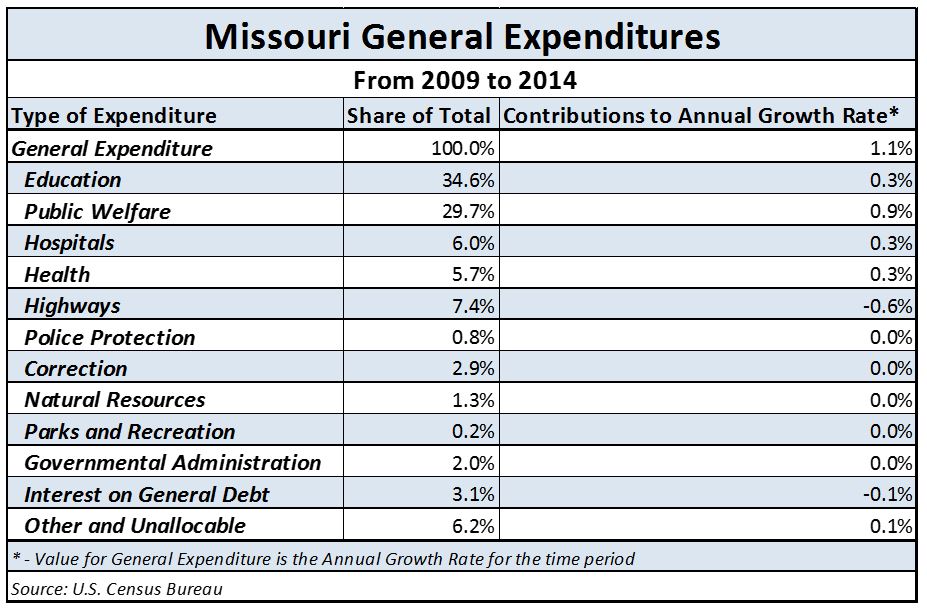
Since the passage of the Affordable Care Act, public welfare and healthcare state spending have become the largest contributors to Missouri’s general expenditure growth.  Public welfare spending by itself, which includes Supplemental Security Income, Temporary Assistance for Needy Families, and Medicaid, now accounts for 34 percent of growth in Missouri’s general expenditure spending since the recession ended.

For most states, education remains as the biggest slice of pie for general expenditures, and for Missouri this is still the case. However, education is no longer the strong magnet of state dollars it once was.

The table below, from the U.S. Census Bureau, shows that while education still commands the largest share of Missouri’s general expenditures, spending on public welfare has increased at a faster pace than spending on education since the 2008 recession.

Some takeaways from this table:

  • Education expenses are almost 35% of total expenditures, but only grew (on average) by 0.3 percentage points annually from 2009 to 2014.
  • Public welfare expenses make up nearly 30 percent of total expenditures, but are the biggest culprit in the growth of total spending, with expenses rising at an annual rate of 0.9%.
  • If we combine public welfare spending with Hospitals and Health spending, then spending on healthcare and social assistance would account for 42 percent of general expenditures.

As we approach the 2017 legislative session, these trends in spending can inform policy decisions. If public welfare spending growth continues unabated, other services—like education, transportation, and public safety—might find dollars increasingly hard to obtain.

Microhospitals Booming-But Not in Missouri, Thanks to Certificate of Need

We often preach that boosting the supply of health care services is a necessary component of any serious and significant health care reform. Indeed, we published a whole paper about its importance last month. And along with licensure reform—to which most of that paper was devoted—doing away with the Missouri's Certificate of Need (CON) laws for hospitals would be a huge supply-side reform and victory for the state's patients. 

CON laws limit where many health care facilities can open in Missouri, effectively carving out monopolies and oligopolies for incumbent providers. Sometimes the negative consequences of CON aren't obvious to patients because new providers don't even bother entering a CON health care market, so customers never see what they aren't getting. But for patients here in the Kansas City area, the difference between a CON state like Missouri and a non-CON state like Kansas is becoming a lot clearer as new, smaller health care operations are exploding in Kansas—but not here in Missouri.

It’s the overnight beds that make micro hospitals different from free-standing ERs rooms that HCA Midwest Health and Shawnee Mission Health introduced years ago to the area.
 
The overnight beds also help explain why the micro hospital burst in the area will be concentrated in Kansas rather than Missouri.
 
To add overnight beds in Missouri, hospitals must prove the greater bed capacity is needed by going through an expensive and lengthy Certificate of Need process with the state.
 
Around the country, micros are blooming in Colorado, Texas, Nevada and Arizona—states like Kansas that don’t require Certificates of Need.
 
Other industries have their own versions of CON where the anti-competitive nature of such laws is arguably more overt, like in the case of movers. As the Pacific Legal Foundation observed,
 
…most states have laws like these—called Certificate of Public Convenience and Necessity or Certificate of Need laws—covering a variety of industries, including railroads; gas pipelines; limousine and taxi companies; ambulances; buses; and, of course, moving companies. By my count, 23 states now have these “CON Laws” on the books when it comes to moving companies.
 
Fortunately, the landscape for such legislation is turning decidedly negative. Four years ago, Missouri repealed its CON law for movers; it should do the same with hospitals in 2017. If Missouri doesn't, other states will benefit from our state legislators' inaction, and Missouri patients will continue to be disadvantaged for it.


Well, At Least It’s Not a Check

In a perfect world, municipalities would not need to offer tax incentives to attract investment. That was the consensus on November 15 at the Clayton Board of Aldermen’s meeting concerning Centene’s proposal for $75.6 million in tax abatement over the next 20 years. Unfortunately, policymakers don’t see us as living in a perfect world. They argue that if the city needs to forego a few million in revenues that would otherwise help pay for municipal services, so be it.

Before the board voted unanimously in favor of subsidization, each member gave a brief speech explaining his or her decision. The majority opinion was that tax incentives are not ideal, but that Missouri’s current economic environment demands them. Tax incentives for large projects like Centene’s have become the norm, so withholding the expected tax breaks means running the risk of losing investment to other regions.

But “we’ve always done it that way” is a dangerous line of reasoning when past decisions have negatively impacted cities, and the research shows that economic development subsidies are often used unnecessarily. They have little positive impact on the region’s economy, perhaps because they divert revenues away from crucial municipal services like schools. This is hardly a pattern we should aim to continue.

Clayton’s office vacancy rate is half that of St. Louis City, and Clayton is hardly lacking investors. This, along with the fact that last year Centene placed 4th on Fortune’s list of the nation’s fastest-growing companies, calls the need for subsidies for Centene into question.

Clayton officials justified the use of incentives by saying that no physical checks are written to Centene. If the city doesn’t give any money to the development, then they are not losing out. This reasoning fails to account for the millions of dollars in lost revenue from taxes that will go to the developer instead of into the city’s tax base.

It’s disappointing that the board felt, despite their distaste for tax incentives, that today’ market environment demands subsidization. Cases like this remind us of the need for reforms that can help create a more growth-friendly environment in the Saint Louis region and across Missouri.

Support Us

The work of the Show-Me Institute would not be possible without the generous support of people who are inspired by the vision of liberty and free enterprise. We hope you will join our efforts and become a Show-Me Institute sponsor.

Donate
Man on Horse Charging