Debating GO Bond Policy

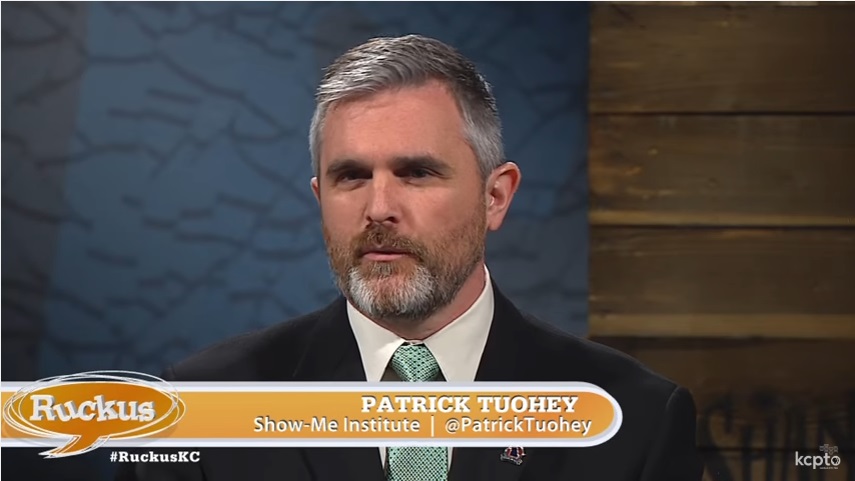
We were disappointed to learn that Mayor Sly James has turned down an offer to debate the Go bonds issue with us.  Nick Haines had extended the invitation for his KCPT program Week in Review. This is an important issue worthy of public debate.

Kansas City voters are being asked to consider borrowing $800 million dollars by issuing bonds backed by an increase in property taxes that will last 40 years. The campaign in favor of the proposal has raised hundreds of thousands of dollars from some of the biggest corporations and special interests in Kansas City. The Mayor and members of the City Council have spoken at town hall meetings and on radio and television. And yet serious questions remain.

Show-Me Institute analysts have been skeptical of the city’s GO bond claims for some time. We were the first to point out that the city was proposing 40 years of debt (not 20), the first to expose the city’s misleading tax assumptions, and the first to point out that the city will be able to divert general revenue funds to other unrelated matters.

A policy debate is nothing to fear. For example, on March 20, Councilman Scott Wagner and I discussed the GO bond at the Indian Mound Neighborhood Association. The talk was professional, and I am confident that the room full of attendees were pleased to have both sides represented.

The public only benefits from a government that is transparent and accessible. We reiterate our invitation to the Mayor. If his schedule doesn’t permit the particular time and place offered by KCPT, how about another time and place?  With $800 million at stake, the decision voters make on the GO bond should be an informed one. We can think of no better way to educate Kansas City residents than a debate, and we would welcome an opportunity to join with the Mayor to present two different perspectives on this important issue. 

Coming Together for Free Speech

In an earlier post I argued that Dr. Charles Murray’s assault at Middlebury College might mark a turning point in the battle for free speech on college campus. As if on cue, two leading American intellectuals published an open letter supporting free speech and encouraging other academics to sign it.

Robert George and Cornel West provide a great example of the kinds of open intellectual exchange that should happen on college campuses. For over a decade the two have team-taught a course at Princeton that examines important works of political philosophy and offers students a chance to see these works from George’s right-leaning and West’s left-leaning perspective.  (If you want some indication of how this might look, check out this video of George and West talking about the purpose of a liberal education at AEI last fall.)

The letter, now signed by hundreds of scholars, is worth reading in full, but I do want to highlight two paragraphs that I found especially compelling:

None of us is infallible. Whether you are a person of the left, the right, or the center, there are reasonable people of goodwill who do not share your fundamental convictions. This does not mean that all opinions are equally valid or that all speakers are equally worth listening to. It certainly does not mean that there is no truth to be discovered. Nor does it mean that you are necessarily wrong. But they are not necessarily wrong either. So someone who has not fallen into the idolatry of worshiping his or her own opinions and loving them above truth itself will want to listen to people who see things differently in order to learn what considerations—evidence, reasons, arguments—led them to a place different from where one happens, at least for now, to find oneself.

All of us should be willing—even eager—to engage with anyone who is prepared to do business in the currency of truth-seeking discourse by offering reasons, marshaling evidence, and making arguments. The more important the subject under discussion, the more willing we should be to listen and engage—especially if the person with whom we are in conversation will challenge our deeply held—even our most cherished and identity-forming—beliefs.

A good lesson for all of us.

Kansas City’s Food Desert Insanity

Kansas City has started to demolish the vacant grocery store at Linwood Blvd. and Prospect Ave. and will subsidize the construction and operation of a Sun Fresh grocery store at the same location to address what urban fabulists have dubbed a “food desert.” We’ve written about this issue here and here. Even amid scores of bad municipal policies, this one stands out.

First, food deserts themselves turn out to be a figment of the imagination. The USDA has published research indicating that people do not rely on the closest store to them. The Star makes this point by interviewing a woman who currently travels well past the closest market for her groceries. She may patronize the new grocery store when it opens, but she has other choices.

Second, the store that was in this location closed ten years ago. If there wasn’t enough private interest to keep it open at the time, or to renovate it while it sat empty for a decade, why does anyone think it will work now? (Besides the fact that taxpayers are subsidizing the rent to the tune of thousands of dollars a year.)

Third, the project keeps getting more expensive. It was estimated at $11 million in 2015. $15 million in 2016, and the latest estimate is $17 million.

In a city that struggles to offer basic services, this is one expensive misadventure that could have been avoided. 

Can the Kansas City Streetcar Expansion Be Built Even If It Wins?

The Kansas City Star published a story the other day which examined the new budget proposal from the Trump administration. The piece stated:

Trump’s budget, which would go into effect in October if Congress approves it, would eliminate the Transportation Investment Generating Economic Recovery (TIGER) grant program, a nearly $500 million grant program run by the U.S. Department of Transportation.

The streetcar expansion plan is reliant on federal support. According to a 4-page document put out by the Kansas City Regional Transit Alliance, $100 million of the $227 million expansion cost to expand the downtown streetcar line would be provided by the federal government through the Small Starts program. But that program is also facing a funding freeze:

The New Starts program, which helps fund local transportation projects costing over $300 million (a sister program, Small Starts, assists with projects under that threshold), would be frozen. New applications to the program, which currently has $2.3 billion to spend annually through 2020, would be outright rejected, limiting any new grants and placing the onus on local and state government to fund additional projects. [Emphasis added.]

This means the Kansas City request for streetcar money could be rejected outright. And that money is required for the extension to take place. According to the Kansas City Regional Transit Alliance,

The project will require federal grant funding, and the applicant and recipient would be the City just like with the starter line. If federal funds are secured, public involvement in the engineering and design is required.

The language from the court ruling allowing the new transportation development district (TDD) throws another wrench in streetcar advocates’ plans: no taxes or assessments can be collected from within the district until enough external funding—in this case federal funds—are available. The Trump administration has made the availability of federal funds highly unlikely. Congress could seek to continue federal New Starts funding, according to Rich Sampson of the Community Transportation Association of America, but it will be an uphill climb. And even if streetcar funding is provided by Congress, the administration may choose not to spend it.

Voters are being asked to take the risk of expanding the TDD and levying on themselves a special property tax assessment and a sales tax contingent on the Trump administration coughing up 40% of the total streetcar expansion cost. Laying aside the merits of the policy at hand, voters should be wary of approving something that is dependent on a funding source that may be little more than wishful thinking.

Missing: Credible Evidence that Stadiums Grow the Economy

What do leprechauns, ghosts, and economic benefits from sports stadiums all have in common? They lack any substantive evidence for their existence.

Would-be owners of a Saint Louis Major League Soccer team are trying to persuade the public to part with $60 million so they can build a new stadium just west of Union Station. In their effort to woo tens of millions of dollars away from an already over-burdened public, proponents and officials are promising a host of economic benefits if the stadium is built.

Unfortunately, the vast majority of economists can’t find any evidence that these promises will be kept—and Saint Louis is definitely the wrong place to start looking. Despite hundreds of millions of public dollars for the convention center and dome, downtown Saint Louis continues to languish. In fact, the areas adjacent to the dome are mostly empty, and development on Washington Avenue is propped up mostly by decades of subsidies through tax increment financing, abatement, and special sales tax districts. Why should Saint Louisans think that “investing” in a new stadium is anything but doubling down on the same-old, wrongheaded policies?

Stadium boosters often come armed with reports predicting their projects will deliver prosperity in a handbasket. These promotional studies completed by for-hire economists will be packed with predictions of new jobs, urban revitalization, and boosted tax revenue. But as economists Dennis Coates and Brad Humphreys explained in a 2008 Econ Journal Watch article on the topic, such promotional studies suffer from “a long list of methodological and theoretical problems.” And as far back as 2000, John Siegfried and Andrew Zimbalist wrote in the Journal of Economic Perspectives that studies cited by developers “inevitably adopt unrealistic assumptions regarding local value added, new spending, and associated [economic] multipliers.” In short, we should be suspicious of “studies” commissioned by stadiums proponents for stadium proponents.

The scenarios presented by stadium boosters aren’t just fanciful—they are in direct conflict with expert economic opinion. Eighty-five percent of economists are in favor of eliminating subsidies for stadiums, while only 5% are against jettisoning such handouts. Consensus like this exists virtually nowhere else in the economic literature. And why are economists all singing the same tune? Because the economic benefits touted by stadium proponents are as elusive as Bigfoot. As Coates and Humphreys put it, “No matter what cities or geographical areas are examined, no matter what estimators are used, no matter what model specifications are used, and no matter what variables are used, articles published in peer reviewed economics journals contain almost no evidence that professional sports franchises and facilities have a measurable economic impact on the economy.”

If your doctor tells you a medicine won’t cure your illness, you don’t go purchase five bottles of it. If your financial advisor warns that a company is far too risky for its potential payoff, you don’t buy a majority share in it. And if economists counsel against subsidizing a stadium in order to grow the economy . . . well, you see the pattern here. Before committing millions of taxpayer dollars to a new soccer stadium, Saint Louisans should demand something more compelling than “analysis” from the only people these stadiums have been shown to benefit—the developers themselves.

The Unlikely Promises of Questions 1, 2, 3, and 4

Kansas City voters face four questions on the April 4 ballot that could commit them to years of higher taxes. All four are very unlikely to live up to their supporters’ claims.

City leaders have been speaking far and wide about the general obligation (GO) bond before voters (Questions 1, 2 and 3). Their presentations focus on what could be done with the money. But often overlooked are two important points: the city’s assumptions about cost, and how the City Council spends money.

At a public meeting in Waldo, Finance Department Director Randy Landes said, “the average impact to the property tax owner . . . is an $8 increase each year.” Other council members have said largely the same thing. A reasonable listener would conclude that the cost is only $8 per year. But that would be incorrect.

As detailed in the Star’s March 11 story, campaign literature understates the cost to taxpayers. The GO bond would saddle taxpayers with 40 years of debt. After the last bond payment was made in 2056, the owner of a $140,000 house and a $15,000 car would have paid $4,152.98. The owner of a $100,000 house and $15,000 car would have paid $3,154.24.

The city reaches their low numbers by doing two questionable things. First, they include in their estimates the existing bonds that will be paid off over the next 20 years. But those levy reductions will happen regardless; including them only serves to confuse the issue. Second, the city assumes that there will be no increases in the property tax. Current city leaders have no idea what subsequent councils will do, but it’s difficult to imagine the levy remaining the same for the next four decades. That assumption is misleading.

Another concern is whether the city will divert these taxes to pet projects. City leaders are quick to point out that the money raised by these bonds is required to go to streets and sidewalks. But that isn’t the case with general fund money that currently funds these needs. Councilman Lucas admitted in the meeting, “If we spend important dollars on this bond obligation, we’re able to free up funds to attack other vital issues.” If the bonds are passed, the city will be able to reallocate general funds to projects other than streets and sidewalks.

A more accountable and transparent approach would be to issue smaller bonds and be very explicit about how bond and general fund money will be spent. Voters could then assess each project before committing to a subsequent bond. On April 4, voters risk funding the same sort of misspending that put Kansas City in the mess we have now.

Also on the ballot is Question 4, a measure to increase the city-wide sales tax by one-eighth of one percent to fund economic development projects on the East Side.

No one can dispute that decades of neglect from City Hall—combined with the past ten years of generous taxpayer subsidies to wealthy developers to build in economically successful parts of town—have devastated Kansas City’s urban core. These subsidies not only help steer development away from the East Side, but they also divert resources from basic services such as public education, libraries, and health services that are vital to these communities.

While supporters of Question 4 are to be congratulated for wanting to address economic injustice, one more tax-funded subsidy will not solve the problem. In fact, one more increase in an already-high sales tax likely will do more harm.

Questions 1 through 4 seek quick fixes to serious financial challenges in Kansas City. Without substantive long-term solutions to the problems that got us here, voters risk spending more to get the same outcome we have in the past.

Criminal Justice Reform: Addressing the Costs of Incarceration

Missouri has a criminal justice problem. While the spike in homicides in Kansas City captures a lot of attention, as it should, it isn’t our only challenge. Rates of property crime and violent crime in Missouri are higher than the national average, and our state has one of the highest incarceration rates in the country. Research suggests that Missouri can adopt policies that will reduce recidivism and prison costs.

According to the National Institute of Corrections, “The crime rate in Missouri (2015) is about 18% higher than the national average rate.” Missouri is also eighth in the nation in its incarceration rate, imprisoning 530 people per 100,000 population in 2015.

Then there is the cost. The Department of Corrections budget has grown from $580 million in 2006 to $710 million in 2016. In the last five years that growth has been driven chiefly by adult institutions. The only good news in Missouri’s prison data is that as of 2012, Missouri paid $22,350 each year per inmate, well below the national average of $32,142.

Missouri is not alone in struggling with crime and incarceration rates. High crime rates in the 1970s led many state legislatures to adopt harsh sentencing guidelines, including mandatory minimum sentences for various crimes. The states embarked on “throw the key away” crime control measures that increased the prison population at great public expense. But research has shown that there are diminishing returns to harsh sentences—they don’t always result in a reduction in crime. States have been reexamining their sentencing laws, and the results are promising. Early research from around the country suggests that some criminal justice reforms, such as those that address mandatory minimum sentencing, can reduce crime rates and save states money. The American Legislative Exchange Council (ALEC) has published an excellent paper on the matter.

According to the Missouri Department of Corrections’ just-released Profile of Institutional and Supervised Offender Population (page 33), of the 30,754 members of the prison population, 41 percent are there for either nonviolent crime (7,377 inmates) or for drug-related crimes (5,403 inmates). These two offender groups, incidentally, are the fastest-growing populations since 2011. Imagine how much Missouri could save if courts had the flexibility to sentence these nonviolent offenders to treatment programs or probationary periods prior to locking them up—while still retaining the ability to treat violent or habitual offenders harshly.

Furthermore, imagine the benefit in human capital if nonviolent and drug offenders were sentenced to treatment or probation instead of being warehoused in state institutions with few opportunities for self-improvement.

The model reforms ALEC recommends are known at the Justice Safety Valve Act, and have been introduced in the Missouri general assembly as HB1037 and HB1046. If these reforms can do what they have done elsewhere—protect Missourians while avoiding unnecessary sentencing and costs—they are well worth consideration.

Support Us

The work of the Show-Me Institute would not be possible without the generous support of people who are inspired by the vision of liberty and free enterprise. We hope you will join our efforts and become a Show-Me Institute sponsor.

Donate
Man on Horse Charging