“Chokepoints” Demonstrate Need for New Charter Schools

I grew up in a small town where several elementary and middle schools funneled into a single high school. While this arrangement was great for fostering a sense of community, it was not without its downsides. The community had put all of its eggs in one basket. If that high school hadn’t worked for students, families would have been stuck without any other options.

Unfortunately, this situation faces 17 school districts in Missouri. According to state accreditation standards, not every school in a district has to perform above 70 percent on the annual performance review to keep accreditation—just the district as a whole. This system has left kids in failing schools while keeping alternatives like charter schools out of the area. Recent proposals in the Missouri legislature could help solve this problem.

A few weeks ago, the Missouri House of Representatives passed HB634. A similar bill is now in the Senate. While HB634 does not allow charter schools to open everywhere in the state, it would increase the number of districts where charter schools could open. One section of the law targets districts with underperforming schools, and would allow charter schools:

In any school district in which at least one school building has received a score of sixty percent or less on its annual performance report for two of the three most recent annual performance reports available as of the date on which a charter school applies to open a charter school in the district under this subdivision.

Based on the 2014, 2015, and 2016 Annual Performance Reports, 97 schools in 29 school districts would fit this criterion, including Kansas City and Saint Louis (where charter schools already operate) and the Normandy Schools Collaborative (which is unaccredited but does not have a charter school yet). Thus, this rule would add 26 new school districts to those where charter schools can operate currently:

School Districts with at Least One “Failing” School*
Calhoun Hazelwood Poplar Bluff Slater
Cape Girardeau Hickman Mills Purdy Southland
Carthage Independence Raytown Springfield
Columbia Jefferson City Ritenour Saint Joseph
Ferguson-Florissant Jennings Riverview Gardens Wright City
Hannibal Kennett Senath-Hornersville  
Hayti New Madrid Sikeston  
*A failing school is defined in HB 634 as scoring 60% or less on its Annual Performance Report for 2 of the 3 most recent years.

Certainly, it is a cause for concern that Missouri has so many districts with chronically underperforming schools. There is another problem, however, with failing schools being the only option in some of these districts.

Out of these 29 districts, 17 have “chokepoints”—schools that every student in the district will have to attend—that have been rated as failing in two of the last three years. Normandy is one such district; the others are the districts in bold in the table above. Most of the chokepoint schools are middle schools and junior high schools.

Children in these communities have no choice but to spend some part of their education career in a school that the state deems failing. Families in these districts and across Missouri deserve better options for their kids. 

Wisconsin Passes Project Labor Agreement Reform

Back in February I noted that Missouri would not be alone in its pursuit of pro-growth construction labor reforms this year. Specifically, reform-minded Wisconsin declared early this year its intent to pass a bevy of such proposals, in particular significant rewrites of its prevailing wage and project labor agreement (PLA) laws. (You can find more information about each of these reform ideas here.) Those legislative priorities put Wisconsin and Missouri in direct, albeit friendly, competition to see who would be the first to advance taxpayer interests in these policy spaces.

Well, Missouri is falling behind in that race. Like Missouri, Wisconsin’s prevailing wage reforms are still being debated today, but earlier this March PLA reforms passed out of the Wisconsin assembly and on to Governor Scott Walker. Our think tank colleague in Wisconsin, the MacIver Institute, has a video account of the debate.

For those familiar with the discussion so far in Missouri, the terms of Wisconsin’s PLA debate will sound familiar.

The bill’s supporters say it will encourage more construction firms to bid on projects, leading to taxpayer savings. Opponents say it is part of a continued effort to weaken labor unions and would put worker safety and wages at risk.

“We’re saying let the market decide, let employers decide,” [Rep. Rob] Hutton told reporters before the vote. “This is really just to clarify and get the government out of the business of determining whether a project labor agreement is necessary.”

The benefit of moving away from PLAs is twofold. The first is the benefit to taxpayers being able to spend less and get more for their money, as PLAs tend to push up the cost of public construction. But the second is nearly as important: to ensure that contractors, union and not, are treated on equal footing when they bid these public projects.

Fortunately and in furtherance of both ends, a version of PLA reform is moving its way through the Missouri House after passage in the state Senate. Chances seem very good that PLA reform will happen this year, and paired with a prevailing wage reform that just passed out of the House, reform in construction labor appears to be on the way in our state. Missouri may not beat Wisconsin to the post on these reforms, but so long as the state gets there by session’s end, it’s all the same to us. Nonetheless, vigilance remains necessary, especially given the legislative drag being experienced in the upper chamber; we’ll keep you updated.

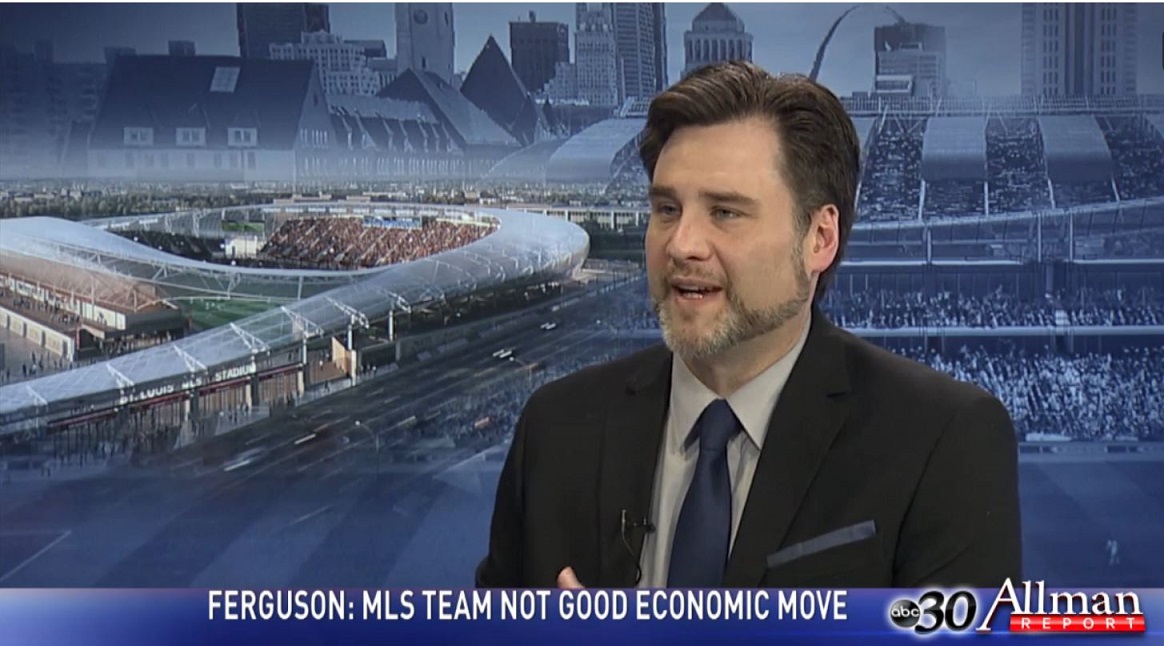
Cheerleading Won’t Make the MLS Stadium a Good Deal for Taxpayers

This past week I’ve been discussing plans to write a $60 million taxpayer check to potential owners of a Major League Soccer (MLS) team in Saint Louis. Proponents of the subsidy claim an MLS stadium will breathe new life into downtown, attract millennials, and grow the economy. I’ve written about why I believe these claims are misguided (see here and here). But there are smart, reasonable people who disagree with me, and they’ve made their cases recently as well.

Dr. Patrick Rishe of Washington University in Saint Louis argues the current MLS stadium deal is one of the best he’s ever seen, as it includes numerous safeguards for the city and taxpayers and doesn’t use sales taxes to fund construction. Moreover, only 39% of stadium costs will be paid for by the public, compared to the usual 65% to 70%. Therefore, it’s a good public investment—and it certainly isn’t “corporate welfare.”

While his premises are true, the conclusions Dr. Rishe draws are not.

  • Rishe states that this deal protects taxpayers in ways previous stadium deals did not. For instance, the ownership group must pay for cost overruns from construction, and the team has to stay in Saint Louis for 30 years (if the MLS doesn’t fold before then). These are reasonable provisions, but they don’t have anything to do with whether a stadium will grow the economy or redevelop downtown. The contractual safeguards simply manage the city’s risk; they don’t guarantee any of the glitz and glam proponents are promising. The stipulation that taxpayers won’t cover cost overruns doesn’t mean the benefits used on to justify the public expense, like economic growth, will be realized.
  • Rishe points out that use taxes, which are paid by businesses, will go toward funding the stadium—not sales taxes paid by all city residents. Supposedly, it follows that residents won’t pay for the stadium unless they own a business or buy tickets. But while sales taxes won’t go directly to the stadium, city residents must increase their sales tax rate to get the stadium. That’s because use tax revenue can only be diverted to the stadium if voters first approve a sales tax hike for the MetroLink expansion. So while your sales taxes won’t pay for the stadium, you have to pay extra sales taxes for the stadium.
  • If 39% is a breathtakingly low public contribution for a private venture, I’m in the wrong business. Cities across the country have been scammed by sports teams for decades, and the fact that other cities have agreed to worse deals than this one is hardly reason to celebrate. If $60 million is such a negligible contribution, why doesn’t the ownership team simply pay it themselves? Only cash-addicted millionaires would look at an offer to pay 61% of the cost for their own pleasure-dome as a selling point. (As for the $150 million expansion fee the ownership group is coughing up, recall that when the MLS announced the fee would be $50 million less than originally announced, stadium boosters didn’t reduce their ask for public assistance.)
  • Rishe contends that giving away $60 million in handouts isn’t corporate welfare because MLS teams don’t turn a good profit. First, the profitability of an enterprise doesn’t bear on whether or not its receipt of subsidies counts as welfare. And second, if the teams currently in the league aren’t turning a profit, what does that say about the long-term prospects of a franchise in Saint Louis? We already have one stadium without a team downtown—do we want to risk adding another?

Joe Reagan, head of the Saint Louis Chamber of Commerce, notes (along with others) that the ownership group will invest $5 million over 20 years in youth sports programs. Moreover, an economic analysis shows the stadium will generate $77.9 million in taxes for the city over the next 30 years. Mr. Reagan presents these factors as evidence that the stadium deal is worthwhile. But here too some perspective is in order:

  • The ownership group’s commitment to youth sports is commendable, but this is still a $5 million commitment in the context of a $60 million subsidy.
  • The analysis stadium boosters rely on makes rosy assumptions and must (at the very least) be taken with a grain of salt. For instance, it assumes every man, woman, and child will spend roughly $50 on tickets, concessions, and food each time they attend a game, and that spending will increase faster than inflation for 30 years.
  • More importantly, most of the economic activity at the hypothetical stadium won’t be “new,” but simply redirected from elsewhere in the city and region. This isn’t money that people were planning to keep hidden under the mattress—much if not most of it would be spent on other entertainment options if there were no soccer games to attend. And let’s not forget the $60 million that businesses are losing because of the use tax. But even assuming proponents’ analysis is correct, the stadium would only bring the city an average of $2.4 million annually—less than a quarter of a percent of the city’s $1 billion annual budget!

The history of stadium deals in Saint Louis and across the country shows these projects fail to make good on the promises made by their promoters. If sports stadiums were such lucrative investments, private investors would be flocking to Saint Louis to get their cut. Despite its supposed virtues, the facts and history indicate that the MLS deal is a bad one for taxpayers. 

Don’t Count Health Care Chickens Before They’ve Hatched

I raise chickens. No, I don’t own a farm, but for the four hens that live in my backyard, it might as well be one. And as you would expect with chickens, my wife and I receive a steady stream of edible eggs that will never hatch. Not having a rooster will do that.

I was reminded of our unhatched eggs after reading a commentary last month by Columbia Daily Tribune editor Henry J. Waters III. While I agree with Mr. Waters from time to time, I can’t help but disagree with his assessment that “what’s next” after the American Health Care Act is “single-payer.” Although it remains a persistent threat to good public policy, single-payer is a counted chicken from an unhatched egg—and an egg that may, in fact, never produce a bird.

I say this for several reasons.

First, the laws of economics are as true in health care policy as anyplace else. Top-down cost controls in single-payer systems have significant tradeoffs that become obvious when looking at the Medicaid program alone. Rather than introduce market mechanisms to control costs, Medicaid programs across the country more often pay doctors less to provide the same services, or simply cut services directly. That means fewer doctors and worse access for patients. Many taxpayers recognize this and believe this sorry dynamic shouldn’t be applied to the public writ large. We need markets; single-payer systems don’t deliver them.

Second, it isn’t obvious to me that the window for Obamacare reform has closed. President Donald Trump and Speaker Paul Ryan have publicly declared their intent to move on to other legislative priorities like tax reform, but in the weeks since the AHCA’s withdrawal, it’s not clear that the AHCA itself is dead, or that reform will not come through another legislative vehicle. Keep in mind that Obamacare passed over a year after negotiations on the bill began in 2009; there is plenty of reason to believe that despite the posturing of legislative leadership, another attempt at reform is forthcoming.

Third, and perhaps most importantly, measures continue to flow into the present health care policy landscape, even as federal efforts remain in limbo. State-based legislative changes that would: do away with hospitals’ certificate of need monopolies; empower patient–doctor relationships through direct primary care arrangements; open new avenues to care through licensing reforms; and introduce market mechanisms into existing state programs remain active issues in the states, and issues that Missouri legislators have often been on the forefront of implementing. And that’s just the short list of currently debated reforms.

Surely federal health care efforts are an important part of the reform puzzle, but it presumes too much to think that federal officials are the only ones calling the shots in health care policy. For many years now, states have had a primary role in these decisions, from demurring on Obamacare exchanges to rejecting the law’s unsustainable Medicaid expansion.

This isn’t to say that the single-payer health care system Mr. Waters envisions is a political impossibility; market reformers need to take such efforts seriously. But the odds of it becoming law anytime soon are sufficiently unknowable that Mr. Waters is better served by not counting that chicken, at least not yet.

The mistakes of heavy government intervention in our health care over the last few decades are now coming home to roost. Rather than continue those mistakes, we should be reducing the government presence in our health care decisions, not increasing it. Hatching an even bigger government intervention in American health care seems more likely to produce a rotten egg than a productive hen.

Different Paths to Course Access

Course Access is a hot topic in Missouri right now. Both the governor and legislature have made it a priority, and, at least so far, it is enjoying broad, bipartisan support. Now it is a matter of getting it done. As it turns out, there is no one exact way to “do” course access. There are, in fact, several possible paths.

One path, outlined in the governor’s budget, simply funds a course access program. Missouri already has the architecture with its Missouri Virtual Instruction Program (MOVIP), but there simply aren’t funds for students to take advantage of it. Governor Greitens proposed $2 million in funding so that students could access those courses.

Legislation now making its way through the legislature is taking a second path. House Bill 138 and Senate Bills 327, 238, and 360 create a course access program funded by redirecting existing funds that the state sends to school districts. If students want to take a course access program course, the fraction of funding that would have funded the class in their school of residence is used to pay for it. What’s great about these plans is that, as their fiscal notes attest, they cost the state zero additional dollars. They simply redirect existing spending.

A third is outlined in this great piece by AEI’s Rick Hess and the Manhattan Institute’s Max Eden. The broader article is about how states can best use the flexibility inherent in the Every Student Succeeds Act (the 2015 update to No Child Left Behind), but this paragraph stands out:

State education leaders would do well to employ ESSA’s direct student-services provision, which allows states to set aside a portion of federal Title I funds in order to support districts that are expanding instructional choice (in addition to school choice) for students. This means expanding choices for students without requiring that they opt to change schools, as with “course access” programs. Such initiatives, pioneered in Louisiana and Utah, use state funds to provide students the opportunity to access a range of online courses that their school might not offer — and to pursue them at their own pace. Under ESSA, states can use up to 3 percent of federal Title I funds to deliver online-course options that give rural students access to subjects that their schools don’t offer, to give all students access to Advanced Placement, and to give high schools the ability to deliver robust career and technical training.

According to this table, Missouri school districts get a little bit north of $240 million per year in Title I dollars. Three percent of that would be $7.2 million. This could fund thousands of course enrollments.

Taken together, Missouri could draw from several wells of funding to create a robust course access program that ensures that every student in the state has access to the coursework that best fits their needs.

For an overview of course access and information on how it has been implemented in other states, see this essay that Brittany Wagner and I co-wrote last year.

Calling the Previous Question

Last week I published a piece in Forbes about my concerns about the progress of this year’s legislative session. I wrote about the high expectations taxpayers had and the mandate they sent for legislative reform—including labor reform, tax reform, ethics reform, education reform, and many others. Some legislators, particularly in the Senate, have explained the legislative lethargy we’ve seen as the result of Senate tradition, where filibusters are generally allowed to go on for as long as the filibusterer chooses. But within that tradition, of course, is a way to sidestep the filibuster: calling the previous question.

A previous question motion, or “PQ,” allows for a vote on a bill or amendment if a majority of the chamber chooses, even if a filibuster is ongoing. The details of the motion are laid out in Rule 84 of the Rules of the Senate, which describes the PQ as follows: 

The previous question shall be in this form: “Shall the main question be now put?”. It shall only be admitted on written demand of five senators, and sustained by a vote of a majority of the senators elected, and in effect shall be put without debate, and bring the senate to direct vote upon a motion to commit, if such motion shall have been made; and if this motion does not prevail, then upon amendments, and then upon the main question. On demand for the previous question, a call of the senate shall be in order, but after a majority of the senators elected have sustained such a motion, no call shall be in order prior to the decision on the main question.

Translation? Five senators can initiate the PQ, and a majority of Senators can end a filibuster. Why Senators would hesitate to call a PQ isn’t necessarily captured in the rules, of course, and as we’ve seen in previous sessions, spurned Senators can grind the chamber to a halt by opposing motions that require unanimous consent or filibustering other legislation. This eats up time for other legislative priorities, which is essentially the point and central to the threat.

But the PQ shouldn’t be considered in a vacuum or treated as if it were dictated by immutable laws of Senatorial physics. Whereas the filibuster and the PQ are well within the realm of Senate tradition, so too are rules changes that would head off the sort of obstruction that has dissuaded previous sessions from appropriately using the PQ motion; after all, if rule changes were not part of Senatorial tradition, then there wouldn’t be rules explicitly allowing for changing Senate rules. “Tradition,” as it turns out, is both a shield and a sword, and legislators obstructing reform need to realize the “tradition” argument cuts the other way as well.

The real question, then, isn’t whether the PQ and related rule changes are consistent with Senate tradition—they are—but whether Senate leadership has the courage to break the reform logjam. Time will tell, but time is running out.

Mayor James Gets It Wrong

Kansas City Mayor James penned a guest commentary for The Kansas City Star on Wednesday. Unfortunately, it is riddled with errors and half-truths.

The Mayor begins with an assessment of the problem stemming from years of previous city councils failing to spend properly on infrastructure. Then he characterizes his solution thusly:

Over 20 years at approximately $40 million per year, this plan asks everyone in the city to invest through an annual property tax increase on both residential and commercial properties.

If the bond passes on April 4, the city says it will issue 20 different 20-year bonds. The last one will be issued in 2036 and will be paid off in 2055. The GO Bonds commit taxpayers to 40 years of debt, not 20. He also speaks to the cost to taxpayers:

The average residential property owner, with a $140,000 house and a $15,000 car, would see an increase in their property taxes each year for 20 years. That property would see an average of $8 added to their property tax each year. In year 20 that property owner would pay an average of $160 more than they pay today.

Both the Show-Me Institute and the Star have explained that this claim is inaccurate. The City Manager has stated that the cost is closer to $100 a year. The true cost of this bond to the owner of a $140,000 house and $15,000 car would be over $4,100.

The Mayor also refers to a report card that will account for projects and costs, but voters should be wary. If the GO Bond campaign—including this piece by the Mayor—is any indication, the report cards will be designed to present city spending in the best possible light. Remember, this is the same Mayor who refused to have the City’s Water Department audited.

As the Mayor points out, Kansas City is in this situation because important infrastructure and maintenance spending has been neglected. City leaders always find something else they want to fund. Without any significant changes to how City Hall operates—and this measure contains none—why should voters risk increasing their taxes just to see the exact same neglect repeated?

Can Legislation Make You Forget to Buy Insurance?

My colleague Michael McShane recently wrote a legislative “half-time report” on education reform in Missouri. While some bills haven’t moved as quickly or as far as he would like, education reform appears to be in much better shape than transportation reform. SB 185, a promising bill that would streamline regulations for transportation network companies (TNCs) like Uber and Lyft, has hit a snag. After moving uncontroversially through a senate committee, the bill has been filibustered.

SB 185 would create a statewide regulatory framework for TNCs, making it possible for them to operate across different jurisdictions that may have conflicting local regulations (or no TNC regulations at all). The law embodies free-market principles and could create jobs, improve mobility, and increase personal freedom. Show-Me Institute analysts, myself included, have testified in favor of SB 185 and similar legislation (e.g. HB 130) for years. So why is the bill hung up?

The Missouri Times reports that a senator:

opposes the legislation because he fears it will lead to fewer people, namely those who sign up to become drivers for TNCs like Uber, Lyft or Sidecar, to forgo paying for insurance. If a person signs up to become a driver, he says, and a TNC promises to cover his or her insurance when they’re driving for the company, drivers could forget their insurance only applies when they are on the clock when it comes time to renew their personal insurance.

In short, the bill seems to have been held up over concerns that TNC drivers, who use their own personal automobiles while on the clock, will simply forget they still need to purchase an individual auto policy.

If this concern is indeed motivating the filibuster, it seems misguided for two reasons. First, most TNC drivers work part time, and therefore likely own automobiles for personal use (57% of Uber drivers work less than 15 hours/week, and 86% work less than 35 hours/week.) Since these drivers own cars primarily to use themselves, it seems unlikely they’ll just forget to buy insurance once they start driving a few hours a day for a TNC. Second, to register your vehicle in Missouri, you need proof of insurance! It’s hard to understand why Missourians would forget to purchase (state-mandated) insurance just because they receive commercial coverage when driving for a TNC. It’s even harder to see how that fear would outweigh the potential benefits of sensible TNC regulations.

Proponents of SB 185 are still optimistic, but the future of free-market transportation reform is unclear. I remain hopeful that the policies embodied by SB 185 will eventually enable drivers to earn a living, help riders save money, and make it easier for all Missourians to get around. 

Support Us

The work of the Show-Me Institute would not be possible without the generous support of people who are inspired by the vision of liberty and free enterprise. We hope you will join our efforts and become a Show-Me Institute sponsor.

Donate
Man on Horse Charging