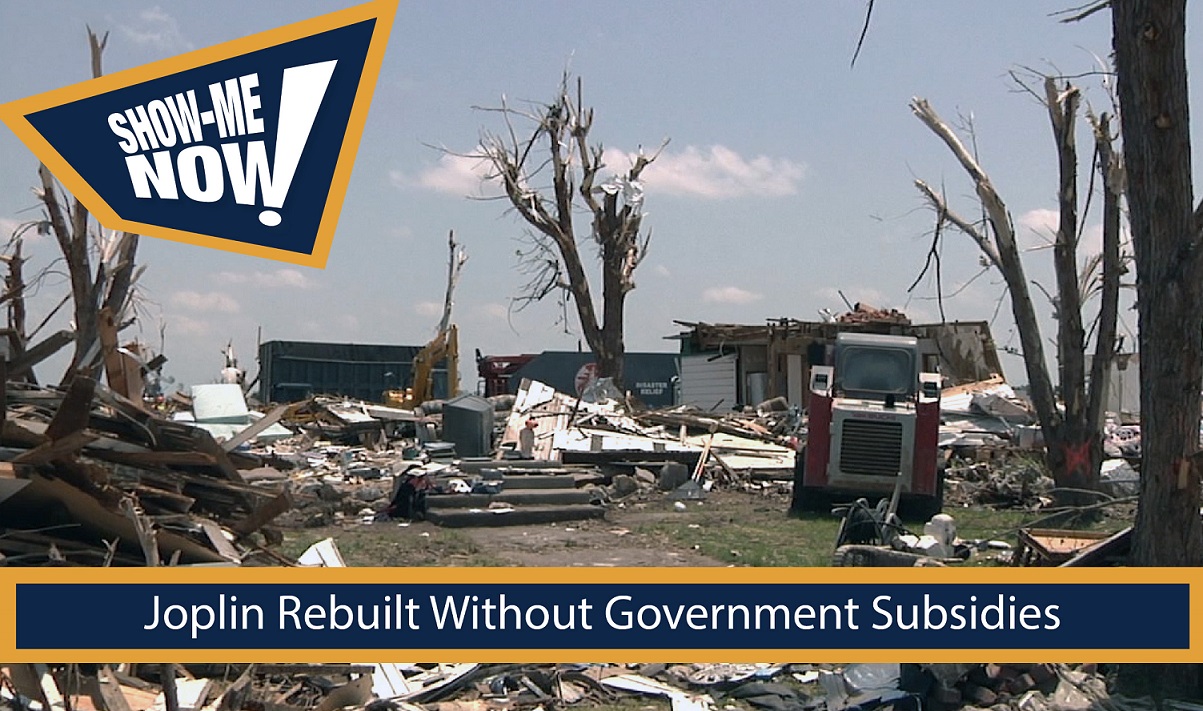
Show-Me Now! Joplin Rebuilt Without Government Subsidies

Six years after a tornado destroyed much of Joplin, MO, the city is back. The population is larger now. Property values are higher now.  And what role did government play in all this? They helped with the cleanup and they reduced the regulatory burden on construction, but when they tried to subsidize the rebuilding effort through tax increment financing (TIF), the developer that received the TIF money failed. And yet the people of Joplin pulled themselves up by their bootstraps and demonstrated for the country that subsidies are not needed to rebuild.

For more information, read our recent case study, Tax-Increment Financing in Post-Tornado Joplin.


Break Missouri’s Utility Monopolies

Yesterday Governor Eric Greitens announced that he is calling the Missouri legislature back into a special session that would address economic development issues in the state’s Bootheel. Specifically, the legislature will likely take up a bill, or a variation of it, that died in the regular session’s final days that would allow state regulators to negotiate lower electricity rates for at least two plants in southeast Missouri—a privilege not readily available to other Missouri companies and individuals. Supporters argue that because the plants would be heavy electricity users, a variance in state utility policy is warranted to make the sites more competitive, especially in light of the jobs that would come to those facilities. As the session closed, one representative in particular presented an electric, heartfelt soliloquy on behalf of his constituents who would benefit from the change. I have little doubt that this special session is being called at least in part because of that representative’s fervent advocacy. 

But as happens with proposals like this, there is a tradeoff: other electricity users would ultimately pay more so that these plants could pay less. And it’s that tradeoff that promises to be hotly debated next week when the bill comes up for reconsideration.  Here is the 64-dollar question: rather than carving out exceptions to rules as they go along, why don’t policymakers first consider whether the rules themselves need to be changed for everyone? Such a reanalysis seems exceedingly appropriate as the Legislature focuses its energy on Missouri’s public utilities.  

As a general matter, utility customers across the state do not have a choice in who provides their power, and that impacts us all. If you could only subscribe to one cell phone company, the incentive for that company to compete for your business with better service and lower prices would be drastically reduced. The same is true of utility companies.  Why does Missouri allow the default electricity arrangement to be basically choiceless for the average Missouri customer? 

The state is part of a dwindling subset of utility regulators that still substantively curb utility choice in the United States. I would be more open to the notion that an energy customer is uniquely situated to require a break on its energy costs if Missouri was already operating in a market environment for utilities—one in which market forces could drive down the prices everyone pays. Whatever the eventual disposition of the smelter legislation in this special session, legislators need to have that serious reform discussion sooner, not later. And chances are good that discussion will begin in earnest next week.   

School Choice Criticism: Heads We Win, Tails You Lose

On multiple legs of my commute this week I’ve heard parts of an NPR series on school vouchers. In general, I think much of the commentary has been fair. School vouchers are not some miracle cure that improves schools overnight. Voucher programs are created imperfectly, implemented imperfectly, and thus have growing pains, so not everyone is happy with them. Those people deserve to have their stories told just like families who use vouchers and are thriving.

However, one line of criticism has irked me. The headline of this story encapsulates it well: “Indiana’s School Choice Program Often Underserves Special Needs Students.”

It is true that a smaller percentage of voucher-using students in Indiana are identified as having special needs. It is also true that the maximum voucher amount in the state is $4,800.

That $4,800 number was reached because opponents of vouchers argued that the program should not be able to access local property tax dollars or federal dollars for low-income students or students with special needs. The voucher is derived only from the funding that the state allocates to educate children. What’s more, it also leaves behind 10% of state funding so that traditional public schools have money for fixed costs like debt service and capital upgrades, because opponents also argued that even if students leave, traditional public schools still have to keep the lights on, the building heated, and the parking lot paved.

So opponents constrain the funding amount to a level that can barely pay to educate a student with zero special needs in an already efficient school and then complain when schools don’t take on harder (and more expensive to educate) children.

It’s heads we win, tails you lose. If you actually get the money you need to meet the needs of students with special needs, you are sucking the system dry. If you don’t, and thus don’t serve those kids, you’re discriminating. School choice programs can’t win.

We should be realistic about the tradeoffs in the design of school choice programs. Limiting the amount of money that follows each child will shape who gets served and who doesn’t. If you want voucher programs to serve more students with special needs, send more money with them. If you don’t want to send that money, how is it fair to cry “discrimination” when students aren’t served?

Another Stadium Subsidy Bites the Dust

Missouri taxpayers dodged a bullet last December when state funding for a soccer stadium in downtown Saint Louis was opposed and not pursued by then Governor-elect Greitens. But some policymakers in Jefferson City were determined to spend state taxpayers’ money—during a time of budget cuts—on a different sports arena in Saint Louis: the Scottrade Center, home of the Saint Louis Blues.

Senate Bill 469 (SB 469) would have allowed for up to $6 million a year in state funding for renovations to the hockey arena. All in all, proponents of the bill were asking state taxpayers for $70 million. Fortunately for taxpayers across Missouri, the bill didn’t make it to the governor’s desk.

SB 469 was poor policy. It would have forced all Missourians, from Maryville to Branson to Kirksville, to subsidize an arena benefiting wealthy team owners. While proponents touted a variety of economic benefits, from construction jobs to gushing tax revenues, they failed to acknowledge decades of economic consensus: stadiums and sports teams don’t grow the economy. As Dennis Coates and Brad Humphreys put it in their 2008 Econ Journal Watch paper:

No matter what cities or geographical areas are examined, no matter what estimators are used, no matter what model specifications are used, and no matter what variables are used, articles published in peer reviewed economics journals contain almost no evidence that professional sports franchises and facilities have a measurable economic impact on the economy.

Does SB 469’s demise mean the Scottrade Center will fall into disrepair? Almost certainly not, as local policymakers in Saint Louis have already committed 64 million in taxpayer dollars to the facility earlier this year—without a public vote. And since the facility is abated from all property taxes, it should have cash on hand to make some of the upgrades it wants.

But just because SB 469 wasn’t codified into law this legislative session doesn’t mean a similar bill cannot or will not be introduced next year. Before state policymakers conjure up another package of subsidies, they would do well to take a sober look at the research on sports stadiums.

(For more on the economics of stadium subsidies, see here, here, here, and here.)

Who Wants to Talk About Failure?

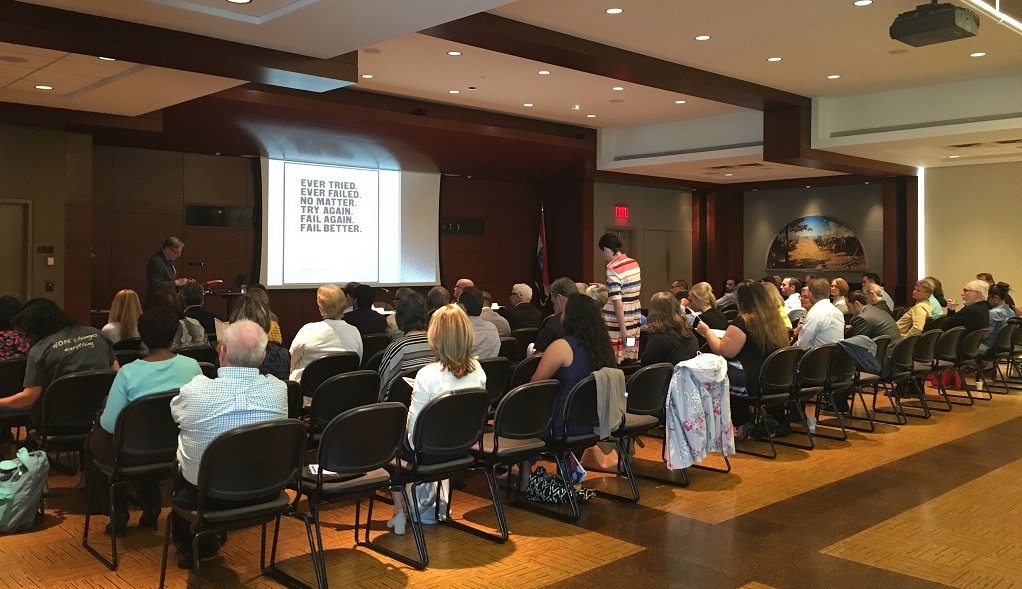
It was the Irish Playwright Samuel Beckett who wrote, “Ever tried. Ever failed. No matter. Try Again. Fail again. Fail better.”

This admonition is often forgotten in the world of education reform, where advocates wade hip-deep into the trenches of political warfare, researchers build staffs that require ever more philanthropic dollars, and writers make the TED talk circuit. Saying “I was wrong” can be seen as suicidal.

But it doesn’t even have to go that far. Policy ideas like charter schools, teacher evaluation, and high standards first exist in the abstract. When they are actually implemented, they look quite different from state to state or district to district. What one state calls “charter schooling” might look different from charter schooling in another state. So, if charter schools struggle in one state, it isn’t necessarily an indictment of the idea a whole. It might just be that the implementation didn’t match the specific environment where it was tried. In an ideal world, we’d learn from that, and do better.

But we don’t. When a new study comes out that says a policy has “failed,” we man the ramparts. Opponents (who were against the policy before any data was available) come out and tut-tut at advocates, telling them to “follow the data” or not to “cling to ideology.” Advocates circle the wagons. They spin the findings or pettifog the implications. They counter with personal stories or impugn the motives of critics. Rinse and repeat. (By the way, much of this is covered much more in depth than I can manage here in Rick Hess’s great new volume Letters to a Young Education Reformer).

Now I’m not naïve. Part of this is the way of the world. We live in a dynamic, diverse, pluralistic, democratic republic; the politics that define us, as the old saying goes, ain’t beanbag.  I’m hard pressed to advise one group or another to unilaterally disarm and allow people who aren’t dealing in good faith to seize the high ground. Still, if we want to be better, we’ve got to do better.

For our part, Jay Greene (head of the University of Arkansas’ Department of Education Reform) and I are co-hosting a conference in Kansas City on May 22 where top education researchers are going to talk about failure. We have recruited a rock-star set of presenters who will discuss papers that are slated for publication in the near future by Rowman and Littlefield as an edited volume. Local education figures will serve as discussants, preventing any conversation from being too theoretical.

Authors will tackle many of the major topics of education policy of the last quarter century: Test-based teacher evaluation, technology in classrooms, teacher Preparation, No Child Left Behind, and more.  But rather than trying to make some kind of global statement about whether or not something like evaluating teachers based on performance or having the federal government intervene in low-performing schools is a “success” or “failure,” authors will dig into specific examples, what went wrong, and most importantly, what we can learn from it.

Anyone who has spent more than a day in front a classroom knows that failure is an essential part of learning. You’ve got to let a student get a math problem wrong so they can learn how to avoid that mistake in the future. You wouldn’t tell her that she should never try and solve for a missing side of a triangle using the Pythagorean Theorem. You’d help her figure out how she applied it incorrectly, or if it was a right triangle in the first place. That’s how children get better. It’s how adults get better too.

We have to be humble. We are going to get stuff wrong. The more honest we can be about that, and the sooner we can admit we made a mistake, learn from it, and fail better, the better our overall system will be.

Keep the Line Moving: Looking Beyond the 2017 Session

The Missouri legislative session ended May 12th, and there are enough storylines of intrigue, failure, and victory to fill a season of Game of Thrones. There was shouting and foot-dragging and name-calling, but by the time the session ended at 6:00 pm last Friday, several substantive reforms had gone to the governor for his signature. Right to Work, the elimination of Project Labor Agreements, minimum wage harmonization, TNC reforms, and the success of Article V convention legislation all qualify as important advancements for the state. That the state has fully funded the formula for K-12 schools also deserves recognition.

The accomplishments of the session still leave Missouri far from where it needs to be. And certainly we would offer our 2017 Blueprint as a baseline for the sorts of reforms our state needs going forward. That menu of reforms includes the elimination of the state’s Certificate of Need laws; expansion of school choice through education savings accounts, charter schools, and course access; and substantive transportation and labor reforms to make sure that the state can compete for jobs and capital, whether already in the state or currently outside of it. Alongside the policy, we need procedural reforms in the state Senate where an historic number of bills languished and died; indeed, a filibuster on the last day of session nearly killed the state’s minimum wage reforms.

Still, there is ample room for optimism. The governor’s Committee on Simple, Fair and Low Taxes seems well-positioned to make 2018 the year of serious tax reform. Those reforms should include advancement of an earned income tax credit, the reform of state and local tax incentives, and the reduction of taxes on individuals and businesses in the state. Moreover, the passage of some priorities this year obviously clears space for the passage of other priorities in education, labor, and other areas that didn’t make it to home plate as the 2017 session closed.

The key, as some Kansas City Royals fans might put it, is to “keep the line moving.” The legislature doesn’t have to hit a home run every time it steps up to the policy plate; it just has to keep hitting singles with increasing frequency. And as baseball fans would tell you, if you do those small things right, chances are good that big things will eventually come.

While we would all have loved to see a towering moonshot of a legislative session, the Legislature ultimately hit enough singles to merit a cheer from free marketeers. Missourians had a good inning; we’re looking forward to seeing bigger and better things happen in the next one.

Session Notes: Electrician Licensing Reform Passes

Congratulations to Missouri’s electricians who, thanks to legislation that passed the House yesterday, will soon have greater flexibility in where they can work around the state. As we’ve written before, Missouri’s patchwork of local electrician licensure laws has acted as a barrier to employment for electricians—and as a barrier to service for consumers—preventing qualified tradesmen and women from easily plying their trade around the state. The bill now goes on to the Governor, who is expected to sign it into law.

As McGraw Milhaven, tongue in cheek, asked our own Brenda Talent earlier this week, “Is electricity different in South County [Saint Louis] than it is in North County?” Of course not, and it’s good to see the Legislature take action to pursue a state licensing policy that reflects that truth.

Support Us

The work of the Show-Me Institute would not be possible without the generous support of people who are inspired by the vision of liberty and free enterprise. We hope you will join our efforts and become a Show-Me Institute sponsor.

Donate
Man on Horse Charging