
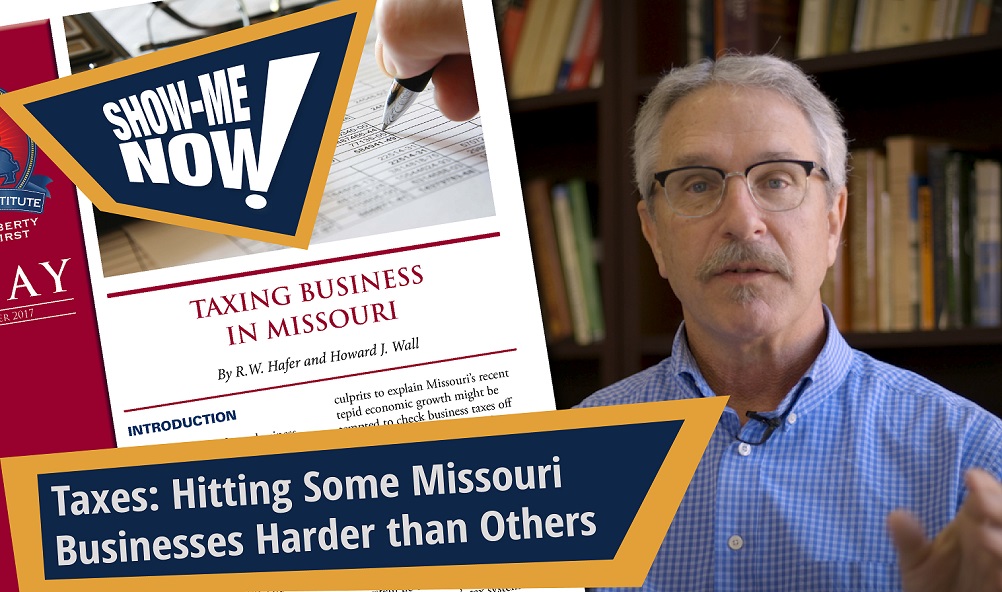
In their essay, “Taxing Business in Missouri,” Professors Rik Hafer, Ph.D., and Howard Wall, Ph.D., review the research of the Tax Foundation to better understand tax policy in Missouri. Their meta-analysis explains why Missouri’s economic performance remains below the national average. If Missouri reformed tax policy to lift the burden on all businesses, would that improve the Show-Me State’s economic performance?
TechNet Companies: Want More Education Funding? Then Pay Your Fair Share.

In a recent opinion column, Linda Moore, the president and CEO of TechNet, a “national, bipartisan network of technology CEOs and senior executives,” heralded Amazon’s seeking of a new headquarters as a wake-up call to policymakers about the need for increased computer science and STEM education funding. While her goals are laudable, she overlooks a significant problem with the growth of companies such as Amazon and others: it often comes at the expense of local education funding.
Moore is correct that metropolitan areas are falling over themselves to lure Amazon. In doing so, many will offer all sorts of taxpayer subsidized goodies such as tax credits, property tax abatements and tax-increment financing. Philadelphia offered to forgo property tax for 10 years; New Jersey is offering 7 billion dollars of tax incentives. Here in Missouri, Saint Louis and Kansas City areas have both submitted proposals—but won’t share them with the public. If the past is any indication, they will likewise be loaded with such taxpayer giveaways.
Therein lies the problem. Big companies seek and get a great deal of public assistance. Using the online subsidy tracker developed by Good Jobs First, one can see that the companies constituting the executive council of TechNet have received at least $1.2 billion in state and federal subsidies—almost five times more than the $250 million Moore calls for in additional federal education funding.
Like any company, Amazon doesn’t want to pay any more taxes than it has to. The problem is that subsidies such as those being offered for their new headquarters actually divert money away from schools, libraries and other basic services funded by property taxes. The size of the various Amazon proposals only multiplies the effect. Most of those hired to work at the new headquarters would likely be drawn from elsewhere, placing additional demands on school districts in the form of hundreds of new children—while granting the districts no additional resources. This is in addition to the stresses placed on infrastructure and other services, such as and policing.
Because federal funding for education makes up only a small portion of any school district’s budget, the terrible irony is that even with the increase in federal funding Moore calls for, the school districts in the city that “wins” Amazon’s second headquarters may still be worse off because of the loss of local property taxes.
Seventy-three civic organizations responded to these realities by writing an open letter to Amazon CEO Jeff Bezos demanding that Amazon pay its taxes—including on “building materials, machinery and equipment.” The letter also includes the following:
If you want a highly-educated local talent pool you must pay all of your property taxes to fund our schools, public safety, infrastructure and other public goods and services.
If tech leaders like those at TechNet want to increase education funding of any kind, they should stop asking national, state and local governments to subsidize their companies and start contributing their fair share to public coffers.
Teachers’ Opinions of Missouri’s Public School Retirement System

For years, Show-Me Institute analysts have written about reforming teachers’ pensions. Multiple research projects have demonstrated that poorer districts subsidize pensions in wealthier districts, that pension funds are taking on riskier and riskier investments to chase higher returns, and that pension plans have huge unfunded liabilities.
Given that teachers will be a constituency that would be significantly affected by any changes to pensions in the state, we thought it wise to ask them what they think, both about their current pensions as well as possible alternative arrangements. We worked with both district and charter school leaders to cast a wide net and include as broad a range of viewpoints as we could.
Unfortunately, not long after we put our survey in the field, one of the state’s teachers’ unions instructed its members not to participate in our data collection. It’s unfortunate, but at this stage, not unexpected.
While it significantly curtailed our sample, 53 teachers did choose to respond, and we thought their voices deserved to be heard—even when they disagreed with some of the stances that Show-Me Institute writers have taken in the past. Accordingly, in addition to the complete survey results we have included an appendix with every open response that teachers gave—the good, the bad, and the ugly.
We encourage you to give the paper a read. Teachers have complicated and often conflicting views on their pensions as well as alternatives. Understanding those views will improve public pension policy.
Auditor Report on Tax Incentives and Exemptions
Missouri State Auditor Nicole Galloway has issued a report on the Cost of Tax Incentives and Exemptions. The auditor calls for more rigorous fiscal impact studies—but inadvertently shows how important such studies are by making some questionable assumptions of her own.
The auditor notes that the fiscal impact of proposed pieces of legislation was not followed up by analysis after the fact.
State law does not require a post-implementation review of fiscal notes to determine the actual fiscal impact of legislation enacted in comparison to fiscal note estimates. Post-implementation reviews would be especially beneficial for legislation impacting the tax base or for which the fiscal note included an estimated impact on tax revenues.
For example, the auditor finds that the estimated fiscal impact of a particular bill (SB 19 in 2015) was estimated at $15.2 million annually, but she claims the actual cost for the first two years of implementation was about five times greater. To reach that number, the auditor simply examines revenue from before adoption with revenue post-adoption and assigns all the impact to a single bill. Officials from the Department of Revenue make this exact point in the text of the auditor’s report (page 9):
DOR personnel could not identify the actual cause in the reduction in corporate income taxes, but indicated SB 19 (2015) was likely one of the contributing factors along with other potential factors including “other legislative changes” and “changes in the overall economic market.”
The point the auditor is making is valid and laudable: we don’t know the actual cost of the tax laws we’re adopting. Public policy is only as good as the information it relies upon. The Show-Me Institute welcomes any thorough analysis of tax policy—but the auditor’s report may be worse than doing nothing at all as it ascribes all the change in revenue to a single legislative act.
The DOR indicated in the report that such data are often misleading and collecting it can be a burden to businesses, but that the department is implementing a revenue system that may allow for more analysis. Undertaking such an analysis “would require a substantial increase in full-time employees,” which is politically unlikely. Perhaps allocating more resources to track fiscal impact of legislation is something the legislature should consider—if only to guard against the overly broad assumptions being made in the auditor’s report.
Broadway Economics
The Broadway Inn is convenient for all the universities in Columbia, and its owner wants to build a $20 million expansion that would include a second hotel tower. Adding on to the hotel could be good for the area and a worthwhile investment for the owner, but the $2 million in tax-increment financing (TIF) built into the expansion proposal make it a bad deal for Columbia.
Let’s walk through this. The project will add about $20 million to the productive capital in Columbia. Between 2001 and 2016, each dollar of capital added, on average, 17 cents to the value of output—that is, goods and services—produced in Columbia. Based on this historical average, Columbia would produce an additional $3.5 million in output when the project is completed in a couple of years. One more piece of information: Columbia collects about one cent of revenue for every dollar of output produced. Consequently, city coffers would increase by about $35,000 in the first year that the expansion was operating. However, even allowing for this additional output to increase at Columbia’s average annual growth rate, which is 1.8 percent, there is not enough revenue for the city. After discounting future revenues to their present value and summing over the 23-year period, the value of the stream of city revenues comes to about $650 thousand. In other words, the city gives the developer $2 million to get back $650 thousand. Not a good return.
Proponents of the deal contend that without TIF, the expansion (and accompanying economic growth) won’t happen at all—that without an infusion of taxpayer money, development won’t be profitable enough to attract investment. However, data from cities like Chicago, Saint Louis, and Kansas City say otherwise. Comparing employment or income, the evidence indicates that economic outcomes are no better in areas that award TIF than in areas that do not.
The Broadway expansion proposal offers the appearance of certainty. At the very least, we have a good idea of what a new hotel tower will look like, so it’s easy to imagine that it will lead to an increase in economic activity. It can certainly seem riskier to turn down the proposal and wait to see what (if any) productive use the land next to the current hotel is put to. But there is no guarantee that the expanded hotel will be successful, either.
Fundamentally, economies grow when people put labor and machines and capital together in a way that yields more valuable stuff. Growth is the product of creative and innovative people who are trying to earn a profit. The law permits people to ask the city government for a subsidy to make a profit. But city officials must determine if granting the request is the best use of resources collected from citizens. Looking at the numbers, one is hard pressed to show that the Broadway expansion is the best use of city funds.
David French on Free Speech
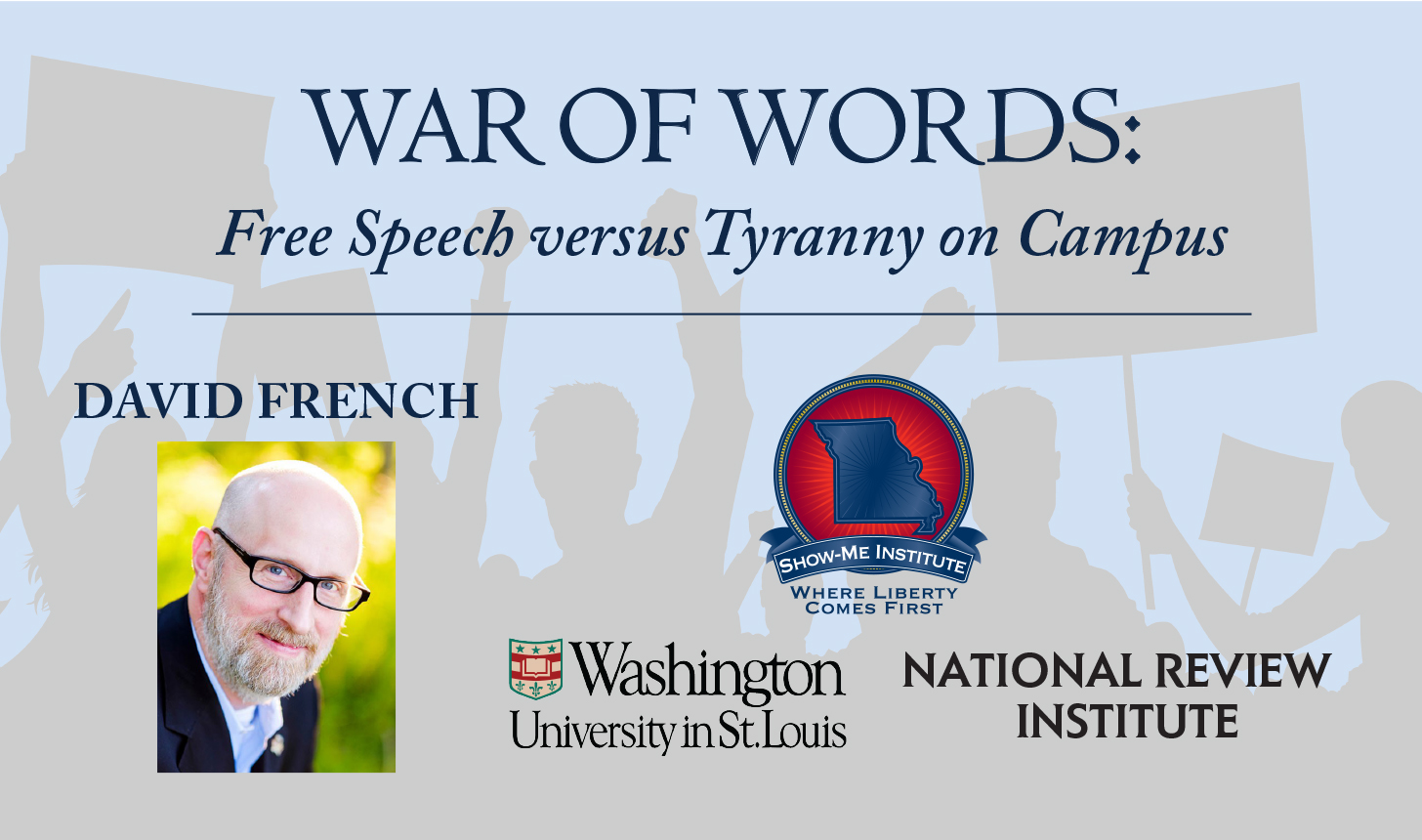
On October 11, National Review Institute Senior Fellow David French was at Washington University in Saint Louis to deliver a lecture titled “War of Words: Free Speech versus Tyranny on Campus.” French discussed the growing threat to First-Amendment rights that is currently most visible on university campuses, but is spreading to all corners of public life.
One More Lap around the Ice Rink
As our readers might remember, the Chesterfield Hockey Association (CHA) wants to raise $7 million from the Chesterfield Valley Transportation Development District (CVTDD) to help fund the construction costs of its proposed new ice rink. Researchers at the Show-Me Institute have rejected the arguments of proponents of this and similar initiatives, but as the project has now been presented to residents of the CVTDD for consideration, I’d like to reiterate some facts about transportation development districts (TDD) in general, and the CVTDD specifically.
First, if the district is extended, the district and its taxes can continue up to an additional 15 years beyond its originally scheduled termination. Put more simply, that means up to 15 more years of collecting taxes that would not otherwise have been levied. To say that’s not a new tax is like a bank adding over a decade’s worth of payments to your home mortgage and telling you there’s nothing to worry about because the payments aren’t “new.”
Second, TDDs were meant to raise funds for critical infrastructure projects; what they actually raise funds for is often anything but that. A recent report by the Missouri State Auditor exposed TDDs in Missouri as routinely “engaging in questionable practices with little oversight or transparency.” One example has been the CVTDD itself, which used over $500,000 taxpayer dollars to construct a “beautification wall”—a project whose questionable use of tax dollars has been documented before.
Third, the ballot initiative language for extending the CVTDD is hardly reassuring to those interested in good government. The language provides an extensive laundry list of items that revenue from the CVTDD may be used to fund. While a casual reader might assume the list is exhaustive, such an assumption would be incorrect. The list of permissible expenses is preceded with the words, “including without limitation.” The scope of spending could exceed even the problematic spending priorities that are explicitly spelled out to voters. The items articulated on the ballot aren’t limits; they’re examples.
Fourth, if this ballot initiative passes, then anyone who shops in the CVTDD—not only the well-to-do, but also single mothers, poor families, and those of meager means—will be subsidizing the recreation of the CHA through the sales tax that they pay at Walmart and other stores in the district.
Setting aside the deficiencies of the ballot language and even assuming that taxpayers’ money is efficiently used within the explicit scope of the project, the proposal itself remains troubling. It would commit an entire community, through the vote of only a few, to subsidizing significant amenities for members of a narrowly tailored special interest organization—not to mention that there has been no showing of need that cannot be met without a tax that is inherently regressive. That a private group may end up with a public windfall, thanks to the state’s broken TDD laws, should bother us all.
Are Kansas City and Saint Louis Getting Taken?
The deadline for submissions to Amazon to host their new headquarters building has come and gone, and both Kansas City and Saint Louis tendered proposals. Unfortunately, neither city is releasing its proposal to the public, citing a non-disclosure agreement with Amazon.
The Kansas City Star editorial board has been critical of the secrecy, noting in an October 6 column that the agreement is
aimed at keeping a lid on Amazon’s proprietary information — not the cities’ best arguments about why they would be perfect for HQ2. Other contender cities that are playing by the same Amazon-imposed rules have managed to make more information public.
The state of Missouri, without favoring either Kansas City or Saint Louis, issued what can best be called a brochure for doing business in the Cave State. (It’s been called a proposal, but that is a generous description of the 13-page slide show.)
Until we know the details, we’ll just have to sit and wait to see what commitments municipal leaders have made on behalf of taxpayers. If the past is any indication, they will include generous taxpayer subsidies in the form of abatements, tax credits, and tax-exempt freebies wherever possible. Philadelphia is offering ten years of property tax abatement. New Jersey’s bid included $7 billion in tax incentives.
The question for taxpayers will be whether the benefit is worth the investment. Research suggests this is rarely the case. One economist from Mizzou, Saku Aura, put it bluntly:
As a Missouri taxpayer, I really hope Amazon doesn’t come here. The place that most grossly overestimates the benefits from a large company moving is going to be the one who’s going to get it. If they choose to come to Missouri, to me that would almost imply that we ended up being the biggest sucker among the 50 states.
Is Missouri being played for a sucker? Richard Florida, an urban studies theorist focusing on social and economic theory seems to think so. According to the St. Louis Post-Dispatch, Florida said, “the cities I talked (to) all know they are being taken and resent it.” Among those cities would be Kansas City, as Florida was a paid consultant to its effort
Show-Me Forum: David Steelman Discusses Mizzou Two Years after the 2015 Protests

David Steelman discusses the fate of Missouri’s flagship state university two years after the disruptive protests of 2015.
