Reconsidering Teacher Pay

Recently in the Springfield News-Leader, I argued that school districts should reconsider how they pay teachers. Most districts use a step-and-lane salary schedule, which rewards teachers for years of experience and extra degrees. I argued in my op-ed that salary schedules are a poor way to pay teachers. Since I was limited to 500 words, I focused on demonstrating how schedules, which are nonbinding, often create tension in times of financial stress. My suggestion was that school districts “should examine how they pay teachers.”

Teacher compensation is an important policy discussion. Yet, too often the mere suggestion of change is met with hostility by teachers. As a former teacher myself, I understand that there is safety in salary schedules along with uncertainty about what they might be replaced with. Indeed, one retired teacher took to the newspaper’s pages to make this point. Although she didn’t argue specifically for salary schedules, it was clear that she was averse to change. But many people are examining how we pay teachers, and they often reach the same conclusion I reached—we need to change how we do business. But what should that change look like?

On July 27, a National Public Radio station in Michigan ran a story called, “Are we thinking about teacher pay all wrong?” The piece described Washington, D.C.’s merit-based pay system. As the piece notes, “There are two parts to the D.C. pay system: an annual bonus of up to $25,000 after one year of being rated ‘highly effective,’ and an increase in base salary of up to $27,000 for teachers who are rated ‘highly effective’ two or more years in a row.” Rigorous evaluation has shown that D.C.’s system, which is a combination of pay reform and a new teacher evaluation process, has improved the teacher workforce and led to an increase in student achievement.

There is of course still debate as to whether the D.C. model could be effectively implemented in other cities, let alone in rural parts of Missouri. Nevertheless, Missouri students and teachers would benefit from a critical examination of our teacher pay policies.

Unfortunately, too many teachers (like the one who wrote a response to me) and their union representatives seem unwilling to have a serious discussion on this important matter. One teacher in the NPR story suggested that we “need to offer starting teachers an apprentice pay for 5 years at $55,000. If they are effective after 5 years, bump them up to $75,000. If they are highly effective pay them $100,000.” Such a structure simply is not economically feasible. The response from David Hecker, of the American Federation of Teachers of Michigan, was equally unsatisfying. He first suggested that “starting pay should be comparable to other professions,” but went on to ask, “Should the senior teacher get more for experience, or the younger teacher who needs to make a decent living so they can be attracted to and stay in the field? That should never be the trade off.” His answer displays a fundamental lack of economic understanding. Of course there is a trade-off! There is always a trade-off.

We should not continue to pay teachers solely based on years of experience and extra degrees, especially when those things are not closely related to student outcomes. But in any case, if we are going to have a fruitful conversation, teachers need to come to the table with thoughtful suggestions. Maybe then we could create a system that truly fosters excellence and rewards teachers for the hard work they do.

Is School Choice Racist?

According to the leadership of the American Federation of Teachers, the opinion page of the New York Times, and the Center for American Progress, contemporary support of school choice is a smokescreen for racism. 

This must come as a surprise for readers of this blog, many of whom support school choice because it gives greater opportunity for minority families trapped in schools that are failing to meet their children’s needs. Sorry to break it to you! It turns out (or so we are told) that because some racists used school vouchers 60 years ago to try and thwart integration and some unsavory characters spoke ill of public schooling more than a century ago, school choice is forever tainted.

This is a terrible argument.

It is a terrible argument on the facts, which are either contradict the critics’ claims or are grossly oversimplified. (Not convinced yet? Even more detailed evidence here.)

It is a terrible argument because examples of racists twisting policies and ideas to suit their own purposes are everywhere: from the minimum wage, to federal support for housing, to labor unions, and even to traditional public schools themselves. Pointing out these examples is not a good way to argue about contemporary problems.

But more than anything it is a terrible argument because so many minority families want school choice and benefit from it.

The old lawyerly saw advises “When the facts are on your side, pound the facts. When the law is on your side, pound the law. And when neither are on your side, pound the table.” School choice opponents are doing some serious table pounding right now. Don’t fall for it.

Show-Me Now! Course Access: Opening Opportunities Across Missouri

Mike Brown, Executive Director of the Missouri Online Summer Institute, discusses the opportunities this program offers for students interested in using online resources to supplement the education they’re getting in school. Courses offered range from remedial classes for students struggling with their regular coursework to advanced-placement courses that would otherwise be unavailable to students in many districts. Click on th link above to watch.

Face-Palm: Loop Trolley Over-Budget, Likely Delayed, Again

Face-palming is defined as:

Bringing the palm of one’s hand to one’s face, as an expression of disbelief, shame, or exasperation.

It’s what I did when I read that the Delmar Loop Trolley, supposed Millennial-magnet and urban-revitalizer extraordinaire, is yet again over-budget and likely delayed. Joe Edwards, who’s leading the trolley effort, says he needs an additional half-million to cover signage and vehicle restoration costs, and to ensure the system can operate over “reasonable hours.” In other words, the Loop Trolley needs another bailout to help pay its regular bills—not to cover unexpected costs.

This request is not fake news, and unfortunately it shouldn’t come as a surprise. The Trolley has an expensive and protracted history. Sometimes past performance really is the best indicator of future results.

First, in 2014, bids for building the vintage streetcar line came in $11 million over-budget. A second round of bids came in $3 million lower, but that still put the project—originally estimated to cost $43 million—nearly 20% over-budget. County taxpayers coughed up the extra cash to bail the trolley out, after they were told cost-overruns would be paid by a special taxing district, the loop trolley transportation development district, which levies an extra sales tax for the project.

And then there were the delays.

Before construction even began, the Federal Transit Administration, which pledged to pay for most of the trolley’s capital costs, threatened to withdraw its financial support because of a lack of engineering and design progress. Then the University City council had to extend the terms of a special building permit six months so construction would be legal when it actually began. At that time, the line was slated to open in late 2016.

But then the public was told the line would open in spring of 2017. It didn’t. Trolley proponents later said the opening date would be sometime in summer of 2017. It wasn’t. Then they said the opening date would be in August. It no longer is. And then they said it would be sometime later in the fall of 2017. I wouldn’t be surprised if the trolley actually starts moving people sometime closer to 2018.

The Loop Trolley is a textbook example of government mismanagement. Proponents over-promised and under-delivered, and ultimately, taxpayers are on the hook. Unfortunately, the trolley’s foundering was entirely predictable. Projects like it are consistently over budget and often delayed for years. Perhaps policymakers will take this as a learning opportunity. It looks like the federal government may be doing just that.

The St. Louis Business Journal reports that:

Edwards also said he has been told by Federal Transit Administration Regional Administrator Mokhtee Ahmad that if the trolley is not completed in the immediate future and does not operate successfully for the first three years, future federal funds for other St. Louis-area projects could go to other cities. [emphasis mine]

Is the federal government really so displeased with the Loop Trolley that it is questioning whether regional leaders can competently manage infrastructure projects? On top of taxpayers not being able to ride the trolley they were promised, will they miss out on other, more meaningful projects?

Pension System’s Generous Benefits Come from the Pockets of Others

Teachers love their pension system. And why not? A teacher can retire at age 55 with 30 years of service and draw 75% of their final average salary for the rest of her life. For a teacher who becomes a principal or superintendent, this benefit could easily be six figures annually. But have you ever stopped to ask yourself how the plan manages to achieve this? There is no magic. The plans do not have wizards for fund managers. The answer is much more straightforward—the system redistributes wealth from some individuals to others.

Logic tells us that when people receive benefits that far exceed the value of their contributions and interest, the funds must come from somewhere . . . and they do. They come from teachers who work for fewer years, from teachers with relatively low pay, and from future generations of teachers. The same characteristics of Missouri’s teacher pension system that enable some teachers to enjoy a comfortable retirement also create several forms of inequity that could undermine these plans.

Currently, teachers in Missouri (except in Kansas City and Saint Louis City) contribute 14.5 percent of their salary to the pension system. The district matches that amount, for a total equal to 29 percent of the teacher’s salary. A teacher who leaves before the five-year vesting period ends forfeits the district’s match. But even vesting doesn’t guarantee a teacher will receive full value for their contributions, let alone the district’s match. Because the benefits accrue slowly at the start of a teacher’s career and then rapidly as they approach retirement, a teacher must work more than 20 years just to recoup their own contributions. The teacher who works 15 years and moves because of a spouse’s job in another state, for example, will be leaving money behind that helps fund the generous benefits of others. This is known as intra-generational inequity—within a cohort of teachers, some benefit and others lose.

Another form of intra-generational inequity is the cross-subsidization that occurs between workers with different earnings trajectories. Some teachers (generally in wealthier districts) get very large raises over the course of their careers, but others do not. Teachers who become administrators make even more money. Since pension payouts are based on salary earned in just the final three years of employment, these individuals receive retirement benefits that exceed the amount of their own contributions to the system over the course of their careers.

Others have to make up the difference. These “others” come, in part, from poorer districts and districts with relatively flatter salary schedules. Teachers in these districts pay more into the system than they will get out. Their “excess” contributions go to fund the pensions of the former superintendent making $150,000 a year in retirement.

Even though the pension system shortchanges many teachers, it still does not have enough funds to cover all its expected obligations. Therefore, the system must rely on new teachers to fund the benefits of retired teachers. This is the third type of inequity—inter-generational inequity. As generations of teachers contribute less than they receive in benefits, unfunded liabilities grow. In turn, future generations are asked to contribute more to the system. We have already seen individual contributions to PSRS grow from 10 percent in 1995 to 14.5 percent today.

Defenders of Missouri’s teacher retirement system will be quick to tell us that the system is well-funded, over 80%. (We can quibble about this calculation another time.) They will reiterate that the system is well-liked by teachers and claim that retirees are doing well in this system. To make that argument is to miss the point of this entire article: unless we tie benefits to contributions, the pension system will continue to favor some at the expense of others.

Is TIF Failing the “But-For” Test?

Tax-increment financing (TIF) is a development subsidy program abused all over Missouri, and especially in Saint Louis. See exhibit A: the Boulevard development in Richmond Heights, just east of the Galleria.

The development has been awarded more than $30 million in TIF over the years for the construction of high-end shopping, office, and luxury residential spaces in one of the most economically successful areas in the region. Just read this developer overview, which claims this part of Richmond Heights “forms the metropolitan area’s most successful and dynamic commercial and residential district.” The area hardly looks like the “urban blight” TIF was originally designed to remedy.  

But there’s a recent development, beyond the (ahem) questionable use of subsidies in this area, worth touching on.

The most recent phase of the development was originally estimated to cost just shy of $80 million. Back then, developers claimed the project was financially infeasible without TIF and other subsidies. But now the project’s costs are up $20 million and it’s still moving forward. But how can this be? How can a project that was infeasible at $80 million be moving ahead when it is now $100 million?

Here are three theories:

  1. The magnanimous developers decided they could part with an additional $20 million of their own funds even though they claimed the original cost of their project was too high to burden privately.
  2. The initial request for public assistance was far more than was actually required to move ahead, and so, the $20 million setback can be easily absorbed. (Though I doubt any public assistance could be considered reasonable for this project.)
  3. The developers were going to build their project with or without public assistance, but helped themselves to taxpayer cash because it was being offered.

This list may not be exhaustive; there may be other ways to explain the project going ahead. Nevertheless, if I were a betting man, I’d put my money on #2 or #3. Why? Because much of the academic research on TIF suggests developments will happen regardless of whether or not subsidies are awarded. The Boulevard development is consistent with this theory, and suggests that perhaps taxpayer handouts aren’t as essential to economic growth as many public officials seem to think they are.

Charter Schools Boost College Completion

I graduated from high school in 1999. Since then, I have had few interactions with anyone who works for my alma mater, and none in any formal capacity. No one called a year later to see if I went to college. No one checked to see if they could offer me any career support. I didn’t expect them to. They had done their job. I had graduated high school, and that was that. I suspect this is the case for most high school graduates.  

When you have always come to expect something done one way, it can completely rock your world when you see someone doing it differently. That was the case when I visited KIPP Delta, a charter school in southeast Arkansas, midway through my doctoral program. I spoke with a staff member who told me about their mission to get students to, and through, college. The school was using business software to manage contacts with graduates and ensure that each student would have a KIPP staff member following up with them periodically post-graduation. Graduates within a certain distance would even receive a visit from someone from KIPP.

When I heard this, my first thought was, Why hadn’t my school done something like this?

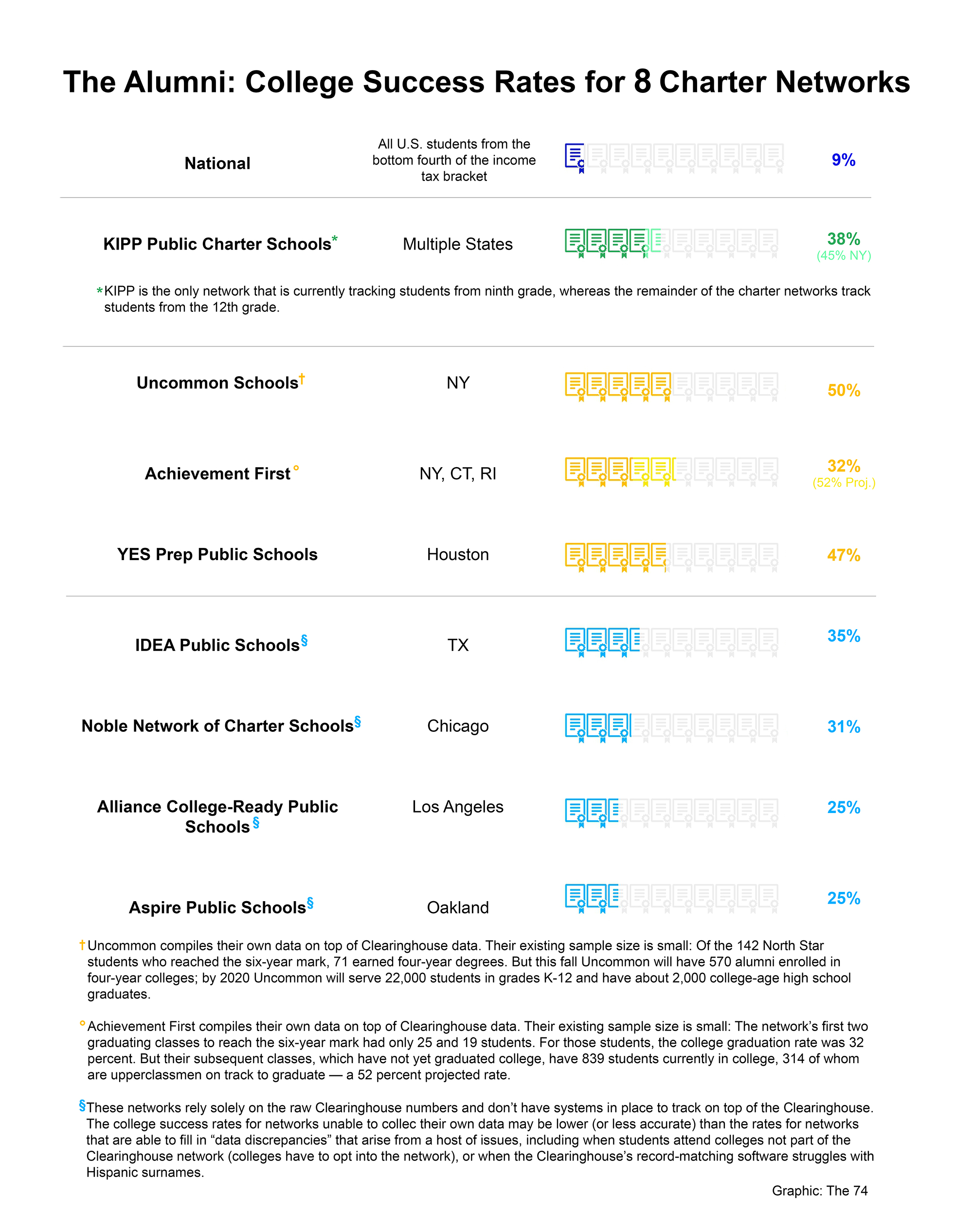
Recently, The 74 reported that just 9 percent of students from the bottom fourth of the income distribution graduate college within 6 years. For a number of charter school networks, however, that figure is significantly higher. Nationwide, 38 percent of all KIPP graduates go on to graduate from college within six years. That’s more than four times the national average!

I’m sure it isn’t just KIPP’s post–high school follow-ups that have led to this dramatic increase in college graduation; KIPP schools also appear to provide their students with a firm K-12 foundation. Whatever they’re doing, it seems to be working.

Yet, in Missouri we continue to restrict where charter schools can open. Both my experience visiting KIPP Delta and the evidence presented here suggest that we would be wise to remove these unnecessary restrictions. Doing so could help more of our students from low-income families get their college degrees.

For more information, read: “Charter Schools: Do They Work?” by Michael McShane. 

Support Us

The work of the Show-Me Institute would not be possible without the generous support of people who are inspired by the vision of liberty and free enterprise. We hope you will join our efforts and become a Show-Me Institute sponsor.

Donate
Man on Horse Charging