

Is TIF Failing the “But-For” Test?

Tax-increment financing (TIF) is a development subsidy program abused all over Missouri, and especially in Saint Louis. See exhibit A: the Boulevard development in Richmond Heights, just east of the Galleria.

The development has been awarded more than $30 million in TIF over the years for the construction of high-end shopping, office, and luxury residential spaces in one of the most economically successful areas in the region. Just read this developer overview, which claims this part of Richmond Heights “forms the metropolitan area’s most successful and dynamic commercial and residential district.” The area hardly looks like the “urban blight” TIF was originally designed to remedy.  

But there’s a recent development, beyond the (ahem) questionable use of subsidies in this area, worth touching on.

The most recent phase of the development was originally estimated to cost just shy of $80 million. Back then, developers claimed the project was financially infeasible without TIF and other subsidies. But now the project’s costs are up $20 million and it’s still moving forward. But how can this be? How can a project that was infeasible at $80 million be moving ahead when it is now $100 million?

Here are three theories:

  1. The magnanimous developers decided they could part with an additional $20 million of their own funds even though they claimed the original cost of their project was too high to burden privately.
  2. The initial request for public assistance was far more than was actually required to move ahead, and so, the $20 million setback can be easily absorbed. (Though I doubt any public assistance could be considered reasonable for this project.)
  3. The developers were going to build their project with or without public assistance, but helped themselves to taxpayer cash because it was being offered.

This list may not be exhaustive; there may be other ways to explain the project going ahead. Nevertheless, if I were a betting man, I’d put my money on #2 or #3. Why? Because much of the academic research on TIF suggests developments will happen regardless of whether or not subsidies are awarded. The Boulevard development is consistent with this theory, and suggests that perhaps taxpayer handouts aren’t as essential to economic growth as many public officials seem to think they are.

Charter Schools Boost College Completion

I graduated from high school in 1999. Since then, I have had few interactions with anyone who works for my alma mater, and none in any formal capacity. No one called a year later to see if I went to college. No one checked to see if they could offer me any career support. I didn’t expect them to. They had done their job. I had graduated high school, and that was that. I suspect this is the case for most high school graduates.  

When you have always come to expect something done one way, it can completely rock your world when you see someone doing it differently. That was the case when I visited KIPP Delta, a charter school in southeast Arkansas, midway through my doctoral program. I spoke with a staff member who told me about their mission to get students to, and through, college. The school was using business software to manage contacts with graduates and ensure that each student would have a KIPP staff member following up with them periodically post-graduation. Graduates within a certain distance would even receive a visit from someone from KIPP.

When I heard this, my first thought was, Why hadn’t my school done something like this?

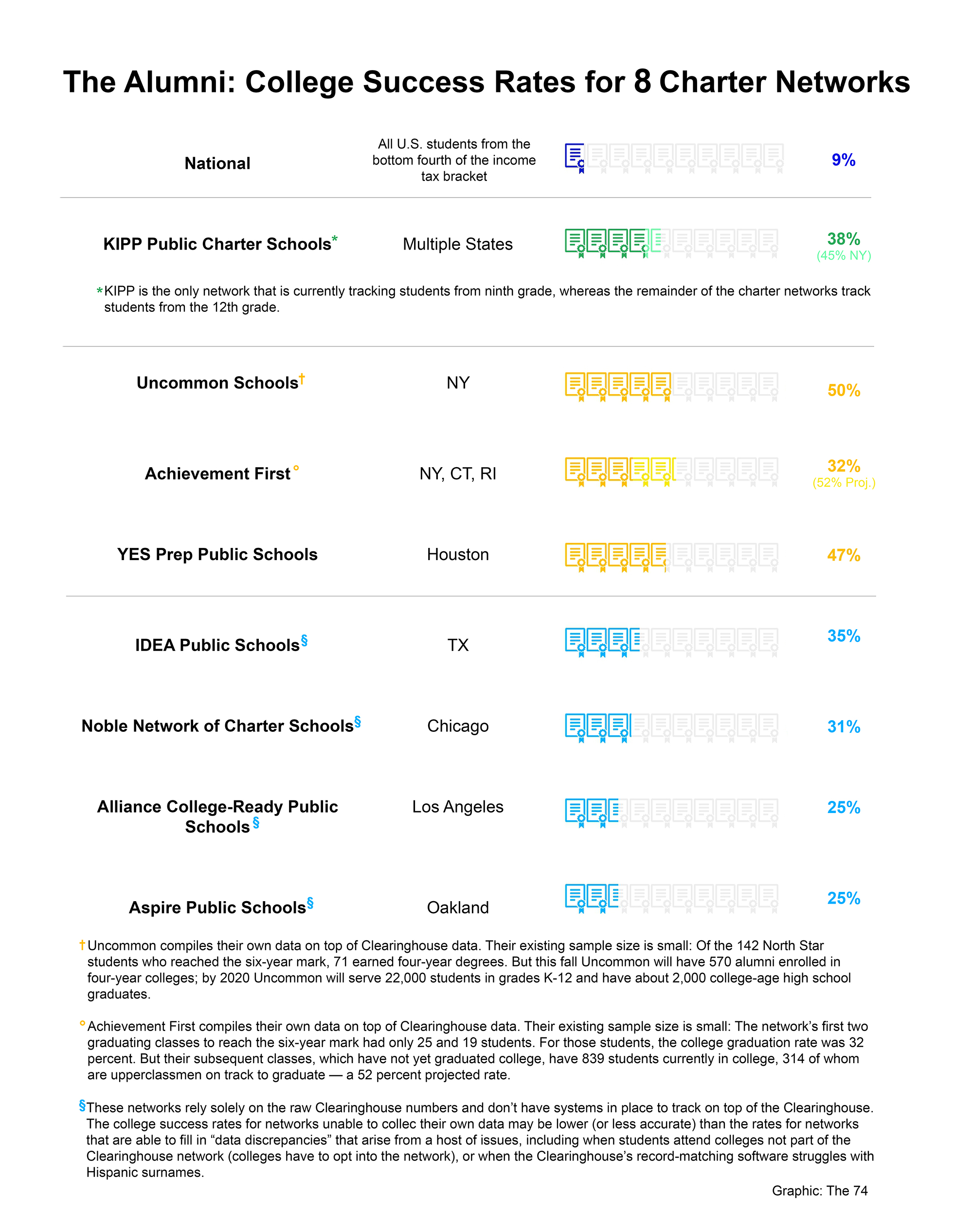
Recently, The 74 reported that just 9 percent of students from the bottom fourth of the income distribution graduate college within 6 years. For a number of charter school networks, however, that figure is significantly higher. Nationwide, 38 percent of all KIPP graduates go on to graduate from college within six years. That’s more than four times the national average!

I’m sure it isn’t just KIPP’s post–high school follow-ups that have led to this dramatic increase in college graduation; KIPP schools also appear to provide their students with a firm K-12 foundation. Whatever they’re doing, it seems to be working.

Yet, in Missouri we continue to restrict where charter schools can open. Both my experience visiting KIPP Delta and the evidence presented here suggest that we would be wise to remove these unnecessary restrictions. Doing so could help more of our students from low-income families get their college degrees.

For more information, read: “Charter Schools: Do They Work?” by Michael McShane. 

Georgia Paying to Promote Missouri with “Ozark” Series

If you’re a Netflix subscriber, you may have noticed a new series being promoted on the site that features a very familiar setting. The show, Ozark, follows Jason Bateman, Laura Linney, and an intriguing cast of characters as they try to advance their mostly-illegal schemes at Missouri’s own Lake of the Ozarks. From drug running to money laundering to outright murder, the series in many respects follows the Breaking Bad television blueprint. I’ve seen all the episodes. It’s worth your time.

But this blog post isn’t a review. (If only!) Alas, it is instead a continuation of our sometimes-Sisyphean task of criticizing the corporate welfare doled out by government, albeit this time with a twist. This time Missouri, where “Ozark” is set, didn’t subsidize the show’s production. Georgia did.

While the show won’t film at its namesake location, it is expected to drive film tourism to the Lake of the Ozarks. The expansive Missouri reservoir will be recreated at Lake Allatoona. The decision to film elsewhere is likely to do with Missouri’s lack of film tax incentives, after their 35% tax credit programme expired in November 2013.

The state of Georgia on the other hand has one of the most lucrative film incentives in the country. Productions filming on location need to incur a minimum spend of USD500,000 to access 20% in transferable tax credits. An uplift of 10% is available if productions embed an official Georgia logo somewhere in the finished product.

There are no per-project caps on the amount that can be claimed through the programme, which has made Georgia an incredibly popular filming location for productions of all sizes. AMC’s The Walking Dead has been filmed in multiple areas throughout Georgia including Atlanta and Senoia.

References to real places in and around the Lake of the Ozarks are everywhere in the show, and at one point about two episodes into the series I turned to my wife and said I thought Ozark was good enough, and its geographical depiction true enough, to drive some serious tourism to the Lake of the Ozarks—that a lot of people were going to be introduced to this uniquely Missouri asset and want a closer look. Certainly residents at the Lake have a right to gripe about the less-than-positive portrayals of the Ozarkian villains in the show, but on the whole, you couldn’t really craft a more subversive promotional vehicle for the mid-Missouri region.

Suspense! Excitement! Drugs! Violence! Light comedy! More drugs! And all the while, Georgia is paying for that entertainment—at no charge to Missouri taxpayers or Lake residents. 

In fact, contrary to what tax credit supporters may suggest, letting Missouri’s film tax credit expire in 2013 was a benefit to the state and ultimately got the Peach State to pay for about 10 hours of promotional material free of charge for the Show-Me State, with potentially hours and hours more to come should the show be renewed. And renewal is looking likely.

If I were Georgia, I’d cut bait on the credit. But if I were Missouri? I’d laugh all the way to the Lake.

Subsidized Downtown Stadiums, Forever and Always, a Bad Idea

The Kansas City Star editorial board rightfully condemned even idle talk of building a sports stadium downtown.  And while most of the editorial was sound, it ended on a disappointing note:

For now, though, downtown baseball is and should be off the to-do list. The region must deal with more urgent priorities first.

Subsidizing sports stadiums is a bad idea regardless of the timing. Recently, Saint Louis has spent an inordinate amount of time and money trying to force taxpayers to do exactly this. First, there was an effort to build a new riverfront stadium for the Rams. When that plan failed, there was a sprint to build a soccer stadium in hopes of luring an Major League Soccer team to town. Stadiums are said to generate jobs in their construction (they don’t), and drive economic development once they are built (they don’t). At best, they divert people’s disposable income from one activity to another. Stadiums only create wealth for the team owners—who don’t have to share their profits with the taxpayers underwriting their team’s overhead. (In Wyandotte County, Kansas, taxpayer subsidies likely just postpone the inevitable closing of a baseball park.)

These aren’t just the musings of free-market, small-government cranks, either. There is a robust body of research from organizations left and right and in-between that shows stadium handouts are a waste of public resources. Nor do we need to rely on academic studies. The dome formerly known as Edward Jones failed to attract the economic development or population density its boosters promised. Anyone who doubts this should just look at aerial photos of Truman Sports Complex. Much of the land around two stadiums lays un- or under-developed.

Subsidizing sports stadiums, wherever they are built, is bad public policy. Not because of timing, or because there are other more pressing matters in Kansas City, which is true. It’s bad because diverting tax dollars to help big businesses build their own buildings is wasteful of limited public resources intended to provide basic services.

Chesterfield’s Corporate Welfare House of Cards

Missouri’s development house of cards is all too often built upon a shaky foundation of corporate welfare. It looks as though Chesterfield may be stacking the cards higher and higher.  

If you drive along I-64/40 in western Saint Louis County, you’ve likely seen three competing shopping malls: Chesterfield Mall, Taubman Prestige Outlets, and Saint Louis Premium Outlets. You can’t tell just by looking at them, but the two outlet malls are subsidized through various special taxing districts. Yes, that means the public is helping to pay for two competing malls less than five miles apart. And no, the bad policy doesn’t stop there.

Chesterfield Mall, around long before either outlet mall, has been in steady decline, and was recently foreclosed on. Unsurprisingly, the mall’s owners claim business declined significantly after the outlet malls opened roughly five years ago. (Other failing malls in the region make similar claims.) While competition is good for consumers, the government subsidizing some market participants at the expense of others isn’t something to cheer about. It is no more than government picking winners and losers.

And things get worse still.

Public officials and developers are now cooking up ways to bring new life to Chesterfield Mall. One proposal would convert the mall into a mixed-use facility, incorporating office, residential, and retail uses. This is an exciting idea, and could keep a long-standing community fixture in use. The issue isn’t with what the mall might become, but how its rebirth might be funded. Chesterfield’s department of economic development has a troubling idea: create a special taxing district (in particular, a transportation development district) to help subsidize a conversion. Sound familiar?

Government interference seems to have helped put the mall in the spot it is today. But if government subsidies didn’t work the first time—or only worked for some at the expense of others—why use them again? Why not let the market work? If the mall doesn’t prove to be a good investment, why should taxpayers have to bail it out?

It’s unfortunate to see a major community development languish. But it is even more unfortunate that taxpayers could be asked, yet again, to remedy what could be a government-induced development collapse. 

Man versus Machine in Saint Louis

We’ve written about the encroachment of machines into the workforce previously. From fast food kiosks to the advent of workplace computers, the march of technology remains constant. This week we learned that Schnuck’s in Saint Louis has roaming robots to check stock on the shelves and verify prices.

Maryland Heights-based Schnuck Markets, which operates 100 stores in five states, on Monday will begin testing its first Tally at its store at 6600 Clayton Road in Richmond Heights. The pilot test is expected to last six weeks. A second Tally will appear in coming weeks at Schnucks stores at 1060 Woods Mill Road in Town and Country and at 10233 Manchester Road in Kirkwood.

The race between man and machine is a fixture of popular culture, from John Henry to Yoshimi Battles the Pink Robots. In most stories, robots represent the movement of technology replacing man: of cheaper, stronger, more efficient labor. It’s not surprising then that in most folklore, the machines are depicted as sinister. But that isn’t the case for consumers.

All of this is an effort by producers to provide better, faster and cheaper service, and to that end it is a good thing because it drives down prices for everyone. It should be a wake-up call to activists who think they can affect positive social change merely by increasing the minimum wage—in which only a few benefit at the cost of many. Making labor more expensive not only makes technology more attractive, but it puts smaller businesses who cannot afford the investment in technology at a competitive disadvantage.

Why Haven’t We Fixed This Law Yet?

Whatever our policy inclinations, we should all agree that government ought to be for the public good, transparent, and accountable. Unfortunately, some of Missouri’s community improvement districts fail to satisfy these uncontroversial, common-sense requirements of good government.

CIDs are special districts that levy extra sales, property, and other taxes to fund various, supposedly public, improvements and services. The law governing CIDs makes it possible for landowners—or a single landowner—to form a district and impose sales taxes often without residential voter approval.

Unsurprisingly, CIDs sometimes direct taxpayer funds toward projects aimed at achieving private, rather than public, goals. In Kansas City, the luxurious InterContinental Hotel charges an extra 1% through a CID to help pay for the renovation of its guestrooms. In Saint Louis, the Cardinals established a CID to help fund construction of the second phase of Ballpark Village, and in Chesterfield the stores of St. Louis Premium Outlets charge extra taxes to cover help cover the cost of their development. What business would turn down an additional 1% profit? 

And the pennies add up. According to reports filed with the State Auditor’s office, CIDs across the state have collected more than $146 million since 2014. As Missouri’s CID law has been on the books since 1998, CIDs’ toll on the public may be in the billions.

And as bad as that sounds, it significantly understates the impact CIDs have on Missouri’s tax burden. Because of poor reporting on CIDs, reports for many years are missing or filed months or even years late (if at all). In fact, the original plans for CIDs are seldom posted publicly online, so their cumulative impact on taxpayers is hard to pin down. The transparency issues are obvious. Funding improvements with a CID can be much like using a company credit card and never submitting your receipts.

The source of the problem with CIDs is a lack of accountability, particularly in districts with no residents. In these districts, developers can impose a tax without allowing consumers any say in the matter. When a CID’s only constituents are the developers it’s benefiting, there is no independent check on revenues and expenditures. Throw in a lack of state oversight and CIDs become a too-good-to-be-true opportunity for politically savvy developers and business owners. It’s no wonder the number of CIDs across the state has exploded from one in 2000 to 275 in 2016. During this period, 99 CIDs were established in Saint Louis City and County alone, most of which are still operating.

So what can we do? Apart from eliminating CIDs altogether, the first step is to tighten CID reporting standards so data on revenue and spending are easily accessible to the public. The State Auditor or Department of Revenue could compile and publish the information annually. The second is to prohibit landowners from imposing sales taxes on an unsuspecting public. The current law authorizes private interests to tax the public with little or no accountability.   

Common-sense reforms like these could help stop the needless abuse of taxpayers that Missouri law currently authorizes. 

KC Convention Hotel Still Coming Up Short?

A piece in The Kansas City Business Journal suggests that the efforts  of Mike Burke and his development partners to raise the private money needed to build a convention hotel might be cause for concern. It is difficult to tell, however, because the developers have hardly been forthcoming about the project. Given the public involvement and assistance with this project—and our history with big, subsidized projects negotiated in secret—shouldn’t taxpayer investors know more? 

The piece in question is about how Hyatt learned only recently that they would not be the hotel operator and includes the following:

[Hyatt senior vice president of development, David] Tarr said he also had been surprised to learn a few months earlier [than June 21] that KC Hotel Developers was coming up $30 million to $40 million short on equity.

“When we partner with a development group, we like to know that they have the most meaningful portion of the equity (in a new hotel project),” Tarr said. “That’s our preference in most situations, and in this particular situation, we came to the table with this group because we felt that they had the wherewithal to assemble the capital to do the project and that our equity was not required.

Tarr was wrong. According to The Kansas City Star, “Tarr said Hyatt was approached by KC Hotel Developers for additional equity in the project.” Hyatt declined, and on June 21 found out that after years of work that they had been cut out of the deal. Tarr suspects the developers may have gone to the market looking for additional equity, “but may have settled for significantly less than that.”

Just over a month ago I wrote that, despite their claims to the contrary, the developers didn’t have the financing in place. Now we learn from Hyatt that the developers had a $30 to $40 million gap. Was Loews, the company chosen to operate the hotel, offering to make up the difference? A June 21 Star piece suggests this was the case:

Burke said Hyatt is a terrific operator “but at the end of the day, our obligation was to get a convention hotel financed, built and operating. We believe that partnering with Loews gives us certainty,” he said. “That’s most important. This deal has been kicked around for six years.”

Unfortunately, we can’t be sure. According to the Star, “Burke and [Lowes CEO Jonathan] Tisch declined to provide details of how much money Loews is investing in the project, which has had a total estimated cost of $311 million.”

It’s worth asking whether Loews—a smaller company than Hyatt and which does not appear to operate any other convention hotels—is in a position to put up the $36 to $48 million that Hyatt elected not to contribute. Until City Hall starts demanding transparency from the developers, taxpayers won’t have any way of knowing the risks involved. Even if only investors lose on a venture, another failed convention hotel would be a blight on the KC skyline.

Is It Good for the Children?

Dave Helling of The Kansas City Star noted a while back that every ordinance approved by the City Council of Kansas City, must address a simple question: “Is it good for the children?” The vast majority of time it is answered with a one-word, “Yes.” The appearance of the question ranges from the somewhat defensible (capital improvements to Starlight Theatre) to the absurd (collective bargaining pay scales and convention and visitors center contracting).

This legislative afterthought was brought to mind after reading Councilwoman Teresa’ Loar’s guest column in the Star last month. She wrote.

We have spent an inordinate amount of time on this issue [building a new single airport terminal] at City Hall. And while it is very important, we are neglecting areas that are critical. Two of those issues that greatly affect all citizens of Kansas City are the escalating homicide rate in our city — currently 30 percent higher than last year — and the impact on families of higher water and sewer bills.

Loar is right; so much political attention is being spent on issues that are not important to Kansas City families. As this is being written, there have been 85 homicides in Kansas City, 50% higher than last year, the highest so far in a three-year spike. What good is a new airport terminal or a convention hotel if Kansas City has a national reputation for homicide? What could be more important than getting a handle on murders?

Our mayor likes to complain that Kansas City is the only major city in the country that does not control its own police board. But the mayor is not without his own considerable power over policing. In addition to sitting on the Board of Police Commissioners ex officio, Mayor James has veto power over the city budget. Not a dime is spent by any Kansas City department—including the police department—without his tacit approval. There is no greater power any politician can have than the power of the purse. Yet this power isn’t exercised to tackle the hard problem of violent crime; no, it is spent pursuing civic luxury items our city neither needs not can afford.  

If the city officials at 414 East 12th Street have trouble focusing on their priorities, perhaps they ought to ask themselves with each ordinance, “How does this help reduce the number of homicides in Kansas City?” Would that be good for the children? Most definitely yes. 

Support Us

The work of the Show-Me Institute would not be possible without the generous support of people who are inspired by the vision of liberty and free enterprise. We hope you will join our efforts and become a Show-Me Institute sponsor.

Donate
Man on Horse Charging


