

From all of us at the Show-Me Institute, Happy New Year!
Does the Math Work on Kansas STAR Bonds for the Chiefs Stadium?

Guest hosting Mundo in the Morning on KCMO Talk Radio 95.7 FM and 710 AM on December 30, 2025, Patrick Tuohey of the Show-Me Institute breaks down the math behind Kansas STAR bonds proposed for a Kansas City Chiefs stadium, explaining why the revenue projections may not add up and why taxpayers could be more exposed than advertised.
Happy Holidays from the Show-Me Institute

A Chapter 353 Tax Abatement Plan is the Last Thing Charleston Needs

Supporters of a plan to “revitalize” Charleston, a city in southeast Missouri just a bit north of the Bootheel, are acting like they have struck gold with the idea of a chapter 353 tax abatement plan for the city.
“We have gone from about 80 properties to about 480 properties,” Hulshof explained. “My cup runneth over.”
Like supporters of government-managed economic development programs everywhere, backers of the plan in Charleston think that if the government approves the right plan here, with the right subsidy there, with the right government agency approval soon, that government plans can magically turn a struggling city into a boomtown. As economist Dick Netzer once mocked these eco devo officials, “Who needs oil wells, when a state can be another Kuwait just by increasing the budget of a tiny agency?”
A Chapter 353 plan with mass property tax abatements would not help Charleston. It would, in fact, almost certainly hurt it more. If property taxes are too high for businesses in Charleston (which I doubt, to be honest), then the city, school district, county, etc. should lower the rate for everyone, not give some property owners in downtown Charleston a big tax abatement that will almost certainly force tax increases on everyone else to make up the difference.
There are a multitude of studies that demonstrate the fallacy of believing that government economic development agencies can successfully engineer economic growth through various subsidies. Here is one simple summary from two economists who have looked at the question thoroughly: “The best case is that incentives work about 10% of the time and are simply a waste of money the other 90%.”
There are other economists who wouldn’t even agree they work 10 percent of the time. As one economist said after he reviewed a similar tax-subsidy laden plan for north St. Louis:
Among the most vocal critics of the NorthSide plan was the chair of Washington University’s Department of Economics, Prof. Michele Boldrin, who testified at the trial that the benefits promised by McKee such as new jobs and increases in property value were “dreamy,” “out of thin air,” “unreasonable,” and “completely arbitrary” and further stated that “if an MBA student came up with it, I’d throw him out of my office.”
St. Louis and other cities in Missouri have been using tax incentives as a prop for politicians to claim they are “doing something” for decades. How has it worked out for St. Louis? As author Colin Gordon wrote in him study on that precise question in his book, “Mapping Decline”:
The overarching irony, in Saint Louis and elsewhere, is that efforts to save the city from such practices and patterns almost always made things worse. In setting after setting, both the diagnosis (blight) and its prescription (urban renewal) were shaped by — and compromised by — the same assumptions and expectations and prejudices that had created the condition in the first place.
If you think the results in Charleston are going to be any different, I have a bridge over the Mississippi to sell you. A Chapter 353 plan for Charleston will allow politicians and planners to claim they are doing something, it will benefit the politically connected and the lucky, and it will empower city government to get more involved in the local economy. All of these things are, by the way, bad things. What a 353 plan won’t do for Charleston is help revitalize the city or grow the economy.
Medicaid’s Wake-Up Call

For years, federal audits of state Medicaid programs weren’t much more than a bureaucratic annoyance. Come 2030, Missouri has something to fear.
Over the past several months, I’ve written about the many changes coming to Missouri’s welfare programs as a result of the One Big Beautiful Bill (OBBB). One of the most impactful changes involves the Supplemental Nutrition Assistance Program (SNAP). In short, if Missouri doesn’t get its SNAP payment error rate below 6%, state taxpayers will start paying for a portion of the program’s benefit costs (the federal government currently covers 100% of benefits), which could potentially increase the state taxpayer cost to $400 million per year. A similar change is coming to Medicaid.
Despite accounting for roughly one fifth of total U.S. healthcare spending, Medicaid has until now lacked stringent federal accountability for payment errors. Just last year, more than $31 billion in improper payments were made across the program according to the U.S. Department of Health and Human Services (HHS). The OBBB requires HHS to reduce state Medicaid matching payments (more here on how Medicaid is financed) starting in 2030 when improper payment rates exceed 3% of total Medicaid expenditures.
Missouri should be particularly concerned about this change. In 2022, when the state’s Medicaid program was last audited by the federal government, its improper payment rate was 4.2%, which already exceeded the new 3% threshold. And there’s little reason to believe things have improved since then. Just last month, I wrote about the recent state audit showing that Missouri lacks systems to check enrollees against death records and that thousands of recipients went years without having their eligibility verified.
The financial implications for Missouri could be substantial. With more than one in five Missourians now on the program and Medicaid already consuming a massive portion of the state budget, even a small reduction in federal matching payments could force state taxpayers to cover millions more in costs.
The good news is that Missouri has more time to address this than it does for SNAP. The bad news? Given the state’s track record on technology modernization and the sheer volume of problems that need fixing, there’s plenty of reason for skepticism about whether Missouri will rise to the challenge.
While the OBBB’s focus on program integrity might be a nuisance for state bureaucrats, there’s no doubt that a corrective measure is long overdue. Taxpayers shouldn’t be burdened with millions (or perhaps billions) in new Medicaid costs because our state can’t get its improper payments under control.
One Word Could Let Missouri Students Leave Unsafe Schools

Under the federal Every Student Succeeds Act (ESSA), states must identify unsafe schools and notify families of students who attend them that they have the right to move their child to a safer public school. This requirement is called the Unsafe School Choice Option (USCO). In Missouri, it isn’t working. The problem comes down to one word in state policy.
Right now, Missouri only classifies a school as unsafe if it has a high rate of violence and a high number of expulsions for three years in a row. Because expulsions almost never happen, the conditions are almost impossible to meet. As a result, no school is ever designated as unsafe, and families aren’t allowed to transfer out.
Changing one word, from “AND” to “OR,” would finally make the rule work the way federal law intended.
What doesn’t work
Since the law passed, there have been nearly 19,000 violent incidences in Missouri schools and over 4,000 weapons violations. In 2024, more than 12,200 Missouri students attended schools that had at least one violent incident in each of three consecutive years, 2022, 2023, and 2024. Even with these numbers, the state has not identified a single school as unsafe.
Missouri schools expelled zero students in 2024 and only five students in 2023. With so few expulsions, the Unsafe School Choice Option almost never applies, even in schools with serious safety problems.
The simple fix: change one word
In places like Poplar Bluff, University City, and the City of St. Louis, students face serious safety problems each year, yet their families have never been told about their rights.
Missouri should replace the word and with or.
A school should be designated unsafe if it has serious violence, or a high expulsion rate, or weapons violations.
This one change would help families learn when a school is unsafe and allow them to use the transfer option that federal law gives them.
More About the USCO
This one-pager explains how Missouri’s overly narrow definition leaves families without the protections ESSA guarantees and outlines steps policymakers can take to fix it.
If the PDF does not display, click here to download.
Tiara Jordan-Sutton joined Susan Pendergrass on The Show-Me Institute Podcast to discuss school safety, parental power in education, Missouri’s failure to implement the federal Unsafe School Choice Option, and more.
Accountable, Understandable, and Comparable

There are so many things that go well together during the Christmas season. Faith and family, sweet potatoes and those little marshmallows on top, and (less enjoyably) my fantasy football team and a tragic playoff loss.
Jokes aside, I came across a recent poll from the yes. every kid. foundation that reminded me of a vital pairing for holding education systems accountable: understandable information and comparable information.
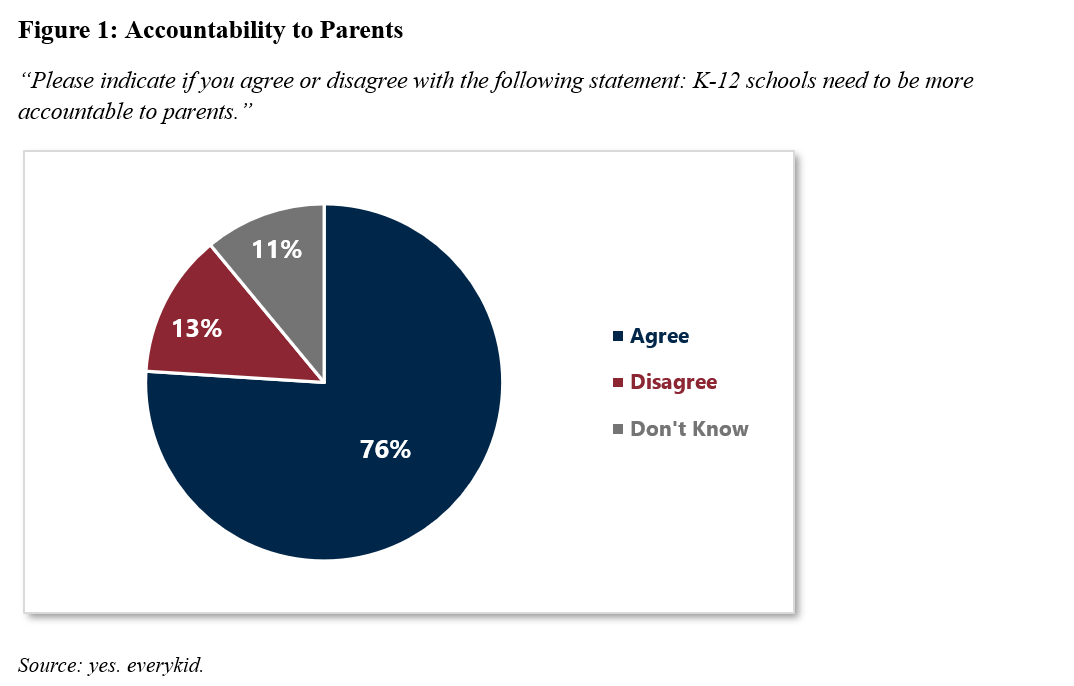
The poll is nationwide, but the results apply to Missouri. Parents want to hold schools accountable, but they need high-quality information to engage.
Our annual Blueprint has consistently emphasized the importance of building informational resources that are both understandable and comparable. Missouri provides some data, but there is no central, user-friendly landing place where parents can easily access and evaluate information about the quality of their children’s schools.
For instance, this data dashboard from DESE reports a number of understandable statistics for the year, but you cannot compare districts to each other. Some DESE sources are difficult to decipher and navigate altogether. And if a parent truly wants to compare districts and years, they will need to break out their Microsoft Excel skills.
Using DESE’s dashboard, a parent can see that 58 percent of Parkway C-2 students scored proficient or advanced in mathematics on the Missouri Assessment Program. But is that good? Isn’t 70 percent usually a passing score? How does it compare to last year? How does it compare to other districts across the state? Should a parent be concerned, or encouraged?
These are all important questions, and sadly, the answers require a lot of digging.
Thankfully, parents can find the answers to these questions on our own website, MOSchoolRankings.org.
There, Parkway C-2 is ranked as one of the better districts in our state: 133 out of 551 overall. In fact, its math score is the 37th best in the state. But it’s not all peachy in Parkway, as its low-income math scores ranked 378th in the state, and the overall mathematics score declined from the prior year. These statistics give meaningful context for parents to more accurately hold schools accountable.
Our website serves as a valuable resource for the state, but DESE ought to provide a similar tool—one that is even more comprehensive and accessible—using the state’s greater manpower and authority.
Taken together, survey data and practical experience point to the same conclusion: Missouri’s education system needs to be more accountable to parents. Achieving that goal requires creating resources that are both understandable and comparable.
Legal Challenge over Belton Housing Project Highlights Flawed Approval Process

A legal battle has erupted over a proposed housing development in Belton, Missouri. Regardless of the lawsuit’s outcome, the case illustrates how the housing approval process enables small but organized opposition to stall or halt development, driving up costs and constraining supply, regardless of planners’ or developers’ intentions.
On December 2, Jabal Companies and Calvary University filed a federal complaint alleging that the City of Belton discriminated in rejecting a proposed 252-unit affordable housing project on city-owned land. The plaintiffs argue that public opposition included racially coded language and that the city council’s decision violated the Fair Housing Act by relying on stereotypes about prospective tenants.
The project was modest in scale, encompassing just over eight acres near Westover Road and Bong Avenue, across from Calvary University and adjacent to a public golf course. Plans included a mix of one-, two-, and three-bedroom apartments, along with amenities such as a pool, playgrounds, and a community clubhouse. The site had remained undeveloped for decades.
Belton’s own community development staff had described the parcel as “an underutilized property not being used for its highest and best use.” The city was expected to contribute nearly seven acres, with Calvary selling an adjacent one-acre parcel. Jabal Companies had already secured low-income housing tax credits and begun engineering and design work.
Public opposition quickly emerged. During rezoning hearings, residents raised concerns about crime, school overcrowding, and declining property values—common themes in debates over subsidized housing. According to the lawsuit, many of these objections, and the council’s response to them, reflected coded language around race and socioeconomic status.
Whether the legal claims succeed remains uncertain. But from a policy standpoint, this case illustrates a broader challenge: what political scientist Francis Fukuyama termed a “vetocracy,” in which a small number of actors can block change, even when there is widespread recognition that change is necessary.
Across the country, similar dynamics play out in neighborhood meetings, zoning boards, and advisory councils. These forums are intended to enhance democratic participation. In practice, they often amplify the voices of politically engaged homeowners who oppose new housing near their properties.
In Belton, the developers spent months working with city officials and cleared several early procedural steps. Yet because no binding approvals had been secured, a single up-or-down vote by the city council effectively killed the project—despite prior staff support and what the plaintiffs contend was a complete and compliant application.
These decisions carry real consequences. Projects that are blocked or delayed leave more families searching for housing that doesn’t exist. Each additional layer of discretionary approval adds uncertainty and expense, discouraging developer investment.
The current system also distorts the market. Developers recognize that affordable housing proposals often face the most resistance and may instead pursue higher-end projects with fewer political risks—or leave the market altogether. Or, as is too often the case, developers seek public subsidies to offset the additional costs of delays and red tape. In contrast, cities such as Raleigh, North Carolina, which have restructured local review boards and relaxed zoning restrictions, have seen measurable increases in “missing middle” housing options such as duplexes and townhomes.
Community input remains essential, and many developers are willing to engage with residents. But Missouri’s approval process, which features duplicative reviews, ambiguous standards, and politicized hearings, is simply too burdensome.
A Free-Market Guide for Missouri Municipalities Part Four: Parks and Recreation

This fourth installment in A Free-Market Guide for Missouri Municipalities series examines how cities provide and manage parks and recreational services. It outlines which park assets are best funded through general taxes and which should rely more heavily on user fees, and explains why those distinctions matter. The report also explores opportunities for outsourcing, contracting, and service sharing to reduce costs and improve service quality, while cautioning against taxpayer-funded facilities that unnecessarily compete with the private sector.
