Unfunded Pension Liabilities: Unaccountable and Unaffordable

A while back a colleague at UMSL approached me in the hallway. In a joking manner she asked, “Hey, why do you want to take away my pension?” A former teacher, she had heard that was my nefarious plan. We had a great conversation about unfunded liabilities and all things pension. Last week she followed up with a question. She didn’t understand how the pension system could be unfunded. When she was a teacher, she and the district each contributed to the account. She was under the impression that she could only get that money plus interest in retirement. She was greatly mistaken. In a defined-benefit pension system, retirees can receive much more in benefits than they ever contribute to the system. Indeed, benefits are essentially unlimited (for the lifetime of the retired teacher).

 You have to understand this aspect of defined-benefit pension systems when you consider the recent report, “Unaccountable and Unaffordable,” produced by the American Legislative Exchange Council. They estimate that state-administered pension plans have more than $6 trillion in unfunded liabilities. That is the difference between the amount we’ve promised workers and how much we have in the retirement accounts to pay for those promises. This figure is up $433 billion since 2016. (These figures use a risk-free discount rate.)

 Missouri ranks 31st in total unfunded liabilities with more than $107 billion across the state’s pension plans. This translates to $17,642 per capita. That is, each Missourian would have to pay more than $17,000 to meet the obligations we’ve already promised. Unfortunately, these liabilities look like they will keep growing.

 I don’t want to take away anything that we’ve promised to a public-sector worker, but we need to realize two things. First, pension benefits are not simply a function of how much workers contribute. Second, we must do something about these mounting unfunded liabilities. Either employees and employers must contribute more (which is asking a lot when they already contribute the equivalent of 29 percent of a teacher’s salary), we must hold down benefits, or we must move to a different system. If we don’t, these unfunded liabilities will eventually wreck Missouri’s finances.

 You can check out the full report here.

 

Is an Audit in the Works for the City of Saint Louis?

A lack of clarity regarding how the City of Saint Louis manages taxpayers’ money has pushed some residents to demand answers. Audit STL, a local activist group, is currently attempting to collect signatures to trigger an audit from the Missouri State Auditor’s office. Because the Saint Louis Metropolitan Police Department was under state control prior to 2013, previous audits of the city have not included the police.

A story in the St. Louis Post Dispatch reports on Audit STL’s concerns:

“Taxpayers have a right to know how their money is being managed, the group [Audit STL] argues, especially because city leaders have asked them to approve half-cent sales tax increases twice in a six-month period.” St. Louis mayor Lyda Krewson added that “This audit will clarify the cost of all city operations so that city leadership can make informed choices. Just like at home, the city can’t afford everything we want, so we must make the hard and difficult choices to fund our priorities.”

Taxpayers certainly have the right to know how their money is being spent. That’s why we have started a checkbook project. Thus far, we have issued over 150 sunshine requests to municipalities all across Missouri for records of their spending. We are currently processing these records and building a searchable database that will be available on our website. Once completed, this checkbook will be a useful tool for concerned citizens across Missouri. 

Residents of Saint Louis have every right to know the details of their city’s finances, and if that requires a state audit, then so be it. Governmental bodies must be accountable to the people they serve, and any serious level of accountability can only be achieved through transparency. 

TIF Doesn’t Create Jobs

Paul F. Byrne, a professor at Washburn University in Topeka, Kansas—who has examined tax increment financing (TIF) use in Missouri for the Show-Me Institute—has a new working paper on TIF job creation in Missouri. In the paper, Byrne examined data from the Missouri Department of Revenue and the U.S. Bureau of Labor Statistics to see if there is a correlation between the claimed job creation from TIF districts and county-wide job growth.

Anecdotally, it appears that TIF doesn’t really create jobs. As we’ve written about the H&R Block TIF and the Power & Light District, TIF doesn’t really create jobs. At most it just moves them from elsewhere in the area. Byrne wondered,

If the number of jobs created by TIF, as reported by TIF administrators, is a true economic impact, then the number of reported jobs should have a positive impact on county employment as measured by the BLS.

Anyone familiar with research on TIF (and not everyone cares about the research) will not be surprised by the results. Byrne concludes,

This paper’s results indicate that the number of jobs supported by TIF, as reported by local economic development agencies in Missouri, does not have a significant positive effect on county employment as measured by the BLS. The lack of a positive impact of reported jobs on employment suggests that TIF-supported jobs either come at the expense of other areas in the county or would have located in the county regardless of the existence of Missouri’s TIF districts.

TIF diverts a lot of money from municipalities that would otherwise go to support schools and basic services. Research from all over the country tells us that it does not create jobs, does not spur investment, and does not mitigate blight. It’s time for reform or elimination altogether. 

I Don’t Think the Data Say What You Think They Say

Much to the consternation of public education officials, the State Board of Education voted to remove the commissioner of education, Margie Vandeven, from her position last Friday. The vote came after a failed attempt to remove the commissioner just a couple of weeks ago. The five members of the board who voted to oust Vandeven were all appointed by Gov. Eric Greitens. This post, however, is not about the maneuvering of the governor to assemble a board that would take this action. This post is about bad evidence.

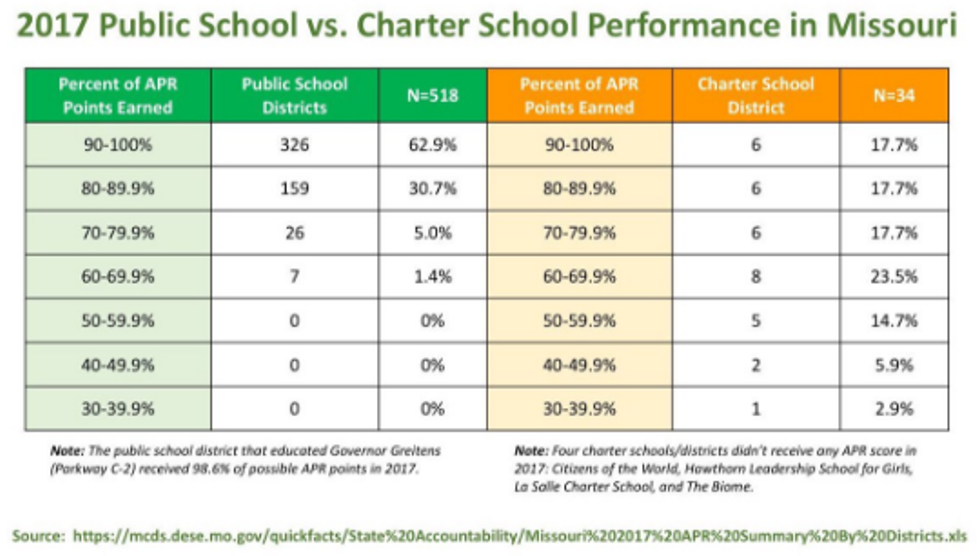
When it became clear that the governor was attempting to remove Vandeven, public educators rallied to her cause. Some defended Vandeven as a competent and well-regarded public servant. Others, however, sought to attack charter schools. They presumed that the whole ordeal wasn’t about Vandeven, but about putting someone in place who would work to expand school choice in Missouri. Several public school administrators tweeted the below graphic. One wrote, “More tax dollars could soon be siphoned to these ineffective schools if @GovGreitensMO gets his way.”

The claim that this chart shows anything meaningful about charter school effectiveness would be amusing if it wasn’t being vigorously advanced by numerous individuals who should know better. Take a look to see what I mean. The table shows a comparison of public school districts performance on the Annual Performance Review with individual charter schools. There are two huge problems with this. First, we are comparing whole school districts with individual schools. Second, it compares districts with schools that serve entirely different types of students. Charter schools in Missouri are only in Saint Louis and Kansas City. It is hardly fair to compare their performance to the Rockwood or Nixa School Districts that serve much more affluent students. 

A better comparison would be to compare charter school performance to the performance of individual schools in Saint Louis and Kansas City. I’ve done that below. As expected, the comparison is much more favorable for charter schools. In total, 58% of Missouri charter schools scored above 70% on the APR. Meanwhile, just 45% of public schools in Saint Louis and Kansas City scored in that range. Interestingly, 13 of the 16 traditional public schools in the top category were magnet schools, as were 6 of the 11 in the next category. These are hardly traditional schools. Neither traditional schools nor charter schools are allowed to have admissions requirements, but magnets can. Some magnet schools require students to take admissions tests and score at a certain level before they can be admitted. 

Given this more accurate context, charter schools appear to be outperforming their traditional public school counterparts. Yet, even this comparison tells us little about the effectiveness of the schools themselves. For that, we’d need a more sophisticated analysis. Fortunately for us, the Center for Research on Educational Outcomes (CREDO) at Stanford University conducted such a comparison. Using a matching design, in which they compare charter students to similar students in district schools, they found Missouri’s charter schools outperformed the district schools in reading and math.

It is understandable for public school officials to defend Margie Vandeven or even for them to oppose charter schools. However, it is not acceptable for them to build their case on misleading data. Let’s have a productive dialogue about public education and school choice in Missouri, and let’s have that conversation by looking at what the evidence actually says. 

Policy Breakfast: No MO Red Tape

Are government regulations blocking the path to growth and job creation? This year, Governor Eric Greitens signed Executive Order 17-03, designed to identify and eliminate red tape and needless regulations. In this presentation, Justin Smith, Deputy Counsel to Governor Eric Greitens, outlines Missouri’s effort to eliminate burdensome rules on business.
 

Computer Science Classes Coming to More Rural Districts, but Much of the State Is Still Left Out

CodeHS, a California-based company, announced a new initiative called Code Missouri that will bring computer science and coding classes to more rural school districts. It’s great news, but unfortunately it will only be available to a few districts in the state.

For the 15 rural school districts that are selected, Code Missouri is an exciting development. CodeHS is going to give these districts its computer science program, training for teachers, the curriculum, and tech support—all for free. Fayette High School, which is near Columbia, is piloting the program, and students there are learning to build their own mobile apps.

The only downside is that there will still be a lot of kids in other rural districts without the opportunity to take these classes. This is not a knock against CodeHS at all; rather, it is a call for Missouri to find a solution for all its students.

Show-Me Institute analysts have written about course access at length, especially how it can help rural schools, and how we already have much of the infrastructure for it. If students across the state could use a portion of their annual per-pupil funding to enroll in courses online or at community colleges, they could learn how to code. More importantly, course access would go beyond computer science and give students the choice to take courses across a wide variety of subjects.

No doubt, these new computer science and coding programs are going to give students in a few, fortunate districts valuable new skills and help prepare them for the future. Since the infrastructure is there and course access would redirect current education spending, what’s stopping us from giving all students in Missouri the same opportunity?

Attendance Matters: Following Up with Riverview Gardens

A little over a month ago, the St. Louis Post-Dispatch reported that two administrators from Riverview Gardens filed separate lawsuits against the district over pressure to falsify attendance data. Since then, the district received a 70.7 percent score on the 2017 Annual Performance Review (APR), marking the third year in a row it scored over 70 percent—the threshold for full accreditation.

While the State Board of Education did not upgrade the district this year, it does not seem there will be a full review of Riverview Gardens’ records by the Department of Elementary and Secondary Education (DESE). The Post-Dispatch’s latest article quotes Sarah Potter, DESE spokesperson, who states that DESE “informally reviewed Riverview Gardens’ attendance data after hearing of the allegations, but didn’t find anything to investigate further.” Based on emails from a records request by the Post-Dispatch, the situation seems to merit a more thorough investigation.

Here are some of the findings from the Post article:

  • The district’s overall attendance rate was 78.8 percent on May 30 after the school year ended, but the district submitted an 81.5 percent attendance rate to DESE. (FYI, the attendance rate is the percentage of students who attend school at least 90 percent of the time.)
  • Riverview Gardens received 10 out of 10 attendance points on the APR for its 81.5 percent attendance rate. If its attendance rate was actually 78.8 percent, it would have received only 6 out of 10 points and the district would have scored 67.9 percent overall on the APR instead of 70.7 percent.
  • Superintendent Scott Spurgeon has denied any wrongdoing and said the district does attendance data clean-ups to ensure the data are accurate. Other Saint Louis area districts, however, say they rarely go back to fix their attendance records but make sure throughout the school year that their records are accurate.

It is possible that the numbers Riverview Gardens submitted to DESE are accurate, and that the district just manages its data differently than other districts. Nevertheless, these emails raise some red flags about its attendance numbers, and they also call into question the accuracy of other records it has submitted to the state.

As I explained in an earlier post, accurate attendance data matters quite a bit. In addition to affecting how much funding the district receives from the state, these numbers also affect the district’s accreditation classification—and consequently, whether students are allowed to transfer to better-performing districts. We must be sure students were not short-changed when Riverview Gardens was upgraded last year from unaccredited to provisionally accredited.

At the very least, shouldn’t DESE do a full audit of the district? Putting aside other issues with the accountability system, we must be confident that the numbers are accurate for the system to have a chance at being effective. Otherwise, failing schools will be let off the hook, ultimately hurting the students who live in those districts. 

Support Us

The work of the Show-Me Institute would not be possible without the generous support of people who are inspired by the vision of liberty and free enterprise. We hope you will join our efforts and become a Show-Me Institute sponsor.

Donate
Man on Horse Charging