About All Those Airport Surveys

Polling indicates that building a new single terminal at Kansas City International Airport is unpopular, yet we seem inundated with surveys that purport to show that opinions are changing. It’s tough to say, because we don’t necessarily know if the information is trustworthy. What we do know, however, is not comforting.

In opinion survey research, the number of people surveyed is less important than randomness. A survey of 2,000 people who themselves decided to complete an online questionnaire, for example, may be less valuable than a survey of 200 people who were contacted at random. Without adequate randomization, survey results may over-represent the views of a group of passionate partisans.

Unscientific survey data—data lacking adequate randomization—has played a big role in the debate about whether or not to build a new single terminal at MCI. Some of it is due to passionate partisans; some of it is due to questionable reporting. Much if not all of it creates the sense that building a new terminal is more popular than it is.

Consider some questionable reporting. The Kansas City Business Journal published a front-page piece indicating that the average TSA wait time at MCI was 29 minutes. Anyone who has flown from Kansas City would be suspicious of that figure, and other average wait times should have suggested to reporters that the data was problematic. (Jacksonville and Phoenix airports both listed an average TSA wait time of zero!). Kevin Koster, who served on the Mayor’s Airport Terminal Advisory Group, was skeptical, and he followed up with his own research (see here and here). In short, the TSA reports that MCI’s actual average wait time was 3.63 minutes. The discrepancy is due to the fact that the Business Journal data came from a website in which travelers report their own wait times without any independent verification. The Business Journal basically relied on an online survey that has little or no scientific validity—perhaps travelers whose wait times were uncharacteristically long were overrepresented among the website’s respondents.

Even some of the other, likely scientifically valid polling that has been reported fails to meet the ethical standards set by the American Association of Public Opinion Researchers (AAPOR) because it does not disclose all the questions asked.

Then there is the Aviation Department’s own online survey. At the City Council’s August 10 Business Session, department officials provided an overview of their presentations to groups across Kansas City about the need for a new terminal. After their presentation (which included a long discussion of the Aviation Department’s own scientifically invalid survey of session attendees), Councilman Jermaine Reed offered a startling admission [starts 19:26],

I can tell you that every time I fly I certainly try to get on the survey and make sure I mark everything bad about the airport. I don’t say anything good. I put no, no, one, one, zero, zero. What can we improve? Everything.  In my comments so … I shouldn’t probably tell you that. If you see the comments it is probably me.

Proponents for a new terminal are aware of public misgivings. Sadly, rather than having the serious and legitimate concerns of skeptics addressed, we have seen favoritism, secrecy, and now questionable polling that creates the misleading impression that the public is on board with their plans. Kansas City deserves better. 

Bevy of Laws Come into Effect Today

It’s August 28th, and for policy nerds — and especially taxpayers — this is an important day. Today is the day that most of the bills passed in the regular session are becoming law, which depending on your perspective and depending on the legislation, could be a great or terrible thing. Missourinet has an excellent rundown of some of the higher profile bills now in effect, and Marshall Griffin also has another excellent summary, with links, at the St. Louis Public Radio website. Check them both out to get a flavor of what is changing.

Have questions or comments about any of these legislative items? Leave them in the comments below. 

Airport Proposals Fly while the Public Feels Grounded

Both Kansas City and Saint Louis are considering major changes to each of their biggest public assets: their airports. While the circumstances of each project are different, the inclination of some officials to avoid public scrutiny may sink both efforts. Regardless of the merits of any proposal, the process must remain open and transparent to taxpayers.

In Kansas City, the effort to spend $1.2 billion on a new single terminal has been limping along for years. Beset from the beginning by self-inflicted wounds from Aviation Department leadership and an aversion to open discussion (Mayor James recently tried to require elected officials to sign non-disclosure agreements about competing bids), the effort now appears to be racing toward a November election. Voter support is in no way assured.

In Saint Louis, a consortium of business interests and former city officials are moving forward with a privatization effort that has yet to be the subject of much public discussion. While free-market solutions are a worthwhile consideration for many public services, market decisions are only as good as the information available.

Why the secrecy over matters that are obviously of great public interest? If Kansas City and Saint Louis are developing good plans for managing, developing, or privatizing their airports, their leaders should be confident that they can defend the plans in the marketplace of ideas. If the plans are flawed, isn’t it better to expose the problems while there is still time to make adjustments?

One thing is certain. The longer deliberations are kept secret, the more the inference will grow that the officials leading the efforts have something to hide. It makes for an inauspicious start for what will, eventually and inevitably, become campaigns for public approval.

It’s a Good Idea for Mizzou to Cover Tuition for Low-Income Students, but the Reason May Surprise You

Earlier this week, the University of Missouri announced that it has created the Missouri Land Grant and Land Grant Honors scholarship programs. Both will cover all tuition and fees for eligible low-income Missouri residents.

I think this is a great idea, for one reason that is obvious, and for another that might be less so.

The obvious reason is that we have a public university system (note that the university’s name for the program harkens back to the “land grant” nature of Mizzou) to provide higher education to bright students who might not otherwise be able to afford it. This intuition is not new in America.

Thomas Jefferson, the father of the University of Virginia, himself wrote of students:

“that they should be called to that charge without regard to wealth, birth or other accidental condition or circumstance; but the indigence of the greater number disabling them from so educating, at their own expence, those of their children whom nature hath fitly formed and disposed to become useful instruments for the public, it is better that such should be sought for and educated at the common expence of all, than that the happiness of all should be confided to the weak or wicked.”

As college costs increase, our universities are pricing out many students who would thrive at them, but simply cannot afford the skyrocketing tuition. This program will work to solve that problem and we should laud it for that.

But the second reason why this program is a great idea is subtler.

In the past, efforts to try and help low income student attend college have had unintended consequences. Typically, states and the federal government have given low-income students scholarships, like Pell grants, or subsidized loans to help defray the cost of education. In response, many universities started to “price” these scholarships into the cost of tuition, banking on the fact that students will automatically be able to pay it, and this has driven up the cost of schooling.

Mizzou’s program is different. Rather than rely on outside funding, Mizzou is footing the bill itself. That means that any increase in the cost of providing an education is borne by Mizzou. This should provide a powerful disincentive for the school to become more expensive.

Now, the devil is always in the details, and the program isn’t launching for another school year, so we won’t know the full scope and effect of the program for some time. But if programs like these are representative of the type of bold thinking that university leaders are engaging in, Mizzou is putting itself on a much better path into the future.

Show-Me Now! How Can We Fix Teacher Pensions?

Is Missouri’s teacher pension system unfair? That’s the question Show-Me Institute’s Distinguished Fellow of Education Policy, James Shuls, asks in his latest essay. Shuls demonstrates how the system makes it possible for some individuals to receive more in benefits than they made in contributions and for others to receive less. Interestingly, teachers in our least-affluent school districts are often the ones getting short-changed. Shuls has proposed some options for reforming the system to make it more fair for all. Read more:

https://showmeinstitute.org/publication/public-pensions/missouris-teacher-pension-system-unfair

Stadium Subsidies, All Over Again . . .

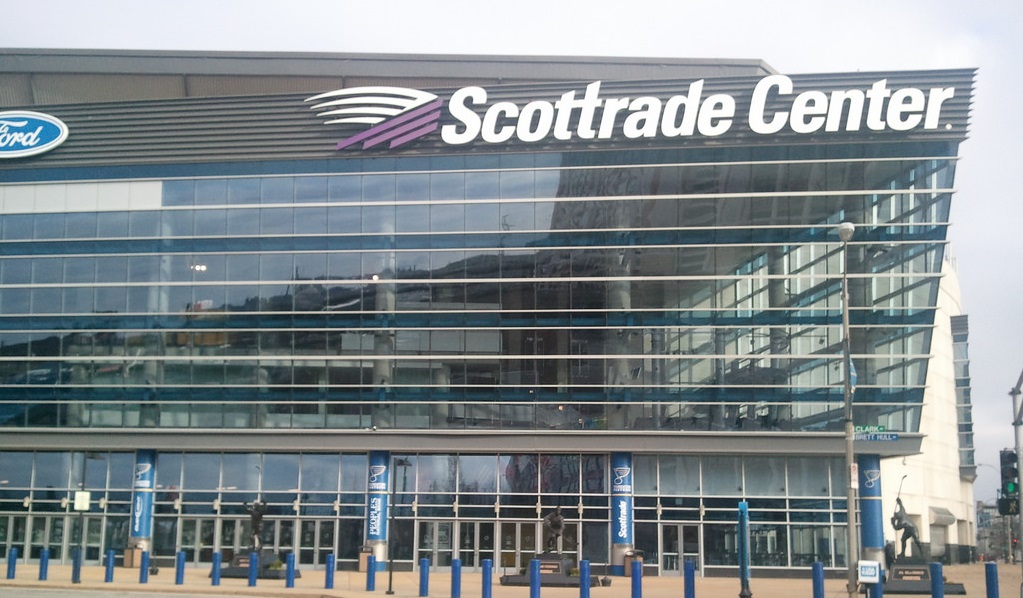
Earlier this year, the Saint Louis Board of Aldermen narrowly approved the issuance of roughly $65 million in bonds to fund improvements at the Scottrade Center. Renovations have begun, but bonds have yet to be issued, and recently a lawsuit was filed against the city and others which alleges that publicly funding improvements to a facility that benefits primarily private interests—the NHL Blues and its ownership—violates the Missouri Constitution. You can read more about the suit here. The Blues have filed a suit of their own, too.

I am not a lawyer, and I have no intention of commenting on the legal merits or demerits of the suit. Rather, I’d like to use this as an opportunity to think about the policy fundamentals underlying the public funding of arenas.

But first, some facts about the current project*:

  • The city owns the property and leases it out for $1 a year.
  • Scottrade currently brings in about $6 million in sales and other tax revenue a year to the city.
  • The bonds would cost the city a total of $106 million over 30 years.
  • Based on projections, renovations will bring in an additional $145 million in tax revenue over 30 years, meaning the city would make a $40 million “profit” over that period.
  • If the facility isn’t renovated, it is projected to generate less and less, finally bottoming out at $4 million a year. (These are just projections from the Scottrade Center’s consultants—click on the link below to see their full 32-year set of estimates).

*For arguments sake, I am assuming the projections are accurate. But, as an aside, these figures were produced by a consulting firm which regularly is off by margins of 50%.  

So what are we to make of the current situation? For one, “investing” in the facility is not a get-rich-quick (or even a get-rich-slow) proposition for the city. Taxpayers could see a much higher return on a similar investment in a diversified portfolio. Alternatively, no taxpayer investment could be made at all, and the city would still see $4 million come in every year.

Nor will investing in Scottrade significantly contribute to urban core revitalization. For one, if the city doesn’t fund these improvements, the facility will not disappear from the face of the earth. In addition, stadiums and mega-events are overwhelmingly considered by economists as poor ways to grow an economy. It is radically unscientific to claim stadiums and arenas are boons for the economy.

Now one might say that the city owns the building, and so, like any decent landlord, should pay to keep things up. This line of thought is understandable (though some claim the city doesn’t own the facility, but just the land it sits on), but it appears misguided. I understand that a landlord has an obligation to keep property in good shape if a tenant pays rent. The Blues pay neither rent nor property taxes. (Sure, events at Scottrade generate sales tax revenue, but that’s an ancillary benefit of the arena, not an excuse to avoid paying for use of the building or for upgrading it.) Plus, many of the slated improvements are things like new scoreboards and sound systems, not just building fundamentals like piping, furnaces, and other mechanical improvements. Demanding the city pay for upgrades is akin to demanding a landlord install big screen TVs for the squatters living on his or her property.

If the Blues have had the facility rent and tax free, and take in all the revenue from NHL and other events it hosts, isn’t it reasonable for them to pay for upgrades themselves? Perhaps the city can help put in new pipes, but is there any good reason for city, and potentially state, taxpayers to fix up a facility that primarily benefits wealthy team owners?

Why is our city so desperate to hand out tax dollars it simply doesn’t have? 

Obamacare’s Total Eclipse of Bad Policy

On Monday, much of Missouri experienced a complete solar eclipse, the last of its kind in the state until 2024, when Cape Girardeau will be ground zero for science geeks. For other areas of the state, the next eclipse will be a tad more distant; Kansas City’s next total solar eclipse will happen early in the 23rd Century, in 2205. Whatever your perspective, though, it can be said with mathematical precision that you can depend on astronomical events like this to happen regularly.

Unfortunately, bad policy can also recur like an eclipse—and sadly, not nearly as infrequently as Kansas City’s two-hundred year solar eclipse cycle.

Seven years ago, Congress passed the Patient Protection and Affordable Care Act (or “Obamacare”) on a party-line vote and into law. Not only has that law disrupted the health care of millions of Americans—particularly rural Americans—but it has doubled down on a broken status quo that puts “insurance” at the center of our health care system rather than care. Forcing people to purchase value-questionable comprehensive insurance plans as a stand-in for actual care has not worked so far, and it will not work in the future.

But what’s especially frustrating is that some of the same folks who made Obamacare the law of the land now want to commit even further to a government-centric approach to health care policy, labeling it “bipartisanship.” I submit that bipartisanship that views government as the white knight of health care is not an appropriate compromise position, nor is it the solution to our country’s health care problems. The market is.

Market solutions to health care require reliable pricing signals established by the transacting parties, not the continued reliance on a third-party negotiator for services that has affected care quality, cost, and access over the last half-century. That means disintermediating insurance in our health care system. It means massively overhauling Medicaid to ensure our most vulnerable receive the care they need and that the program doesn’t bankrupt us in the process. It means clearing the way for people to freely help one another through licensing and regulatory reform. It means, in other words, often doing precisely the opposite of what Obamacare supporters want government to do—rather than get government more involved in our health care, it means getting it less involved.

I hope that good policy won’t be eclipsed by a broken Obamacare health care system that continues to hurt millions of Americans. But I especially hope the bad policies driven by Obamacare aren’t exacerbated yet again by another cycle of bad government-centric policy, now seven years on from its last appearance. We’ve seen these mistakes before, and we don’t really need to see them again.

Support Us

The work of the Show-Me Institute would not be possible without the generous support of people who are inspired by the vision of liberty and free enterprise. We hope you will join our efforts and become a Show-Me Institute sponsor.

Donate
Man on Horse Charging