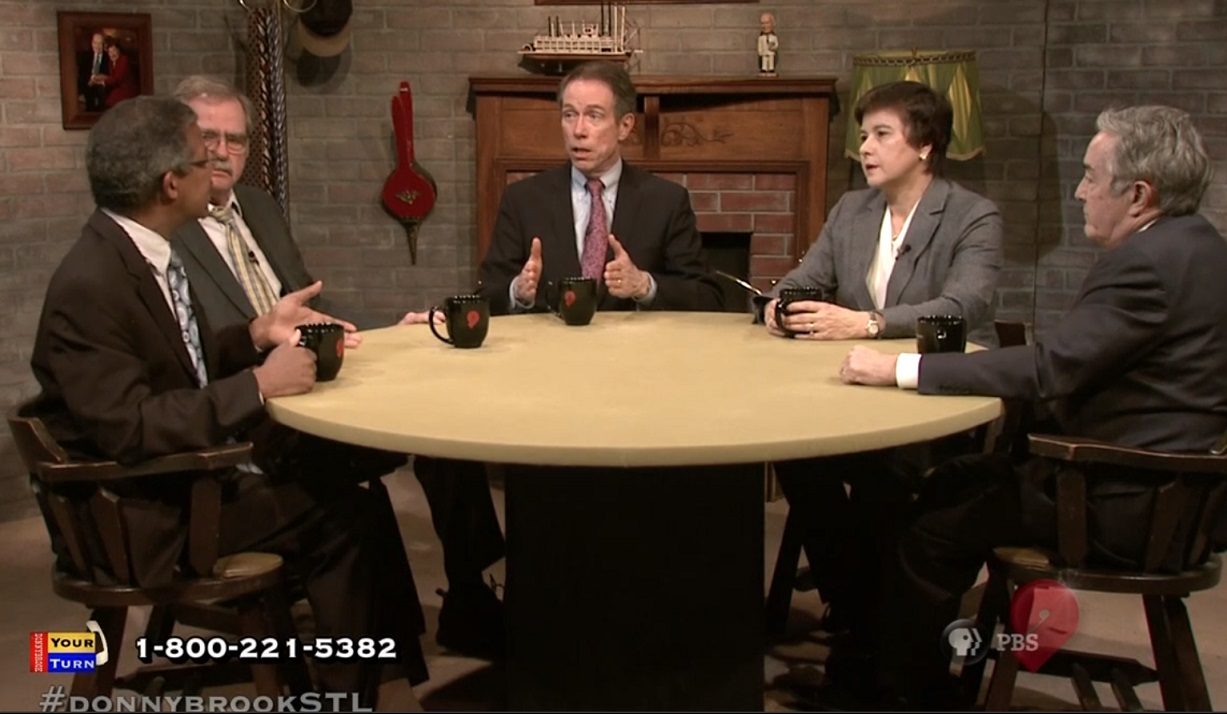
Brenda Talent appeared on ABC 30’s The Allman Report on January 4 to discuss reforms to education, taxes, public sector unions, and regulations.
Is This How Trust Is Regained?
After voters rejected implementing a local use tax in November, the Columbia City Council made it their mission to win back the trust of voters by being wise stewards of taxpayer money. Councilman Matt Pitzer talked about how to go about the task:
We do that by making smart financial and fiscal decisions . . . and being open and transparent in our spending and where the citizens’ tax dollars are going.
This commitment to good government is admirable. So why would the Columbia City Council vote 5-3 in favor of approving the Broadway TIF after the Columbia TIF Commission overwhelmingly voted 8-3 against the proposal?
For several months, a developer who owns The Broadway Columbia Hotel, has been trying to convince the TIF Commission to declare 1104 E. Walnut St. a redevelopment area so that he can qualify to receive $2 million in taxpayer subsidies to expand. To support this effort, the developer claimed in his development plan (pp. 4–5) that the building meets the “Conservation Area” criteria for TIF eligibility because it is 56 years old and “displays obsolescence due to age, ongoing vacancy, and deferred maintenance of external items like the roof and gutters.”
Furthermore, the developer claimed in testimony provided to the TIF council on October 30 that while not blighted yet, the redevelopment area may qualify due to excessive vacancies, litter, and alcohol containers on the grounds. Should taxpayers be asked to pick up the tab for cleaning the area up, or should it be the responsibility of the property owner?
The developer also noted that without TIF assistance, potential investors and lenders said they would not be willing to join the project because the financial risk would be too great. And yet, in a letter sent to the commission, the Boone County Auditor pointed out that “just a few blocks west of the parcel in question . . . a multi-story office building is currently under construction [and] is proceeding without TIF financing on a smaller lot than the subject lot, and at a significant investment … of several million dollars.” If similar projects can proceed without subsidy, then can’t this one as well?
Finally, the Boone County Assessor has warned that over its 23-year life, the TIF arrangement would divert $4.3 million away from schools, libraries, and municipal services—but the hotel expansion is projected to produce only $695,000 in tax revenue. Proponents say this diversion of money will lead to job growth. However, this argument is at odds with multiple studies that have concluded that TIF has no demonstrable effect on job creation. Is this the sort of smart fiscal decision-making that is supposed to regain the trust of the voters?
Last year, the Missouri Legislature passed a law stating that if a city passes a TIF over the objection of a TIF commission, then the money raised from it can only be used towards the demolition and clearing of the site. Unfortunately, the law only applies to Saint Louis County, Saint Charles County, and Jefferson County. Maybe it’s time to include Boone County—or the rest of Missouri—under the law.
Want Better Hotels? Then Support a Free and Open Market
One accomplished hotelier believes that “Airbnb is a mortal threat to the U.S. hotel industry. The only way you can compete with a strong idea is by having another strong idea.” While the hotel industry seems to believe the first part, they are using their political influence rather than good ideas to stamp out Airbnb and other short-term rental (STR) companies. That battle is coming to Missouri.
The author of the quote above is Ian Schrager, creator of boutique hotels and nightclubs, including Studio 54. In a recent Wall Street Journal piece, Schrager talks about the threat and how he is designing hotels to maximize efficiency and deliver a superior service to modern customers. Unfortunately, rather than innovate, some hotels are seeking to use the power of government to thwart competition. And governments are too often willing to do their bidding.
According to The New York Times, the American Hotel and Lodging Association trade group has launched a “multipronged, national campaign approach at the local, state and federal level.” One document shows that the group seeks to work with “a broad coalition of affordable housing advocates, community groups, neighborhood associations, labor, and other progressive entities.” The entire document is worth reading.
We’ve already seen some of this play out in Missouri, although the AHLA document does not cite efforts in the Show-Me State. Some neighborhood association activists have raised unsubstantiated fears about increases in crime. Kansas City’s own Planning and Development Department is exaggerating complaints against short-term rentals such as Airbnb. If Kansas City wants to present itself as a tech-friendly millennial magnet, it ought not keep fighting tech innovations such as Uber and Airbnb. Yet fight them it does.
In the 2017 legislative session, HB608 was an effort to pre-empt the current hodge-podge of municipal regulation that is being driven by the hotel industry’s concerns. The bill kept political subdivisions from imposing fees or prohibiting short term rentals outright, while permitting those subdivisions to impose “reasonable regulation” to “protect the public’s health and safety.” It may have been this last part that doomed the effort, as supporters of STRs feared that “reasonable regulation” was too broad a concession. As of this writing, January 4, there does not appear to be a similar bill proposed for 2018.
More recently, Airbnb announced a deal with Missouri in which it would start collecting and remitting state and local taxes on behalf of their owners. In their statement they estimated this would amount to $1.1 million in tax revenue.
New internet platforms such as Airbnb and VRBO (Vacation Rentals by Owner) offer great opportunities for consumers and for business innovators like Schrager who are up to the task. The churn of the free market—although sometimes ugly in the short term—is the reason why our country enjoys so many technological advantages and conveniences. Allowing big business to use its influence over government to thwart innovation by protecting existing markets isn’t just bad for Airbnb, it’s bad for hotels, government revenue, and consumers.
Some Thoughts on Regulating Airbnb
Kansas City wants to present itself as tech friendly and forward looking, yet too often city leaders stand in the way of innovation. The city stumbled with its effort to welcome ride sharing technology such as Uber and Lyft, but we have another opportunity with short-term rentals (STRs). If we do this right, Kansas City could not only see increased home values, but spur development and be a leader for other cities to follow.
On January 17, Kansas City’s City Council will again consider an ordinance regulating STRs such as Airbnb and VRBO (Vacation Rentals by Owner). Some neighborhoods are fearful of change, but there are great opportunities for all homeowners. Failure to think anew could create an uneven and potentially unconstitutional patchwork of regulations that harm consumers and property owners.
STRs have been illegal in Kansas City since 2011, but the City has chosen to overlook infractions and instead work on regulations allowing for STRs. STRs themselves are nothing new. What is new is the ease of finding and booking them thanks to Internet platforms such as Airbnb and VRBO. In the view of some homeowners, STRs amount to boarding houses and would irrevocably change the character of their communities from owner-occupied neighborhoods to more transient rental tracts. But research does not support that fear.
Protecting neighborhood character may sound good, but it is too broad to be a meaningful standard for regulation. As for fear of crime, there is no research that shows a causal relationship between criminal activity and STRs. In fact, studies have found that an increase in STRs increases property values in the surrounding areas. This shouldn’t be a surprise. People who seek to make a living off their homes have every reason to maintain the property and keep it attractive—and the income they receive from STRs helps them do so.
Cities like ours have plenty of housing codes to address issues that might arise from STRs. But there appear to be few actual problems. A public records request of the City Planning and Development Department uncovered only 68 complaints going back to 2014. Fifty-four of them simply noted that the location is being used for Airbnb or a STR, as opposed to specific complaints about noise or crime.
Meanwhile, Kansas City is host to hundreds if not thousands of long-term rental properties. Those homes do not require substantially different regulation—owners are not required to get permission from neighbors or pay additional fees or taxes. What’s more, once a unit is rented, there is little incentive to maintain the property—think of the stereotypical negligent landlord. STRs have the opposite impact by maintaining an incentive to be a good host and neighbor.
Those incentives are important. It is in the interest of every STR owner and every online platform to make sure that the experience is positive for everyone. Airbnb wants happy and safe customers; owners want respectful and well-behaved guests. Neighbors should see the opportunity for better-maintained and higher-valued neighborhoods.
The big problem with an outright ban, at least according to Jamila Jefferson-Jones of the UMKC School of Law, is that it amounts to an unconstitutional restriction on an individual’s property rights. Cities may be able to regulate the industry, but they may not be able to stop it.
Some regulation may be welcomed by STR owners. Airbnb recently announced it would collect and remit state and local taxes on behalf of their owners. Perhaps a nominal registration fee is warranted as well. People living in apartments or condominiums may want assurances that common areas remain secure. But using the power of government to stamp out a new aspect of the sharing economy is unwise and likely unworkable.
If Kansas City wants to be seen as an innovation leader, it needs to welcome new opportunities. Opening ourselves to short term rentals is a good way to do so.
What Is the Cost of ‘Raising the Age’?
On December 1, legislation was prefiled that would raise the age of criminal responsibility to 18 years old rather than 17 in Missouri. Currently, our state is only one of five where 17-year-olds are automatically prosecuted as adults no matter the crime. This new legislation would place them in the juvenile justice system unless—due to their history or the nature of the crime—they are certified as an adult by a judge.
Giving judges this discretion should reduce concerns that offenders will be let off the hook too easily. Repeat offenders, or those whose crimes are especially serious, could still be dealt with appropriately. Meanwhile, the juvenile justice system could handle the others, which could benefit both the teens and the state.
One concern about this policy is the cost. Based on the fiscal note for similar legislation introduced during the last legislative session, placing more teens in the juvenile system would cost an additional $6.715 million per year. Dr. David Mitchell, an economics professor from Missouri State University, used an alternative cost calculation in a paper he presented at a recent Raise the Age panel discussion.
He argues that even though the per-person/per-year cost is higher in the juvenile system than in the adult prisons, 17-year-olds sent to adult prison spend more time behind bars, on average, than they would if they were in juvenile detention centers. Thus, the cost savings would be higher for the Department of Corrections than originally estimated and the net burden on the state would be closer to $2.432 million per year. He also points out that this amount is only .008% of the state’s budget.
So the cost of this policy to the state would be less than previously assumed. The benefits, however, could be large according to Dr. Mitchell’s estimates. Based on several factors, there could be long-term economic gains from placing most 17-year-olds in the juvenile system.
First, teens convicted of crimes have better earning potential if they go through the juvenile system. Studies have found that teens who have been in adult prison have a 20 percent lower chance of being employed after they are released and work 25 to 30 percent fewer hours if they do manage to find a job. On the other hand, teens who were convicted of a crime but did not go to an adult prison had almost as good a chance at finding a job as teens who did not commit a crime at all.
Second, there is a large disparity in recidivism rates between the juvenile system and the adult system. In Missouri, the recidivism rate for youthful offenders coming out of the adult prison system is about 67 percent, whereas the rate for those coming out of the juvenile system is 15 percent.
With these two factors in mind, placing most 17-year-olds into the juvenile system could be fiscally beneficial to the state. They would be more likely to have a job and be paying taxes (money gained for the state) after serving their sentences, and less likely to end up back in jail (less money being spent by the state).
It’s impossible to know exactly how much raising the age could save the state, but Dr. Mitchell’s analysis indicates that it would be a worthwhile investment. With such a small upfront cost and potentially large long term gains for the state—not to mention positive impact on these teens’ lives—shouldn’t Missouri join the vast majority of states with this sensible reform?
A New Year’s Resolution for Education Reform
A new year and a new legislative session are upon us, and with them, most likely the same old debates over school funding. A new study from EdChoice, however, could help reshape conversations in Missouri by showing that in general, people greatly underestimate how much we spend on education.
So just how much do we spend per student each year? This survey found that only 11 percent of people selected the correct range of $8,000 to $12,000. In fact, the national average is a little over $11,000, while Missouri spent on average $10,899 per student for the 2016–2017 school year.
Nevertheless, 31 percent of respondents thought America spends less than $4,000 on each student every year, while 29 percent did not know or did not want to answer.
Then the survey asked if people thought we spend too much or too little on education. For this question, however, half of the respondents were given the actual spending figure and half were not. Here are the results:
| Too high | About right | Too low | Don’t know/did not answer | |
| Split A: Without information | 11% | 28% | 54% | 7% |
| Split B: With information | 19% | 32% | 38% | 11% |
Source: EdChoice, “2017: Schooling in America.”
When presented with the real numbers, the proportion of those who think spending is “too low” fell significantly. So when people say that our schools are underfunded, it seems that many base their opinion on estimates of actual spending that are too low.
Too often, our debates over education policy get hung up over funding even though many of us lack a clear picture of how much we are spending now, let alone how much should be spent. If we want to accomplish meaningful education reform in 2018, resolving to have informed discussions about spending would be a good place to start.
Happy New Year
What’s in a Name?
A prefiled bill that is only 49 words long may go a long way to deter politicians from spending public funds on personal legacy projects.
House Bill 1235 simply adds the following language to Missouri statutes:
No state land or building shall be designated in honor of an individual unless such person has been deceased for more than two years. This section shall not apply if money is donated to a state entity in exchange for the right to name state land or buildings.
If former U.S. Senator Christopher “Kit” Bond wants to give his own money to Missouri to build a bridge, or former Governor Jay Nixon wants to reach into his own pocket to build a state park, that’s fine. But spending taxpayer dollars is different, and rewarding individual politicians for doing their official duties by naming public assets after them—at least while they’re still alive—seems a questionable practice at best.
In fact, why not extend the same restriction on all political subdivisions. To me, Emanuel Cleaver II Boulevard is just . . . tacky. Shouldn’t taxpayers be confident that those who spend their money are not seeking fame and self-aggrandizement? House Bill 1235 helps get us there.
This is a revised version of the original post.