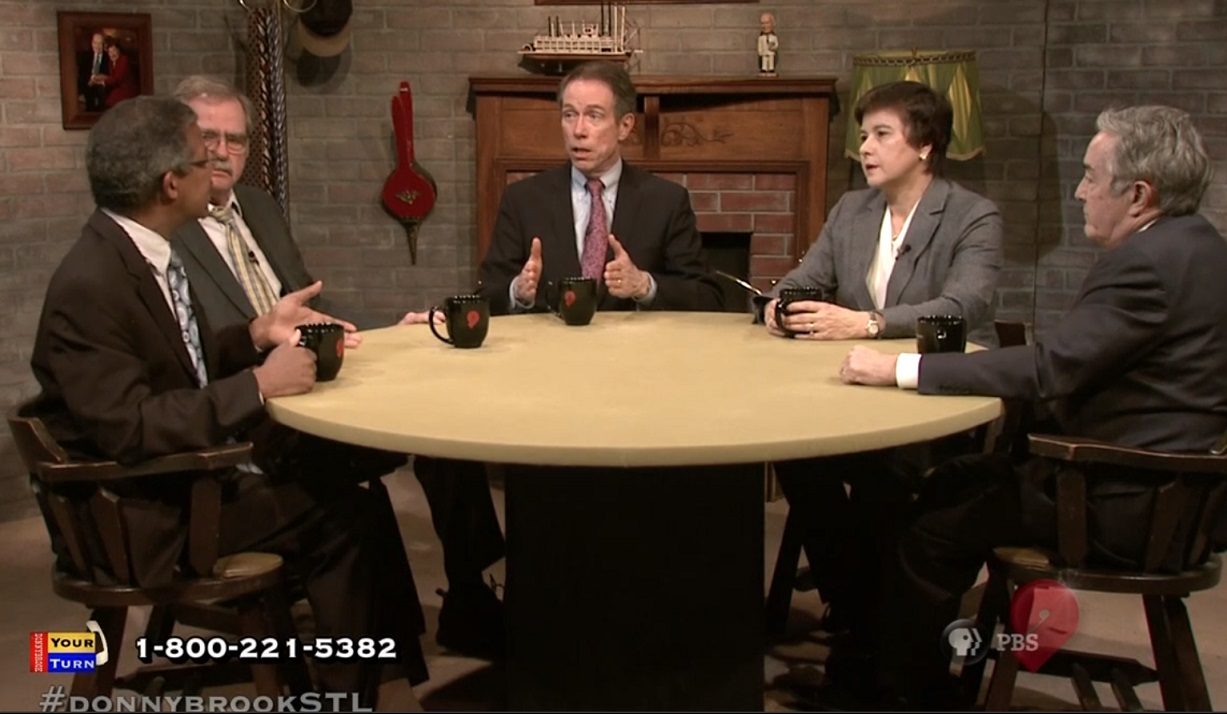
Brenda Talent Discusses Saint Louis County Budget on KETC’s Donnybrook

On December 21, Show-Me Institute CEO Brenda Talent appeared on Saint Louis Public Television’s Donnybrook to discuss cuts to Saint Louis County’s budget, the selection process for a new Saint Louis City police chief, state government transparency, a complete smoking ban in Saint Louis County, and other state and local issues. 

More Research on Food Deserts

I’ve written here before, skeptically, of the plans to address the so-called food desert on Kansas City’s East Side. Specifically, the plan to spend millions of dollars to subsidize a SunFresh grocery store is unwarranted and a waste of taxpayer funds. I’ve documented research that shows that nutritional inequality is not a function of distance from a grocery store. New research is bearing this out.

A study released this month from the National Bureau of Economic Research examines food inequality with an eye toward quantifying the impact of grocery store location. The paper concludes:

We find that equalizing supply would close the gap in healthy eating between low- and high-income households by less than ten percent. After separating out supply variation, the descriptive correlations in our final section show that education and nutrition knowledge predict healthy grocery demand and explain non-negligible shares of the relationship between income and healthy grocery demand. For a policymaker who wants to help low-income families to eat more healthfully, the analyses in this paper suggest that improving health education—if possible through effective interventions—might be more effective than efforts to improve local supply.

There are several nonprofit organizations in Kansas City working to address the issues of nutrition in the urban core, including Rollin’ Grocer and Kanbe’s Markets. If there is a market for healthy food, these efficient, private efforts are much more likely to succeed than a single, multi-million-dollar box store.

City leaders may get to point to a new, revived grocery store and shopping center as a result of their political largesse. But a subsidized grocery store won’t create much new interest in eating healthy—it is more likely to merely draw traffic away from other businesses that contribute to the local tax base.  It will also consume public funds that would otherwise go to support infrastructure and, ironically, education. If food deserts are real, they are psychological, not geographical. A taxpayer-funded Sun Fresh won’t do much but get in the way.

NoMORedTape Respondents Seek Hundreds of Regulatory Reforms

In contrast to this Columbia Missourian story about the NoMORedTape regulatory reform project, I take a much rosier view of how the state’s regulatory outreach project is doing. So far, hundreds of sections of regulation are explicitly cited in the NoMORedTape data as needing reform, and while it would be accurate to say that a lot of people want no change on one issue — puppy mills — it is also true, and enormously important to note, that a lot of people want a lot of change on a lot of other regulatory issues.

I was a little disappointed that the Missourian also went out of its way to portray many NoMORedTape respondents as somehow not grasping the purpose of the site, incharitably citing some of the least informed comments in its article while omitting serious responses. Indeed, I’ve found the vast majority of the comments to be enlightening.

Comments like:

I did not renew my minority women status because they made it so difficult. Faxes are no longer acceptable and the instructions were in a format that I could not open. When I used the password given me it was not acceptable. I gave up because I had no more time to spend on it.

And:

“Certificate of Need” process makes developing critically needed Senior Living buildings a political instead of market-based process. It is costing Missouri many millions of dollars of development. Our $35,000,000 development was just denied Monday in Jefferson City by anti-competition, anti-market political forces. Eliminate the “Certificate of Need” process entirely like almost ALL other states in our Union.

And:

Currently the Missouri Dept. of Elementary & Secondary Education has too strict of rules for teacher and administrator certification, specifically for CTE professionals. In a time when we need more qualified candidates, they are often discouraged by the process.

And:

The University requires vendors to have Liability insurance that covers the University Curators. We print t-shirts, when has anybody sued over a t-shirt? 4 million dollars of liability insurance! This increases our costs and limits the smaller players or unnecessarily burdens the smaller players.

And so on.

Point being, regulatory reform is a serious issue that many serious people take seriously. I hope that public colloquy projects, like NoMORedTape, become more common, not less so, and I appreciate the public policy dividends NoMORedTape has already realized by engaging the public as it has.

Tax Cuts And Jobs Act Passes

As its details became clearer, we talked a lot over the least few weeks about the policy ideas that underpin the federal Tax Cuts And Jobs Act. The bill reduces taxes on individuals and corporations, nearly doubles the standard deduction, and reins in some of the itemized deductions that historically have tended to favor a cavalcade of special—and oftentimes wealthy—interests. I would have liked to see steeper cuts to the state and local tax (SALT) and mortgage deductions, but with the passage of the tax reform bill yesterday, we will have to save those fights for another time.

Congress approved a sweeping $1.5 trillion tax bill on Wednesday that slashes rates for corporations, provides new breaks for private businesses and reorganizes the individual tax code.

The Senate passed the GOP bill early Wednesday morning and the House then voted on it for a second time to fix technical problems with the legislation, the final step before it’s sent to President Donald Trump for his signature.

According to the Tax Policy Center, 8 out of 10 Americans will see their taxes reduced under the finalized bill, including the vast majority of middle income earners. It also sounds like entitlement reform could be coming soon to pair any long-term revenue reductions from this tax relief with long-term spending reductions, as well. Entitlement reform should have happened with or without tax reform, obviously, but that the two issues are being talked about in the same breath now is a positive development for supporters of good, sustainable governance.

But let’s not forget one other big development in the tax reform bill: starting in 2019, the end of Obamacare’s mandate penalty/tax.

The individual mandate was included in ObamaCare in part to draw young and healthy people to sign up for insurance in the marketplaces as a way to offset the costs of older and sicker enrollees.

Still, not everyone agrees that the measure has worked as intended, with some saying the mandate hasn’t been as effective as originally thought to entice people to buy health insurance.

“Today, we’re turning Obamacare from a mandatory program into a voluntary program and providing additional tax relief for the millions and millions of Americans who have chosen and will choose not to buy a government-mandated product that for them provides not the value that they want,” Sen. John Barrasso (Wyo.), the No. 4 Senate Republican, told reporters on Tuesday.

To me as a Millennial, the functioning of Obamacare’s mandate was a particularly objectionable piece of that bill that used younger, generally poorer Americans to subsidize everyone else in the individual market. It’s why so many young people instead risked not getting the insurance at all, especially as the premiums on the plans available to them exploded year after year. 

In the end, while I’d like to have seen more from the bill—and frankly, more from this year, including a full repeal of Obamacare—the passage of the TCJA is a welcome win in what could otherwise have been a dicey year for supporters of free market reform. 


Unfunded Pension Liabilities: Unaccountable and Unaffordable

A while back a colleague at UMSL approached me in the hallway. In a joking manner she asked, “Hey, why do you want to take away my pension?” A former teacher, she had heard that was my nefarious plan. We had a great conversation about unfunded liabilities and all things pension. Last week she followed up with a question. She didn’t understand how the pension system could be unfunded. When she was a teacher, she and the district each contributed to the account. She was under the impression that she could only get that money plus interest in retirement. She was greatly mistaken. In a defined-benefit pension system, retirees can receive much more in benefits than they ever contribute to the system. Indeed, benefits are essentially unlimited (for the lifetime of the retired teacher).

 You have to understand this aspect of defined-benefit pension systems when you consider the recent report, “Unaccountable and Unaffordable,” produced by the American Legislative Exchange Council. They estimate that state-administered pension plans have more than $6 trillion in unfunded liabilities. That is the difference between the amount we’ve promised workers and how much we have in the retirement accounts to pay for those promises. This figure is up $433 billion since 2016. (These figures use a risk-free discount rate.)

 Missouri ranks 31st in total unfunded liabilities with more than $107 billion across the state’s pension plans. This translates to $17,642 per capita. That is, each Missourian would have to pay more than $17,000 to meet the obligations we’ve already promised. Unfortunately, these liabilities look like they will keep growing.

 I don’t want to take away anything that we’ve promised to a public-sector worker, but we need to realize two things. First, pension benefits are not simply a function of how much workers contribute. Second, we must do something about these mounting unfunded liabilities. Either employees and employers must contribute more (which is asking a lot when they already contribute the equivalent of 29 percent of a teacher’s salary), we must hold down benefits, or we must move to a different system. If we don’t, these unfunded liabilities will eventually wreck Missouri’s finances.

 You can check out the full report here.


Is an Audit in the Works for the City of Saint Louis?

A lack of clarity regarding how the City of Saint Louis manages taxpayers’ money has pushed some residents to demand answers. Audit STL, a local activist group, is currently attempting to collect signatures to trigger an audit from the Missouri State Auditor’s office. Because the Saint Louis Metropolitan Police Department was under state control prior to 2013, previous audits of the city have not included the police.

A story in the St. Louis Post Dispatch reports on Audit STL’s concerns:

“Taxpayers have a right to know how their money is being managed, the group [Audit STL] argues, especially because city leaders have asked them to approve half-cent sales tax increases twice in a six-month period.” St. Louis mayor Lyda Krewson added that “This audit will clarify the cost of all city operations so that city leadership can make informed choices. Just like at home, the city can’t afford everything we want, so we must make the hard and difficult choices to fund our priorities.”

Taxpayers certainly have the right to know how their money is being spent. That’s why we have started a checkbook project. Thus far, we have issued over 150 sunshine requests to municipalities all across Missouri for records of their spending. We are currently processing these records and building a searchable database that will be available on our website. Once completed, this checkbook will be a useful tool for concerned citizens across Missouri. 

Residents of Saint Louis have every right to know the details of their city’s finances, and if that requires a state audit, then so be it. Governmental bodies must be accountable to the people they serve, and any serious level of accountability can only be achieved through transparency. 

TIF Doesn’t Create Jobs

Paul F. Byrne, a professor at Washburn University in Topeka, Kansas—who has examined tax increment financing (TIF) use in Missouri for the Show-Me Institute—has a new working paper on TIF job creation in Missouri. In the paper, Byrne examined data from the Missouri Department of Revenue and the U.S. Bureau of Labor Statistics to see if there is a correlation between the claimed job creation from TIF districts and county-wide job growth.

Anecdotally, it appears that TIF doesn’t really create jobs. As we’ve written about the H&R Block TIF and the Power & Light District, TIF doesn’t really create jobs. At most it just moves them from elsewhere in the area. Byrne wondered,

If the number of jobs created by TIF, as reported by TIF administrators, is a true economic impact, then the number of reported jobs should have a positive impact on county employment as measured by the BLS.

Anyone familiar with research on TIF (and not everyone cares about the research) will not be surprised by the results. Byrne concludes,

This paper’s results indicate that the number of jobs supported by TIF, as reported by local economic development agencies in Missouri, does not have a significant positive effect on county employment as measured by the BLS. The lack of a positive impact of reported jobs on employment suggests that TIF-supported jobs either come at the expense of other areas in the county or would have located in the county regardless of the existence of Missouri’s TIF districts.

TIF diverts a lot of money from municipalities that would otherwise go to support schools and basic services. Research from all over the country tells us that it does not create jobs, does not spur investment, and does not mitigate blight. It’s time for reform or elimination altogether. 

Support Us

The work of the Show-Me Institute would not be possible without the generous support of people who are inspired by the vision of liberty and free enterprise. We hope you will join our efforts and become a Show-Me Institute sponsor.

Donate
Man on Horse Charging