
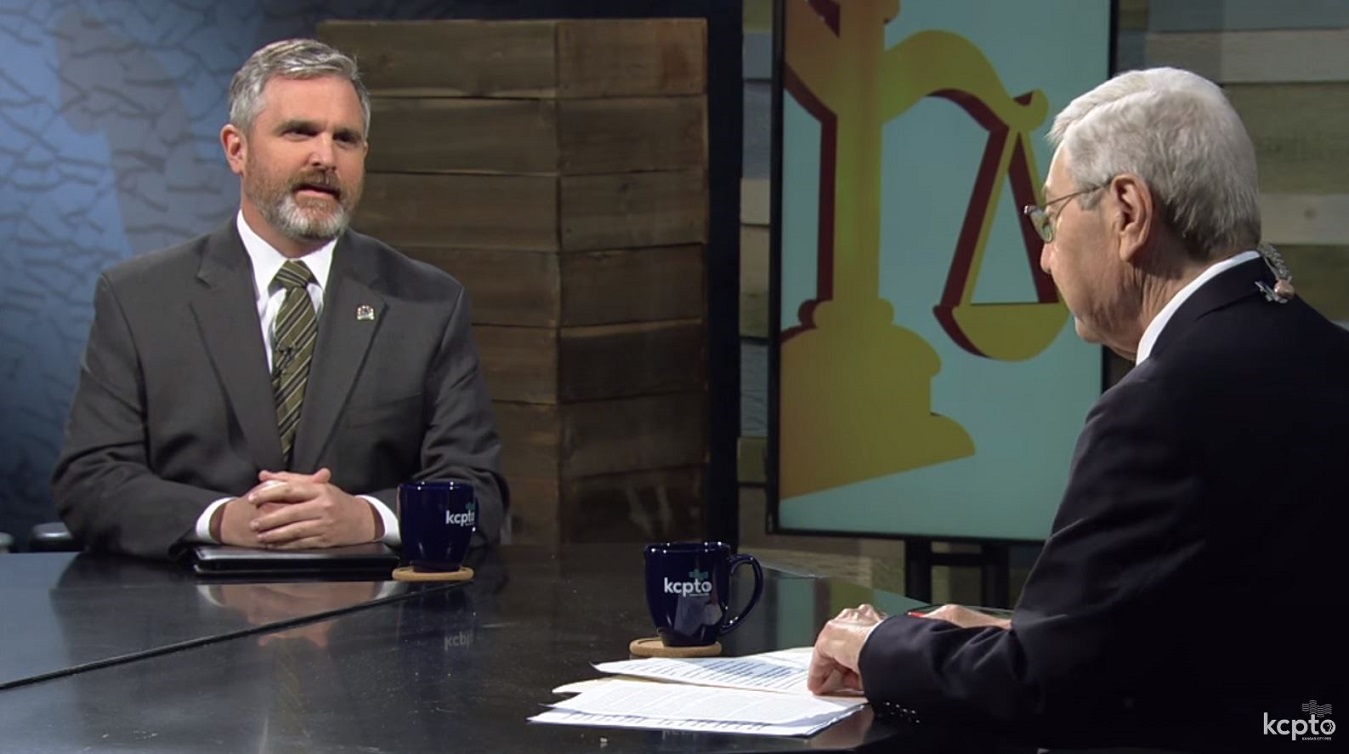
On Thursday, May 17, the Show-Me Institute’s Patrick Tuohey appeared on KCPT’s Ruckus to discuss multiple issues facing Jackson County, debate over the local impact of the Sprint merger, and other state and local issues.
Government Union Reform Passes the Legislature

Meaningful labor-reform legislation is on its way to the Governor’s desk. Last night the Missouri Senate passed an amended version of House Bill 1413, and this afternoon the House passed it as well, sending it to the Governor. Put briefly, HB1413’s transparency and accountability measures will go a long way to ensuring that the interests of both government employees and taxpayers are protected. Show-Me Institute analysts have talked about these issues extensively over many years—including, for example, union recertification, financial transparency, and paycheck protection—and I’m delighted at least one substantive version has finally made it across the finish line.
In contrast to private unions, government unions are often uniquely positioned to choose the parties they will negotiate with when they collectively bargain. Accordingly, it is incumbent on policymakers to ensure that workers subject to these agreements have their voices heard, and for taxpayers’ interests in transparency and stewardship to be protected throughout these processes.
And to reiterate, at one time there was a broad consensus on the problems that government unionization would impose on good governance objectives. Indeed, the Show-Me Institute’s concerns about government unions are not dissimilar to those of Franklin Delano Roosevelt, who said that “[a]ll Government employees should realize that the process of collective bargaining, as usually understood, cannot be transplanted into the public service.”
The reforms contained in HB1413 represent a move toward good governance and better, more responsive representation for government employees. While more will need to be done in the future, passage of HB1413 addresses many of the concerns that Show-Me Institute analysts have raised about state labor policy over the years. Congratulations to the legislative leaders who made this happen.
Finally, a Victory for Parents and Students in Missouri

The doors to a better education may have opened wide for all Missouri students this week. Despite a distracted legislative session—and with just three days left—the Missouri legislature voted to give every student access to tuition-free online courses and a virtual schooling program. For years researchers at the Show-Me Institute have been pressing the legislature to give every student in the state free access to online classes through the Missouri Virtual Instruction Program, or MoVIP. This week it finally happened and, if not vetoed by the Governor, it will be a win-win for students and schools.
We know that it can be challenging for small communities to find Calculus, Physics, or AP teachers for their high schools. But we also know that there are bright and talented students all across the state who deserve, at the very least, the opportunity to take the courses required to apply to the University of Missouri. The legislature has cleared the way for students and parents to be able to sit down with their school counselor, figure out what classes they need, and seamlessly register to take those courses either in the building or online.
Students will also be able to enroll in MoVIP as full-time virtual students. This can be a game-changer for rural students, students who are being bullied, and for others who want options beyond their assigned public school. Providing more options for students and parents is essential to making sure that all Missouri students can reach their potential, and course access is one way to do that.
Researchers and analysts at the Show-Me Institute have traveled to Jefferson City multiple times to provide testimony on this important issue. We’ve included it in our legislative Blueprint for the last two sessions, we’ve written blog posts and essays, we’ve talked about it on the radio, and we’ve produced a video on why Missouri students deserve to have their school districts provide free access to courses that the districts are unable or unwilling to offer. It is truly a victory for Missouri families that course access is so close to being a reality.
Of course, good policy requires good implementation. The new law requires every school district and charter school to inform parents and students of their new rights under this legislation, including adding it to all registration documents and home pages. In addition, the legislation has guardrails in place to make sure that students’ progress is monitored and that they are on track with the coursework. Both of these safeguards are critical to the success of this legislation.
If this law becomes final, we will follow the progress on the implementation closely to make sure that it gets done and done right. We will also help let Missouri families know that their education choices have been expanded. But we won’t stop working to give parents even more options – from education savings accounts to charter schools in any district. For now, though, it’s time to recognize a job well done by the Missouri legislature.
The Government Shouldn’t Mandate a “Living Wage”

On the last Monday of the legislative session, almost 90 people were arrested in downtown Jefferson City for blocking a street while protesting for economic and racial justice. The group identified itself as the Poor People’s Campaign, and one of its major goals is to raise the minimum wage. Its website states, “We demand the immediate implementation of federal and state living wage laws that are commensurate for the 21st century economy…”
Here at Show-Me Institute, we have written extensively about raising the minimum wage: how it increased unemployment and decreased hours worked in Washington D.C. and Seattle (here is a closer look at Seattle), how it would harm Kansas City workers, and why it actually hurts low-income and low-skilled workers the most. Let’s not forget how a “living wage”—usually pegged at $15/hour—would cost Missouri up to 218,000 jobs according to one study.
Moreover, the American Enterprise Institute put out a study just last month that showed how recent state minimum wage increases that were over a dollar decreased employment among low-skilled workers. Despite all of this evidence, there is still an initiative in Missouri to put a $12/hour minimum wage on the November ballot.
Wanting to improve the lives of poor Missourians is a noble goal, but there are better policies than mandating a higher minimum or “living” wage. For instance, implementing an earned income tax credit in Missouri and pursuing occupational licensing reform could open the door to higher incomes without negatively affecting employment. If organizations like the Poor People’s Campaign really want reforms that will help low-income Missourians, they should abandon the minimum wage and pursue more economically sound policies.
Research on School Choice Nets Prize for Economist
Somewhere, Milton Friedman is smiling. Last month the American Economic Association announced that Parag Pathak, an economist from MIT, is the recipient of the 2018 John Bates Clark Medal. Each year this award is given to the most impressive economists under forty. Historically, the winners—including Dr. Friedman—have had about a one in three chance of winning the Nobel Prize in Economics.
Over 65 years ago, Milton Friedman suggested that while the government should pay for every child to be educated, the government shouldn’t necessarily run the schools. Breaking the public school monopoly by allowing parents to choose their children’s school should lead to parents selecting the most effective schools. Low-performing schools would have to either improve or close.
Similarly, Dr. Pathak’s research has focused on finding smarter ways to allocate education resources. He has studied market design and how parents choose schools when they have to provide their top choices to a system that matches students to schools. Looking at students in Boston, he discovered that some students (and presumably their parents) are simply more sophisticated choosers than others, which makes them better at securing spots in the most-desired schools (even if sometimes the schools picked by the sophisticated choosers weren’t the best fit for them). This discovery led to a revision in the matching algorithm of the enrollment system so that it is now more difficult to game.
Dr. Pathak pursued similar work in New York City and in New Orleans. Overall, he found that improving the choice system can lead to better matching of students and schools. This better matching can, but doesn’t always, lead to improved outcomes for the students. Pathak has also contributed significantly to the growing body of evidence that urban charter schools can generate large achievement gains for low-income students of color.
Unfortunately, Dr. Friedman didn’t have a chance to study school choice systems after they were implemented. But his efforts have allowed others to pick up the torch, and results suggest that his hypotheses had merit. I look forward to learning more from Dr. Pathak.
Tourism: When Kansas City Is Not Kansas City

Eyebrows were raised at the claim by Kansas City’s tourism board, VisitKC, that Kansas City has over 25 million visitors each year. The skepticism is warranted. After all, Denver only claims to have had 16 million visitors in 2015. Is Kansas City really a bigger tourist draw?
The 25-million-visitor claim comes from the 2016 Tourism Economics report prepared for VisitKC by Longwoods International and the U.S. Travel Association. A copy of the report is available at the link at the bottom of this post. The study defines Kansas City as “a five county region in Kansas and Missouri—Johnson and Wyandotte in Kansas; Clay, Jackson, and Platte in Missouri.”
This means the 25 million visitors visited not only Kansas City, Missouri, but Kansas City, Kansas; Overland Park; Olathe; and Independence. It includes the Cabela’s at the Legends Outlet, which for a while was the number one tourism attraction in the entire state of Kansas, and since then has only added attractions such as Sporting KC’s stadium.
The report divides visitor spending by the five different counties, with Jackson County, the home of Kansas City (and Independence) receiving just under half. It is reasonable to conclude that only half of the 25 million visitors are coming to Jackson County—and even fewer may be visiting Kansas City proper. After all, the five-county area has a population of 1.8 million, while Kansas City has only 480,000.
For an administration that talks about dealing only in facts, the 25 million visitors claim is misleading at best. People are right to be skeptical of such big claims, and city leaders should do a better job of ensuring their accuracy.
Missouri Poised to Raise the Age
Today, the Missouri Senate passed Senate Bill 793, which the House passed earlier this week. With the Governor’s signature, the new law would make Missouri the 46th state to raise the age of criminal responsibility from 17 to 18 years old. As a result, 17-year-olds would be placed in the juvenile justice system unless they are certified as an adult by a judge because of their criminal history or nature of the crime.
Not only is this policy good for Missouri’s youth, it is also a more effective use of tax dollars. According to Dr. David Mitchell from Missouri State University, compared to teens who are incarcerated in adult prisons, teens that go through the juvenile system have better earning potential and are much less likely to return to crime. Embracing this policy is a step in the right direction for Missouri’s teens and communities. Congratulations to the General Assembly for a job well done.
The Time Is Right for Mandatory Minimum Reform
In a vote that was itself noteworthy, on May 1 the Missouri House voted unanimously, 148 to 0, to approve House Bill 1739, giving judges more discretion in applying mandatory minimum sentences. It is now before the Senate to pass and send to the governor.
I testified regarding how HB 1739 and its companion bill Senate Bill could benefit Missouri. The reform effort promises the possibility not only of saving taxpayer money, but of better protecting the individual liberty of Missourians in the criminal justice system. I hope the the Senate acts swiftly to make these reforms a reality.
The Most Unkindest Tax of All
We’ve written a great deal about the various forms of taxation in Missouri. Some taxes are too high, some may be too low, and some shouldn’t exist at all. But the most dastardly tax out there, unfair and regressive, is alive and well in Missouri’s cities: the tax on groceries.
The Tax Foundation reported last year that 32 states exempt food purchased for consumption at home from tax. It reports that six other states tax food at a lower rate,
Food sales tax rates in these states are as follows: Arkansas: 1.5 percent, Illinois: 1 percent, Missouri: 1.225 percent, Tennessee: 5 percent, Utah: 3 percent, and Virginia: 2.5 percent.
This is true but incomplete. The Missouri General Assembly did in fact reduce its sales tax on food, but local sales taxes are still collected on food and beverage purchases. In St. Louis’s Central West End, the tax rate on groceries adds up to 7.4 percent; in Kansas City’s Power & Light District it is 7.6 percent.
What makes this the most unkindest tax of all, as Shakespeare might say, is that it is regressive, meaning it weighs disproportionately on the poor as everyone must buy food. Because Kansas City and St. Louis charge additional sales taxes on top of the state rate, any intention by the General Assembly to spare low-income consumers this tax is undermined.
To make matters worse, both Kansas City and St. Louis charge a flat and regressive 1 percent earnings tax on every dollar earned. The earnings tax is levied on the first dollar earned, and there is no exemption for lower-income workers. Adding insult to injury, the earnings tax is not levied on types of income enjoyed by wealthier citizens such as investment income or retirement.
Kansas City and St. Louis have a large number of low-income residents. Unfortunately, the cities’ taxes only add to the problem. The first order of business for any city leader who wants to help low-income workers should be to take less of their money away from them.
