In Janus, A National Reexamination of Government Unions

On Monday, February 26, the U.S. Supreme Court heard oral arguments for Janus v. American Federation of State, County, and Municipal Employees, Council 31dealing with whether government unions can require fees from non-members as a condition to public employment. If ruled in the plaintiff’s favor, the Janus case would have more of an impact in about 22 other states than in Missouri, where agency fees in the government sector are not really permitted by law.

That isn’t to say the issue doesn’t crop up from time to time. In 2013 non-union officers in Kansas City had their employment threatened by the union when they refused to cough up money for the union’s activities. And while that incident is an exception to the Missouri rule, it’s an episode that supporters of good government in Missouri have to keep in mind as they survey the policy landscape post-Janus

Indeed, Janus brings with it the opportunity to reassess public policies that generally provide considerable latitude to government unions. Most states have a laws on the subject that are literally to the left of Franklin Delano Roosevelt, since Roosevelt himself was highly skeptical of collective bargaining and traditional unionization among government workers. Not only does the risk persist that a union could elect members into government to negotiate them sweetheart contracts, but the prospect of a company’s failure that faces private labor negotiations hardly ever truly attaches to a government agency—if economic conditions go sideways, taxes can be raised, services can be reduced, or some combination of the two could take place to protect the government union’s interests.

Point being, government unions have been given a wide berth to operate over the last half-century, and it is overdue that the latitude they’ve been granted was reviewed—in light not only of the law and the Constitution, as will happen in Janus, but of good policy as well. Government union members, non-union government employees, and taxpayers certainly deserve better than the status quo.

What I Saw at the TIF Hearing

Anyone who has been paying attention to the Show-Me Institute over the past few years knows that our analysts are not impressed with a number of economic development subsidy programs in Missouri. While we write often about tax-increment financing (TIF), there are many other programs ripe for reform. But as my time spent in one legislative hearing shows, those with a vested interest in the programs are going to put up a fight.

The bill in question was SB 859, which was heard by the Senate Economic Development Committee on February 20. A copy of my own testimony is here. The bill is fairly straightforward; it would limit the circumstances under which TIF can be used and would require a third-party analysis of the need for a taxpayer subsidy.

Opponents of the bill included members of the Economic Development Corporation of Kansas City, whose budget is dependent upon fees generated by the TIF projects they oversee. In fact, EDC staff once received bonuses because the group received so much money from TIF fees. The two officials testifying for the EDC offered anecdotal evidence of TIF success, highlighting two or three projects. But there are at least as many projects in which TIF has been abused, including the world headquarters buildings of Burns & McDonnell and H&R Block, along with other failures such as the Power & Light District and the never-actually-built Citadel. In fact, I am confident that in a battle of anecdotes opponents of TIF would win handily.

Other opponents of reform at the hearing included representatives from a few businesses that have benefitted from these taxpayer subsidies. They urged legislators to “be careful” lest reform hinder Missouri’s ability to fight a subsidy border war with Kansas (a border war, incidentally, that is a “financial folly for taxpayers”). If only those same businesses urged local officials to be careful with the TIF subsidies they give out so easily.

But good public policy ought not be based on mere anecdotes. Even if you don’t care what the research indicates, good policymaking is dependent on good information. And the research on TIF is clear: It doesn’t work at spurring investment or creating jobs. If you don’t want to depend on Show-Me Institute research, you can look at a UNC-Chapel Hill study on Chicago, or to the Upjohn Institute for Employment Research for nationwide data analysis. You can even turn to a study conducted for the St. Louis Redevelopment Corporation on the TIF subsidies that the corporation itself recommends and administers! This is the testimony that should matter.

Legislators should be wary of testimony from people with a vested financial interest in a bill’s outcome, or of testimony that amounts to little more than cherry-picked anecdotes. They should seek out broad research from disinterested parties—which, in the case of TIF, tells us that these subsidies are a waste of taxpayer money.

Branson Water Park to Soak Taxpayers

Imagine someone knocking on your door with a business proposal. He and his partners want to build on the vacant lot next to your home. Right now the venture is a guaranteed money-loser, but if you chip in some of your money, the other investors are guaranteed a better return. You’ll never get your money back—and if the project is successful, the other investors won’t share its profits with you, but in 23 years, maybe, the city will see increased tax revenue. So . . . are you in?

According to news reports, this is exactly the deal developers are seeking from the city of Branson. The developer wants to build a water park that they project will bring 600,000 visitors each year, making it the 7th most popular water park in the country. They claim the project will create 900 full-time jobs immediately and ramp up to 1,200 as the park is completed. The park also will include restaurants, hotels, and other amenities.

Despite all that potential, there isn’t enough financial interest—from the people who invest in these sorts of things for a living—for the project to move forward. So the developer has come knocking on the door of the taxpayers—in the form of the Branson Tax Increment Finance (TIF) Commission—asking for your money. And the members of the TIF commission voted 7 to 4 in favor of awarding TIF. The board of aldermen will pass judgment at a later meeting.

Overwhelmingly, research on TIF in Missouri and around the country shows that the process does not live up to its promises. (This perhaps explains why private investors aren’t so excited about these deals to start with.) If you were to peruse the 2017 TIF Annual Report compiled by the Missouri Department of Revenue you’ll find that only about one-half to one-third of the promised jobs ever materialize—and those numbers are reported by the developers themselves without audit.

The argument in favor of TIF largely rests on a logical fallacy: an assumption that development that happened after TIF happened because of TIF. But the research tells another story. One study of TIF in Kansas City and St. Louis—the state’s most prolific users and abusers—found that economic growth in areas without TIF met or exceeded growth in areas with TIF. In St. Louis, a report prepared by the very people who staff the TIF commission concluded that it was a waste of taxpayer money.

Perhaps the developers should scale back their ambitious plans. Maybe it makes sense as a smaller project—say, the country’s 12th most visited water park. If it is as successful as the developer claims, the park can always be expanded with the profits. But all of this should be done entirely with private money, from people who know a good investment and expect to see a return.

In Branson and across Missouri, cities are struggling to deliver basic services. Diverting sales and property tax dollars away from education, infrastructure, and public safety to invest in a park that itself may increase demand in all three of those areas is unwise and unnecessary. Branson’s success is due to individuals realizing great success from private investments, there is no reason now to change that winning formula.

Reducing Mandatory Minimums

In the 2017 legislative session, we published posts in favor of reforming mandatory minimum sentencing and expanding parole. Those measures are back in this session, perhaps with more support, and we’ve submitted testimony in favor of both.

The case is fairly straightforward, and our testimony is brief. Because Missouri’s incarceration rate is so high—8th in the nation—we are on course to need two more state prisons at a cost to build and operate of $485 million over the next 5 years. Giving judges the flexibility to avoid mandatory sentences where there are extenuating circumstances will not only save taxpayers money, but also reduce the burden on individuals trying to piece together their lives.

What’s Going On with High School Graduation Rates in Missouri?

If you google “What is the value of a high school diploma?” you get some pretty inspiring results: “Though it may seem like a cliché, the value of a high school diploma cannot be overstated. Graduating from high school offers tangible career benefits as well as intangible value to the holder.” Or: “A high school diploma is more than just a piece of paper. It’s a promise we make to our children: put in the hard work to earn one, and you’ll be on the path to achieve your goals in life.”

I guess it’s good news that Missouri’s graduation rate in 2017 was nearly 90 percent—higher than the national average. But have we really put those students on the “path to achieve their goals in life”? Or has a high school diploma become little more than a participation trophy?

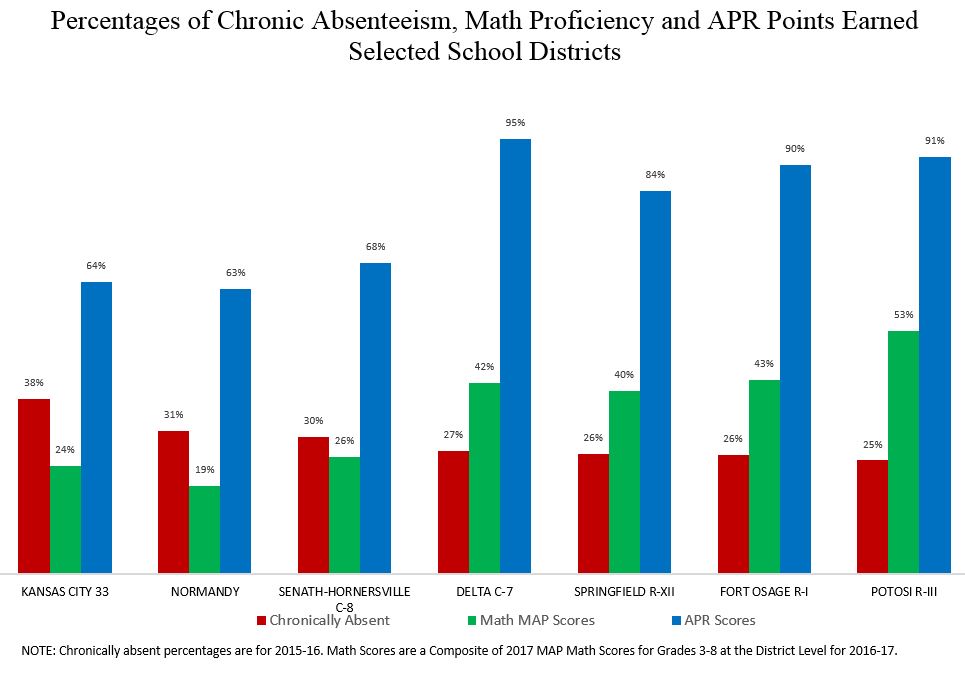
Consider that in 2017, the percentages of Missouri 11th-graders who scored Proficient or above on the state assessments were 35 percent in English/language arts, 15 percent in math, and 20 percent in science. And, according to the Missouri Department of Elementary and Secondary Education (DESE), just 42.5 percent of 2017 graduates were “College or Career Ready”—meaning that they met or exceeded the state standards for the ACT, SAT, COMPASS, the Armed Services Vocational Aptitude Battery (ASVAB) or they received and industry recognized credential (IRC).

This is backed up by a 2011 study commissioned by the Missouri Department of Higher Education, which found that 64 percent of Missouri students who were first-time undergraduates at public two-year institutions took at least one remedial course, including 56 percent who needed remedial math. At public four-year institutions the numbers were better, but still one in five students took at least one remedial course. Taking remedial courses is expensive and discouraging.

Recently, stories of “graduation rate malfeasance” have surfaced in nearly 10 states. Nationally, graduation rates are at an all-time high even as rates of proficiency have stagnated or declined. What good is it to increase graduation rates if academic performance and college readiness aren’t improving?

The Every Student Succeeds Act (ESSA), passed in 2015, moves much of the responsibility for school accountability back to states. ESSA required states to submit accountability plans that include graduation rates as a measure of school quality. Most states are now implementing their approved plans and, sure enough, graduation rates are taking off. Does that mean we’re holding schools more accountable? Probably not.

As was pointed out in a recent essay by the Show-Me Institute, accountability plans—even the most complicated ones – can be toothless, gamed, and even ignored. Missouri has an opportunity to design and implement an accountability plan that gives parents meaningful information about how their child’s school is performing. They can also give parents options when their child’s school doesn’t measure up or isn’t a good fit.

A high school diploma should be more than a piece of paper. Missouri’s education system is responsible for doing more than just issuing diplomas – they should be making sure that there is something behind the diplomas they issue.

Without Consequences for Failing Schools, Students Lose

A high-school diploma is supposed to mean something. A student who earns one should be ready to attend college or a trade school, or to start working right away. But a diploma’s value depends on the quality of the school that stands behind it. And down in the bootheel of Missouri, Hayti High School’s class of 2019 has gone all the way from kindergarten to its junior year in high school without ever attending a good school by the standards set by the State Board of Education’s (SBE).

In statewide testing, less than half of the students in the district scored proficient or advanced in English and only about a third scored proficient or advanced in math. The latest average ACT score was 16.5, nearly five points below the national average of 21. Has the Hayti School District sufficiently prepared the class of 2019 to succeed after graduation?

Hayti has been provisionally accredited for over a decade, but that does not necessarily mean the state has taken adequate steps to make sure the district improves. The state monitors provisionally accredited districts, but there are few real consequences if their performance stagnates—and the SBE has been quick to upgrade districts even before sustained progress has been made. Unfortunately, the Missouri School Improvement Program is a series of graduated but mostly meaningless interventions.

My recent essay for the Show-Me Institute, “Accountability in Missouri’s Public School System,” goes into greater detail about our state’s struggling districts and argues that if accountability is defined as tangible consequences for district and school personnel, the state has been at best inconsistent in holding districts responsible for poor performance.

Some examples: Jennings and Caruthersville, both formerly provisionally accredited, were reclassified as fully accredited by the SBE even though they failed to meet the academic goals the districts set themselves. Not far behind Hayti, Calhoun R-VIII, and Hickman Mills have been provisionally accredited for 5 or more years.

Unaccredited districts also have been let off the hook despite a lack of significant progress. The SBE voted unanimously to classify Kansas City as provisionally accredited even though the former Department of Elementary and Secondary Education (DESE) Commissioner said the district had not established a “consistent trend of improvement.”

Two other once-unaccredited districts—Riverview Gardens and Normandy—failed to meet most performance targets set by the state before the SBE granted them provisional accreditation. In the case of the St. Louis City School District, its scores in all performance areas had not improved significantly . . . but it was unanimously approved for full accreditation.

These examples call into question the commonly held assumption that the state holds traditional public schools accountable. One could argue that the 1993 transfer law—although separate from DESE’s Missouri School Improvement Program—is the best form of accountability for districts. When students have the right to leave for a better school, unaccredited districts must improve to avoid having to pay other districts to educate their students.

Now that there are no unaccredited districts in Missouri, however, students in districts like Riverview Gardens and Normandy no longer have the right to transfer. Before thinking of this as a cause for celebration, we should recognize that this creates a trap for students whose districts are performing just well enough to prevent triggering the transfer law, but not well enough to provide a genuinely good education.

Families should not be waiting years or even decades for schools to make small gains or else become unaccredited so that students can transfer out. Under the current accountability system, the kids are the ones who face the consequences—whether they have to take remedial classes in college or cannot get a well-paying job—not the district or school leaders. Our accountability system is failing, and students deserve better than being forced to stay put in poorly performing schools.

Tell Me Something I Didn’t Know: We Don’t Need a Task Force for Facts about Charter Schools

Yesterday I wrote about the latest delaying tactic proposed by opponents of charter schools in Missouri: a bill to create a task force to study various questions regarding charter schools—questions that could be answered by spending an hour on the internet researching what we already know about charters.

That was my initial reaction to this political attempt to deny Missouri parents public school choice, but there is so much more to be said.

Charter schools are no longer a new thing. They’ve been established for decades in many different forms in many different states. Initially, they may have been experiments that policymakers either chose to, or were forced to, accept in their public school districts. Today, they are an established sector of public schooling that continues to build on what early pioneers accomplished. Millions of U.S. public school students have spent their entire K-12 educational experience in charter schools, and more than 1.5 million public school students have received their high school diplomas from charter schools. A wealth of research, experience, and anecdotal evidence has shown that charters are a good option for many families and a vital option for families who live in failing school districts and don’t have the ability to move.

I’ve stood beside parents when they were fighting, with limited means but great determination, for their kids to have a chance for a decent life. Because that’s what this issue means for them—quite literally. Charter schools, without question, have made great strides in educating students who had been dismissed for decades as too difficult to educate. For low-income students of color in our worst-failing urban districts, charter schools are a lifeline.

Too many kids grow up, often without fathers, in tough neighborhoods that have abandoned properties and high crime rates. But if they can go to a good school, with principals who are allowed to keep order and teachers who have freedom and incentives to tailor the curriculum to the needs of their students, they have a chance. Cynthia Brown, a parent of a student at North Side Community School in St. Louis—a charter school that was opened in one of the highest-need neighborhoods in the city—put it this way, “It’s setting a stage for a change. When you have children who are being brought up right, being educated right, the outcome is much different. There is so much turmoil in St. Louis. A lot of it has to do with the lack of education.” The students at North Side Community School are twice as likely to be proficient in reading and three times as likely to be proficient in math than as peers at other high-poverty elementary schools in St. Louis.

The good news is that these charter schools are helping families change their trajectories. Many of them will make it out. We know that. Nine of the largest charter school networks in the nation that serve disadvantaged students and have enough alumni to track have college graduation rates that are three to five times the national average for low-income students. Not only are these students off the street and out of jail, they are starting their adult lives with college degrees.

And don’t think for a minute that these successes are only happening in poor, urban districts. Hundreds of public school districts in the U.S. are using charters as a tool in their toolbox—when enrollment is growing faster than they can add buildings, when enrollment is declining and their small-town school might be forced to close, and when parents seek unique educational programs that their public school district cannot or will not offer. Last year, five of the top ten high schools in the U.S., according to US News, were charter schools. These are five highly rigorous, suburban high schools with long waiting lists.

And yet, opponents have continued to trot out the same tired arguments for decades. Charter schools don’t cost more than public schools; typically, they cost less because charter school students only get, on average, about 78 percent of the funding that traditional public school students get. And they produce more bang for the buck. Charter schools don’t cherry pick or discriminate. They don’t charge tuition. They don’t teach religion.

To those of us who work in this field and have seen the same excuses for all these years, it’s clear that  where charter schools aren’t made widely available, it’s because they threaten a powerful establishment. In these places, charter schools might be reluctantly allowed to compete with the poorest performing schools, but they are barred from competing elsewhere, lest they expose the “good” schools as really just mediocre or worse. They threaten the public school monopoly because, if forced to compete, the monopoly may lose market share. Charter schools are agents of change, and in some places, the public education establishment, all its talk notwithstanding, is viscerally afraid of change.

This isn’t the case everywhere. In many districts, charter–district collaboration has led to increased funding for all schools, sharing of best practices and professional development, unified data and information systems for parents, and improved outcomes for all students—charter and traditional alike. While détente is possible, collaboration, as it turns out, is even better.

But, unfortunately, not for the parents and students in Missouri.

In Missouri, every time someone makes a real proposal to expand charters, the threatened interest strikes back. The public employee unions lean on liberal lawmakers from the urban areas, while school superintendents and school board members and “public spirited” corporate types lean on conservatives from the suburbs and the rural areas. Wealthy and middle-class parents—the kind of people who would insist on change if their kids were at stake—make their own arrangements for their own families and stay out of the debate. And most elected officials aren’t willing to buck the tide—not when the only real interest on the other side are marginalized people who may not vote at all and, if they do vote, probably won’t figure out who is blocking their chances anyway.

So the politicians vow to study the problem, or cite canards about charter schools in interviews with reporters who don’t know anything about the subject, or pass legislation purporting to make charters widely available while regulating them in a way that ensures they will never open.

But we’ll keep fighting. We’ll keep making the arguments; we’ll keep recruiting a few precious champions, whether liberal or conservative, and we’ll keep trying to persuade the other lawmakers to do what’s right. And we’ll keep helping parents demand what they know they deserve—high-quality education for their children, regardless of where they live.

License Reciprocity Proposal Could Be A Major Reform, But Vigilance Will Be Necessary

It may not be the sexiest topic, but licensing reform is a big deal for providers and consumers in lots of industries. The economics are straightforward: Government restrictions on the supply of service providers tend to push up the cost paid by consumers for that service and tend to decrease access to it. Licensure can also harm practitioners who are qualified for a job but not allowed to do it. We’ve talked about these phenomena in many contexts, particularly for electricians, hairbraiders and doctors.

Fortunately, legislators are starting to have regular, and serious, debates about licensing issues. 

One bill in particular, already passed by the House, could go a long way toward unwinding some of the problems imposed by a patchwork of licensing regimes nationwide—by accepting professional licenses obtained in other states here in Missouri. I say it “could go a long way” rather than “would,” for two reasons.

First, the law won’t apply to professions governed by “the state board of registration for the healing arts, the state board of nursing, the board of pharmacy, the state committee of psychologists, or the Missouri dental board.” That reads like a carveout for state professions with formidable lobbying arms, which is to say that while it’s probably a rational political consideration, it isn’t justified on policy grounds. Alas, it is what it is.

Second, and more subtly, for the professions that would be impacted, a lot still depends on the Boards that govern them. According to the text, a Board “shall” issue a license in reciprocity with another state, but only

if it determines that the licensing requirements in the jurisdiction that issued the applicant’s license are substantially similar to or more stringent than the licensing requirements in Missouri for the same occupation, profession, or activity . . .

That the same Boards which historically have helped to lock out competition are also empowered to determine the grounds of licensing sufficiency could be a problem. I can imagine some Boards left unchecked simply determining that Missouri’s standards are pretty much above everyone else’s standards—beating back reciprocity that way. Even examination requirements that could be met by other states’ licenses might still be imposed by these Boards “if [a Board] determines that waiving the requirements for the applicant may endanger the public health, safety, or welfare.”

Again, the devil is in the details, but it is often the details that determine whether a law is effective or not. Whether Boards will adhere to the intent of this reform is a huge concern here.

License reciprocity would be good for pracititoners and consumers alike. Hopefully this reform would bring about meaningful reciprocity. But if it doesn’t, in practice, deliver reciprocity for all of the professions it contemplates bringing reciprocity to, this incremental reform will have to be revisited to ensure its intent isn’t subverted.

Support Us

The work of the Show-Me Institute would not be possible without the generous support of people who are inspired by the vision of liberty and free enterprise. We hope you will join our efforts and become a Show-Me Institute sponsor.

Donate
Man on Horse Charging