Why Can’t They All Be Like Winfield?

One question that drives our municipal checkbook project is: What is the cost of transparency? Because Missouri’s sunshine law allows cities to charge for the time it takes to fulfill requests, it is not uncommon that producing public records will come with a price tag attached. When we sent sunshine requests for expenditure records, cities had the discretion to either charge nothing for these records, or—like the City of Battlefield—quote a price of over $35,000.

One argument we have heard from skeptics of checkbook transparency is that small cities like Battlefield (population 5,590) cannot afford to provide spending records at a low cost. Certainly, different cities have various staffing levels and challenges, but responses like Battlefield’s should raise concerns. And while we do not expect small cites to have the same resources as the City of Saint Louis, several cities provided us their expenditure records free or at very little cost, and some of those cities are smaller than Battlefield.

Consider the example of Winfield (population 1,404), which stands out not only because it shared its expenditure records free of charge, but also because of its commitment to transparency. When I spoke with the mayor, he said that while he loved our Municipal Checkbook database, his city could not afford to host its checkbook on its own website.

But after I told him we planned to put the city’s records in our database, he said that he would provide a link to our website so citizens could see how Winfield is spending its money. And if you check out Winfield’s website today, you’ll see that link. He also said the city was in the process of updating its transparency portal on the city website—not bad for a city of fewer than 1,500 people.

Cities, no matter their size, should provide easy access to information about how they’re spending our money, and modern accounting software used by most cities allows for quick generation of accurate reports. In Winfield’s case, the city saw in the Checkbook Project a tool to increase its own transparency. I applaud its commitment to promoting a culture of municipal accountability and good governance.

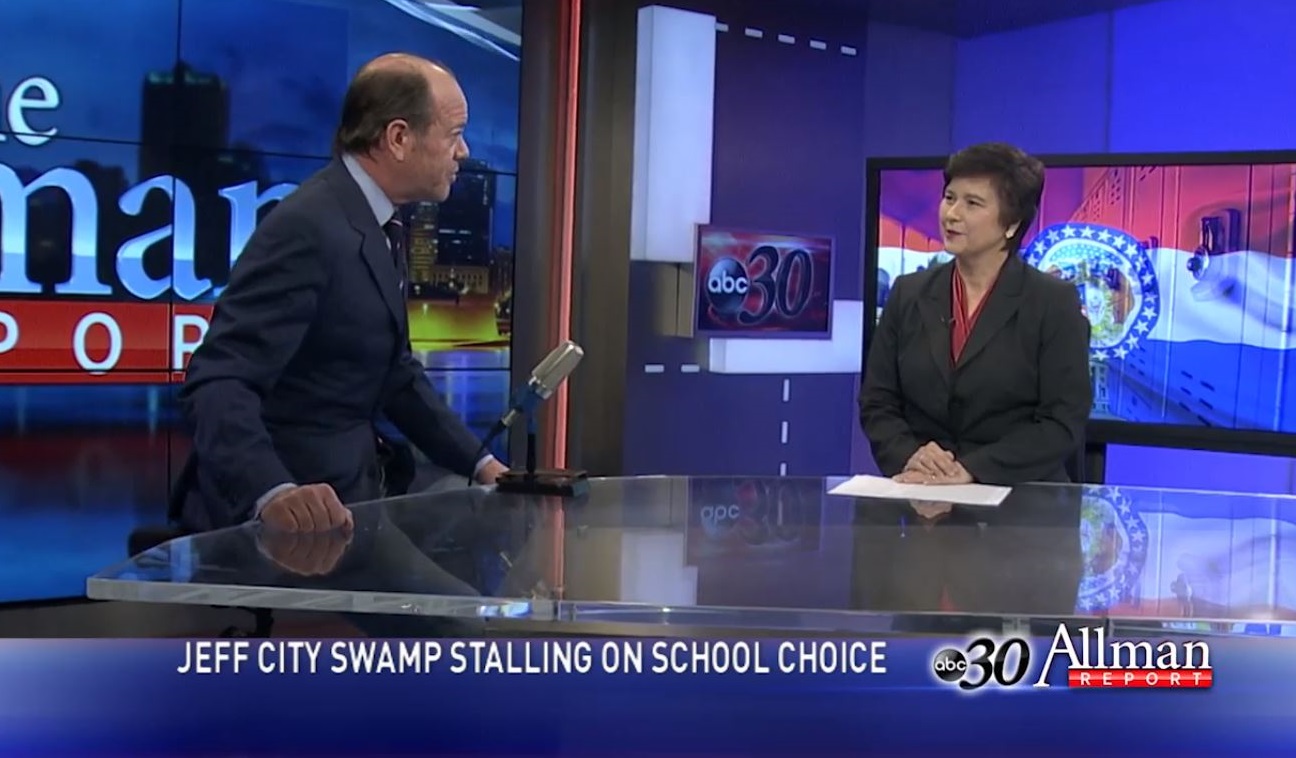
Charter Schools 101: Why Would We Need Charters in Suburban, Rural, or “Good” Districts?

In addition to fielding questions about what a charter school is, and whether charters are private or public schools, I’m often asked: Aren’t charter schools intended for failing urban districts serving low-income students of color? They do serve those communities well, but let’s talk about who else they serve.

While it’s true that over half of all charter schools are in urban districts, in the 2015–16 school year there were nearly 1,800 suburban charter schools and over 1,200 in small towns and rural communities.

It turns out that curriculum really matters to middle-income parents, and many gravitate to charter schools because they offer educational models that aren’t available in traditional public schools. Some of these models are more rigorous, some are more open and creative, and some offer unique programs. There are hundreds of examples of outstanding suburban and rural charter schools, but I’ll offer just a few to ponder.

Take the BASIS charter schools: In the 2017 US News rankings of the top 10 public high schools, nine were charter schools and five of these were BASIS charter schools. BASIS currently operates 20 charter schools in Arizona, Texas, and Washington, DC. Most of them are suburban, and they serve populations that reflect their communities. Like all charter schools, BASIS schools don’t have admissions tests—students are admitted by lottery. But once they’re in, it’s not easy. In this preschool through grade 12 program, students take biology, chemistry, and physics before they start high school and all high school students are expected to pass at least 6 AP exams. The key to success in BASIS schools is having highly professional teachers who are subject matter experts. Teachers are given considerable autonomy in their classrooms, but all of them, even kindergarten math teachers, must have a college degree in the subject they teach.

Or, what about the NYOS (Not Your Ordinary School) charter school in Austin, Texas? This school was founded twenty years ago and offers smaller class sizes, year-round school and “looping” (in which a student stays with the same teachers for several years). NYOS serves 950 students in grades K through 12, but they have 3,000 more students on a waiting list for a spot.

But many small towns are taking advantage of charter schools also. Graysville, Indiana opened Rural Community Academy in 2004 when their local school was slated to close. Since then, the school has grown to 150 students and some credit it with reinvigorating the community, saving the post office, and bringing several new businesses to the area.

Rural charters aren’t always opened to save a school, though. The Upper Carmen Public Charter School in Idaho was founded in 2005 “to complement the existing public school system by providing an alternative learning environment to enable more students from Lemhi County to be successful.” This school serves no more than 90 students and emphasizes personalized learning that allows students to progress at their own pace, rather than be grouped by age. Upper Carmen Charter School has consistently ranked among the top ten percent of schools in Idaho.

Asking if there are any good charter schools outside of major cities is like asking if there are any good restaurants outside of major cities. Of course there are. Teachers, parents, and community leaders with great ideas for educating kids are everywhere. Charter schools aren’t a perfect fit for every student, but they’re a great fit for the students they serve.

Greene County, Missouri, Spending 2013 to 2017

Those who have been following our Government Checkbook database closely may have noticed that a new folder was added in the last week or so: County Checkbooks. As with the municipal checkbooks, Show-Me Institute researchers are in the process of asking every county in the state for a list of their transactions, the dates of those transactions, the county’s vendors, and related “checkbook” information so that the public can more easily see where their money is going.

After all, if government can spend your money, it should be able to account for it.

It’s appropriate for government at all levels to regularly provide expenditure information to the public, and to do so in a format that is easily searchable and accessible. Consistent with this objective, and as we have already done with the state’s spending, we are sharing a “portal” for Greene County, Missouri, using information provided to us by the County, free of charge. We hope this serves as a reasonable example for political subdivisions of what 21st-century governmental transparency can look like.

Tuition Caps on Higher Education Are Anti-Free Market

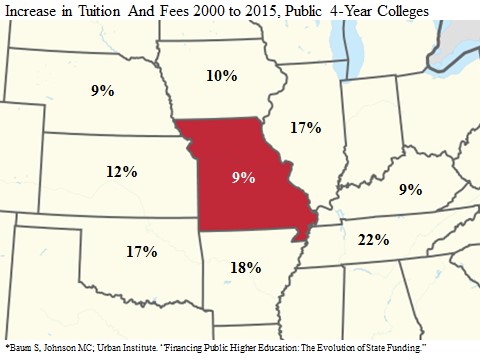
Public funding for higher education has been on the wane in Missouri. As Mike McShane pointed out in his 2017 Show-Me Institute essay, “Stuck in the Middle with Mizzou,” state support for higher education, in inflation-adjusted dollars, decreased by 20.4% from 2000 to 2015. The national average, for comparison sake, was a 1.2 percent decrease. During this period, just 9 states had bigger decreases in state support. In that same period, tuition in Missouri rose 9 percent. In comparison, the average tuition growth was nearly 18 percent among the nine states that had higher decreases in state funding. Among our border states, Kentucky and Nebraska saw similar tuition increases while all the others had larger increases. Oklahoma and Illinois, for instance, increased tuition by 17 percent while Arkansas and Tennessee increased tuition by 18 and 22 percent, respectively.

Missouri’s tuition increases are lower than most other states because state law prohibits colleges and universities from increasing tuition beyond increases in the consumer price index. The point here is that Missouri’s institutions are getting a double whammy. They are seeing reductions in state revenues and are simultaneously limited from raising additional funds through tuition.

To some, this doesn’t sound so bad. There has been growing concern about the rising costs in higher education. And increasingly, there is concern about the seemingly illiberal attitudes on college campuses that shout conservative speakers down. And we all remember the fiasco at Mizzou a few years ago.

These are legitimate concerns. Indeed, as George Mason economist Bryan Caplan has suggested in his recent book, The Case Against Education: Why the Education System Is a Waste of Time and Money, there are compelling arguments against public subsidies for higher education.

There are few solid arguments, however, for not allowing colleges and universities to raise tuition to the level they deem appropriate.

I understand the sentiment of wanting to make college affordable, but there are better ways to do it. For example, as mentioned in SMI’s Blueprint on Higher Education, Missouri could encourage competency-based education programs or income share agreements.

Prices are the thing that help the free-market flourish. Prices tell producers where they can make profits, and prices allow consumers to choose wisely. Tuition caps are anti-free market because they distort the true cost of a college education by artificially keeping the sticker price low. It’s time to remove these artificial caps and allow more free-market policies into higher education.


How Would Missouri Fare in a Global Trade War?

You might think that as a Midwestern state, Missouri would be less exposed than most other states to damaging repercussions from the Trump administration decision to impose tariffs of 25 percent on steel and 10 percent on aluminum.

But one of the most attention-getting findings contained in a newly released report from the Brookings Institution titled “How Trump’s Steel and Aluminum Tariffs Could Affect State Economies“ might cause you to think otherwise.

As the Brookings report points out, Missouri’s imports of steel and aluminum amount to $1.4 billion, or 7.4 percent of our state’s total imports. By that measure, Missouri’s exposure to tariff-driven increases in the price of those two commodities is the highest of any state in the country. But how meaningful is that metric?

Joseph Haslag, chief economist for the Show-Me Institute, points out that the metric is misleading for a couple of reasons. One is the presence of a large automotive sector in our state, and the other is the simple fact that Missouri is just not a large importing state.

A better measure, therefore, is to look at Missouri’s exposure relative to our state’s total output of goods and service—its gross domestic product. By that measure, Missouri falls from the state that is “most exposed” to steel and aluminum purchases to the 8th most exposed state—still not anything to be happy about.

At both the state and national levels, agriculture is one sector of the economy that is likely to suffer. As Blake Hurst, president of the Missouri Farm Bureau, told me, “Farmers are going to be hit two ways—having to pay more for tractors, combines, and other equipment made from steel and aluminum, and also having to deal with the possible loss of foreign markets due to retaliatory tariffs on U.S. agricultural exports.”

 Watch this space for further information on how changes in tariffs and trade agreements are likely to affect Missourians.

In Janus, A National Reexamination of Government Unions

On Monday, February 26, the U.S. Supreme Court heard oral arguments for Janus v. American Federation of State, County, and Municipal Employees, Council 31dealing with whether government unions can require fees from non-members as a condition to public employment. If ruled in the plaintiff’s favor, the Janus case would have more of an impact in about 22 other states than in Missouri, where agency fees in the government sector are not really permitted by law.

That isn’t to say the issue doesn’t crop up from time to time. In 2013 non-union officers in Kansas City had their employment threatened by the union when they refused to cough up money for the union’s activities. And while that incident is an exception to the Missouri rule, it’s an episode that supporters of good government in Missouri have to keep in mind as they survey the policy landscape post-Janus

Indeed, Janus brings with it the opportunity to reassess public policies that generally provide considerable latitude to government unions. Most states have a laws on the subject that are literally to the left of Franklin Delano Roosevelt, since Roosevelt himself was highly skeptical of collective bargaining and traditional unionization among government workers. Not only does the risk persist that a union could elect members into government to negotiate them sweetheart contracts, but the prospect of a company’s failure that faces private labor negotiations hardly ever truly attaches to a government agency—if economic conditions go sideways, taxes can be raised, services can be reduced, or some combination of the two could take place to protect the government union’s interests.

Point being, government unions have been given a wide berth to operate over the last half-century, and it is overdue that the latitude they’ve been granted was reviewed—in light not only of the law and the Constitution, as will happen in Janus, but of good policy as well. Government union members, non-union government employees, and taxpayers certainly deserve better than the status quo.

What I Saw at the TIF Hearing

Anyone who has been paying attention to the Show-Me Institute over the past few years knows that our analysts are not impressed with a number of economic development subsidy programs in Missouri. While we write often about tax-increment financing (TIF), there are many other programs ripe for reform. But as my time spent in one legislative hearing shows, those with a vested interest in the programs are going to put up a fight.

The bill in question was SB 859, which was heard by the Senate Economic Development Committee on February 20. A copy of my own testimony is here. The bill is fairly straightforward; it would limit the circumstances under which TIF can be used and would require a third-party analysis of the need for a taxpayer subsidy.

Opponents of the bill included members of the Economic Development Corporation of Kansas City, whose budget is dependent upon fees generated by the TIF projects they oversee. In fact, EDC staff once received bonuses because the group received so much money from TIF fees. The two officials testifying for the EDC offered anecdotal evidence of TIF success, highlighting two or three projects. But there are at least as many projects in which TIF has been abused, including the world headquarters buildings of Burns & McDonnell and H&R Block, along with other failures such as the Power & Light District and the never-actually-built Citadel. In fact, I am confident that in a battle of anecdotes opponents of TIF would win handily.

Other opponents of reform at the hearing included representatives from a few businesses that have benefitted from these taxpayer subsidies. They urged legislators to “be careful” lest reform hinder Missouri’s ability to fight a subsidy border war with Kansas (a border war, incidentally, that is a “financial folly for taxpayers”). If only those same businesses urged local officials to be careful with the TIF subsidies they give out so easily.

But good public policy ought not be based on mere anecdotes. Even if you don’t care what the research indicates, good policymaking is dependent on good information. And the research on TIF is clear: It doesn’t work at spurring investment or creating jobs. If you don’t want to depend on Show-Me Institute research, you can look at a UNC-Chapel Hill study on Chicago, or to the Upjohn Institute for Employment Research for nationwide data analysis. You can even turn to a study conducted for the St. Louis Redevelopment Corporation on the TIF subsidies that the corporation itself recommends and administers! This is the testimony that should matter.

Legislators should be wary of testimony from people with a vested financial interest in a bill’s outcome, or of testimony that amounts to little more than cherry-picked anecdotes. They should seek out broad research from disinterested parties—which, in the case of TIF, tells us that these subsidies are a waste of taxpayer money.

Branson Water Park to Soak Taxpayers

Imagine someone knocking on your door with a business proposal. He and his partners want to build on the vacant lot next to your home. Right now the venture is a guaranteed money-loser, but if you chip in some of your money, the other investors are guaranteed a better return. You’ll never get your money back—and if the project is successful, the other investors won’t share its profits with you, but in 23 years, maybe, the city will see increased tax revenue. So . . . are you in?

According to news reports, this is exactly the deal developers are seeking from the city of Branson. The developer wants to build a water park that they project will bring 600,000 visitors each year, making it the 7th most popular water park in the country. They claim the project will create 900 full-time jobs immediately and ramp up to 1,200 as the park is completed. The park also will include restaurants, hotels, and other amenities.

Despite all that potential, there isn’t enough financial interest—from the people who invest in these sorts of things for a living—for the project to move forward. So the developer has come knocking on the door of the taxpayers—in the form of the Branson Tax Increment Finance (TIF) Commission—asking for your money. And the members of the TIF commission voted 7 to 4 in favor of awarding TIF. The board of aldermen will pass judgment at a later meeting.

Overwhelmingly, research on TIF in Missouri and around the country shows that the process does not live up to its promises. (This perhaps explains why private investors aren’t so excited about these deals to start with.) If you were to peruse the 2017 TIF Annual Report compiled by the Missouri Department of Revenue you’ll find that only about one-half to one-third of the promised jobs ever materialize—and those numbers are reported by the developers themselves without audit.

The argument in favor of TIF largely rests on a logical fallacy: an assumption that development that happened after TIF happened because of TIF. But the research tells another story. One study of TIF in Kansas City and St. Louis—the state’s most prolific users and abusers—found that economic growth in areas without TIF met or exceeded growth in areas with TIF. In St. Louis, a report prepared by the very people who staff the TIF commission concluded that it was a waste of taxpayer money.

Perhaps the developers should scale back their ambitious plans. Maybe it makes sense as a smaller project—say, the country’s 12th most visited water park. If it is as successful as the developer claims, the park can always be expanded with the profits. But all of this should be done entirely with private money, from people who know a good investment and expect to see a return.

In Branson and across Missouri, cities are struggling to deliver basic services. Diverting sales and property tax dollars away from education, infrastructure, and public safety to invest in a park that itself may increase demand in all three of those areas is unwise and unnecessary. Branson’s success is due to individuals realizing great success from private investments, there is no reason now to change that winning formula.

Support Us

The work of the Show-Me Institute would not be possible without the generous support of people who are inspired by the vision of liberty and free enterprise. We hope you will join our efforts and become a Show-Me Institute sponsor.

Donate
Man on Horse Charging