
The Show-Me Institute’s Chairman Crosby Kemper III appeared on KCPT’s Ruckus on Thursday, April 19, to discuss the future of the failing American Jazz Museum and a recent march pushing for local control of the Kansas City Police Department.
Jazz Museum Hits A Sour Note

The American Jazz Museum in Kansas City is a failure, as is the entertainment district in which it resides. It is an expensive failure. As we’ve written previously, all of this was foreseeable, and was foreseen, when the 18th and Vine District was in its infancy. Our government-funded jazz district is in shambles, while the privately financed Beale Street in Memphis is soaring.
According to a story from KCUR, a consultant’s report on the Jazz Museum was scathing:
The museum, according to the consultants’ report, is “in need of complete rethinking, akin to starting a new museum.” The report called for a “complete rebirth, starting with its leadership, but continuing with a revamped financial model, visitor experience, and operational infrastructure.”
Among the consultant’s 26 recommendations was to close the museum for a period of time. Again from the KCUR story:
Five recommendations involve immediate action, including the closure of the museum “for a predetermined period of time.” A temporary closure for less than a year, the report said, would allow the organization to “save costs and focus on basic operating needs.”
I am no museum consultant, but that seems like pretty good advice to me. In fact, it was exactly the advice I offered on KCPT’s Ruckus back in October 2017. City leaders may prefer to ignore the advice of the report and further involve government management and taxpayer subsidies. Doing so would be a shame.
Taxes in Kansas City: Still Too High, Still Unfair

Kudos to Kansas City Star editorial board member Dave Helling for his recent column on taxes in Kansas City, and legislative efforts to cap sales taxes at 14 percent. Helling goes into detail about city tax rates and their impact on those at the bottom of the economic ladder. Then he concludes,
Taxes should be simple — easy to collect and understand. They should be as low as possible. And they should be fair, based in part on ability to pay.
Kansas City’s tax structure meets the “simple” test. But local taxes are not low, and they are not fair.
This argument is not new to readers of this blog or to anyone who lives in the city and has to pay the taxes. But conceding that local taxes aren’t low is a noteworthy turnabout for Helling, who wrote just two years ago on March 1 2016,
Kansas City’s tax burden is relatively low, and it’s pretty balanced. It fails miserably on the fairness index — relying far too much on flat sales and income tax rates that hurt the poor — but that shortfall is difficult for most voters to see.
My colleague responded at the time that taxes are not relatively low in Kansas City. In fact, we’re a high-tax city when one considers not just the sales tax—which is itself high—but property taxes and our one percent earnings tax. And Helling is correct that taxes are not only high, but brutally regressive, resting on the backs of the working poor in Kansas City. Kansas City goes the extra regressive step of even taxing food. To add insult to injury, some tax rates in poor communities are higher than in wealthier neighborhoods.
Kansas City has serious problems with how it collects and spends revenue. These things are worthy of public debate, and Helling’s piece is an important contribution to that discussion. City leaders—or those who would be city leaders—need to come forward and join the discussion, not just ask (as Mayor Sly James did last week) to be left alone.
The Great GASB
Three cheers for The Kansas City Business Journal for writing about the costs to taxpayers of economic development subsidies offered up by city leaders. My colleague Patrick Ishmael wrote about new accounting standards instituted by the Governmental Accounting Standards Board (GASB) in 2015, and now City Hall has begun reporting in accordance with the new standards—which require states and localities to provide more information about tax abatement agreements into which they offer, including gross dollar amount.
For us at the Show-Me Institute, the additional reporting requirements and transparency are a good thing. They largely confirm our assertion that Kansas City gives away far too much of its own money and the money of other taxing jurisdictions such as schools and libraries.
While the city diverts just under $90 million of money it would receive from sales, utility and income taxes to developers, this does not include the money from property taxes that would otherwise go to other taxing jurisdictions such as school districts. That amount, according to the Journal, is just under $42.5 million.
So taken all together, the city itself is reporting that the costs of economic development subsidies is $132,311,000. This does not include other costs, such as the $14 million the city allocates from the general fund to cover the debt incurred by the Power & Light District. (See FY 2018-19 budget, p 63.)
That brings the total up to at least $146 million every year.
Long-time followers of the Show-Me Institute will not be surprised by any of this. We have consistently pegged the cost to taxpayers of subsidies at, “north of $100 million a year.” This has garnered howls of denial from The Kansas City Star editorial board (read here and here) and dismissals from city leaders. GASB is requiring the city to account for its handouts in a more transparent manner, and for that we should all be grateful.
Are We Getting Schooled by Fish?

Behavioral economists study humans to figure out how we react to things like prices, supply and demand, and signaling, to name a few. But some researchers are taking that field of study to a non-human level and they’re discovering some very interesting phenomena. Could animals possibly be entrepreneurial? Might they set up a market to exchange commodities? Do they respond to the fundamental law of demand? Surely they’re not smarter than us . . .
Let’s take a look at a market that has developed in the coral reefs of the Red Sea. Dr. Redouan Bshary, a behavioral ecologist, spent more than a year on an Egyptian beach studying coral reef fish and he made an interesting discovery. Cleaner wrasses—small fish that eat dead skin and parasites off of other fish—set up “cleaning stations” to serve “clients,” who line up for their services. What’s more, not all clients get equal treatment. Some fish don’t roam much; they’re “resident” clients over which cleaner wrasses essentially have a monopoly. They get the basic package: short cleaning session, no massage, and, occasionally, a bite. “Floaters” migrate over large areas and can shop around for a favorite cleaning station. They get longer cleanings, some massage, and are rarely bitten. Plus, they move to the front of the line over resident clients. And, if a cleaner wrasse senses another fish is watching, they up their game—presumably as a marketing strategy. A fish might have as many as 2,000 transactions per day and yet they’re constantly thinking about their client list.
Cleaner wrasses exhibit completely rational behavior that improves their chances of long-term survival and leads to optimum cleaning for coral reef residents. I imagine that if humans were running the show, we would set up the Bureau of Coral Reef Cleaning and assign each fish to a cleaning station while giving each wrasse their own cleaning district. There would be no incentive to offer anything other than the basic service and, presumably, the coral reef would be less clean.
In a somewhat similar fashion, researchers recently found that schools of choice better match students and schools, leading to higher overall parent satisfaction. Using data from Arkansas conversion charter schools (those that replace a failing school and enroll students only from the same school zone) and open-enrollment charter schools (which parents are free to choose regardless of where they live), the research discovered a positive relationship between open-enrollment schools and parental satisfaction. The implication, according to the researchers, is that increasing the degree of parental choice could increase the quality of schools available.
And yet the status quo, with its irrational assignment of students to schools based on where they live, continues to be fiercely defended. Maybe it’s time to capitalize on a little competitive pressure like our undersea friends.
School Administrators, What Did You Spend Your Money On?
When my wife and I took our four children to Disney World over spring break, we knew they would pester us for every little knick-knack and toy that they saw. So, instead of keeping the purchasing power in our hands, we put it in theirs. We gave them each a set amount of money and put it in an envelope with their name on it. Then when they wanted to purchase something, we took it out of their envelope. If they wanted something and didn’t have enough, we could just ask them “What did you spend your money on?”
As we watch teacher strikes throughout the country, that’s the same question we should be asking public school administrators.
For decades, our nation has seen substantial increases in education funding. In Missouri, per-student spending in inflation-adjusted dollars increased 33 percent from 1992 to 2014. Yet during that time, average teacher salaries decreased by 4 percent. How is that possible?
What did you spend your money on?
When we look at the numbers, the answer is obvious—people and pensions.
As economist Benjamin Scafidi has shown, the growth in the number of teachers and staff has far surpassed the growth in students. From 1992 to 2015, Missouri saw a 9% increase in students. Meanwhile, schools bulked up by increasing the teaching workforce by 28% and all other staff, including school principals and central office workers, by 24%. When given the money, schools chose to spend it on decreasing the pupil teacher ratio from 16.0 to 13.6. They chose to spend it on aides, principals, secretaries, you name it. They chose not to spend it on pay raises.
But that’s not the only thing keeping teacher salaries down. School administrators also chose (or were forced to choose) to shift compensation into retirement and benefits. This was a shift of about 6 percent of current operating expenditures that went from salary to benefits (see the figure below for a breakdown of Missouri expenditure numbers from 1998 to 2014). Make no mistake: This wasn’t done in order to make teacher benefits better. It was done to help pay for the promises they’d already made.
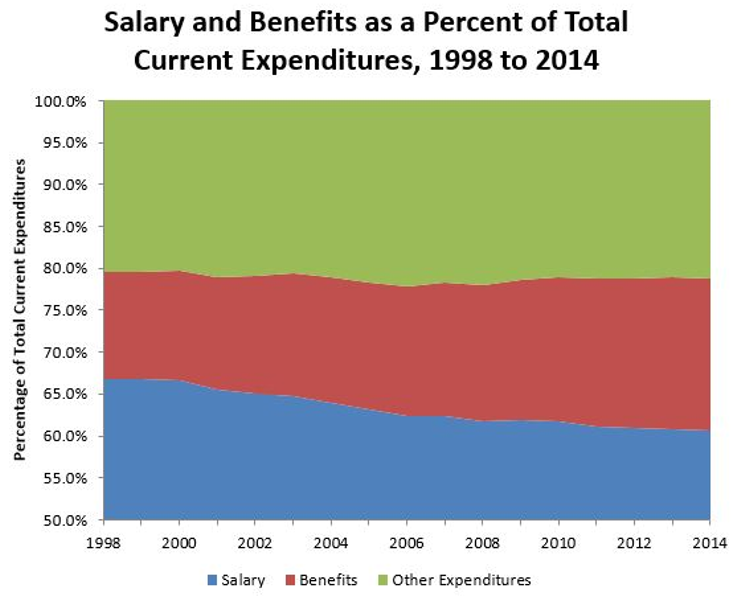
We all want great teachers, and many of us believe we should increase teacher pay. In fact, 61percent of respondents in the 2017 Education Next poll said we should increase or greatly increase teacher pay. Yet when we increase funding for public schools, the money just doesn’t make it into teachers’ paychecks. Something has to give.
Given the budgetary pressures faced in most states, marching to the statehouse is not an effective strategy. Even if they succeed in getting more funding for public education, there is a good chance that it will not result in substantial pay raises for teachers. At least that’s what history has shown us.
Instead, teachers should be marching to their central office; because to get higher teacher salaries, the system has to change. Schools need staffing policies that provide teachers with raises. And pensions must be reformed so teachers can have more pay today, not in 30 years when they retire. In other words, teachers need to start asking the question: “What did you spend our money on?”
The Cost of Transparency
If government is going to spend your money, shouldn’t you at least be able to see how? Unfortunately, depending on where you live this isn’t always the case.
Learn more about our Municipal Checkbook project.
Patrick Tuohey on KCPT’s Ruckus
On Thursday, April 12, Patrick Tuohey appeared on KCPT’s Ruckus to discuss education funding and economic development.
Should Five Percent Appear Too Small…
The Beatles famously sang the above lyric in their song Taxman. It comes to mind because, believe it or not, leaders in Kansas City think that a 14 percent sales tax is—I am not making this up—not high enough.
KSHB TV, WDAF TV and The Kansas City Star reported on the matter. The latter quoted Kansas City’s Mayor James saying, “I’m not asking the state legislature to do anything other than leave us alone.” (This is usually the Mayor’s response unless he is looking for more money from state government, such as in tax credits or state funds.)
The Star reports,
And if the city imposes a new 1 cent sales tax for the Central Business District—part of a deal it struck last month with Power & Light District developer Cordish to help pay for parking garages—the cumulative rate would be 13.6 percent.
You don’t need to be an anti-tax ideologue to wonder if there is a point at which sales taxes are just too high. Back in 2014, Steve Vockrodt of The Pitch asked, “City Hall rationalizes these incentive deals by saying they boost the local economy and expand the tax base. But if that’s true, then why do all these tax proposals keep coming up?” That was back when the sales tax at the Power & Light District topped out at 11.1 percent.
If Kansas City is undergoing revitalization—as city leaders claim—then why are we still raising taxes for the many to give tax breaks to the few? If this is success, it appears taxpayers can’t afford much more of it.
