Taxpayer Largesse Unnecessary, Wasteful in U City Development

University City officials seem far too eager to give away taxpayer dollars to developers who are hardly in need of a handout.

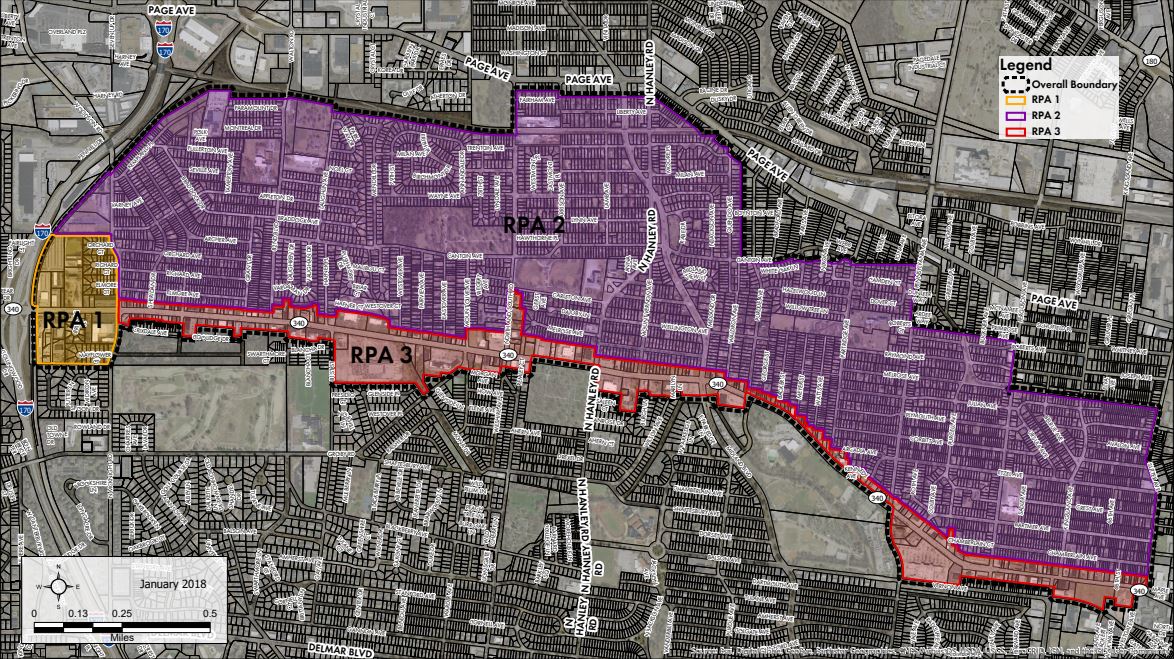
Developers and officials in University City are pushing for a $70.5 million subsidy to help fund a $190-million development at Olive Blvd. and Interstate 170. The project is slated to include a Costco, apartments, restaurants and retail space. The taxpayer money would come via tax-increment financing (TIF), which captures increased sales, property and other taxes generated by a development to cover some of its costs. In this case, taxpayers would cover nearly 40 percent of the project’s costs!

The controversial project has raised a number of concerns. Some worry about gentrification, neighborhood and cultural disruption and the possible use of eminent domain to force out longstanding businesses. These topics are serious and ought to be debated at the June 22 public hearing on the potential development. But a fundamental problem with the project deserves more attention: the fact TIF is unnecessary and fails to deliver on its proponents’ promises.

First, TIF was intended to encourage development in areas where no one wants to invest money, which hardly describes the area under consideration. The developer’s proposal cites (see pp. 6–10) conditions such as cracked sidewalks, overgrown grass and overflowing dumpsters as evidence that the area is “blighted.” These conditions, though less than ideal, surely don’t make development so unappealing as to require $70.5 million in taxpayer assistance. The area surrounds a busy interstate interchange and is flanked by Olivette, Ladue, and Clayton—there’s a reason current businesses don’t want to leave!

More importantly, proponents are promising the public higher property values, increased tax revenue for city services, and a bustling, inclusive neighborhood should the subsidy be approved, but decades of research shows these promises are rarely kept. It was just in 2016 that the City of St. Louis released a mammoth report detailing the near-total failure of its incentive programs. From 2000 to 2014, St. Louis lost out on more than $700 million in revenue because of TIF and related programs for naught. “[W]hile there may be disagreement about the value of some [incentive] packages,” the report concluded, “it is clear that the City gains no net benefit from an extremely costly program with no real economic development impact” (p. 6).

The study also failed to find a significant connection between TIF and job creation or increased property values outside parcels directly benefiting from subsidies. “[T]here is little evidence of significance [sic] spillover effects around incentivized parcels after the use of incentives. Across most project types,” the report continues, “there is no significant change in the trajectory of assessed value, permit investments or jobs” (p. 5). Economists from across the country have found almost exactly the same thing. In short, there is little evidence to support claims that handing out taxpayer cash will usher in an urban renaissance in University City, or anywhere else for that matter.

If officials and residents want to invest in University City’s third ward (where the proposed development would be located), there are other, more prudent ways to scratch cash together. Businesses and residents could form a community improvement district to collect property taxes—authorized by a public vote—to fund improvements. The “blight” designation assigned to the area as part of the TIF application would mean that those revenues could even be used to help fix up private residences. Before officials needlessly forego tens of millions in revenue over the next two decades, they owe it to University City residents to consider other options for improving the third ward.

A Fine First Step in the Right Direction for Special Taxing District Reform

For decades, Missourians have been paying hundreds of millions in special sales taxes they all too often had no clue about. Special taxing districts, like transportation development districts (TDD) and community improvement districts (CID), collect taxes to (mostly) subsidize private developments. While the laws authorizing these taxes have transparency provisions, they’re seldom enforced (or are toothless), so reliable data on TDDs and CIDs are hard to come by.

Thankfully, reforms are being passed and Missouri’s shadowy sales tax mosaic may soon come into view. HB 1858 was signed into law this past Friday. The law will require all political subdivisions (such as counties, cities, TDDs, and CIDs) to submit maps of their boundaries to the state Department of Revenue. The result will be a clear and concise presentation of the myriad sales tax jurisdictions littering our state. The map should be available by July 2019.

A map of all the jurisdictions collecting sales taxes may not sound like a big deal, but it is. While it’s easy to know what county or town you’re in, it hasn’t been so easy to figure out whether you’re shopping in one or more TDDs or CIDs. These districts are required to present maps of their boundaries only when petitioning to form, and so it is often nearly impossible to figure where they are exactly later down the road. They can also be as small as a single shopping center or district! In short, you could have been paying an extra two percent in sales taxes and had no way to find out where to shop to avoid it (other than an expensive sort of trial and error).

While HB 1858 is a win for taxpayers and transparency advocates, there is still a lot of work ahead of us. TDDs and CIDs continue to be used for projects with questionable public benefits, have poor reporting standards, and operate with little to no public scrutiny. Missouri taxpayers deserve accountable, transparent government for the public good, and it’s time to give it to them.

Kansas City Dodged the #HQ2 Bullet

Richard Florida is an urban studies theorist who promoted the idea that the creative class would drive urban renewal and that smart cities should cater to them. He was wrong, and he admits it. But not before cities like Kansas City, Missouri jumped on board and spent “probably in excess of a billion” dollars trying to create a hipster paradise downtown.

More recently, Florida tweeted a warning to cities jockeying to play host to Amazon’s new headquarters. In responding to a Financial Times story on unpleasant working conditions in Amazon’s UK warehouses, Florida tweeted:

Psst HQ2 cities. You’re gonna subsidize this company to the tune of billions … Maybe think twice …

Florida is right. Amazon demanded lots of taxpayer subsidies from the cities lining up to woo them, including Kansas City. Show-Me Institute researchers have been warning cities about such subsidies for years, but I wonder if Florida offered this same warning to Kansas City, as the area development council paid him to assist on the Amazon bid.

Mercatus Study Affirms SMI Tax Credit Suggestion from 2012

Six years ago, Michael Rathbone and I coauthored a paper that looked at Missouri’s corporate income tax, assessed its problems and posited a way of eliminating it through tax credit reform. As we said at the time, 

Missouri issued more than $400 million in development tax credits in 2012 alone. That is a lot of wealth transference.
 
Yet the magnitude of Missouri’s tax credit problem brings with it a great opportunity. Missouri’s CIT recently has generated slightly more than $300 million per year for the state—nearly equivalent to what development tax credits cost Missouri each year. In a sense, the CIT could be seen as underwriting the state’s tax credit largesse, but as has been described before, both the CIT and these tax credits tend to hurt economic prosperity. It is a growth-busting double whammy.
 
Observing that tax credit spending exceeded corporate income tax revenue, we noted that “the CIT can likely be extinguished without raising other taxes or forcing any cuts to services.”
 
Enter our colleagues from Mercatus, who released a report this week on tax incentives nationally and their impact on state tax policies (emphasis mine):
 
Several states, including Missouri and New York, could reduce their corporate tax rates by more than 90 percent if policymakers eliminated corporate incentives. Michigan, Nebraska, and Oklahoma could completely eliminate corporate taxation and still have room for cuts in other taxes if they eliminated all corporate incentives.
 
Tax credit spending and corporate income tax revenues vary year-to-year, but the picture is the same; if legislators abandoned corporate tax incentives, they could effectively eliminate the corporate income tax. Mercatus’s verification of this circumstance in Missouri is gratifying. You can find some of the underlying data used in their analysis here.
 
Missouri’s decision this year to reform its corporate income tax and reduce it to 4% is certainly welcome. That said, the ultimate target should be the elimination of the tax entirely. It hurts growth. It hurts the state. But ultimately, it hurts people. It’s time to move past it.

Where Is That City Report on Economic Development?

Are economic development incentives worthwhile? Abundant research from all over the country says they are not. Kansas City leaders disagree, and the City commissioned its own study of the practice—but that report is already over a year late and counting.

On November 1, 2016, the Council of Development Finance Agencies (CDFA) signed a contract with Kansas City to study the city’s economic development practices. Show-Me was critical of the City for hiring CDFA,  because they are a trade association whose mission is “to promote the common interest of Development Finance Agencies with respect to public policies and programs.” In other words, this group is being hired to analyze the success of the programs they promote. That hardly sounds like an impartial researcher. (But then our TIF Commission staff is funded by fees collected from TIF recipients, so conflicts of interest seem to be the standard operating procedure.)

Nevertheless, a study such as this is warranted, because Kansas City spends or diverts a lot of tax money to private developers. Studies of TIF and other incentives have found they are largely a waste of taxpayer money. This includes a report recently completed in St. Louis for the very corporation that doles out these dollars. That study concluded that TIF does not spur investment or create jobs; that it is not used in the economically struggling areas that need it; and that the level of reporting on these subsidies is poor. Other studies by universities and research institutions have likewise found TIF policies greatly wanting. Kansas City is due such an examination.

The contract signed with CDFA set a maximum payment of $350,000 for the study and set a deadline of May 1, 2017 for the final report. In an October 2017 email, Kerrie Tyndall, the director of economic development for Kansas City, wrote that the report should be received by the end of 2017—seven months late. In a November 2017 Kansas City Star story, Steve Vockrodt wrote that the report should be released in January 2018—eight months late. Ms. Tyndall indicated to me in March that the report should be delivered in mid-April—11 months late. As of this writing, May 25, there still is no report.

It is noteworthy that Public Financial Management, Inc., the company retained to provide analysis of economic development subsidies in St. Louis completed its study in 15 months and for half the cost of what Kansas City authorized. The Show-Me Institute issued its own analysis of TIF use in Kansas City and St. Louis after less than a year of study and at no cost to taxpayers.

A pricey, publicly funded and repeatedly delayed report on subsidies—performed by a group that supports such spending—isn’t likely to build confidence among residents. Kansas Citians deserve better policy and better policymaking.

Like a Sore Thumb: Missouri’s Testing Standards Buck National Trend

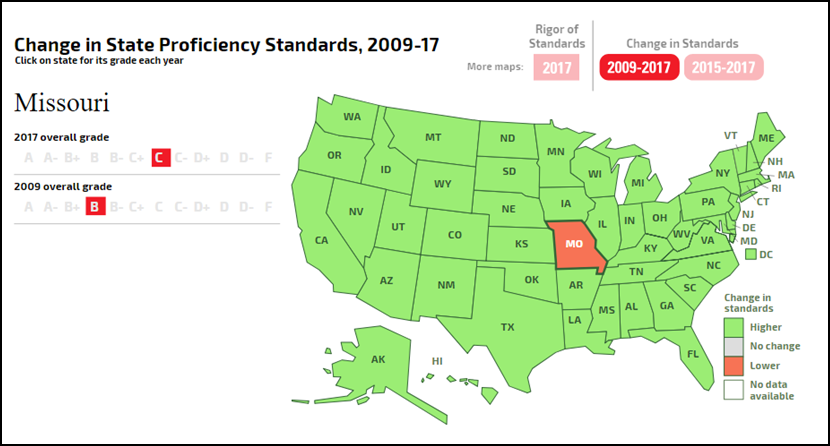
Marching to the beat of your own drummer is all good and well as long as you know where you’re going. A recent study published in Education Next suggests that Missouri—alone out of all 50 states—is headed in the wrong direction with regard to state proficiency standards for students. The study compares how well students in each state do on their states’ proficiency tests to how well they do on the National Assessment of Educational Progress (NAEP). For example, if 25 percent of students in a state scored proficient on the state’s test, but 50 percent scored proficient on the NAEP, that would indicate that state’s proficiency standards are more rigorous than the national standards. Since states have different state assessments and the NAEP is administered in every state, the NAEP serves as a Rosetta stone and allows us to compare the standards of different states.  According to the analysis, every state in the nation increased the rigor of their proficiency standards from 2009 to 2017. . . except Missouri. This could have significant implications for Missouri students, especially students in Missouri’s most disadvantaged school districts.

When a school district in Missouri loses accreditation, students are allowed to transfer to a higher-performing school district. In recent years, thousands of students from the Normandy and Riverview Gardens School Districts used this provision in state statute to transfer to some of the highest-performing school districts in the state. But students lost the right to transfer when the state board of education voted to give the school districts provisional accreditation, based in part on improvements in student achievement-test scores. Based on the Education Next study, we have to wonder whether those learning gains were just an illusion caused by the state making the test easier.

It is important to understand this analysis is not comparing the rigor of the learning standards in each state. Standards say what students should learn in each grade. The relevant measure here is what students must score to be considered proficient by the state assessment. While the tests are developed based on the standards, setting the cut-score is a subjective process.  The lower the cut-score, the higher the percentage of students who will score proficient.

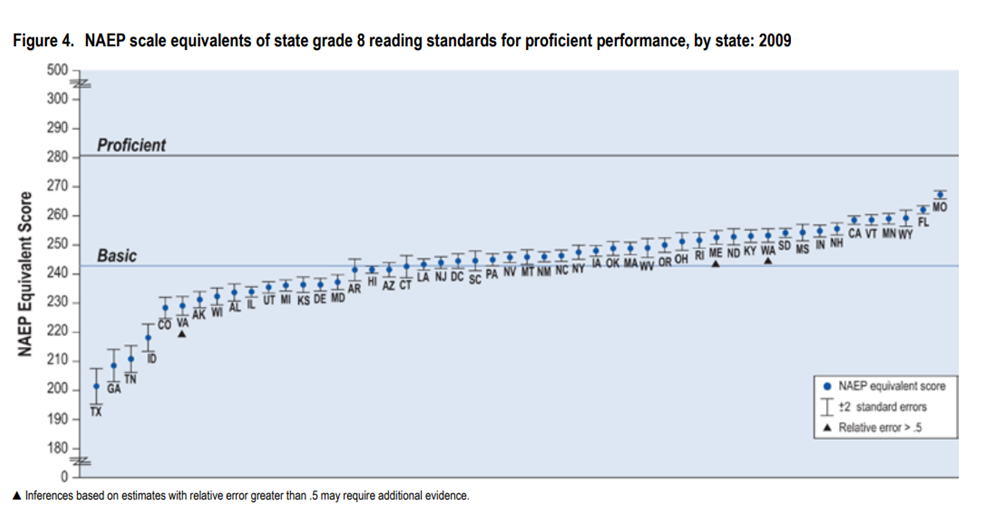
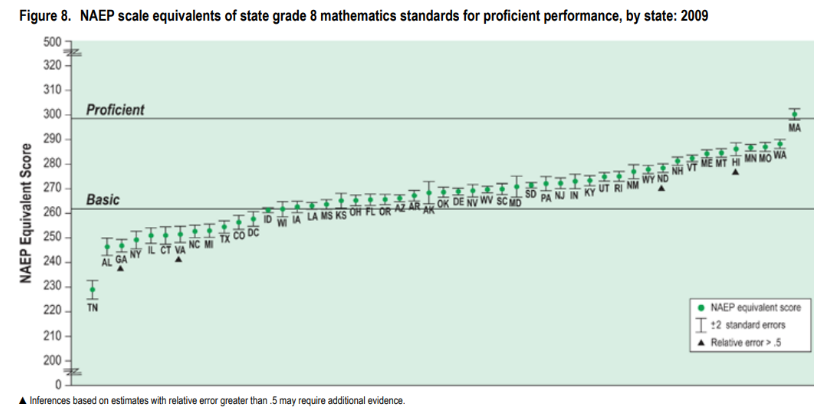
In 2009, Missouri had among the most rigorous assessments in the nation. The two images below come from a report from the U.S. Department of Education, “Mapping State Proficiency Standards Onto the NAEP Scales.” Look far to the right and you will notice that Missouri led the nation in rigor on the 8th grade reading assessment and had the third most rigorous state assessment in 8th grade mathematics.

Language Arts Standards Graph

Mathematics Assessment Graph

What followed 2009 was chaos. Missouri adopted the Common Core standards and ditched our rigorous state assessment. The state then went through turmoil as citizens pushed back against the Common Core, the legislature called for new standards to be written, and the state shuffled through four different state assessment systems. In the end, we wound up with an assessment that was easier than the one we had before.

Forget for a moment the overall message that lowering standards sends and the potential it has to impact all students. In the cases of Normandy and Riverview Gardens, lowering standards may have had a direct and detrimental impact on students. The year Normandy lost its accreditation, just 22 percent of the district’s students scored proficient or advanced in communication arts and 23 percent did so in math, according to the St. Louis Post-Dispatch. In 2017, the district regained provisional accreditation even though the performance of students in the district was not substantially better. That year, 34 percent of students scored proficient or advanced in communication arts and only 19 percent did so in math. Keep in mind these scores were with the easier tests.

Missouri’s state board of education voted to give provisional accreditation to the Riverview Gardens School District in 2016 and the Normandy Schools Collaborative in 2017. It seems those decisions may have been based on the faulty assumption that the student achievement in the districts was improving, when it seems the state was just giving easier tests. At the very least, we owe it to the students of these districts to investigate this further.

On Superintendents and Their Districts

Does it really matter who’s running a school district? Put another way, is paying top dollar for a superintendent a smart investment for a school? Recently, Show-Me Institute researchers sent out Sunshine requests to the 20 largest school districts in Missouri seeking their superintendent contracts dating back to the 2010–2011 school year. The purpose was to take a closer look at superintendent pay and compare it with school performance.

Sixteen districts responded with contracts showing superintendent salaries ranging from $125,000 to $294,000 per year. We also looked at an evaluation of those same school districts from the Stanford Center for Education Policy Analysis (CEPA), which measured the performance of 3rd-grade students in 2009 and then, five years later in 2014, measured the performance of the students in 8th-grade. The object of the CEPA study was to determine if students experienced a full five years of academic growth in five calendar years.

The table below shows superintendent salaries from 2011 to 2014 and student performance growth from 2009 to 2014 for each school district that responded to our sunshine request.

District Mean growth (in academic “years”), 2009–2014 Average superintendent salary, 2011–2014
Columbia 93 4.61 $182,095
Ferguson-Florissant R-II 4.28 $212,851
Fort Zumwalt R-II 5.59 $176,330
Francis Howell R-III 4.80 $191,797
Hazelwood 4.72 $228,247
Kansas City 33 4.33 $234,970
Independence-30 4.70 $210,820
Lee’s Summit R-VII 4.68 $238,553
Liberty 53 4.36 $164,000
Mehlville R-IX 4.64 $190.233
North Kansas City 74 4.56 $230,913
Parkway C-2 5.44 $229,406
Rockwood R-VI 4.37 $235,920
Springfield R-XII 4.55 $171,901
St. Joseph 4.39 $152,953
Wentzville R-IV 5.16 $198,326
Average 4.70 $203,082

The average academic growth between 3rd grade and 8th grade in these 16 districts is 4.7 years. Only three districts had five or more years of growth over the five-year period studied—Fort Zumwalt, Parkway, and Wentzville.

Because the time covered in the Stanford study (2009–2014) doesn’t align exactly with the superintendent salary information (which only goes back to 2011), we can’t make a perfect comparison of the salaries against performance. But based on the four years for which we have both sets of data, it’s difficult to see a direct connection between the two. Of the three districts with more than five years of growth in the table above, only Parkway paid its superintendent above the average rate from 2011 to 2014.

In fact, evidence of any connection between superintendents and student performance is hard to come by. One Brookings Institute study looked at the effect of superintendent turnover on student performance in North Carolina and Florida schools. It failed to find a significant connection. Nor did the study find a relationship between student performance and superintendent longevity.

Such studies make it appropriate to question why superintendent salaries are so high. There are certainly plenty of reasons why people think they should be high. Superintendents are like the CEOs of the school district. They oversee the management and budget of all the schools in the district. Perhaps most importantly, they hire principals and other administrators in the district, who in turn hire the teachers.

But with little evidence that superintendents are making a significant difference in student performance, it’s reasonable to ask why districts are paying them so much. The people in the school hierarchy who have the most effect on student achievement are teachers—and at an average salary of around $53,000, they earn around one-fourth of what superintendents earn. That’s not even considering the school pension system, which definitely favors the higher paid. All of which takes us back to a question that James Shuls raised in an April blog post: Is this really where we want to spend our money?

Support Us

The work of the Show-Me Institute would not be possible without the generous support of people who are inspired by the vision of liberty and free enterprise. We hope you will join our efforts and become a Show-Me Institute sponsor.

Donate
Man on Horse Charging