Kansas City Airport Stumbles Along

One year ago, Steve Vockrodt of The Kansas City Star wrote an excellent piece on the “original sin” of the airport’s new terminal effort. Among his findings was that the then-director of the Aviation Department, Mark VanLoh, did not know that Missouri law required a public vote on airport bonds. It may have been that ignorance of the need for public approval that so hampered the campaign. And what a campaign it was!

Fast forward a year and Vockrodt writes that the new Aviation Department director, Pat Klein, was unaware of Federal Aviation Administration (FAA) guidelines on conducting an environmental assessment. He writes,

Klein said there had been an assumption that the city could put out solicitations for certain construction work before the FAA approved an environmental assessment in October, and then signing those contracts shortly afterward.

“What we’ve been told initially by the FAA is they don’t think that’s a smart idea,” Klein said. “They think we should hold, so we’re in discussions with them to do that. That’s a three-, four-, five-month lag on our schedule, which could be the difference between summer or winter of 2022.”

Now we learn that even before construction has begun, the project’s opening is being delayed 11 months to October 2022 and will cost much more than originally planned. Delays and increased costs such as these are not surprising for such large projects. After all, the Aviation Department itself has been all over the map on costs for years. Changes in costs and timelines can be forgiven. Not knowing FAA rules on construction suggest a deeper problem of management.

The Kansas City Star editorial board rightly called for more transparency in the construction of the new airport terminal. The Show-Me Institute has also called repeatedly for more transparency in the airport process since 2013, when the Council first took up the matter.

It’s difficult to be confident that the City will suddenly adopt a position in favor of transparency after years during which the process was opaque. We remain confident, however, given the Aviation Director’s unfamiliarity with FAA guidelines, that transparency remains the highest need.

Recognizing and Reacting to Market Failure

It doesn’t happen often, but markets can fail. Markets usually work with almost uncanny efficiency, but free market proponents should recognize failure when it happens so that government intervention—which is almost always inefficient and often backfires—occurs only when absolutely necessary.

Award-winning legal scholar, teacher, and University of Missouri Law Professor Thomas Lambert recently brought this message to our state in a Show-Me Institute Policy Series.  His new book, How to Regulate: A Guide for Policy Makers, outlines the narrow circumstances in which markets fail and how regulators should approach the situation—like a doctor carefully considering the risks to the patient before prescribing surgery where a band-aid would suffice.

The Asterisk in Streetcar Reporting

Bill Turque over at The Kansas City Star wrote the standard piece on this week’s streetcar extension vote, and gave some attention to the uncertainty of necessary federal funds,

Taxes will not be collected until construction is ready to begin.

But the tax funds will not come close to covering the cost of building the new line. The KC Streetcar Authority will also seek $100 million in federal funds. Earlier this year Congress rolled back the Trump administration’s proposed deep cuts in transit funding. But the outlook for help from Washington remains uncertain.

That assertion isn’t wrong, but it is woefully incomplete. As we’ve reported previously, the Jackson County court ruling allowing for the creation of the transportation development district that will levy taxes for the streetcar includes an important restriction: No taxes or assessments are to be collected from within the district until enough external funding—in this case federal funds—is available.

And those federal funds are indeed uncertain. The Trump administration position seems to be that it won’t hand out construction money for transit capital grants unless a previous administration signed a full-funding grant agreement, and no such agreement is in place for Kansas City’s streetcar. The Federal Transit Administration has previously called for the New Starts/Small Starts grant program—on which the Kansas City effort is dependent for funding—to be scrapped. As of now it is authorized only through 2021, after which it will cease to exist. Congress seems unwilling to reauthorize it.

Even if the occupants of Congress or the White House change significantly in 2018 or 2020, we are a long way from receiving any federal money for the streetcar, money necessary to permit the TDD to collect taxes and assessments. In the meantime, expect streetcar advocates to start looking elsewhere for their financial support.

A is for Absent

Being financially responsible—keeping a close eye on your bank balance and even your credit score, for example—isn’t always pleasant. Being truly accountable for educating kids also requires keeping track of numbers, both good and bad. As President George W. Bush said, you can’t fix what you don’t measure.

From reading Missouri’s State Board of Education’s reports, one would think that the state’s kids are succeeding in their studies and attending their classes; however, this is not the case. While Missouri schools and districts report their average daily attendance, and it’s incorporated into their Annual Performance Report (APR), these numbers hide individual students who aren’t showing up.

We can’t prove a causal relationship between truancy and poor academic outcomes, but the two are clearly correlated, and common sense tells us that students need to be present to learn. Unfortunately, recently released federal data show that nearly 110,000 Missouri students missed 15 or more days of school in the 2015–16 school year, meaning that they are categorized as “chronically absent.” In seven Missouri school districts, serving a total of over 50,000 students, more than one-quarter of the students were chronically absent.

At the school level, 42 Missouri schools had chronic absenteeism rates of more than 33 percent.

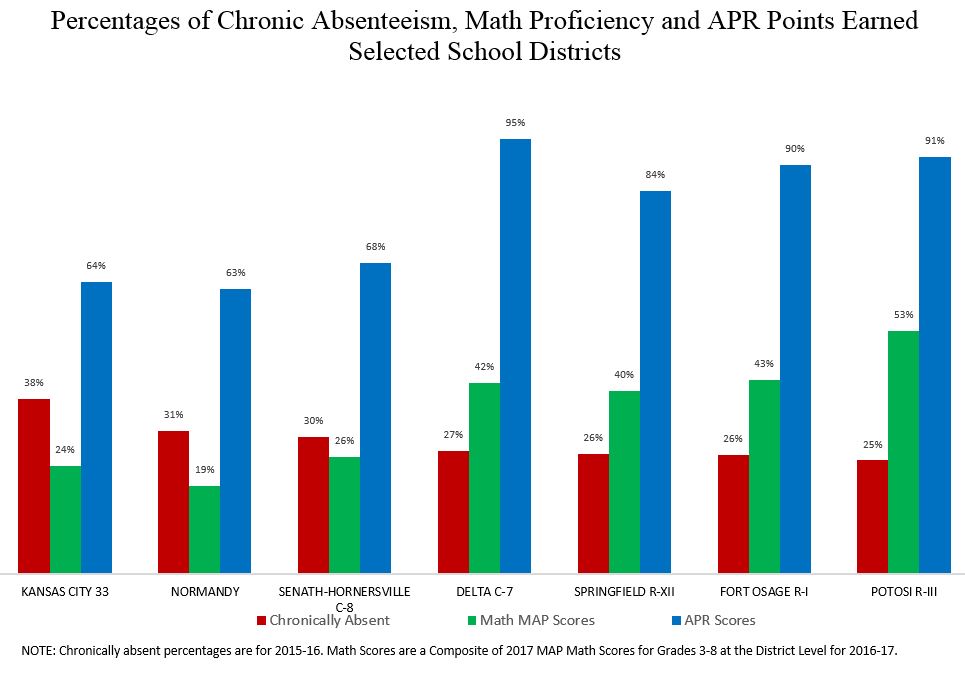
And yet these high-absence schools earned an average of 70 percent of the possible points in the APR evaluation in 2017—well above the 50 percent needed for full accreditation. It’s not surprising that with more than one-third of their students chronically absent, an average of only 15 percent of the students at these schools were proficient in math, and just 32 percent were proficient in reading. In one egregious case, at Kansas City’s Central Middle School, where 54 percent of the students were chronically absent, only 5 percent of students were proficient in math. Yet this school received 75 percent of their APR points, making it fully accredited.

The same trend is apparent at the district level. Kansas City leads with 38 percent of its students qualifying as chronically absent, even though DESE reports a proportional attendance rate of 83 percent for the same year (more on that disconnect in another blog) and a math proficiency rate of less than 25 percent. Yet, the district garnered an APR Score of 64 percent—making it provisionally accredited. Springfield was able to get 84 percent of its APR points, even though one-quarter of its students were chronically absent, and only 40 percent of them are proficient in math.

Though reducing chronic absences will not solve Missouri’s educational woes, making sure kids show up to class is an essential first step for progress. A rating system that gives the impression that children can get a good education when they are not physically present in schools robs them of the chance to succeed. Even more troubling are misleading APR scores that hide the fact that children are not being given the educational opportunities they deserve but being set up to fail.

Absenteeism chart

(Yet) Another Chapter in the Loop Trolley Bungle

The Loop Trolley appears stuck in an endless loop of delays.

It was recently announced that the opening of the over-budget historic streetcar line will be delayed yet again. This is, by our estimates, at least the fifth time the project’s opening has been delayed. Besides these delays, other snags have caught the project up along the way too.

The trolley line, which will run between University City Hall and the Missouri History Museum on Delmar Blvd and DeBaliviere Ave, was originally slated to begin operations in mid-2016. Since then, it’s been bailed out by taxpayers and private firms, threatened by the Federal Transit Administration, and under such financial strain it had to reduce its planned operating hours. It’s become increasingly hard to see the project as anything besides a policy and infrastructure disaster.

Whether you ultimately think the trolley will be a welcome addition to the Loop or just an eyesore and a money pit, all parties can agree the process of getting it up and running has been slow, painful, and embarrassing. This just doesn’t seem like how good policy is rolled out.

St. Louis, University City, County, and federal taxpayers deserve far better.

Are Sales Taxes to Fund Pre-K a Good Idea?

Kansas City Mayor Sly James is working on a proposal for a sales tax increase to fund expanded pre-K education. Despite a real cost to taxpayers, few details have been provided about how the money will be spent. According to The Kansas City Star,

Details and key questions of the sales tax plan — how the money is distributed, who oversees and manages the program, how outcomes are measured — remain a work in progress.

While the details of the 3/8-cent sales tax plan remain unclear, so too are the benefits. My colleague Emily Stahly wrote in late 2016 that,

In Georgia and Oklahoma—states with universal pre-K programs—there is evidence that pre-K has reduced achievement gaps. The jury is still out in New York, which established universal pre-K only two years ago. Tennessee, on the other hand, implemented targeted pre-K for low-income children. Positive results were evident when these children entered kindergarten, but the benefits began to fade by first grade. By third grade, these students were performing worse than other students on statewide assessments.

One much-heralded study claiming big successes as a result of pre-K was perhaps oversold. Mike McShane wrote for National Review,

If you look at the table [page 8 of the study by Heckman et al.] that describes the cohort of students the authors studied, you see an initially recruited sample of 121 students. The actual “treatment” of center-based child care from ages zero to five had 53 participants in one of the two programs and 17 in the other, for a total sample of 70 students. It is a huge leap to argue that such an intensive, hothouse study of such a small sample is proof that such an intervention would work at scale.

Pre-K education makes intuitive sense, but actual research suggests that it isn’t as simple as funding a program and getting results. Sometimes it seems to work, and sometimes it doesn’t. Similarly, we agree that K–12 education is a good idea and yet recognize that not every district does a good job of offering it.

One promising aspect of the plan, according to the Star, is that the program may be set up to offer tuition assistance for families to choose their own program, including from among public and private providers. Giving decision-making power to parents will increase the likelihood that the Pre-K providers will need to produce results if they want to attract students.

In any case, there’s no need for a headlong leap of faith into a costly pre-K program. If Kansas City leaders want to once again increase an already-high sales tax rate, voters need much more detail and likely more time, to evaluate the proposal and its promise.

Michigan Repeals Prevailing Wage, and Missouri Should, Too

Good policy doesn’t have to be complicated. That’s the lesson we should take from the way Michigan legislators took on their prevailing wage (sometimes called a “public construction minimum wage”) law. Here in Missouri, some action was taken in the 2018 legislative session to lightly modify Missouri’s version of it. But last week in Michigan, they showed us how it should be done, achieving an important victory for good governance and free markets by simply repealing the state’s prevailing wage law

With the legislative initiative process Gov. Rick Snyder, who supports the prevailing wage law, does not have to sign the measure. Instead, by meeting a signature threshold and being approved by both chambers, it becomes law immediately.
 
Rep. Lee Chatfield, R-Levering, said the measure eliminates a carve-out.
 
“The success of the United States of America was not made by a government mandate of a prevailing wage. The success of our state did not occur because we had a government mandate and a government carve-out,” he said.
 

Prevailing wage laws force taxpayers to spend more than they should have to on construction labor for public projects. In fact, the research on prevailing wage laws suggests they significantly inflate the cost of public construction projects. At best, the consequence is an inefficient use of taxpayer money. But in some cases, the increased cost is prohibitive, meaning that a potentially beneficial project never even gets started. That could mean putting needed improvements to public services, including schools, on an indefinite pause while additional funds are sought out. Creating special advantages or, as the Michigan legislator put it, “carve-outs,” for particular industries doesn’t just hurt taxpayers in the short term. It also causes long-term, compounding damage as services that might be necessary today are put off.

It was disappointing that in an otherwise successful session, the legislature failed to repeal Missouri’s prevailing wage. As I’ve said before, reconstituting how the wage is conjured is not the same thing as repeal, and yet that is mostly what the legislature passed in 2018. It is true that HB1729 may provide some relief to local governments by exempting projects below $75,000 from the prevailing wage, but that strikes me more as a way of preserving a bad system by reducing the number of communities damaged by it. Rather than being trimmed, the prevailing wage needs to be pulled out of the law, root and stem.

If Michigan (!) can do it, Missouri can, too. I hope repeal will be on the docket in 2019.


Charter Schools: The Education Opportunity Hidden in Plain Sight

By next week, the Missouri State Board of Education should be up and running again. They’ve got plenty of business to attend to, including replacing the needlessly confusing Missouri school accountability system known as MSIP 5 with a new version, MSIP 6. Is there any reason to expect that the new model will be any better than the old one? Meanwhile, there’s growing support among parents for an education reform that actually works—charter schools—but that Missouri policymakers continue to fear.

As I noted in an earlier post, our scores on the National Assessment of Educational Progress (NAEP), considered to be the Nation’s Report Card, have been basically flat for over a decade. For all the changes made to standards and all the accountability efforts, including multiple iterations of MSIP, we’ve made little if any progress. The national scores don’t look much better. In 12 years, American 8th-grade students gained just 5 points in reading and 3 points in math, despite huge bets on No Child Left Behind and the Every Student Succeeds Act.

But what about charter schools? This year, the Missouri House Committee on Elementary and Secondary Education went so far as to suggest that we need a two-year task force to study these new, exotic schools to see if they’re working. No need. In 2005 there were fewer than 4,000 public charter schools serving about one million students. Now there are over 7,000 schools serving over 3 million students. And while traditional public schools in Missouri and across the U.S. were making no progress on the NAEP, the nation’s charter schools were making double-digit gains. This even though nearly one in three charter school students attends a school that has 75 percent or more low-income students, compared to less than one-quarter of students in traditional public schools. At this rate, charter schools will soon surpass the nation’s traditional public schools.

Unfortunately, we can’t see NAEP results for Missouri charter schools because here charters are used as punishment and are relegated to just two cities. What this means is that, unlike in most states, it’s not possible to create a sample of charter school students in Missouri that can be compared to a representative group of students across the state.

The charter model gives participating schools the autonomy to innovate but demands that those schools either produce results or close down. Accordingly, we should expect to see continuous improvement, as low-performing charter schools are closed and what has been learned is used to open newer ones that are stronger. And it seems to be working—at least where it’s allowed to.

Support Us

The work of the Show-Me Institute would not be possible without the generous support of people who are inspired by the vision of liberty and free enterprise. We hope you will join our efforts and become a Show-Me Institute sponsor.

Donate
Man on Horse Charging