Introducing the Show-Me CBAs Project

Following the passage of HB 1413 and in light of the success of our Checkbook projects, we are pleased to share with you our latest “big data” undertaking, the Show-Me CBAs Project. For those unfamiliar, the Missouri legislature passed HB 1413 earlier this year to reform much of the state’s public sector labor laws. Part of the bill sets out clear rules for how collective bargaining agreements, or “CBAs,” are to be negotiated between government and many unions. Those CBAs often set forth the salary and benefits of employees who aren’t even members of the union and who may, instead, want to negotiate their own salaries based on merit; for some of these employees, HB 1413’s CBA rules could functionally offer them that opportunity.

One big problem, however, is that many of these agreements are effectively unknown to the public, and to date there hasn’t been a concerted effort to gather these local agreements and their variations, including memoranda of understanding and other, less-formalized agreements between labor organizations and government. Hundreds of these agreements could be out there, and yet research in this area is surprisingly sparse.

That’s where the Show-Me CBAs Project comes in. By gathering these bargaining agreements, we hope to make it easier for the public to see what their elected representatives have committed taxpayers to in the past, In addition, the Project can also make compliance with HB 1413 an easier undertaking both for government workers and for government regulators charged with implementing HB 1413’s reforms. This project is ongoing, and to date, the Institute has already gathered over a hundred bargaining records, available here. But more are on the way. Stay tuned.

What Will the City’s New MetroLink Tax Get Us?

Last year, voters in the City of St. Louis approved a rather ambiguous half-percent sales tax hike, Proposition 1. Sixty percent of revenues from that tax, which totaled $23.9 million this past fiscal year (p. 49), are slated to fund a north–south MetroLink expansion.

But who knows what city taxpayers will end up getting for their “investment?”

Taxpayers likely won’t get the 17-mile route they were presented last year. After more than a year of study, it was recently announced that the first phase of expansion will run some 9 miles, roughly from Chippewa St. to the NGA site north of downtown, and will cost $700 million. The project is also totally dependent on federal funding, which is a big if at this point, and will begin operations, best case scenario, in a decade.

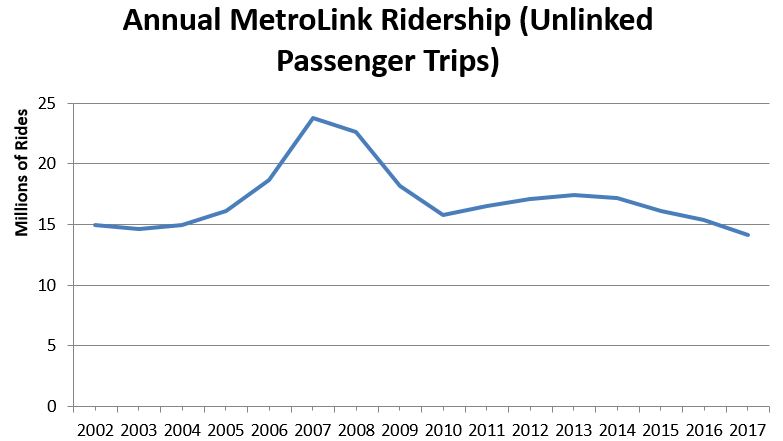
It’s also unclear whether the expansion will get St. Louisans out of their cars. While consultants project the line will carry some 9,200 riders a day, my colleague Joe Miller has pointed out that it runs through neighborhoods with relatively low population density—density about a quarter of what’s needed for light-rail to be successful. Also, overall MetroLink ridership is trending downward; not only has it lost 3.9 million annual rides since 2014, but the rail system carries fewer passengers than it did prior to the 2006 Shrewsbury expansion. And crime on and around MetroLink trains has, according to Metro, contributed to an 11% decline in ridership since last year. While I don’t doubt that an expanded system will (at least initially) carry more passengers, experience—and more than 15 years’ worth of data—suggest we shouldn’t get our hopes up.

MetroLink Ridership

Source: National Transit Database, Federal Transit Administration

But perhaps the biggest if is the economic renaissance promised by MetroLink officials and proponents. Transit advocates claim that rail spurs economic development, that, once you put the rails in, the traffic generated by riders will induce all sorts of business growth. Unfortunately, this claim just doesn’t hold up. Many MetroLink stations are surrounded by land that’s either (a) already developed (and likely heavily subsidized), or (b) relatively empty. In fact, transit-oriented and adjacent development is so scarce in St. Louis that rail advocates have to cast an incredibly wide net for any evidence of it. For instance, Citizens for Modern Transit, the region’s major transit advocacy group, includes investments on Interstates 64 and 70 and parking garages as development “spurred” by MetroLink. And Metro, which operates MetroLink, seems to think any investment within a half-mile of a rail station is causally linked to the presence of their trains. (Or, all they present is data on development within a half-mile of their stations.) Perhaps this is why consultants are now saying that MetroLink could “spur possibly millions of dollars in economic development….” (my emphasis).

At this point, it’s unclear what, if anything, taxpayers will get in return for hiking up their sales taxes. Although rail proponents may have inexhaustible faith, history and facts suggest taxpayers won’t get much for their investment.

Time to Take out the Trash

On the heels of a report finding that St. Louis has some of the poorest-quality city services in America, residents have criticized the city for falling behind in trash collection, and the problem continues to pile up. This situation quite literally stinks. How did we get here?

Originally, the city paid for solid waste collection from ordinary tax revenues. However due to budget constraints—maybe due to the city giving away hundreds of millions of dollars in tax subsidies—the Board of Aldermen passed a bill in 2010 to implement an $11 monthly fee per household to help cover refuse costs. Last August, the Board voted to increase the fee to $14. The additional money was for, among other things, obtaining new garbage trucks to “ensure garbage collectors won’t be forced to work overtime because they’re stuck with poorly functioning trucks.”

And what have the results been? The city’s fleet of garbage trucks continues to deteriorate. Roughly half of the 84 trucks are in disrepair, leaving the other half to cover the 55 daily routes. Even with extended hours and 12 new—leased—trucks, the city still lacks the resources to pick up the trash on time, so the dumpsters continue to overflow.

We are not suggesting that the problem here is exclusively the fault of city officials. For one thing, piles of uncollected garbage don’t make for good optics if you’re an elected official with constituents to keep happy. And the decision to lease new trucks rather than buy them looks like a reasonable response from a city that is behind on maintenance for the trucks it already owns.

Maybe the larger issue is that garbage collection is a better fit for private companies than for a city government. Privatizing this service would allow residents to choose their garbage collector, unlike now, creating competition among service providers and incentivizing high-quality, efficient operations. Wichita, Kansas, a city with 80,000 more people than St. Louis, has no city-run solid waste collection system. The average household in Wichita spends $25 per month on garbage collection. (In comparing this rate to costs in Saint Louis, keep in mind that St. Louis’s current $14 per month fee is in addition to the money from the overall city budget that goes toward trash collection.) As for the quality of service provided, we can’t claim to have our fingers on the pulse of the Wichita trash-collection scene, but our internet searches yielded nothing like this or this or this in Wichita.

Maybe it is time to see if the private sector has an answer to this embarrassing—and smelly—problem.

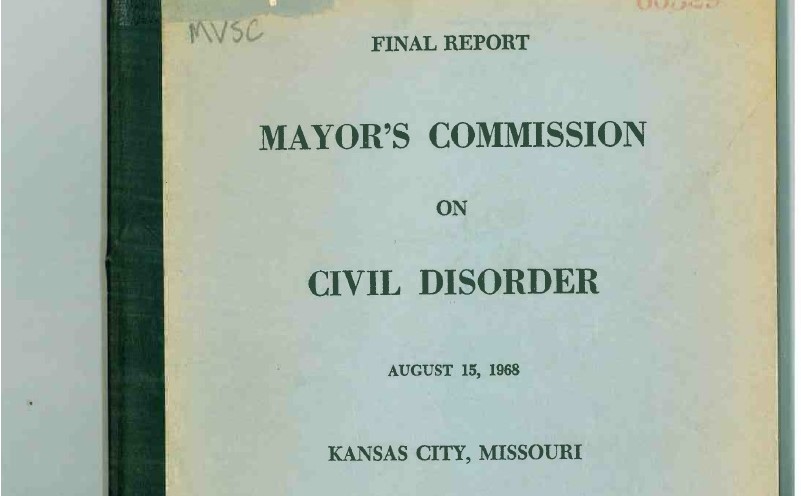
Kansas City Fails to Meet Goals Set by 1968 Report

Immediately following the assassination of Dr. Martin Luther King, Jr. and riots in Kansas City, Mayor Ilus “Ike” Davis appointed the Mayor’s Commission on Civil Disorder to examine events and suggest changes. Reading the commission’s report 50 years to the week after it was issued is an unpleasant reminder of how little progress has been made.

The report examined “the severe civil disturbance that occurred in Kansas City during the week of April 8, 1968 and [made] a report to the people of Kansas City.” Among other things, the report contained recommendations for avoiding future riots and “for the establishment of harmonious relations among the people of this city.”

One of the areas examined was Kansas City’s police—their number, recruiting, training, and tactics. At the time of the report, Kansas City had 932 police officers and was facing reductions. On page 48 the report offers:

Instead of its police force being reduced, this city needs a total of at least 1,500 police officers. Even the existing statute contemplates two police employees for each 800 persons in the population. Since 1961 Kansas City’s population has increased by approximately 15%, and its land area has been nearly doubled by annexation. Expected police service has increased by 58%, but the number of law enforcement personnel has remained approximately the same as it was in 1961.

The commissioners’ call for more police to reduce crime is borne out by subsequent research. Yet Kansas City today has 1,283 sworn law enforcement officers, down 121 from the 1,404 officers they had in 2010. The city never achieved the 1,500 mark recommended by the commission’s report. Nor has the city successfully adopted the commission’s recommendation to rely more heavily on foot patrolmen—but that may be a function of not having enough officers.

Based on 2017 data, Kansas City has the sixth-highest homicide rate in the United States per 100,000 population. Based on FBI statistics, of the ten cities with the highest homicide rates, Kansas City has the fewest officers per 10,000 population.

A years-long, nation-leading spike in the number of homicides is arguably as “severe” a “civil disturbance” as one can imagine. Numerous factors are causally linked to crime, including education, poverty, and income inequality. Yet when it comes to the one aspect of public safety that policymakers can control, policing, Kansas City has fallen short of its 1968 goals.

More Reason to be Skeptical of Economic Development Incentives

If you’re hoping that a new report on Kansas City’s economic development incentives accurately assesses their value, I’ve got some bad news. Based on the draft copies of the always coming, never arriving report sent to me in response to an open records request, the report has one glaring and fatal flaw: It fails to address the much-maligned “but-for” analysis.

For a development project to receive tax-increment financing (TIF), one of the most popular subsidies, two boxes must be checked: A property must be declared blighted, and the proposed project must pass the but-for test. (We’ve written much about the largely meaningless blight standard before.) The but-for test, in short, is proof that a project wouldn’t go ahead in the absence of public assistance. Developers often support this claim by showing that a project would not be profitable without the public assistance, or in many cases not profitable enough for their tastes.

Much of the research on TIF subsidies in Missouri and around the country focuses exactly on that but-for analysis. Studies consistently find that TIF-treated areas grow economically at the same pace as non–TIF-treated areas. This means that cities are subsidizing development that is just as likely to happen without the subsidy—regardless of what the applicant tells you. TIF applications sometimes rely solely on the applicant’s own claim that without subsidies they would not build.

A new working paper from the Upjohn Institute for Employment Research underscores this exact problem in Kansas City when it concludes in part, “Overall, the research literature on incentives’ ‘but for’ effects is not as rigorous as one might hope.” No kidding. The paper sums up its findings as follows:

Based on a review of 34 estimates of “but for” percentages, from 30 different studies, this paper concludes that typical incentives probably tip somewhere between 2 percent and 25 percent of incented firms toward making a decision favoring the location providing the incentive. In other words, for at least 75 percent of incented firms, the firm would have made a similar location/expansion/retention decision without the incentive. Many of the current incentive studies are positively biased toward overestimating the “but for” percentage. Better estimates of “but for” percentages depend on developing data that quantitatively measure diverse changes in incentive policies across comparable areas. [Emphasis mine.]

If the draft report being passed around between the CDFA and Kansas City is any indication, not only does it fail to seriously analyze “but for” claims—unlike a similar study conducted in St. Louis—it barely mentions but-for whatsoever. That means we are being asked to assume that developments that come after subsidies are granted come because subsidies are granted—a basic logical fallacy. Kansas City leaders had the time and resources to commission a more thorough analysis of city incentives, and they chose not to. What they got instead was a report that mimics the failures of their policies.

The More They Give, the More They Take

The bottom line regarding tax giveaways like tax increment financing (TIF) and other subsidies is this: The more officials hand out to developers and special interests, the more ordinary taxpayers need to cough up to make up the difference. It looks like University City Public Library (UCPL) officials, like many officials caught in the middle of generous subsidy deals, know this well.

A recent UCPL survey asked some University City residents how they felt about a potential property tax hike to bolster the library’s budget. The increase mentioned would raise library tax rates from 28 cents per $100 of assessed value to 40 cents per $100 of assessed value. So, for example, a home with an appraised value of $100,000 would pay an additional $23 or so per year in property taxes if such a rate increase were to occur.

What’s notable is not that a public institution is asking for more cash, but that officials seem to be testing the waters as a massive TIF-funded development is being debated. For the proposed I-170 and Olive development,  taxpayers are being asked to part with $70.5 million over the next 20 or so years. Much of that $70.5M would come from property taxes that would otherwise go to schools, libraries, and other jurisdictions. So, in short, if the development goes through as proposed, the library (and school and other districts) would miss out on millions in revenue.

Now, I’m not claiming that UCPL is considering a tax hike because of the I-170 and Olive development, but I wouldn’t be surprised if there was a connection between the two. This would hardly be the first time a library or library district had to go to voters for additional funding because of loose tax subsidy policies. It was just in 2016 that, after years of losing out on millions in revenues because of tax giveaways, the Mid-Continent Public Library in Kansas City asked voters to approve a tax hike. At the time, my colleague Patrick Tuohey aptly dubbed the tax hike the “TIF Tax.”

UCPL and those it serves would likely benefit greatly from extra funding. UCPL has a modest staff of 16 employees and spends around $1.6-1.8 million a year (see pp. 165-171). Besides some pension liabilities somewhat out of their control, UCPL officials appear to be good stewards of the taxpayer funding they’re given. It’s just a shame that libraries and other districts are impacted so much by misguided economic development programs like TIF, and it’s an even bigger shame that taxpayers are often left holding the bag.

Is Success Really Just a Matter of Showing Up?

A student who fails every test in a course is unlikely to get a passing grade just because he makes it to class every day. Yet the Missouri Department of Elementary and Secondary Education (DESE) currently grants accreditation to every single public school in the state*—and some schools keep that accreditation despite poor academic performance because of the way attendance is factored into the state’s formula for evaluating them.

The state’s method of accrediting schools is based on its Annual Performance Report (APR), which uses five factors—academic achievement, subgroup achievement, high school/college/career readiness, graduation rates, and attendance rates—to assess the quality of public schools. Missouri’s APR is among the least stringent in the country, which might be why not a single district is unaccredited. The scoring of attendance is especially problematic, as perfect scores are handed out even when kids are missing for weeks.

This attendance inflation is especially concerning due to the large weight allocated to attendance in the Annual Performance Reports. The possible number of points from all categories varies by school, anywhere from 50 to 140 points, but in all cases a school must get 50 percent of the total available performance points if it is to be accredited. And here’s how attendance fits in: Regardless of how many points are possible for a given school, ten points are allotted for attendance, giving the measure different weights for different schools. This means that a 10/10 attendance score could account for anywhere from 14 to 40 percent of the necessary points for accreditation. Accordingly, a school that would otherwise lose accreditation based on the academic achievement of its students might nonetheless squeak past the 50 percent line thanks to strong attendance numbers. Considering that every Missouri school is currently accredited—even those with poor academic records—and considering the generous attendance formula (as detailed in a previous post), this scenario is hardly implausible.

Kansas City’s Central Middle School is a case in point. It is accredited with 75 percent of its possible APR points and 7.5 of its 10 possible attendance points, even though 54 percent of its student body was chronically absent (defined by the federal government as missing 15 or more days of school) in 2015–16. Its academics are among the poorest in the state, with only five percent of students proficient in math. Normandy’s 7th & 8th Grade Learning Center managed to become accredited with 37.5/70 points (54 percent), 7.5 of which were from attendance alone. The attendance boosted the Learning Center’s score by 11 percentage points, and without it, this school, in which only one in twelve kids is proficient in math, would not have been accredited.

Accreditation implies that Central and the Learning Center are preparing students to succeed, even though almost all students struggle with elementary concepts. Knowing that their schools are accredited will be cold comfort to students who find themselves unequipped for further studies or the workforce. Missouri needs to re-evaluate its educational standards and provide accurate performance reports that call attention to shortcomings in the public schooling system. The APR was never meant to provide cover to underperforming schools at the expense of students.

*DESE has informed us that they accredit exclusively at the district level, and thus do not accredit individual schools.

Missouri’s Making Improvements, but Still Trailing

The last few months have been good for the economy. The benefits of the recent federal tax cuts appear to be taking effect, resulting in a 4.1% national GDP growth for the second quarter of 2018—led by increased consumption and exports—and a 4.0% unemployment rate.

Based on the Bureau of Labor Statistics’ June data for Missouri, there is good news for our state, too. Our unemployment rate ticked down to 3.5% from 3.6% in May, which was already down from 3.7% in January. Missouri is now half a percentage point below the national unemployment rate. Additionally, Missouri’s labor force saw an increase of 8,000 people in just the last month. These data might suggest that an increasing number of Missourians are interested in working, and they are successfully finding jobs.

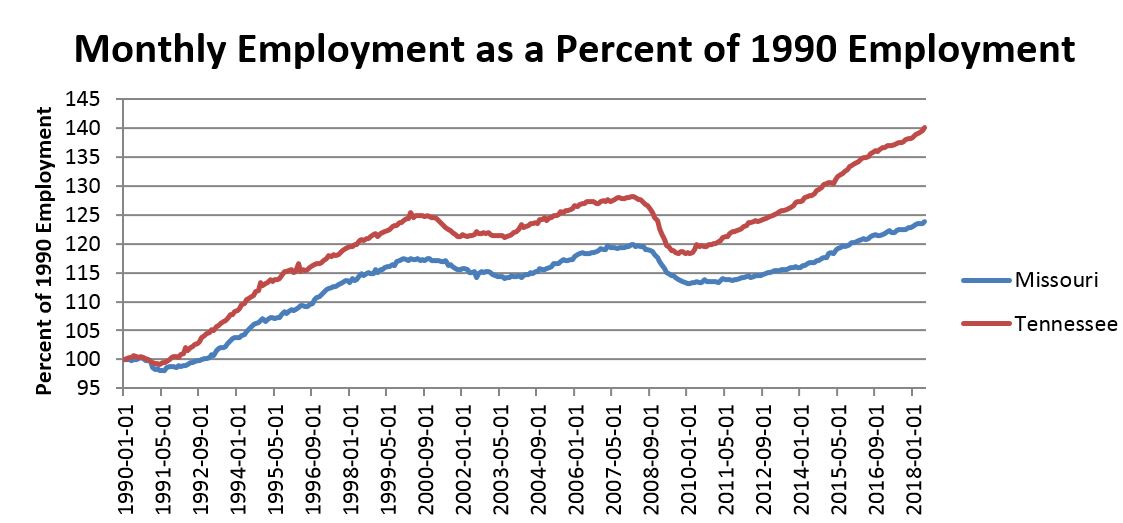
These statistics do not tell the whole story, however. Historically, Missouri is one of the slowest growing states in the nation. Compared to Tennessee, a demographically similar state, Missouri is still underperforming despite having similar unemployment rates. When looking at the growth in employment, Tennessee trumps Missouri. The figure below displays total employment as a percentage of 1990 employment. Even with a good last few months, Missouri lags behind Tennessee.

Chart: Employment as a percentage of 1990 employment

With similar demographics and access to resources, it should be possible for Missouri to experience Tennessee’s level of growth. As we discussed before, Tennessee’s improved performance might be related to its education and workforce development initiatives or lower tax burdens. Missouri has been heading in the right direction in recent months—but should we be content, or should we examine whether Missouri could benefit from adopting the policies that have helped Tennessee’s growth outpace ours?

Support Us

The work of the Show-Me Institute would not be possible without the generous support of people who are inspired by the vision of liberty and free enterprise. We hope you will join our efforts and become a Show-Me Institute sponsor.

Donate
Man on Horse Charging