How Bad was the CDFA Study of Incentives in Kansas City?

It was with great anticipation that I received the long-overdue study of economic incentives in Kansas City conducted by the Council of Economic Finance Agencies (CDFA). Even before the actual publication, I had been critical of the amount spent, the trade association (!) hired to do the analysis, and the repeated extensions given to them—making the report over a year late.

Sadly, my worst fears were realized when I received a draft copy of the report via an open records request. And the release of the final report hasn’t made things any better.  In short, the report tallies up the amount of subsidies awarded in Kansas City, tallies the investments made, and divides the latter by the former. Their conclusion was that “each incentive dollar invested generated $3.83 in additional tax revenue.”

During the years this study took to complete, was any effort made to answer the central question before policymakers—how much development happened because of incentives? If so, I can’t see any evidence of that effort. The question has been tackled by other researchers—most if not all of whom seem to arrive at the same answer: very little—or certainly not enough. The Upjohn Institute for Employment Research concluded in a July 2018 study that “for at least 75 percent of incented firms, the firm would have made a similar decision location/expansion/retention decision without the incentive.” That is a devastating conclusion, suggesting that three out of four dollars spent on incentives is unnecessary.

As a result, policymakers were vexed when the CDFA’s report was presented to the City Council on August 16. The report gives them no information that could help them distinguish good incentive investments from bad.  Councilmembers’ repeated questions about how this report can inform future decisions were met with answers that seemed designed to obfuscate.

Consider the following exchange between one councilmember and the director of the office of economic development (starts at 48:15):

Councilman Lucas: So there is some public conversation at times to the idea that we should not incentivize on the Country Club Plaza, we should not incentivize downtown. I guess the answer that I am hearing is that we can’t quite answer that question. Is it your view, Ms. Tyndall, that this study can actually help answer the question as to whether we have provided sufficient incentivizing activity such that we do not need to continue to extend incentives in certain areas?

Kerrie Tyndall: The way that I would respond to that question is to say that I think that this study shows that in general economic development incentive tools do work. They do provide an overall positive return on investment to the city when we apply them, but they are ultimately—at the end of the day—a tool. And someone has to take advantage of those tools in order for us to see an impact and from a public sector perspective we can certainly invest our dollars and be in control of how we invest our dollars when we’re trying to leverage investment of the public sector we’re somewhat dependent upon them to take advantage of those tools in order to accelerate some of the social gains that we want to achieve . . . [I gave up transcribing here].

In other words, no. City officials seem to be saying that taxpayers ought to subsidize every project in order to realize that three-to-one investment return. After about 90 minutes, the mayor seemed frustrated that council members weren’t buying the report’s conclusions. He asked one of the consultants—PGAV Planner’s Adam Stroud—about whether the incentives created the return that the report touts (starts at 1:25:55),

Mayor James: If $288 million [in incremental real property taxes*] is as a result of some incentive being used, if there is no incentive being used, would the number be zero?

Adam Stroud: I can’t answer that.

James: Would it be less than the $288 [million]?

Stroud: I also can’t answer that.

Again, unlike so many other studies of economic development incentives, this one simply omitted any analysis of whether incentives were necessary to drive development. This report just makes that assumption, but as Stroud honestly points out, he doesn’t know because this study didn’t consider it.

Despite the costliness and tardiness of the study, this giant hole in its design makes the report essentially worthless, both for assessing of existing incentive subsidies and for guiding future policymaking.

*The $288 million that the mayor refers to is actually the amount that will be returned to the developer instead of going to fund city services, so it’s unclear why the mayor asks the question this way. Nevertheless, it’s clear from the context that the mayor is looking for a link between subsidies and higher tax revenues, but this study can’t establish such a link.


Higher Taxes = Less Innovation

When researchers at the Show-Me Institute argue that high tax burdens encourage people to leave Kansas City and St. Louis, city leaders often react with derision. Yet when they want to encourage development in their respective cities, they employ policies intended to attract investment by—surprise—reducing taxes through abatement, tax increment financing and the like. They may not want to admit it, but they are conceding our chief argument: Tax rates affect development.

Now we learn that high tax rates affect more than development. According to a new study from the National Bureau of Economic Research, tax rates affect innovation. The researchers used data stretching back to the early 20th century and looked mostly at state-level taxation. The large amount of data used by the researchers led to some impressive findings (page 33):

A one percentage point higher tax rate at the individual level decreases the likelihood of having a patent in the next 3 years by 0.63 percentage points. Similarly, the likelihood of having high quality patents with more than 10 citations decreases by 0.6 percentage points for every percentage point increase in the personal tax rate.

The report even anticipated some of the usual complaints about innovation in Kansas City that are tied to our development-incentive “border war” with Kansas:

We find that taxes matter for innovation: higher personal and corporate income taxes negatively affect the quantity, quality, and location of inventive activity at the macro and micro levels. At the macro level, cross-state spillovers or business-stealing from one state to another are important, but do not account for all of the effect.

Municipal leaders have invested a lot of taxpayer money and frothy eloquence in innovation and technology. Yet when it comes to actual public policy, such as with ridesharing, they have reverted to regulatory bad habits in both St. Louis and Kansas City.  They certainly aren’t supporting innovation in their tax policies.

If political leaders in Missouri want to spur innovation, they need to enact policies that stay out of innovators’ way—and burden investors less.

Kansas City Incentive Study Misses Opportunity

Kansas City recently released a study of its economic development incentive programs. Unfortunately, rather than a rigorous examination of the link between incentive investment and returns, the city presents a basic logical fallacy: that because development happened after an incentive, it happened because of an incentive. And for this bit of sophistry taxpayers parted with $350,000.

The Kansas City Business Journal reported that the consultant who prepared the study couldn’t show “how much development might have occurred in the absence of all incentives.” This is no small oversight. Kansas City is spending or diverting hundreds of millions of dollars into various development schemes at significant cost to school districts, counties and other basic services. We ought to have some sense of whether this is working. No private sector CEO worth her salt would permit such a significant investment of resources without any idea of the return it was likely to generate.

Worse, the report’s inability to connect investment with return was not a bug; it was intentional. Plenty of organizations, academic and otherwise, have conducted research into this very relationship. In 2016, the St. Louis Development Corporation—the River City’s version of the Kansas City’s Economic Development Corporation—conducted exactly this sort of study and determined that the use of incentives could not be said to drive private investment or create jobs. Incidentally, the company that produced St. Louis’s study, The PFM Group, also submitted a lower bid on the Kansas City project than the vendor the city eventually chose.

A 2018 working paper published by the Upjohn Institute of Employment Research concluded in part, “For at least 75 percent of incented firms, the firm would have made a similar location/expansion/ retention decision without the incentive.” That is a devastating conclusion—and one that is largely supported by research elsewhere. Is Kansas City wasting three out of every four incentive dollars?

Unfortunately, city leaders don’t seem to want to know; the study they commissioned did not even attempt a but-for analysis. City Manager Troy Schulte heralded the study and encouraged developers to make more use of the program. Are we really to believe that every economic development incentive program in Kansas City is a wild success? Really?

The biggest disappointment of the study, as alluded to in the Business Journal’s editorial on the matter, is that the report cannot help policymakers sort good projects from bad. It cannot ensure that future decisions regarding incentives are data-driven. It simply took every bit of economic growth the city has seen and attributed it to the incentives that came before. That is not analysis that encourages better policy. It is political cheerleading, and it is unworthy of the people and policymakers of Kansas City.

Agency Fees in Government Aren’t Allowed in Missouri, But That Didn’t Stop Some Local Governments

When?Janus vs. AFSCME?was decided earlier this summer, its immediate effect was on the 22 states that allowed government unions to collect agency fees from workers. Thanks to?Janus, those government workers can no longer be compelled to support a union as a condition of employment. But fortunately, workers in Missouri had those rights already by statute, namely Missouri Revised Statute §105.510. That section makes clear a number of things, but relevant to the agency fee discussion?is this?(emphasis mine): 


No such employee shall be discharged or discriminated against because of his exercise of such right [to form and join a union],?nor shall any person or group of persons, directly or indirectly, by intimidation or coercion, compel or attempt to compel any such employee to join or refrain from joining a labor organization. 


Which brings me to a research project that we have recently embarked upon: to catalogue and review the collective bargaining agreements (CBAs) that have been instituted by the state, and by local governments across the state.?The Show-Me CBAs Project?is still in its early stages, but it has been remarkable to see how often agency fee requirements are included in these contracts. 


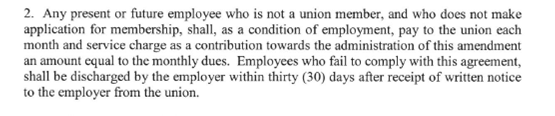
For instance, Crystal City in Jefferson County appears to have amended an existing agreement on March 26 of this year to add a provision requiring employees to pay and become union members, to pay the union the amount of union dues but not be a member, or be fired.?Page 13:

Crystal City

Meanwhile in a contract agreed to this past June, the City of Grandview also included in its contract with Grandview Firefighters, Local No. 42, a provision compelling non–union members to support the union’s activities through a “modified agency shop.” Page 2 of the agreement

Grandview

Curiously, both Crystal City and Grandview struck their respective agency fee sections shortly after we contacted them about their collective bargaining agreements. On the same day that we contacted Grandview (July 24) requesting its collective bargaining agreements, the Grandview Board of Aldermen removed the offending section by ordinance.  We also contacted Crystal City on July 24; and on August 13its agency fee section was removed. 


While the removal of these sections was appropriate, the larger problem here is that it appears these local governments (and many others) may have been violating of Missouri workers’ rights even before the?Janus?decision was handed down. When a contract the city negotiates purports to give the union power over you, and especially when you aren’t given reasonable notice of your actual employment rights, hasn’t the city, through its CBA, “directly or indirectly” attempted to compel you to join a labor organization, in violation of the plain language of §105.510 of the Missouri Statutes? Moreover, if any of these cities exercised a termination provision of one of these agreements against an employee—if they fired someone (or formally threatened to fire him) because he didn’t pay the union as a condition to employment—then the statutory violation seems even more obvious.


In Missouri, these provisions shouldn’t have been in these contracts even prior to?Janus, as they were already contrary to existing state statute. Local governments should be very concerned about whether past and current employees—all workers, both union and non-union, who made decisions based on such language—will want back the dues and fees taken under a CBA regime that misled them about their rights under Missouri law.


More of the Same for the New KCI Project

For years, Kansas City Mayor Sly James asserted that revenue generated at the airport cannot be redirected to the city. This is incorrect. Airport funds have been redirected to the city to cover other bad economic development investments. But his strong insistence makes the recent news all the more puzzling.

According to The Kansas City Star, part of the deal the city struck with Edgemoor, the winning bidder for construction of the new terminal, included diverting airport revenue to workforce training, gap-financing for developers, and support for a program to help the elderly with home renovation. The FAA rejected these expenditures. According to the Star:

The FAA also rejected the use of airport revenues for $1.5 million in assistance to the Northland, including housing, economic development and mental health needs.

Why is this a surprise? Even if city hall doesn’t have a command of the specifics about how airports operate, shouldn’t it be aware of these prohibitions? Shouldn’t Council members—especially the members who served on the Council’s short-lived airport committee—have known this?

This is the second in a recent set of embarrassing revelations about the airport project. Recall that a few weeks ago we learned that the Aviation Department director didn’t know enough about FAA regulations regarding environmental assessments. And before that there was the years’ long parade of advisory groups and consultants.

Building a new airport terminal is a big project, and unforeseen challenges and setbacks are no surprise. But what we’ve seen so far indicates a serious lack of competent leadership.

It’s Time to Fund Bryce’s Law

Dwight Scharnhorst was elected to the Missouri House of Representatives in 2006. Shortly thereafter his grandson, Bryce, was diagnosed with autism. On April 22, 2007 Bryce suffered a seizure that took his life. To Representative Scharnhorst, those events were not unrelated. In a recent interview with the Show-Me Institute he said, “I think the Lord was tapping me on the shoulder, ‘I put you here, and that’s part of why.’” For more on Bryce’s story, see this brief video.

In 2008, Scharnhorst introduced a bill known as “Bryce’s Law” to the Missouri legislature. Had it passed, it would have created a valuable school choice program that provided scholarships for children like Bryce who suffer from autism or other severe health impairments. Funding for the scholarships would have come from donations from individuals who in turn would receive a credit toward their taxes. The tax credit scholarship bill failed to gain support in the House of Representatives and did not pass. Many lawmakers simply would not support a school choice bill that would allow students to use funds at a private school, no matter how needy the students might be.

Undeterred, Scharnhorst proposed similar bills in 2009, 2011, 2012, and 2013. Finally, in 2014 the Missouri Legislature passed Bryce’s Law. However, the bill that finally passed was not the same as the bills that Scharnhorst has previously proposed—it did not contain a tax credit. Instead, the truly agreed to and finally passed bill called on the Missouri Department of Elementary and Secondary Education (DESE) to seek grants to fund scholarships.

The change in the bill meant that donors would only receive a standard deduction for donating to a scholarship organization, just as they would had the bill not been passed. Since 2014, DESE has not reported a single student as having benefitted from Bryce’s law.

Next year Bryce’s law is set to sunset. However, the needs of students with autism and other severe impairments have never been greater, and expanding their education options has never been more important. Rather than let this worthy program simply die without ever having reached its potential, lawmakers should finally fund Bryce’s law. They should do so directly, not through a tax deduction or a tax credit program. This is the only way to ensure that funding is available to serve these precious children in the programs their parents choose.

Check back later this month when the Show-Me Institute releases an essay, “Bryce’s Law Revisited: Serving Missouri’s Neediest Students Through Targeted Scholarships,” co-authored by Michael McShane, Susan Pendergrass, and James Shuls.

Tallying the Costs of Development Subsidies

Cities across Missouri are struggling to provide basic public services. At the same time, they’re giving hundreds of millions of public tax dollars to corporations for private development projects. What’s going on here? We decided to delve into dozens of financial reports to figure out exactly how much schools, libraries, and other public districts across the state have lost because of the generous awarding of subsidies like tax-increment financing (TIF) and other tax-abatement agreements.

A new government accounting standard known as GASB 77 theoretically requires public districts to disclose how much revenue they have foregone because of tax abatements. While GASB 77 provides a starting point, in the first year of reporting under this rule lost revenue was greatly understated—mostly because of carve-outs from the reporting requirements and misunderstanding of how to implement the rule.

Nonetheless, the numbers reported by the governments themselves show that the affected districts lose out on tens of millions of dollars every year. Instead of funding education, libraries, and other services, this money ends up in the bank accounts of private developers who in most cases don’t need subsidies to finance their projects.

About half of all public school budgets comes from local property taxes—so it matters that Missouri’s school districts lost out on nearly $100 million in fiscal year 2017 alone. St. Louis Public Schools missed out on at least $10.5 million, or nearly 3 percent of its annual operating budget, while Kansas City Public Schools lost out on at least $24 million, or nearly 10 percent of its annual budget.

The effect incentives have on other smaller districts, like Ste. Genevieve County R-II School District (1,858 students in 2018), can be even more significant than the larger ones. The amount forgone in fiscal year 2017 was $7.8 million. But with only about 4,500 students in the district, that’s equal to $4,172 per student.

Libraries also took a hit. According to the reports we examined, the 20 largest library districts across the state lost out on at least $6.8 million. A significant chunk of that foregone revenue came from the St. Louis Public Library, which missed out on $1.1 million (nearly 4 percent of its annual operating budget) and the Kansas City Public Library, which missed out on $2.5 million.

These numbers give taxpayers an idea of the cost when policymakers decide to put developers’ interests ahead of basic government services. But even the statistics above fail to capture a significant amount of the total revenue lost. GASB 77 is a step in the right direction, but more transparency is needed.

During a time of teacher protests and tax hikes, these figures give taxpayers an idea of how much money has been diverted from schools and other public services. The next time local officials stump for more revenue, ask them this: What did you do with the taxes we already sent you? Unfortunately, many have been giving them away through tax incentives.

Teachers Live Forever

It has been said that “teachers live forever in the hearts they touch.” And a new report from the Society of Actuaries (SOA) suggests that some teachers live nearly forever, period. Here is a summary from Pensions & Investments Online: “The public-sector tables also show that pension obligations for teachers are higher than other job categories, when other factors are equal. Female teachers reaching age 65 have a life expectancy of 90 or above.” You read that right; the life expectancy for female teachers who have reached 65 is 90 years old or more. Given that roughly three-fourths of teachers are female, this spells trouble for many teacher pension funds.

Missouri’s largest teacher pension fund, the Public School Retirement System (PSRS), has already begun to recognize the improved mortality rates of teachers. A PSRS report on contribution rates for 2017-2018 notes that the system has already begun updating the plan’s mortality assumptions:

People are living longer. Mortality is improving, not just in Missouri, but also across the nation. As a result, actuaries are utilizing updated mortality tables, which reflect this trend. PSRS/PEERS conducted Actuarial Experience Studies to compare our actuarial assumptions to the actual experience of the Systems. In other words, are members living as long as we assumed they would, or are they actually living longer?

According to the internal PSRS analysis, people are living longer than the plan had assumed. Adjusting for greater longevity led to a tremendous increase in the plan’s liabilities. According to PSRS board chairman Aaron Zalis, “the revised mortality assumptions better reflect PSRS/PEERS’ actual experience, which results in an increase of over $2.1 billion in liabilities to the Systems.”

Teachers in PSRS are eligible to retire with full benefits after 30 years of service, and there are also early retirement options. This means a teacher may retire by 55 with 30 years of service. Given the new mortality tables from the SOA, a large subset of teachers might be expected to live beyond 90 years old, drawing a pension for 35 years or more.

It is unclear if the SOA’s updated mortality tables for teachers will encourage PSRS or Missouri’s other two pension plans to once again change their assumptions. If they do, we can assume the financial health of the plans will decline.

Let’s process what that means for a second. Some teachers in the past did not put enough into the retirement system to cover their own benefits. As a result, the pension plan will become increasingly underfunded. To make up for this, the plan will have to increase contributions for new members, hold down retirement benefits for retirees, or seek higher returns on investments (Read: “risky investments”). None of this is good for teachers of today or tomorrow.

So teachers, keep this in mind when you sign that contract. You are agreeing to fund the benefits of those who went before you. You may be striking a bargain that you end up regretting.

Support Us

The work of the Show-Me Institute would not be possible without the generous support of people who are inspired by the vision of liberty and free enterprise. We hope you will join our efforts and become a Show-Me Institute sponsor.

Donate
Man on Horse Charging