Are Missouri Teacher Salaries Going Down?

Last year, teachers went on strike in West Virginia, Oklahoma, Kentucky, Arizona, and Colorado and a general sense of unrest in the education profession swept the nation. As was written in Education Next, “Those walkouts seem to have lent new urgency to teacher demands for salary raises and increased financial support for schools.” Each year, Education Next conducts a survey on a number of education issues. Following the strike, 49 percent of respondents said we should increase teacher pay. This was a 13-percentage-point jump over the previous year’s survey.

In a separate analysis in Vox, Alvin Chang suggests that this unrest may have something to do with the fact that teacher salaries are failing to keep pace with inflation. Using average teacher salaries in each state from 2004 to 2016, Chang finds that teachers have had their pay essentially cut by three percent over this period when we account for inflation. In Missouri, that cut was 2.3 percent.

There is, however, a glaring problem with this calculation. From 2003 to 2016, there have been demographic and staffing changes in the teacher workforce. Schools have decreased class sizes, hiring more, younger teachers. With an influx of less experienced teachers, the average pay will be lower. But this doesn’t mean the salary schedules (the pay systems used for teachers) are losing ground to inflation.

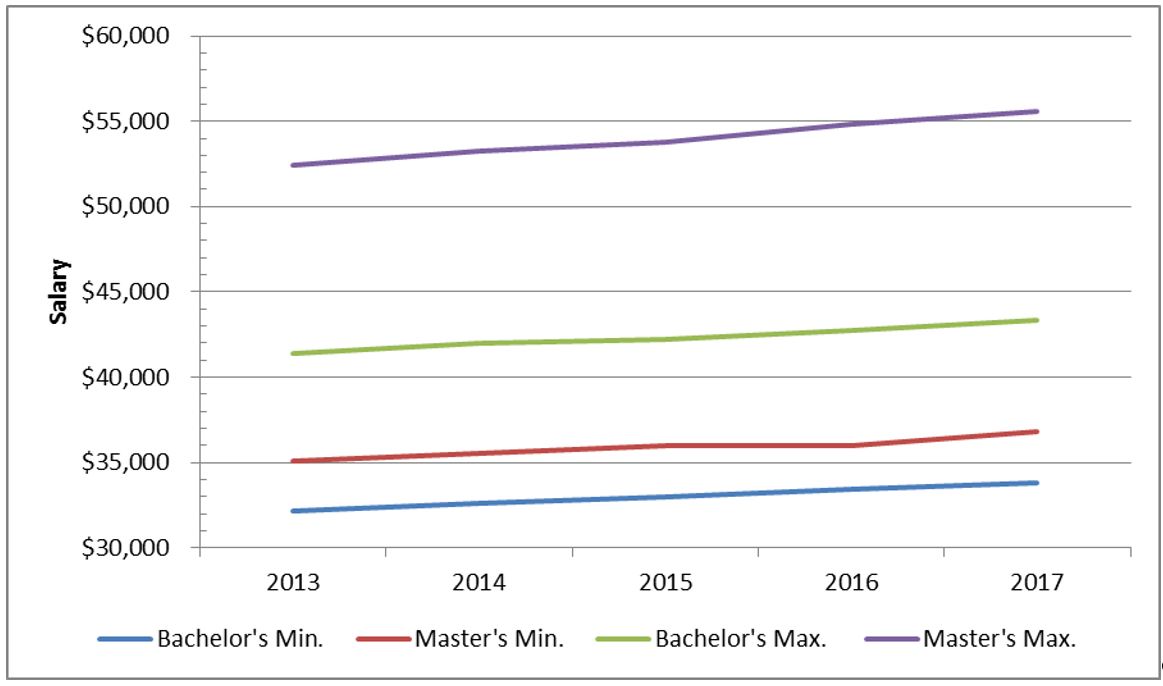
To assess whether teacher salary schedules in Missouri are keeping up with inflation, I reviewed the annual salary report of the Missouri State Teacher’s Association (MTSA). MSTA collects salary schedules from each school district. The report lists the average pay for four key categories: bachelor’s degree minimum and maximum, and master’s degree minimum and maximum. The data cover a five-year period.

Below, I show the average salary, as reported on the salary schedules, in each of these categories.  As you can see, pay has been increasing over this period of time. The question is whether these increases keep pace with inflation, which helps us assess whether teacher salaries are going up or down in real terms without the impact of demographic changes to the workforce.

Figure 1: Average Salaries in Missouri Based on Salary Schedules

Teacher salary graph 1

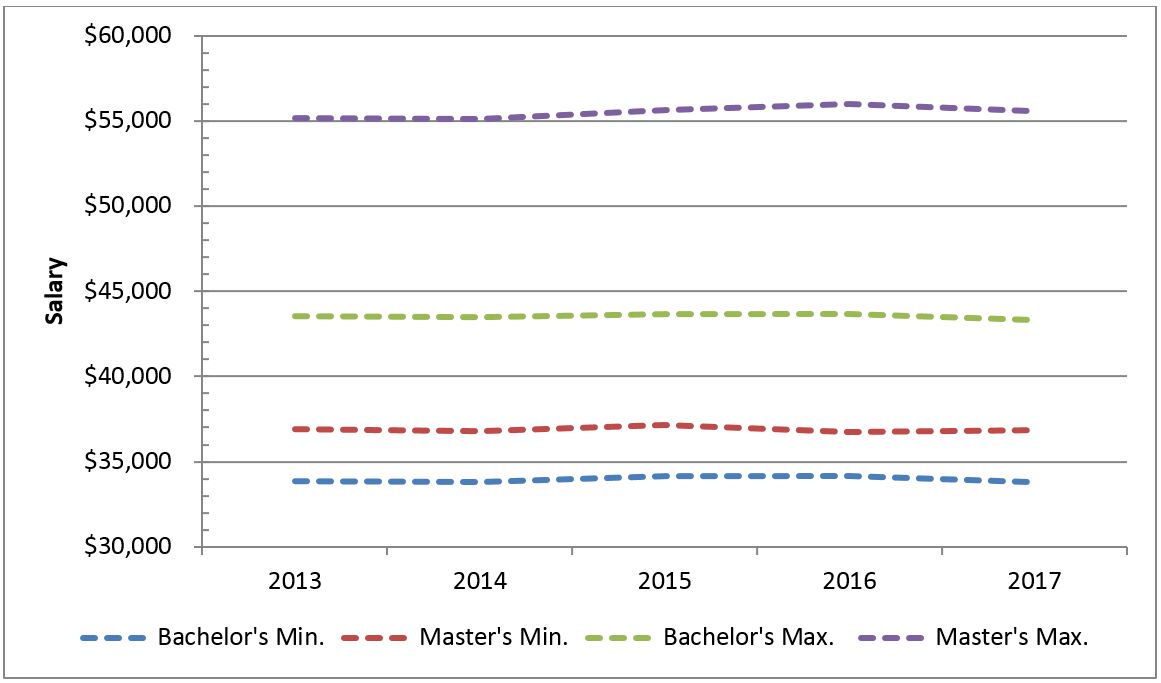
In the next graph, I adjust the salaries for inflation. As a result, all values are in constant 2017 dollars.

Figure 2: Average Salaries in Missouri Based on Salary Schedules (Inflation Adjusted)

Teacher salary graph 2

As you can see, almost all of the lines are fairly flat. From 2013 to 2017, salaries dropped by a small margin for the bachelor’s minimum salary, the master’s minimum, and the bachelor’s maximum, while the master’s maximum saw a small increase.

  • Bachelor’s Minimum Change: -0.001%
  • Master’s Minimum Change: -0.002%
  • Bachelor’s Maximum Change: -0.005%
  • Master’s Maximum Change: +0.007

There is nothing wrong with wanting to ensure that teachers are well paid, but we need to be careful about how we analyze the data. By simply comparing average teacher salaries over time, we forget that the population of teachers is changing.

When we look at the actual salary schedules, which determine how much teachers are paid, we see little change in inflation adjusted pay scale over the past five years. Salary schedules were keeping pace with inflation, but the population of teachers changed, giving some the misleading impression that teacher salaries were falling behind.

Millennials Are Buying in the Suburbs

Kansas City has been on a spending spree to try to attract millennials downtown, having been caught up in the now-discredited “creative-class” strategy originally promulgated by urbanist Richard Florida. Note that this is the same Richard Florida who the Kansas City Area Development Council paidto assist with its Amazon proposal, only to say later that cities felt like they were “being taken” by Amazon and should “think twice“ about wanting the headquarters. But Kansas City jumped in blindly as it tried to woo millennials, spending “probably in excess of a billion” dollars in an attempt to create a hipster paradise downtown. Is it working?

In a word, no.

Despite wishful thinking (and some fuzzy math) from boosters like the Downtown Council, millennials nationwide are choosing to leave cities when they decide to buy a home. According to a study conducted for Ernst & Young, a plurality of millennials, 38 percent, live in the suburbs. According to CNBC,

Among millennial homeowners, the suburbs are the clear No. 1 choice: 41 percent of millennial owners opt for suburbs over cities, small towns or rural areas. That’s up from 36 percent in 2016, Cathy Koch, EY’s Americas Tax Policy Leader, tells CNBC Make It.

It’s not just that they’re settling down as they get older, either, Koch says. When looking at the very same age group today compared to two years ago, there’s an increase in the share of millennials living in the suburbs.

“It was a surprise to me to see this generation increasingly choosing suburban locations to buy homes,” Koch says, but the trend makes sense: “The ‘suburbs’ may very well be smaller cities close to larger urban areas — these still afford the richness of city living (including employment opportunities) at maybe lower home prices.”

The focus on Kansas City’s downtown has not yielded a return worthy of the investment. We’re not attracting millennials. Even the tourism numbers promulgated by the city’s tourism board are suspect. Certainly Kansas City is suffering the same fate of many cities through no fault of its own. But the degree to which that city leaders have focused on developing streetcars, convention hotels, and the airport—while seemingly ignoring a years’ long spike in homicides—demonstrates an unwillingness to face reality.


New Year’s Resolutions for DESE

The holidays are upon us, and now that we have a quorum on the state board of education and a commissioner it’s time to think about what Missouri students and parents should expect from the Department of Elementary and Secondary Education (DESE). This isn’t so much a wish list as a set of objectives that should be met if we are going to improve public education in Missouri.

There are four primary areas that DESE needs to address.

  1. Implementing the Missouri Course Access Program (MOCAP)  Last year the Missouri legislature passed, and the Governor signed, a state law granting all Missouri students access to classes in the MOCAP online program. MOCAP is a step toward providing students with expanded opportunities. Through MOCAP, students can take courses online that their own schools may not offer, such as advanced placement or foreign language classes. The law also allows a student to choose to take their full course load through MOCAP. DESE is responsible for implementing MOCAP. This entails (1) making sure that districts notify parents that they can access the program; (2) ensuring that each district has a link to the program on the home page of its website; and (3) maintaining a fully functional MOCAP website a complete approved course catalog and registration information.
  2. Providing accurate, timely and user-friendly information on school performance  Under the federal Every Student Succeeds Act (ESSA), DESE is required to prepare and widely disseminate an annual report card for each school. The law requires that the report cards be developed with parent input and be easily accessible and understandable by parents. DESE continues to use the Annual Performance Report (APR) to determine accreditation status, but the APR is difficult to interpret and is a poor gauge of student learning. Under the APR system, nearly 99 percent of Missouri school districts were fully accredited by DESE in 2017, making it impossible to determine which schools are doing well and which are doing poorly. Individual school reports are available on DESE’s website, but they are difficult to locate and they don’t contain the full suite of information required. I hope that by December 31 DESE posts accurate, user-friendly report cards that include school-level performance data for 2017–18—as required by law—and I’m curious to find out how they will put these in the hands of every parent.
  3. Making school finance data transparent and accessible  House Bill 1606, passed and signed last year, requires Missouri school districts to post their financial data online in a searchable format. Additionally, federal legislation requires DESE to submit school-level finance data to the U.S. Department of Education. DESE needs to make sure that these obligations are met in good faith and to the full extent of the law. Taxpayers should be able to easily determine how schools spend their money.
  4. Adopting a high-quality accountability system that can be used for a longer time period  DESE should adopt a high-quality tool for assessing student progress, use it consistently, and return results in a timely manner. It has been difficult to see how schools are performing over time because DESE has changed the standardized tests every few years, making it nearly impossible to see whether schools are improving or regressing. Missouri’s most recently adopted accountability plan, submitted to the U.S. Department of Education under ESSA, was given low to mediocre marks by an independent review panel. DESE has an opportunity to get this right.

I have recently expressed my concerns over the State Board’s decision to rehire the former commissioner of education rather than embark on a national search for one who could launch us in a new direction.  Under the commissioner’s prior tenure, DESE was hardly an innovator for real reform. That could certainly change, and I hope it does.

This list is not an ambitious one. One of DESE’s most basic jobs is to generate, collect, and provide data to parents, students, teachers, administrators, policymakers and taxpayers. I simply expect DESE to do that job well.

Is Missouri’s Business Tax Climate Competitive?

How do Missouri’s business taxes stack up against those of our neighbors? According to the 2019 State Business Tax Climate Index by the Tax Foundation, Missouri’s tax climate is more favorable than those of all its neighboring states. Missouri’s nationwide ranking improved by one place from the previous year (from 15th to 14th), passing Tennessee for the first time. However, in many respects the Index paints an incomplete picture.

The Tax Foundation’s rankings are a composite based on each state’s corporate, individual income, sales, property, and unemployment insurance taxes. Missouri ranks in the top ten for three of the taxes (corporate, unemployment insurance, and property), but 25th for the remaining two (individual income and sales).

Despite the generally favorable ranking of Missouri’s tax climate from the Tax Foundation, the state’s economic growth continues to lag. In 2017, Missouri was ranked 37th among states with a paltry 1.1 percent real Gross State Product (GSP) growth rate, while the average growth over the previous ten years is even worse at only 0.48 percent. The tax climate is certainly not the only contributor to economic growth, but the difference in state rankings raises the question of whether the Tax Foundation’s index may be missing something.

To evaluate the applicability of the ranking results to Missouri, it is helpful to consider what makes a business climate attractive to new businesses, and whether the index attempted to capture those criteria. Studies show the main determinants of business climate are the tax and regulatory burdens each business must bear. From the outset, the Tax Foundation index does not measure regulatory burden, and also excludes most local taxes from their calculations. If the Index is missing several important components, should the state’s Department of Economic Development be touting the results?

The Tax Foundation’s rankings offer valuable information about Missouri’s business tax climate, but should not necessarily be the basis for future policymaking. If lawmakers are serious about improving Missouri’s business climate, reducing the regulatory burden and reforming local taxes should be part of the discussion.

A New Internet Sales Tax? Only if It’s Revenue-neutral

As we head into the holidays, many of us are already thinking of the gifts we’ll be giving and receiving. We might even give ourselves a gift! But very few of us would ever give ourselves a gift with someone else’s money, for this holiday or any other. That would be impolite (and probably illegal). Unfortunately, some in Jefferson City are already musing about whether the government will give itself the gift of more of your tax money in the new year—thanks to a proposed Internet sales tax.

The issue here isn’t really the tax itself. Researchers at the Show-Me Institute have long-supported low tax rates with a broad base, and sales taxes are less destructive to growth than income taxes. But as the sales tax base broadens, another tax should contract to ensure the government isn’t growing and treating taxpayers like a piggybank. In fact, the tax reform bill passed earlier this year originally included a provision that would have created an Internet sales tax in the state, but also simultaneously reduced state income taxes. That revenue-neutral approach is not just good governance—it is good policy that shifts the state’s reliance away from growth-destroying income taxes.

More to the point, that revenue-neutral approach to the Internet sales tax nearly became law last year, and I support it becoming law this year. But if lawmakers want to create the tax and gift the revenues back to growing government spending, that will be a non-starter for supporters of small, responsible government and free-market policies.

Sorry, Non-KC Residents . . . The Star Doesn’t Care for Your Opinion

It should be no surprise that people living outside the city limits of Kansas City and St. Louis are interested in what happens in those cities and the ways in which urban policies affect regional prosperity. To take one obvious example, thousands of people who work but don’t live in these cities are directly affected by the earnings taxes they pay. Their opinions matter, too.

That’s why I was startled at the tone of yesterday’s Kansas City Star editorial. The piece targets an individual lawmaker, but it sketches out a remarkably shallow framework for attacking critics of the earnings tax now that its repeal will likely be considered in the next few months. The editorial board can do better, and the Star’s readers—Kansas City residents, suburbanites and exurbanites alike—deserve better.

First, the board’s dismissal of the concerns of residents and lawmakers from “little” Missouri towns—on the grounds that only those who live within the boundaries of one of the cities should have a say in the earnings tax debate—doesn’t hold up to scrutiny. After all, some of the Star’s own executive staff don’t even live in the same state as the earnings taxes in question. If the standard for valid earnings tax opinions is residency, then the Star would be forced to dismiss its own opinion. The board should consider a better limiting principle for who can join the debate if it wants to remain a part of it.

Second, the Star’s sudden appreciation for local decision-making could well strike long-time readers as curious at best. Where was this zeal for local control as the federal government has issued sweeping mandates in education and health care? I could write a whole blog about the difference in the relationship between the federal government and states (sovereigns) and the relationship between states and the cities within them (subdivisions), but it isn’t clear to me whether The Star’s local-government argument here is being made seriously or instead is being offered as a tu quoque to supporters of small government.

Third, as St. Louis City particularly shows, when the hub of a metropolitan area fails, the region flounders, too. The Star says, in short, that the rest of the state should mind its own business regarding the earnings tax—but arguing that my next-door neighbor’s house fire shouldn’t concern me until my own house bursts into flames is the kind of nonsense that has scorched the economic prospects of the St. Louis region for decades. The Star doesn’t constrain its own commentary to matters directly related to Kansas City, Missouri; that it would attempt to delegitimize the opinions of others on the earnings tax question runs precisely counter to what the newspaper should be about.

Lastly, the complaint that a Senator’s proposed legislation is effectively invalid because the impact would be felt outside his district is an objection that would apply to nearly all statewide legislation. I don’t recall the Star objecting on those grounds to proposals by Kansas City politicians for tax increases, health care impositions, or other legislative measures that would affect locales other than (or in addition to) Kansas City.

Show-Me Institute writers have shared a fairly consistent opinion on earnings taxes for well over a decade from our offices in both St. Louis and Kansas City. We have opposed them, for the same reason we have been consistently skeptical of the state’s income tax: Both taxes hurt economic growth and, ultimately, hurt people. The earnings taxes imposed by Kansas City and St. Louis are especially pernicious and regressive because in contrast to the state’s income tax, the earnings taxes attach to earnings at dollar one, meaning the impact on the poor is especially pronounced.

Kansas City’s political class is on the wrong side of history in trying to prop up the earnings tax, not only because it will eventually go away, but because as policy and as a moral matter, it needs to go away.

So yes, people living outside of Kansas City and St. Louis can and do have an interest in how those cities’ policies impact their regions’, and the state’s, prosperity. Rather than resort to ad hominem attacks, the Star would do well to focus on the argument and the policies involved and explain to readers why, unlike thousands of cities across the country, Kansas City and St. Louis couldn’t survive without an earnings tax.

2018: A Bad Year for Government-failure Deniers

Are you a government-failure denier – someone who believes that the government that governs best is one that overflows with good intentions, regardless of the cost? Are you someone who thinks a lot about “market failures” and never stops to think about government failures?

Well, my friend, if you are, I have to admit: You had a couple of modest “wins” in 2018. Here in Missouri, free-market thinking took it on the chin in two ballot initiatives. On Aug. 7, by an overwhelming majority, Missourians voted to kill a right-to-work law passed by the Missouri Legislature in 2017. Then on Nov. 6, Missouri voters passed another ballot initiative boosting the state’s minimum wage from today’s $7.85 to $12 by 2023.

Compared with other news, however, those victories by deep-pocketed trade union groups and their co-dependent, big-government allies were small beer. The year’s big story was the striking success at the national level of free-market policies in driving faster growth and widely shared prosperity for all groups of people. For two years, the federal government has been lifting the burden of regulations and taxes on businesses and consumers alike. The dynamism of American capitalism has done the rest.

Recent GDP growth has been close to 4 percent – or about double the rate sustained over the eight years of the prior administration. Suddenly, there are more job openings than people seeking work. That, in turn, has led to higher pay for people at all income levels.

On Oct 2, Amazon CEO Jeff Bezos announced that he was raising his company’s internal minimum wage for warehouse and other unskilled workers to $15 an hour. This led to mutual back-slapping between Bernie Sanders and Bezos. The self-declared socialist complimented the world’s richest man on “doing the right thing,” and Bezos responded with self-congratulations, saying he hoped that other companies would follow his lead.

But guess what? He wasn’t leading. The U.S. Labor Department recently reported that wages for nonsupervisory warehouse employees had risen 4.6 percent from a year earlier, to $17.87 an hour. That’s almost $3 an hour more than the wage set by Amazon’s act of supposed enlightenment. Faced with the demands of an expanding economy and a tight labor market, companies did what they had to do – they raised wages to poach workers or keep the ones they have. So it wasn’t Mr. Bezos who deserved the compliment, but the unimpeded operation of the free market.

If you look around the country and the world, you see people everywhere who are fed up with the cluelessness of wealthy and long-established political elites who continue to pursue highly questionable policy objectives regardless of the cost in higher taxes, reduced paychecks, and lost economic growth. We are witnessing what the Wall Street Journal calls a “Global Carbon Tax Revolt,” with ordinary people rising up in protest against fuel-tax hikes and costly climate-change initiatives aimed at boosting unreliable renewable power. That has happened with the violent “Yellow Vest” protests in Paris and many rural areas that have rocked the presidency of France’s Emmanuel Macron. Other hot spots in the same revolt by taxpayers opposed to sacrificing growth on the altar of environmental piety include Germany and Canada, along with the states of Arizona, California, and Washington.

In sum, 2018 was a bad year for government-failure deniers. It was a much better year for those who believe in the unrivaled power of free markets to create and spread wealth and to promote greater individual freedom, responsibility, and creativity. But 2018 wasn’t all roses either, with rising fears of a global trade war sparked by retaliatory tariffs.

Tariffs are another tax – a tax on commerce. Of course, the more you tax something, the less you get of it. Missouri is a soybean basket to the world. Our state can ill afford a major disruption in world commerce. Neither can the nation. Looking ahead to 2019, let us hope that the substantial economic gains made in 2018 are not jeopardized or lost through the folly of managed (or mismanaged) trade policy.

Support Us

The work of the Show-Me Institute would not be possible without the generous support of people who are inspired by the vision of liberty and free enterprise. We hope you will join our efforts and become a Show-Me Institute sponsor.

Donate
Man on Horse Charging