End the Cronyism: Repeal Certificate of Need in Missouri

The dance card for health care reforms in Missouri is starting to fill up. Last week the state released a study that looked for ways to improve the state’s Medicaid program, and a number of bills have already been filed to expand short-term medical insurance in the state. Both endeavors deserve serious engagement from our policymakers.

But rounding out the card is the important issue of Certificate of Need (CON). CON laws allow governments to prevent medical facilities from opening, expanding or providing certain services should a given activity fall under the oversight of the CON law. Want to open a new hospital or senior center? Considering a new investment in an existing facility? Unfortunately, the state of Missouri might just have the power to stop you.

In the next month or so we’ll release a paper that provides greater detail about what CON laws affect, here and around the country, but the argument against such laws can be summarized succinctly:

CON laws subvert the marketplace, replacing consumer health care decisions with those of bureaucrats—whose interests are not always aligned with consumers.

In an environment where health care prices continue to rise, it is bizarre that Missouri would maintain a system that places upward pressure on costs. Missourians need greater supplies of, and greater options for, medical goods and services; CON laws are an enormous barrier to that objective.

Currently there’s a minor constellation of CON repeal bills that have been introduced in the legislature, and it remains to be seen which one will break through and get the most attention. There are also a few bills that would “reform” the CON system, which simply constitute a reshuffling of the law. To put it plainly, you can repaint a car that’s a piece of junk, but under that paint job, it’s still a piece of junk. And that’s what CON laws are: junk. They hurt patients, benefit incumbent providers and disadvantage new market entrants.

Given this story about a recent hearing on CON repeal, it seems pretty clear that the providers benefiting from the current system would prefer the illusion of reform rather than the real thing. That’s understandable—they get an advantage under CON, albeit to the detriment of consumers. But allowing that to continue is wrong for Missouri and for Missourians. Keep it simple: repeal CON. Anything short of that is just window dressing.


2019 Legislative Priorities Generally Lining Up with Market Reforms

The Missouri House and Senate may have only just begun their legislative years, yet both chambers appear to be setting a course that free marketeers can get a little excited about. First in the House, Speaker Elijah Haahr made clear in his first address to the chamber that economic growth and small government were key items in his legislative agenda, as detailed by Missourinet:

At the heart of our efforts is one of economic growth. Our message that Missouri is open for business cannot be just lip service coming from this building (the Capitol). The policies we pass must focus on cultivating employers and not controlling their businesses,” Haahr tells the House….

Haahr also focused on conservative policies during his address, saying that “gone are the old ways of thinking that public money alone can end our problems.” He tells the House that Missouri has passed a balanced budget without raising taxes for 15 years that “that will not change on our watch.

Other items, including some health care and transparency reforms, appear to have some inertia behind them, but time will tell what eventually makes the cut and can find a pathway through the Senate.

On the other side of the building, Senate President Pro Tem Dave Schatz laid out a similar vision as that of the House, focusing on employment growth and job training. A recent St. Louis Public Radio piece outlined his agenda:

We face an economy that is very different than the one many of us grew up in,” said Schatz, R-Sullivan. “Advanced, practical skills are the ticket to the middle class and economic prosperity. We need to invest in the citizens of our state by offering training opportunities, regardless of age and experience. And any Missourian that wants to better themselves through hard work and education should have their state as an ally.

What does seem clear is that both the House and the Senate are generally in step with Governor Mike Parson’s priorities of workforce development and infrastructure, particularly roadways. How the two chambers will come to an agreement on specific ways forwards is an open question; the Senate, for instance, may be more predisposed to use a new internet sales tax to fund some of these items—which as we’ve said before, should be a non-starter.

But all things considered, these are good starting places for state government to be beginning the year from. We’ll keep you posted on their progress or, heaven forbid, their lack thereof.

Failure Is Not an Option for Missouri School Districts-but Is That a Good Thing?

Imagine that you’re a professor at a large university and this spring you’re teaching one of the big freshman seminar courses – 518 students. Your dean comes to you and says, “Look, I know these freshmen come with all different skill levels, but I need their parents to keep paying tuition, so you need to find a way to make them all look like they succeeded in your class.”

Okay, I guess you would start by grading on a curve. Then, you would want to make sure that there is a lot of extra credit available. Finally, you would give credit for things like showing up, finishing, and being ready to take another class the next semester.

So, here’s what you might come up with for a grading scale:

  • Two tests worth 16 points each, with two ways to earn up to 12 extra credit points on each of them, and one test worth 8 points with up to 6 extra credit points.
  • Three homework assignments worth a total of 10 points, but with two ways to earn up to 7.5 points of extra credit.
  • Showing up at least 90 percent of the time gets you 10 points, but there’s up to 7.5 points of extra credit if you show up more than you did the last time.
  • Finishing gets you up to 30 points – almost as much as the tests! And, there’s up to 24 points of extra credit. Plus – and this is the kicker – you can finish in one semester, or take an extra month, an extra two months, or even finish in two semesters, whichever works out best for you.
  • Finally, proving (through a variety of ways) that you’re ready for the next class, is worth 30 points, with up to 22.5 points of extra credit.

Now, to get an A, a student needs to get at least 84 of the “real” 120 points—but since there are 90 extra credit points to work with, a student really just needs 84 points out of a possible 210 to get that A.

Great news! At the end of the semester, you give out 512 A’s (86 A+’s with perfect scores!), 5 B’s, and just one C. That ought to keep the parents happy. As far as they know, everyone learned an A’s worth of material.

This is effectively the grading scale that the Missouri Department of Elementary and Secondary Education (DESE) uses to hold schools and districts accountable. It’s called the APR, and its loaded with opportunities for extra credit. Let’s just look at academic achievement, the area we’d all probably agree is most important. Districts are evaluated out of a possible 40 points, divided among math, reading, and social studies. However, a district can get up to 30 extra points if students show growth or progress in these scores. That means to get a “perfect” score, a district only has to get 57 percent of the possible points available to it. That’s a heck of a curve.

There are four other areas in which schools earn points, and those areas are rife with the same problems.

So what does this mean, practically speaking? Using this scale, Kansas City got 82.9 percent of the 120 points, even though, on average, almost half of their students scored “Below Basic” across grades and subjects. The district clearly topped up its score with various extra credit opportunities. St. Louis Public Schools got 78.5 percent of its points, again with almost half of students scoring Below Basic. In the Ferguson-Florissant school district, just 3 percent of 8th-grade students scored Proficient or above in mathematics, and yet the district received 92.1 percent of its APR points.

Kids are more than the sum of their test scores, and accountability systems should consider more than rates of proficiency. But getting students proficient in grade-level subject matter should count for something. And a system that gives passing grades to 512 out of 518 school districts with academic achievement all over the map is not an accountability system at all. Its’ a way to make everyone feel good.


Let Georgia Keep Paying to Promote Missouri

Last year I wrote about how Georgia taxpayers were effectively subsidizing Missouri by offering tax credits to produce Netflix’s show, Ozark. While the show is set in Missouri, much of the production of Ozark actually occurs in the Peach State, thanks to the generous tax incentives offered there.

Would it be nice to have the show produced here? Sure. Is it economical to subsidize such productions? No. As with many tax incentives, research demonstrating the waste associated with film tax credits is fairly clear, so if Georgia wants to underwrite dozens of hours of (dramatic) Missouri tourism videos for us, more power to them. It may already be having a positive impact in that regard.

Unfortunately, bad ideas in Missouri tend to die hard, and that has certainly been true of the state’s film tax credit program.

Missouri hasn’t offered perks for film studios in several years — and producers have taken note, shooting scenes set in Missouri in other, more generous states.

But, if it were up to Lt. Gov. Mike Kehoe, the state would reboot its modest incentive program, with the goal of drawing crews to Missouri to film shows such as Netflix’s “Ozark” and HBO’s “Sharp Objects.”

“I have seen the benefits of us being a film tax credits state,” Kehoe, a Republican, told reporters on Thursday.

“Lake Ozark, Branson area, would really like to work to try to attract some moviemaking,” Kehoe said. “I think we need a small amount.”

That this topic returns again and again to the political scene in Missouri is a testament to the voracious tax credit appetite of the entertainment industry, and I can understand why filmmakers like the set up (it’s basically free money) and why politicians like it (it’s publicity, albeit far from free).

But why should taxpayers let our politicians play Louis B. Mayer to Hollywood types with their tax dollars? Rather than giving away tax money to out-of-towner production companies, elected leaders should be focused on reducing the taxes of the people already here in the state, who are far more likely to reinvest in it.


Private School Choice Students More Likely to Graduate College

Private school may be the most appealing education option for some families, but also the most unfeasible. In Florida, low-income students can access a private education through Florida’s tax-credit scholarship program, bridging the financial gap for families. A recent study from the Urban Institute found that students who enrolled in Florida’s Tax Credit Scholarship program were more likely to enroll in and graduate from college, a notable accomplishment.

The Florida Tax-Credit (FTC) Scholarship program allows corporations to make donations to a scholarship funding organization, and then receive a credit toward their state taxes. Students must apply for the scholarship, and the organizations only distribute scholarships to applicants whose household incomes are no more than 185 percent above the federal poverty line. Students then use the scholarship to help pay for private school expenses. The FTC serves more than 100,000 students each year.

The Urban Institute study used data from the National Student Clearinghouse to track FTC students’ progress into college, comparing them to non-FTC public school students who share a similar background and test performance history. The study found that of the students who began FTC in elementary or middle school, 57 percent of FTC students enrolled in college compared to 51 percent of non-FTC students. Of the students who began FTC in high school, 64 percent of students enrolled in college compared to 54 percent of non-FTC students. FTC students were also 10 to 20 percent more likely to complete college and graduate with a bachelor’s degree. More impressive is that the longer students were enrolled in FTC, the larger the positive effects. This private school choice program is helping thousands of Florida students receive a quality education and has lasting benefits.

A private school tax-credit scholarship program is one aspect of a larger school choice agenda that is bringing about exciting results for Florida students. This success should encourage Missouri to implement a private-school choice option, and give our students a greater opportunity for success.


Do Fewer Remedial Course-takers Mean Better-prepared College Students?

It’s tempting to assume that when Missouri high schools hand out diplomas, graduates are ready for postsecondary education. But far too many students are unprepared, leaving colleges the responsibility of teaching students the prior knowledge required to succeed in their coursework.

Traditionally, unprepared students have taken remedial classes, in which students learn high school–level content and don’t earn credit, yet still pay tuition. The percentage of Missouri public high school graduates taking remedial courses at public universities has declined notably in recent years. In 2013, remedial course taking was at 35.6 percent when college and career readiness was at 37.2 percent; by 2017 remediation had tumbled nearly 13 points to 22.8 percent. At first glance, this is a noteworthy improvement—but what caused it?

Are students simply better prepared for college than students of a few years ago? It’s unlikely. DESE’s own numbers show 37.2 percent of graduates being college- or career-ready in 2013 compared to 42.5 percent in 2017. It’s progress, but probably not enough to account for a much larger decline in remedial course-taking.

A more likely explanation might be a shift in the methods used by Missouri’s Department of Higher Education (DHE) to help underprepared students. One of DHE’s objectives is to “eliminate remedial education in favor of co-requisite models and similar proven methods.” Remedial students are less likely to finish their degree within six years, setting them even further behind and potentially saddling them with student debt. Co-requisite programs help underprepared students by enrolling them in introductory, credit-bearing courses and providing support services. The support services normally include labs and tutoring to supplement the course material, but the specific services offered vary by university. Alternative forms of remediation are offered by 92 percent of public higher education institutions. The most common is co-requisite courses, but other alternative remediation offerings include modularized courses and fast-track options.

DHE only recently began collecting data on course completion rates of co-requisite students, who already show a higher college-level course passage rate than those taking traditional remedial courses. Students in co-requisite programs (page 14) were able to pass a college-level math course in their first academic year at a rate of 53.2 percent, compared to a 19.6 percent passing rate from other types of remediation. In English, 65.5 percent of co-requisite students passed a college-level English class, whereas only 35.7 percent of students enrolled in other types of remediation passed such a class within one academic year.

It’s possible that these numbers overstate the advantage of corequisite courses. For example, remedial classes set students back a semester while corequisite courses are taken concurrently with the credit-bearing class—which means that the rate of completing of a college-level class in the first academic year might not be a fair way to compare remedial and corequisite classes. And in any case, the real test of the corequisite course model will be how likely participants are to earn their college degrees, not just pass a single college-level class.

But giving corequisites the benefit of the doubt—and giving colleges and universities due credit for finding a better way to help underprepared students—shouldn’t mean overlooking the fact that Missouri still has a public school system from which fewer than half of graduates emerge unprepared for college or a career. Rather than leaving it to colleges to finish their students’ high school education, shouldn’t Missouri public schools take a hard look at why so many kids are graduating high school without the necessary skills to succeed in adult life?

The Child Poverty Rate in Mississippi County Is How High?

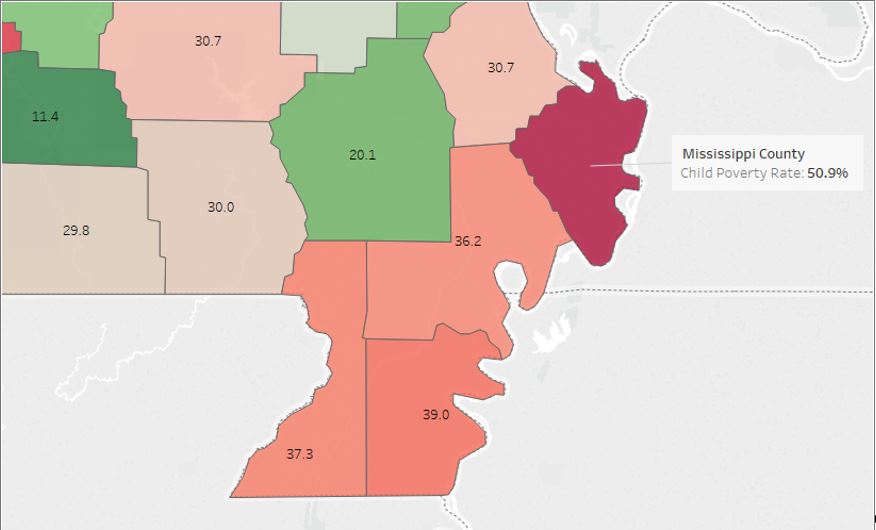
In December of last year, the U.S. Census Bureau released its most recent American Community Survey data, including five-year estimates of county-level poverty rates from 2013–2017, and some areas of Missouri appear to be struggling. While poverty in the southeast corner of Missouri—the bootheel—has been high for some time now, Mississippi County’s child poverty rate—the percentage of children whose family’s income is below the federal poverty line—was estimated at over 50 percent during the five-year period.

About 1,500 children and 3,800 people total live in poverty in Mississippi County, and it has Missouri’s highest overall poverty rate at 31.7 percent. In other words, one of every two kids and one of every three people in this county are living below the federal poverty line, which was $24,600 in annual income for a family of four in 2017.

Even if you take into account the large (±9.1 percentage points) margin of error for Mississippi County’s child poverty rate, in the best-case scenario it would have a child poverty rate of 41.8 percent—which would still be the second highest child poverty rate in the state. If you want to see the latest data on the rest of the state, check out these interactive maps.

While the state’s overall poverty rate is decreasing, pockets of poverty like Mississippi County should not be ignored. In a pair of forthcoming essays, I explore the consequences for the rest of the state of having such areas of poverty. For now, Missourians should at least be aware that some parts of the state are faring much worse than others.


Support Us

The work of the Show-Me Institute would not be possible without the generous support of people who are inspired by the vision of liberty and free enterprise. We hope you will join our efforts and become a Show-Me Institute sponsor.

Donate
Man on Horse Charging