Should Missouri End Some of Its Vehicle Inspections? Maybe

Vehicle maintenance isn’t typically the sexiest legislative topic, but one proposal offered in the Missouri House may make it hot in 2019, to the chagrin of at least a few auto mechanics across the state:

[The bill proposes that] the state law be repealed that requires vehicles of five years or older to be inspected every other year. Rep. J. Eggleston, R-Maysville, said the bill would put the responsibility of having vehicle inspections in the hands of drivers.

“I have no doubt that problems are detected in the inspections and are corrected,” Eggleston said. “The point I was making though, is these problems would, by and large, be detected and corrected anyways even without the inspections.”

Eggleston said he has done a large amount of research on the subject and that states where inspections are no longer required have not seen a major increase in safety problems.

“I’ll be honest when I first heard the topic, I was against getting rid of the inspections and my investigation was to set out and prove that they were helpful,” Eggleston said. “I was trying to prove a former legislator wrong, and I ended up proving him right and proving me wrong.”

Eggleston says that putting an end to the inspections would save Missourians $30 million each year in fees alone. As Eggleston notes, this  isn’t technically a tax, but is practically speaking indistinguishable from one. Tax or not, he argues, that’s millions back in the pockets of Missourians statewide. And he’s right. The issue is already making some headway in the legislature.

The article quoted here, from the St. Joseph News-Press, is worth a full read, as it gets into some of the objections mechanics have against the change, including the fact that sometimes the inspections turn up problems that have to be fixed. I’m sure that’s sometimes the case. But is the cost of a state-mandated inspection worth the cost to Missouri consumers? Or, is its continued existence more a benefit to mechanics, who can get a fee and potentially a customer, if they find anything amiss? Expect to hear a lot of debate over this during the next couple of months.


 

The Public Interest Should Trump the Interests of City Bureaucrats-and It Shouldn’t Be Close

When Phil Oehlerking and I started the Municipal Checkbook Project two years ago, we thought that the bulk of our time would be spent showcasing how Missouri cities spend the money they take from Missourians.

As it turned out, though, most of our time was spent just trying to get spending documents in the first place, and most cities that responded wanted us to pay them to produce these records. Battlefield wanted $35,000, Hollister $25,000, and Buckner $11,000, to name a few of the more outrageous requests. Even the seat of state government, Jefferson City, wanted nearly $1,000 for the public to see what it was spending money on! The list goes on.

These quoted prices are troubling, not only because of the potential conflicts such demands have with the spirit and letter of Sunshine Law requirements, but it also raises the specter of whether there are ulterior motives for pricing out people requesting this information. Perversely, the cities that are probably most deserving of scrutiny under this “pay-to-see our spending” approach are the least likely to get it.

I’m highlighting this issue because a bill that would require cities to publish their checkbooks is now facing blowback from a House committee on precisely these grounds—that many Missouri cities don’t want to publish their spending records, which itself is a startling revelation.

But now, some state legislators are apparently willing to oblige these cities, blocking and tackling against the citizens who want to see how cities spend the money that is taken from them.

Not only is this bad policy, but it is symptomatic of a larger misunderstanding among legislators of who they represent. State legislators weren’t elected to represent the cabal of Missouri’s local officials; they were elected to represent the people, whose money the state allows local government to take by way of taxes.

Geography should not dictate whether Missourians have transparent local government, and state officials should remind themselves of who, exactly, put them in office. Going to bat for local government subdivisions against the interests of the public is a bad call.

Criminal Justice Reform Getting Attention in Missouri

The Governor laid out a number of important priorities in his State of the State address, which my colleague Scott Tanner has already summarized. But I think the focus on criminal justice deserves a little added emphasis. KCUR noted some of the highlights:

In addition to bolstering money for drug courts and prisoner re-entry programs, Parson is planning on closing Crossroads Correctional Center near Cameron and moving inmates and staff to other prisons across the state….

“This decision is largely driven by our dedication to find efficiencies wherever we can in state government — and this can be done while ensuring safety, improving security and delivering a much needed pay raise. All being done with no layoffs.”

I’ve talked about the Crossroads bit before, but there’s more going on here than just straight taxpayer savings through consolidation.

KTTN radio out of Trenton, Missouri, has an interesting post up with audio from Rep. Louis Riggs, talking about some of the same criminal justice issues. Notably, Rep. Riggs says that along with being “smarter” about our criminal justice strategy, “we don’t need to be breaking up families and taking people’s licenses away.” It’s refreshing to hear language like that, which not only considers the issues of punishment—but of rehabilitation as well, with an emphasis on avoiding incarceration where possible.

My colleagues Patrick Tuohey and Emily Stahly have been all over issues of criminal justice reform, so I know they’ll be following developments in Jefferson City closely. But it is good to see the state re-examining what Missouri does in terms of criminal justice and how it can improve outcomes—for taxpayers, and for the accused.


Prison Consolidation a Smart Step Toward Better Government

One of the most interesting announcements that the governor made at his State of the State speech last month was the proposed closure of a state prison facility, Crossroads Correctional Center. At first, I thought there would be some political pushback to the consolidation that was suggested, given that every prison is of course situated in several elected officials’ districts and is generally a pretty big employer.

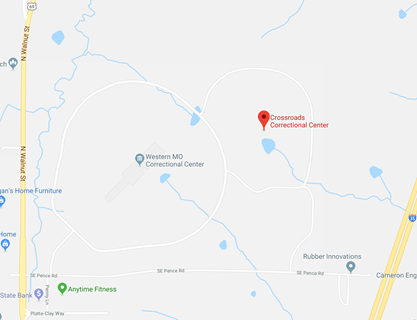
That pushback didn’t materialize, though, because not only would jobs not be lost, but the workers at Crossroads would be employed at a nearby facility. Specifically, when I heard it mentioned during debate on the Senate floor that Crossroads was across the street from the facility it would be consolidated with—the Western Missouri Correctional Center (WMCC)—at first I thought that was an exaggeration. “Across the street?” Really?

But lo and behold, Missouri has had two prisons operating across the street from each other for about 20 years now:

Prison map

Why it took so long to consolidate the prisons, I’m not sure. Because Crossroads is a maximum-security prison, security will have to be fortified in at least part of WMCC, to the tune of about $3 million. Perhaps that was the reason. But that $3 million is a small price to pay for even larger savings, and from a good governance perspective, it sure looks like bringing these facilities together is the right call. Missourinet elaborated on the reasoning for consolidation:

The department has been battling to fill hundreds of correctional officer job vacancies. [State Department of Corrections Director Anne] Precythe says the reorganization plan will create a fully-functioning, safe environment, versus trying to “limp along” with two half-staffed, half-full institutions.

The estimated $20 million savings from closing CRCC is slated to give department employees, minus executive staff, a one percent pay raise for two years of continued service. If Parson’s proposed three percent state worker pay increase happens, then corrections workers would get another raise. Precythe has touted the pay boost as the largest in the department’s history.

This consolidation may have been in the works for a while, but whatever its genesis, it’s an elegant solution to saving taxpayer money and reorienting, if ever so slightly, the state’s criminal justice strategy. If the state can build fewer prisons and push potential inmates back into being contributing members of society, Missourians on the whole will be that much better off.


School Choice Cost Savings Isn’t Magic, It’s Math!

One of the great things about math is it often doesn’t need much defense. The numbers can speak for themselves. In this post, I’m going to provide an example of that. I’m going to show you some math that explains how the state should calculate the fiscal savings in an Empowerment Scholarship Account (ESA).

I’m doing this for two reasons. First, the state’s fiscal note on a recent ESA bill inaccurately accounts for potential savings. The second reason is due to something that was said during testimony about the bill. Scott Kimble, a lobbyist for the Missouri School Administrators Association, mischaracterized how funding works in Missouri. He said something to the effect of, “Districts like Kirkwood only get $500 from the state. If a student left Kirkwood to use an ESA, the state would only save $500.” That’s simply not the case, and it’s similar to the error found in the fiscal note, which uses an “average” expense for each student.

Now, here’s the real math.

In 2018, Kirkwood spent roughly $12,000 in per pupil operating expenses. Over 92 percent of those funds came from local taxes. Meanwhile, just 6 percent came from the state. As such, the state gave the district an average of $728 per student. On its face, it would appear Kimble was correct. However, the state doesn’t fund the average student in each district. The state funds districts through a formula and that formula pays progressively more for each additional student. Let me illustrate (I don’t have exact figures for Kirkwood, these are just illustrative).

This is how the funding formula works. You multiply the weighted average daily attendance (WADA) by the dollar value modifier (DVM, a proxy for cost of living) and the state adequacy target (SAT). Then, you subtract local effort. The end result is how much money the state is supposed to provide the district. Divide that by WADA and you get a per pupil figure.

WADA   DVM   SAT   Local Effort   State Aid State Aid Per WADA
5,760 x 1.094 x $6,261 $35,260,036 = $4,193,280 $728

What the lobbyist mistakenly did is look at that end result and assume that is how much the state would save if a student left the district and used an ESA.

Here is what would actually happen:

  WADA   DVM   SAT   Local Effort   State Aid State Aid Per WADA
Pre-ESA 5,760 x 1.094 x $6,308 $35,556,204 = $4,193,280 $728
Post-ESA 5,759 x 1.094 x $6,308 $35,556,204 = $4,186,379 $726.93

                                                                             Difference=              $6,901           $1.07

Notice what happens. When one fewer student is multiplied by the DVM and SAT, the total state aid required to fund the district drops by the product of those figures. The local effort stays the same in both scenarios. The state doesn’t just save the $728 per student, they save $6,901.

It’s not magic…it’s math!


Lies, Damn Lies, and Airport Politics

In November 2017, Kansas City voters overwhelmingly supported building a new single terminal at the airport. Voters were told, time and again, that the airlines would pay for it—that no taxpayer funds would be used. In fact, the ballot language expressly stated, “With all costs paid solely from the revenues derived by the City from the operation of its airports and related facilities.”

That might not be true.

Kansas City Councilmember Scott Wagner appeared on KCMO Talk Radio with host Pete Mundo (Wagner’s segment starts at 5:14) on February 14 and discussed this very point:

Mundo: So [new terminal contractor] Edgemoor is saying that to basically get this deal going in any type of reasonable time frame we need you, Kansas City, to basically loan us money or loan yourself money to get cash on hand to start this project? Is that the deal?

Wagner: Basically that’s the deal and you’ve got really two things. On the one hand [Edgemoor says,] “we’ve got to repay our loan of 23 million dollars,” because they took out a loan to start doing their work. So they’re saying, “We need you to make us whole by giving us $23 million.”

Mundo: That’s absurd, I mean that’s absurd…

Wagner: Well honestly that’s the deal that the city signed last year, which I didn’t vote for, but eight people on the Council did. And they [Edgemoor] were very clear, they said “We’re going to spend $23 million and we expect to be paid for that.”

Mundo: The city put it to a vote, they said there was going to be no taxpayer dollars used for it. And then they agree to this after the vote, that says, “yes we will pay back $23 million?” That’s-that’s not a good look, Councilman.

Wagner: I can’t disagree with what you just said.

Sadly, this sort of bait-and-switch has become commonplace with the new terminal project. As a result, Kansas City is providing a lesson to the country about how not to deal with transparency. Kansas Citians and indeed everyone in the region deserve much better than this.


Support for Teachers? Or Just Some Teachers?

Want to lose the interest of a room quickly? Bring up pensions. In the 1980s, most private-sector employees were in defined-benefit plans that guaranteed them a steady income after retirement. Now less than five percent of private-sector employees are enrolled in such a plan. Talking about pensions is like talking about Palm Pilots—for most people their dad or mom might have had one, but they see no reason to discuss them.

Not so in the public sector, where 84 percent of employees can still expect to retire at a relatively early age (55 or so) and get a paycheck (and possibly health insurance) until they die. A bill to allow Missouri public school teachers to decide for themselves whether they wanted a traditional pension or a 401(k) type retirement benefit was filed in Jefferson City last week and immediately attacked by both the Missouri State Teachers Association (the teachers union) and the Missouri Retired Teachers Association.

These two associations claim their main mission is advancing the best interests of teachers. But which teachers? It’s estimated that nearly 4 in 10 Missouri teachers won’t get to the five-year vesting requirement to receive any employer benefits. Furthermore, because Missouri’s system is so backloaded that teachers have to stay in the system for 26 years just to break even, only about 38 percent will even hit that point.

So the Missouri teachers union and the retired teachers association are sounding the alarm about “harmful retirement legislation” being filed. But they apparently are not considering the best interests of young teachers who would prefer contributing 5 percent of their salary towards retirement instead of nearly 15 percent. They apparently are not considering anyone who leaves before vesting and would like to take with them what their employer has been contributing on their behalf for 3 or 4 years. And they apparently are not considering teachers who leave before their breakeven point and end up getting less in retirement than what they contributed.

Defined benefit pension plans are expensive, unsustainable, and antiquated. Yes, they work great for teachers who hit the “Rule of 80”—years of work, plus age (retire at 53 with 27 years of service). What are the chances that our best and brightest college graduates see that as their future? Shouldn’t we at least give them some options? Shouldn’t we let them have some control over their careers and earnings?


Will There Be a Cease-fire in Kansas City’s Economic “Border War”?

That’s the billion-dollar question that legislators on both sides of State Line Road are asking themselves. Show-Me Institute researchers have discussed the problem of trading businesses back and forth between Kansas and Missouri, fueled by tax incentives, for years now. Halting these wasteful subsidies, by whatever legal mechanism that can accomplish it, should be a top legislative issue in both Jefferson City and Topeka.

Simply cutting the vast majority of tax incentive spending would accomplish this; the less discretion the states have to spend your money on their cronies, the better. But a secondary option, relating directly to the incentive war itself, would be the establishment of a “truce” between Kansas and Missouri—for both states to largely or completely prohibit the issuance of incentives that would draw businesses from one state to another. What that might look like was outlined in a recent Kansas City Star article: 

Missouri first approved a bill prohibiting the use of state incentives to poach businesses in Douglas, Johnson, Miami or Wyandotte counties in Kansas in 2014.

But to go into effect, the law required Kansas’ governor to enact a similar ban on incentives to lure businesses away from Cass, Clay, Jackson or Platte counties in Missouri.

Kansas, under then-Republican Gov. Sam Brownback, balked at the plan. He came back with a proposal of his own two years later, but it ultimately yielded no agreement.

The Missouri law expired in 2016. A bill filed this year by Sen. Mike Cierpiot, R-Lee’s Summit, would renew it through 2021 to open the door for further discussion.

Extending the period for the truce to be offered is an altogether reasonable proposition, one that I would hope the state of Kansas would consider. In an ideal world, Missouri wouldn’t be doling out vast amounts of money on special projects; bad policy is still bad policy, and tax credit reform that puts a hard cap on incentives should still be the ultimate goal. That said, an all of the above approach that includes a “truce” is nonetheless appropriate as the state’s overall tax credit problem is whittled down.

Support Us

The work of the Show-Me Institute would not be possible without the generous support of people who are inspired by the vision of liberty and free enterprise. We hope you will join our efforts and become a Show-Me Institute sponsor.

Donate
Man on Horse Charging