Missouri Should Be Measuring Intergenerational Poverty, but How We Do It Matters

Recently, legislation was introduced that would require a study by the Missouri Department of Social Services (DSS) to measure intergenerational poverty. Under this bill, DSS would determine “how many recipients of benefits or services…are the children, grandchildren, or great-grandchildren of individuals who also received such benefits or services.”

Distinguishing between short-term and long-term poverty could be a wise move, but how valuable would a single snapshot be in describing a multi-generational problem? Not very. While Missouri should know who is receiving entitlements and for how long, there is a better way to collect that information than what is being proposed.

Utah’s Intergenerational Poverty Initiative is now in its seventh year and has five years of data that allows the state to more accurately measure intergenerational poverty and the success of its various anti-poverty efforts. It also has a data dashboard that shows current data and the trends in intergenerational poverty since 2014. Unfortunately, similarly precise information is unavailable for Missouri, although there are ways to approximate the extent of cyclical poverty in our state.

For example, in my recent essays, “Intergenerational Poverty in Missouri” and “Creating Pathways for Self-Sufficiency,” I estimated the scope of intergenerational poverty in Missouri with a combination of U.S. Census data and economic mobility data. Such extrapolation gives us a general picture of intergenerational poverty in Missouri, but detailed and up-to-date data would be that much more helpful for policymaking purposes.

The years of data Utah has is important for establishing trends, measuring the effectiveness of programs, and having the ability to direct resources to where they could do the most good—in other words, making the most out of the state’s anti-poverty spending. It is doubtful any of that could be accomplished by the singular study that would be commissioned by this bill.

If Missouri’s policymakers are serious about addressing intergenerational poverty and making wise use of welfare expenditures, they should consider a longer-term initiative like Utah’s. As I explain in my essays, intergenerational poverty harms not just those trapped in poverty, but also the rest of the state via costly welfare spending and slower growth.  Ongoing data collection could be well worth the investment if Missouri would use that information to effectively and efficiently move people up and out of poverty. 

 

What Can Millennials Teach Us about School Choice?

Charged with unreasonably loving avocado toast and ”killing” the diamond industry, millennials hear many complaints about choices they make every day. But one thing millennials have not killed is school choice. A recent panel of millennials hosted at a South by Southwest conference expanded on what a fall 2018 genforward survey found: Millennials support school choice.

In the survey, millennials were defined as adults aged 18-34 and the surveyed group was a nationally representative sample. The survey found majority support for voucher opportunities (67 to 84 percent among racial and ethnic groups), described as government funding for private school tuition for low-income students. Charter schools also received majority support, from 54 to 67 percent among racial and ethnic groups. As the millennial generation will soon make up the largest population in the electorate, their preferences are important.

Let’s face it; choices permeate daily life at every turn. On items ranging from transportation (drive or rideshare?), eating (go out or app delivery?), and products (trusted brand or monthly subscription?), people are accustomed to making a choice. Millennials have grown up in an age where their preferences are the driving force of their choices. In any instance of choice, you must evaluate your needs and priorities and then find something, a good or a service, to fulfill those needs. In this way, choices regarding education are no different.

In the case of education, the needs of students may be safety, college preparation, community service, career training, individualized teaching, or many other characteristics. All are good things, but not every school can focus on everything. A system of educational freedom and school choice would allow parents to choose a school where their needs are most met. In order for students to flourish, families should be equipped to respond to their child’s educational needs with choice. Millennial support for school choice should be taken as a sign that they are serious about education serving students well.

As it turns out, millennials may be the best generation so far to ask, “does this option or that option best serve my needs?” This question doesn’t lose its importance outside the realm of restaurants and transportation but its relevance and importance actually increase when it comes to education—the stakes are much higher.


Don’t Charter Schools Hurt Public Schools?

Without a doubt, the question that I get most often about charter schools is, “But don’t they hurt the public schools?” Setting aside the fact that charter schools are public schools, the short answer is charter public schools don’t hurt traditional public schools any more than other factors that can affect enrollment. But they may challenge them.

The assertion seems to be that all children who live within the borders of a public school district are the property of that school district, unless their parents can pay to opt them out. If free public charter schools become available and parents choose them, then they’re rejecting, and thereby hurting, their local school district.

When a parent chooses to send a child to a charter school, the state funding that would have been sent to the public school district where that student lives is sent, instead, to the charter school the parent has chosen. Federal funding, such as that for low-income students or students with disabilities, also, theoretically, follows the student. Some, but not all, of the local funding may go with the student. The same is true whether the student chooses a charter school, moves to another school district, or moves to another state. The local public school district is no longer tasked with educating the student, so they no longer get the money to do so.

It’s true that districts with declining enrollment may struggle to downsize, at least quickly. The same is true whether parents are choosing to move out of the district or whether they turn to charter schools. But the solution isn’t to prevent kids from choosing charter schools because the district can’t afford it, any more than it would be reasonable to prevent parents from moving out of the district.

Public school districts have some options when faced with the loss of students to charter schools. They can consider it a challenge and do what’s needed to bring parents back. They can collaborate with the charter school to better serve the needs of all students. They can move away from long-term fixed expenses to a nimbler way of doing business, similar to how many charter schools finance their buildings. Or they can complain that the world’s not fair.

All students are guaranteed a free public education by the state, and the power over that funding should be in the hands of parents, rather than locked into a public school district. And defenders of the status quo should stop calling for protected status for schools that parents don’t choose.

Missouri to End Debtors Prisons

Working in public policy rarely allows for complete, unadulterated wins. But the Missouri Supreme Court’s decision in Missouri v Richey was a pleasant exception. In a unanimous decision, the Court overruled previous courts, writing:

While persons are legally responsible for the costs of their board bills under section 221.070, if such responsibilities fall delinquent, the debts cannot be taxed as court costs and the failure to pay that debt cannot result in another incarceration.

We previously wrote about the plight of “pay to stay” debtors prisons. In short, courts were locking people up for not adequately paying the fees associated with their previous incarceration, triggering an awful cycle. The Show-Me Institute joined in filing a friend of the court brief on behalf of George Richey. We are grateful to Mr. Richey, among others, who chose to challenge this practice. We look forward to more victories in our search for sensible criminal justice reforms.


Baltimores on the Missouri?

At a recent conference on municipal policy, I had the opportunity to reflect on Baltimore, Maryland. Certainly Charm City has had its challenges in recent years. But there is a lot Missouri policymakers can learn from Baltimore. Specifically, what not to do.

Baltimore’s population has been steadily declining in the past few years. It stands at about 610,000 today—down from 620,000 in 2010 and 650,000 in 2000—and its height of 950,000 people in 1950. Like Kansas City and St. Louis, it has struggled with a high homicide rates, coming in second behind St. Louis in 2017 and ahead of fifth-ranked Kansas City. Like Kansas City’s moniker ‘Killa City,’ Baltimore’s homicide rate earned it the nickname ‘Bodymore, Murderland.’ Baltimore students are some of the worst served in the country.

No one can accuse Baltimore of doing nothing to reverse its fortunes. In fact, Baltimore seems to have done everything that developers and urban planners recommend. Consider the following amenities paid for in part with city and state subsidies:

  • Power Plant Live! entertainment district (developed by Baltimore-based The Cordish Companies, developers of Kansas City Power & Light District and St. Louis Ballpark Village)
  • Rail transit such as the Baltimore Metro and LightRail Link
  • A downtown baseball stadium, Oriole Park at Camden Yards
  • The National Aquarium
  • The Baltimore Convention Center, first renovated in 1996 and now considering another renovation and expansion; the convention center is connected by rail to . . .
  • Baltimore Washington International Airport (BWI), including recent renovations and new concourses
  • Baltimore even has a waterfront development!

These are developments that would make any recent Kansas City or St. Louis mayor salivate. And yet none would want to turn their cities into Baltimore. Why?

Maybe it is because we all understand—whether we admit it or not—that cities need to get the basics right. Cities should prioritize basic infrastructure, public safety, and tax policy done well before they splurge on expensive baubles. Kansas City and St. Louis do not yet have the basics right, and nothing should distract us from fixing it.


Pay to Play in Education

While Missourians clutch their pearls and are scandalized to find out that people with the means to simply pay for college admission do just that, they readily accept that it’s the way K-12 education works here. As Derrell Bradford of 50CAN rightly pointed out, pay to play in K-12 education is done through mortgages, rather than photoshopping pictures of athletes.

I’ve had numerous conversations with parents of young children in St. Louis County who are trying to figure out where and how to buy a house before their child enters kindergarten. And it matters. A 1,900 square foot home with three bedrooms and two bathrooms built in 1990 will cost $240,000 in Florissant, while a similar home would cost $389,900 in Frontenac. Sure, schools aren’t the only difference between the two communities, but they’re certainly factored into that $150,000 premium.

I don’t think I even need to convince anyone of this point—parents who can will pay more money for the same house to get their kids into a school they want. Parents who don’t have the money to do that are stuck. The idea of celebrities buying a spot at USC shocks us in a way that a family scraping together the money to move to a smaller house because it’s in Webster Groves doesn’t.

The quality of a child’s education shouldn’t be connected to the real estate industry. Every parent, regardless of their background or their neighborhood, should have access to an array of choices when it comes to their child’s education.


Just the Facts: Income Taxes Are Destructive to Growth

The debate over whether state legislators should hike taxes on Missourians this year is ramping up in the state Senate. The battle lines appear to be drawn, at least in some part, over the question of whether income taxes harm growth.

In fact, in terms of the research into such matters, the destructiveness of income taxes is among the few things where there is some general agreement in the economic literature. To once again quote researcher Jens Arnold of the Organisation for Economic Co-operation and Development and his review of the evidence:

A stronger reliance on income taxes seems to be associated with significantly lower levels of GDP per capita than the use of taxes on consumption and property. Within income taxes, those on corporate income seem to be associated with lower levels of GDP per capita than personal income taxesIn fact, corporate income taxes appear to be the least attractive choice from the perspective of raising GDP per capita. [emphasis mine]

Letting the government take people’s money before it can be saved or spent denies families and businesses the opportunity to invest that money in themselves, and those negative effects compound over time. That denial of investment impacts overall GDP. It’s that simple. Removing more and more money from the private economy and increasing government’s contribution to overall state GDP is a recipe for disaster that legislators shouldn’t be entertaining.

The goal should be to continue the work of reducing and eliminating income taxes in Missouri, and new taxes on, say, internet sales should not become play money for politicians rather than an offset for income tax relief.


Charter Schools Outperform in Indianapolis

 In Missouri, because of the narrow availability of school choice, you have to be lucky to have access to charter schools. On the other hand, Indiana has decided school choice shouldn’t be restricted to a lucky few. Although there are still gaps in choice across the state of Indiana, the state has charter schools available statewide, a voucher program, a scholarship tax credit and a private/homeschool tax deduction to help families access educational resources. Indiana’s charter school laws have even been ranked as the strongest in the nation for three years in a row since 2016.

The Center for Research on Education Outcomes (CREDO) at Stanford University released a recent study on Indianapolis charter school performance. The study tracked academic growth from the 2013-14 to the 2016-17 school years, comparing the average growth in reading and math in Indianapolis charter school students to traditional public school students.

In order to compare school performance between charter schools and traditional public schools, CREDO creates a “virtual twin” for each charter student that is a combination of similar public school students. This method considers seven characteristics (including ethnicity and income status) of a charter school student, and finds students from traditional public schools who share the same characteristics. The test scores of all the similar traditional public school students are averaged to create a growth score for the virtual twin, which is then compared to the charter student.

The CREDO study found that charter school students in Indianapolis experienced significantly more academic growth in both reading and math than traditional public school students. In the 2016-17 school year, Indianapolis charter school students gained 29 extra days of reading and 4 extra days of math compared to the state average (180 days of learning a school year). Traditional public schools were behind the state average in both subjects; 48 days behind in reading and 96 days behind in math. The difference between Indianapolis charter school students and traditional public school students is striking. Charter school students learned 100 more days of math and 77 more days of reading than the traditional public school students. That’s 20 extra weeks of math and over 15 weeks in reading for charter school students.

Charter schools also produced better results than the city’s traditional public schools for specific student groups. This held true for all the student groups the study measured: Black and Hispanic students, low-income students, English language learners and special education students.

Charter schools are helping Indianapolis students access a quality education. Why wouldn’t Missouri want the same?


Pre-K Supporters Dismiss Research on Efficacy of Pre-K

In a debate about the efficacy of pre-K, Kansas City Mayor Sly James was dismissive of research that suggested there might better ways to help low-income children achieve better education results. We’ve heard others tell us they don’t care about policy research, which is at best an unreasonable and potentially dangerous view, especially coming from a public official.

On Tuesday, March 12, I appeared as a panelist on an American Public Square discussion titled “Pre-K for All?“ about the upcoming April ballot measure. Proponents of pre-K point to a single, small-scale study of a specific pre-K program conducted from 1962 to 1967. The study, called HighScope Perry, did show a positive relationship between participation in the program and educational and financial success. However, the program that was studied was intensive, expensive, and only included 123 children. While the Mayor and Mid America Regional Council (MARC) specifically cites the HighScope Perry study, the plan they endorse for Kansas City is nothing like what was done there.

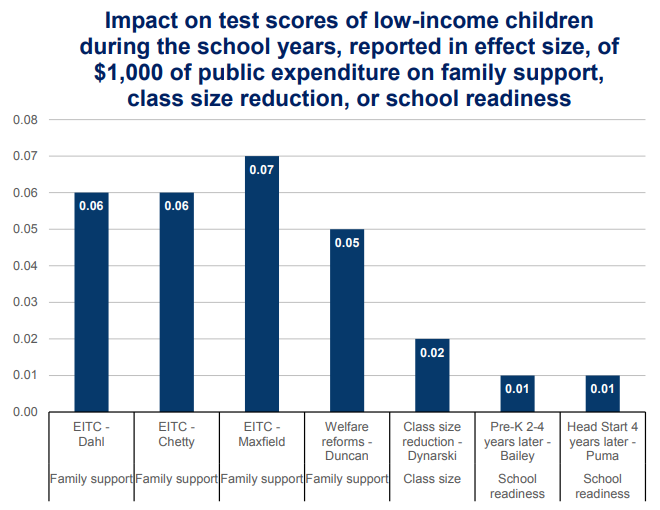
Russ Whitehurst of the Brookings Institution has written at length about the failure of larger-scale pre-K programs such as Head Start and the Tennessee Voluntary Pre-K Program to generate impressive results. We’ll discuss that research more in future blog posts. But in a survey of the research on various school-readiness interventions, Whitehurst pointed out that direct aid to families, such as the earned income tax credit (EITC), “produced substantially larger gains in children’s school achievement per dollar of expenditure than a year of preschool, participation in Head Start, or class size reduction in the early grades.” That is a fascinating bit of information and should be of interest to anyone who is serious about helping low-income children.

During the panel discussion I offered, “You could do more for poor families in Kansas City by removing the sales tax on food and by exempting, say, the first $26,000 of earnings from the earnings tax. You can do more by aiding families—giving them more money in their pocket—than you can by taxing them and providing a program.”

Test score expenditure graph

But Mayor James was not having it. He responded, “There’s no way that you can tell me, regardless of what study you may cite,” that by reducing taxes on the poor that they, “are going to use the money to educate their children.” And maybe they won’t, but the data Whitehurst cites don’t specify how families spend the extra money. EITC funds are not earmarked, yet this direct support to low-income families still outperformed pre-K according to Whitehurst’s research.

Perhaps what low-income families need is not to have more money taken away from them in order to provide them more services. Perhaps what they need is more money, more flexibility, more agency to address their own challenges as they see fit. Perhaps telling poor people that government knows best how to spend their money and educate their children isn’t the best way to solve problems. The research (at least if we go beyond a specific study that seems cherry-picked to support a rosy view of Pre-K programs) seems to suggest this, if only policymakers will listen.


Support Us

The work of the Show-Me Institute would not be possible without the generous support of people who are inspired by the vision of liberty and free enterprise. We hope you will join our efforts and become a Show-Me Institute sponsor.

Donate
Man on Horse Charging