A Field of Subsidies

If at first you don’t succeed, get more government help. That seems to be the mantra of Missouri developers and city officials these days.

Last month, the Hazelwood City Council passed a resolution approving the redevelopment of the failing and deeply indebted St. Louis Outlet Mall. After failing to secure financing for the same project in Chesterfield, the developer, Big Sports Properties (BSP), now plans to convert the mostly vacant mall into a 138-acre youth sports complex called POWERplex, with the help of taxpayer money.

The deal includes nine sources of public financing, which can be divided into four types of incentives:

  • The first type of incentive used is special taxing districts, including a community improvement district (CID) and transportation development district (TDD), and they would together levy a 2% sales tax.
  • Second, the existing tax-increment financing (TIF) district (from the original mall development in 2003) would also collect half of all economic activity taxes paid at the sports complex, and the agreement includes tentative approval of a new TIF, slated to go into effect next January if the project is on schedule.
  • The third type of incentive used involves Hazelwood assisting the developer with debt financing, using economic development loans, Chapter 100 property tax abatement, and property assessed clean energy (PACE) financing.
  • Finally, the fourth source of incentives comes directly from the City of Hazelwood and St. Louis County in the form of $3.6 million to revitalize infrastructure.

If this all sounds too complicated, it’s because it is.

There’s plenty of reason to doubt this project will be a good investment. When the mall was first built in 2003, it received public funds totaling $52.5 million from a TIF and TDD. However, the mall sold for $6 million in 2015, just 6% of its original cost. Earlier this year, it was announced that the mall would be closing, and the TDD was mired in debt. In fact, the TDD’s bondholders agreed to settle the debt for $10.5 million, a reportedly substantial discount, which will be paid by the newly formed CID.

The mall was a taxpayer-subsidized failure, and the city is asking for us to trust them again. Even if BSP manages to see the project through this time (part of the reason the development in Chesterfield failed last year was that BSP missed an important deadline) and the first few years are successful, the long-term risk is substantial. Hazelwood might find itself in a similar situation another 16 years from now.

Besides the risk to taxpayers, government should not be picking winners and losers. Hazelwood pulled out nearly every subsidy in the book to help build a private business with no guarantee of success, and taxpayers got to bear the cost. It’s hard to imagine a time when businesses relied on market forces to decide where to build. Instead, it has become a competition between cities to see who can give away the most taxpayer money, and Hazelwood has done an exemplary job showing us where that leads.

 

Taxes for Thee, But Not for Me (Part 2)

Over two years ago, Show-Me published a piece about how Missouri corporations such as Burns & McDonnell advocate for higher taxes while seeking special dispensation from paying their own. Members of the Greater Kansas City Chamber of Commerce regularly support tax increases despite—or maybe because of—the fact that much of their members’ taxes are returned to them or abated altogether.

Perhaps it shouldn’t be surprising that Burns & McDonnell is at it again, benefitting from a little-debated tax credit expansion passed by the state legislature and signed by the governor that could net them $300 million over 15 years. The Kansas City Star, in a piece worth reading in its entirety, reports that:

Since 2011, Missouri has issued $39 million in tax credits to Burns & McDonnell, according to state records. The company can receive credits for every 25 new jobs it creates and $1 million it invests in its headquarters.

The expanded credit, inserted into the economic development package with almost no debate, will cover not just its physical assets but investment in cloud computing services. It would allow the company to claim 8 times the value of a software license.

Hand-picking which companies have their taxes reduced puts a great deal more power in the legislature, encourages businesses to invest in lobbyists rather than in their core competency, and creates an unjust situation where businesses that don’t receive handouts subsidize their competition through the tax code. If taxes are too high, lower them for everyone—don’t play favorites.

Perhaps most importantly, such tax schemes are so poorly managed that they hardly work. It should not be surprising to learn that the men and women elected to local and statewide office are imbued with no magical forecasting powers to divine the growth industries of tomorrow. It’s a crapshoot.

As a result, Missourians are left holding the tax bill while corporate cronies and their amen chorus in the legislature congratulate themselves. It is unjust, unworthy of the Show-Me State, and an indelible stain on the records of those who would call themselves small-government, free-market conservatives.


Opportunity Zones?

A recent Business Journal story examined Opportunity Zones, a new program created in the 2017 Tax Cut and Jobs Act. Opportunity Zones are low-income census tracts where groups or individuals can receive tax breaks for investing in the area. Because the legislation is so new, there aren’t any data available to see how the program will actually be used. Even in the Journal’s write up, they allowed for unintended consequences:

Some economists and policymakers caution that the law’s loose language is ripe to be gamed or at the very least exploited outside the spirit of the program’s intent. Concerns about gentrification and the displacement of poor, minority neighborhoods in the name of economic development are legitimate, they say, and probably will play out in unexpected ways, should the program work as designed.

Later in the piece we learn the Kansas City Opportunity Zone Coalition is being “spearheaded” by the Greater Kansas City Chamber of Commerce. It is not a surprise that the chamber would be involved, but anyone familiar with their role in city and state economic development policy knows this isn’t necessarily a good sign the program won’t be gamed or exploited.

The Heritage Foundation recently published a piece on Opportunity Zones, and they remain skeptical:

Academic and government studies show that past place-based development experiments often failed to yield promised employment gains or advance general economic opportunity for targeted residents. Even in cases where place-based policies induce greater investment within the targeted zone, the favored businesses gain an unfair advantage over competitors elsewhere. Often, new investments simply represent a shift in capital away from other investment opportunities outside the zone’s boundaries. In those instances where place-based policies draw capital away from more productive investments, they can result in net economic losses of jobs and income.

Incentives lavished on downtown Kansas City are a perfect example of the failed promises of place-based development incentives. A great deal of tax dollars have been spent just to redirect investment; little if any new economic activity has occurred citywide. That’s not to say that governments are powerless. But the power they wield is often negative. They can do the most good by simply getting out of the way, as the Heritage piece notes:

The economic literature, however, does offer a positive vision for helping distressed communities access economic opportunity. Lifting government-imposed barriers to work, housing supply, and education choice can expand economic mobility and opportunity. In stark contrast, top-down federal incentives can unintentionally reward failing state and local policies by masking the need for reform. Paired with removing government-imposed barriers to success, broadly applied tax reforms that reduce taxes on investment for everyone can help lift struggling communities out of poverty.

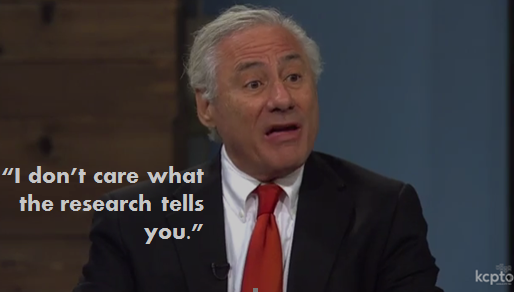
Pundits and policymakers, like former Kansas City Star columnist Steve Rose pictured above, have for too long said they don’t care what the research reveals. That is unfortunate, because good public policy demands that we pay attention to successes and failures here and elsewhere.

A Little Less Conversation, A Little More Action

A little less conversation, a little more action

All this aggravation ain’t satisfactionin’ me

A little more bite and a little less bark

A little less fight and a little more spark

Although Elvis Presley intended these words for a romantic interest, Missourians can be forgiven for thinking they sound an awful lot like a plaintive cry to the state legislature. As an interim committee of the Missouri State Senate considers tax credit reforms, we are reminded of other similar efforts that generated reports and recommendations, media stories, and precious little actual reform.

A 2017 Governor’s Committee on Simple Fair and Low Taxes issued a report offering numerous reforms for all tax credits, and specific additional reforms for the Historic Preservation Tax Credit, the Low-Income Housing Tax Credit (LIHTC) and the Missouri Works program.

In 2010, then Governor Jay Nixon appointed the Missouri Tax Credit Review Commission, which made recommendations on many tax credit programs, including the same three programs singled out in the 2017 report.

Each of these efforts made clear that Missouri’s generous and numerous tax credit programs are a drain on state resources and often fail to produce the desired results. There is plenty of research to support the claim that tax credit programs aren’t worth the cost. Missouri state auditors have been railing against wasteful tax credits for years. And it isn’t a partisan issue; governors and auditors, both Republican and Democrat, have called for substantive reform, yet substantive reform is elusive. Why?

It doesn’t take a cynic to see that the very reason why these tax credit programs are bad for taxpayers—they often offer a very low return on investment for taxpayers, but a very high return on investment for developers—is why they are so popular among developers. My colleague Elias Tsapelas has written recently on the relatively weak reforms considered for LIHTC and how the goal of providing low-income housing can be better achieved without the program. But those who benefit from buying and selling tax credits have every interest in stopping any changes. The claims regarding the necessity of these programs and their economic impact are often overstated—and often backed by no economic analysis or research at all!

The most recent legislative session failed its task of reforming LIHTC, saw overwhelming support for the creation of a new film tax credit program, and gave us self-styled conservatives advocating for tax credits targeted to General Motors. Elvis’s impatience is palpable. Any Missourian can quickly learn which reforms are necessary and why; what is in short supply is the will to actually enact them.


Rebecca Roeber, R.I.P

State Representative Rebecca Roeber passed away Monday night after a long and painful recovery from a brutal car accident this spring.

Rep. Roeber was a tireless advocate for Missouri’s children. She was perhaps the greatest champion of school choice in Jefferson City and worked for years to expand the educational options of our state’s children.

She was curious, she listened, and more than anything, she was kind. She modeled for all of us that we can be passionate advocates without demonizing those who disagree with us. Perhaps it was her years as a teacher that instilled these skills in her. Maybe it was just part of who she was.

We experienced a great loss this week, but it is important for all of us who believe in empowering families with choice to continue the work that she began. She would expect nothing less.

May she rest peacefully in the loving arms of the Lord she so loved.

Show-Me . . . Lots of Bad Government?

When you clean the house as things warm up in the spring, you often find things—dust bunnies and other unsavory creatures—hiding under the couch and in the closets.

Things are no different in government. Analysts at the Show-Me Institute spend a lot of time combing through reports and audits, and as I looked through the state auditor’s 50 or so reports for this year, I found a whole lot of dust bunnies—nasty, government failure dust bunnies.

Of the reports that received a judgment (about half of the reports are follow-ups or monthly postings without a judgment), half enjoyed “excellent” and “good” results, while the other half received “fair” and “poor” marks. In short, about 50% of the public entities audited weren’t doing a great job by any stretch of the imagination. 

For context, here is how the SAO defines “Fair” and “Poor”:

Fair: The audit results indicate this entity needs to improve operations in several areas. The report contains several findings, or one or more findings that require management’s immediate attention, and/or the entity has indicated several recommendations will not be implemented. In addition, if applicable, several prior recommendations have not been implemented.

Poor: The audit results indicate this entity needs to significantly improve operations. The report contains numerous findings that require management’s immediate attention, and/or the entity has indicated most recommendations will not be implemented. In addition, if applicable, most prior recommendations have not been implemented.

Now, this all is a little abstract, so let’s consider some examples.

The City of Hamilton, the subject of SAO Report No. 2019-007, received a rating of “Fair.” For what exactly? Well, among other things, for lacking a road maintenance plan, for failing to stop conflicts of interest, for not following basic payment procedures, for not complying with Missouri’s Sunshine Law, for not giving the public library its money on time, and for failing to put its budget together in a proper way. So, while ‘fair’ might not sound so terrible, it is a long shot from being acceptable.

More troubling reports come from places like the City of Miller and Madison County. 

In Miller, west of Springfield, the city raised taxes for water treatment services but still can’t pay its bills, and has violated the state’s Clean Water Act. Basic timesheet procedures weren’t followed, city credit cards were not adequately tracked, the city’s budget wasn’t put together according to the law and was inaccurate, and the city hasn’t complied with the Sunshine Law. Most troubling is that the former police used city credit cards for personal expenses and kept his brother on the city’s payroll while he was working another job.

In Madison County, in southeast Missouri, where an investigation is ongoing, it appears taxpayers would pay their property taxes and then records of the payment would be deleted from county systems. The money from these transactions appears to have never made it to the bank. In short, it looks as if taxpayer money was being flat out stolen. Bad government? I think so.

With 114 counties, nearly 1,000 cities and villages, and thousands of other public entities across the state, bad government is a constant and ubiquitous problem. A liberty-minded skepticism of government seems warranted when reports like these make news. 


Mission (not) Accomplished

I knew it might be too good to be true. During the 2018 legislative session, lawmakers passed and the governor signed a bill that allows all public school students to take courses online with their home district covering the tuition. Students don’t need to justify why they want to take a course online, but the school could deny them if they think it’s not in the student’s “best interest.”

This means that students in rural schools without a wide course selection could take any AP course. Students with irregular schedules—possibly because they’re intensely committed to a sport—could take some classes in a building and some online. Bullied students could choose to take their entire courseload online. Parents who want to homeschool, but aren’t comfortable doing it themselves, would get assistance. In other words, it means giving parents options that they want and need.

But the devil, in this case, is in the implementation. I’d heard rumors that districts weren’t complying with the law’s requirement that they make the availability of this option clear on their websites. I’d heard that Missouri’s Department of Elementary and Secondary Education (DESE) was interpreting the law’s requirement that the program launch in fall 2018 as a requirement to begin looking into curriculum providers in 2018.

But now, what concerned me most has happened. A parent has had to sue their child’s district to get access to the program. The parents wanted to choose an existing virtual program, known as MOVA, provided by the Grandview R-2 district. Their home district, Fulton, denied the request because they don’t use curricula from other districts. They haven’t even gone through the process of determining if it’s in the child’s best interest, as required by the law. They just gave them a flat “no.”

Survey after survey tells us that parents, especially young parents, want more choice regarding their children’s education. The powers that be may be able to deny them for a little while, as is happening in the Fulton Public School District. But parents can be a powerful force, and that approach won’t work forever.

CID, TDD Collections Jump by More than $13 Million

Missourians pay far more taxes than they think they do.

Because of special taxing districts like community improvement districts (CID) and transportation development districts (TDD), many shoppers pay up to an extra two percent in sales taxes.

Over the past few years, my colleagues and I have written extensively about CIDs, TDDs, and other special districts. In short, most special districts are created by developers to funnel additional sales tax revenues into developments. Most shoppers don’t know about the taxes because they never voted on them and because many businesses in CIDs and TDDs don’t post statutorily required notices.

In a recent paper, Patrick Tuohey and I detailed the growth of these districts and their tax collections. But more recent data on last year’s collections provide even more evidence that CIDs and TDDs have gotten out of control.

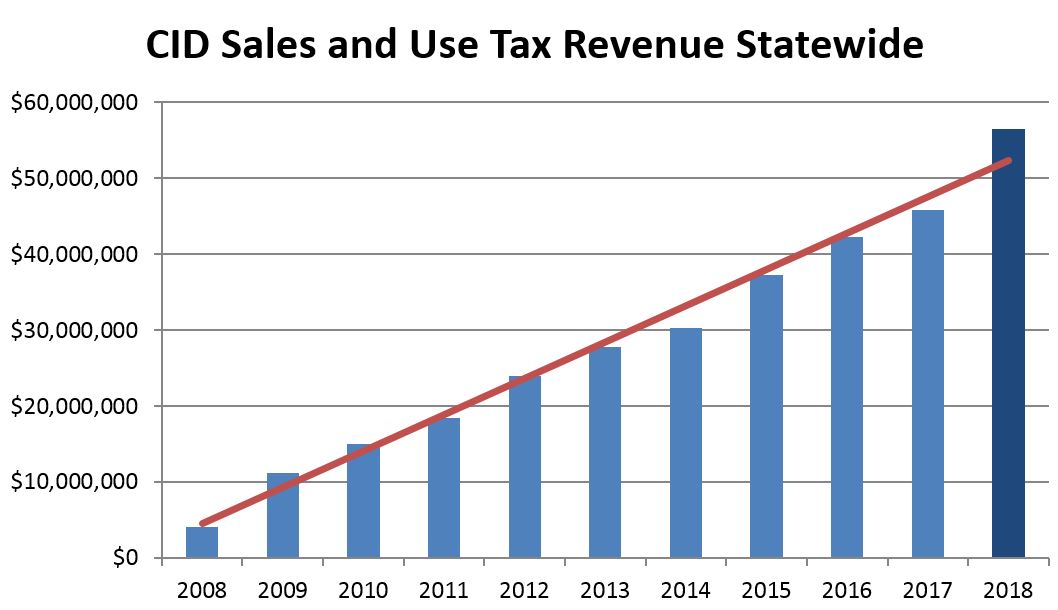
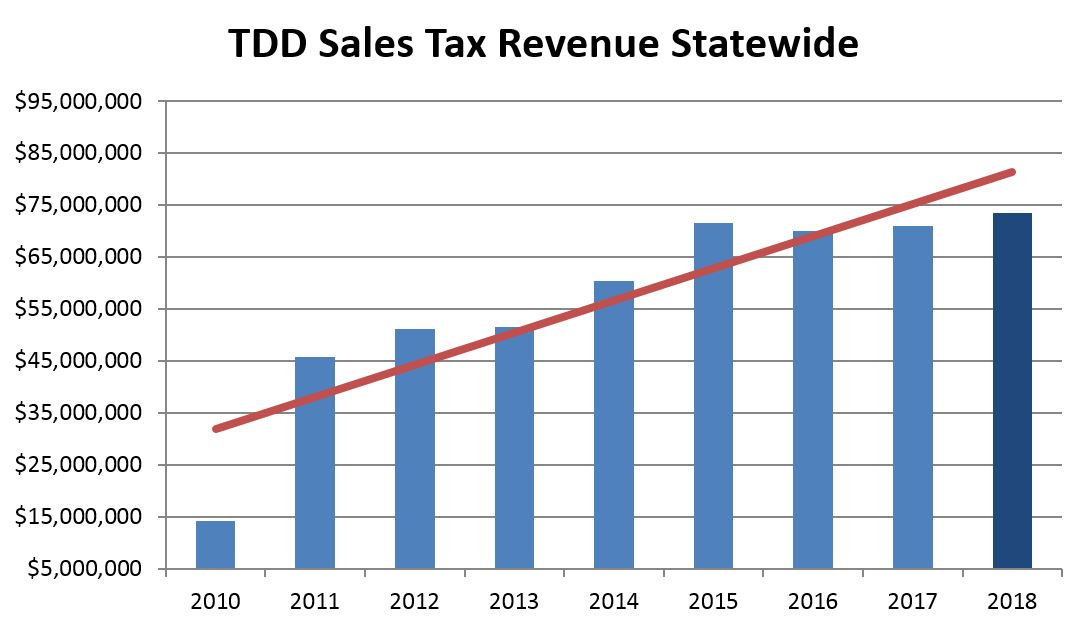
The graphs below depict revenues for CIDs and TDDs. From 2017 to 2018. Statewide CID revenues jumped nearly $10.7 million, the single highest year-to-year increase in Missouri’s CID history. Over the same period, TDD revenues jumped a more modest $2.5 million, but are nonetheless at their highest levels to date, at $73.5 million.

CID sales tax collections


TDD sales tax collections

In our paper, Patrick and I detail reforms to help curb CID and TDD abuse. I would encourage readers to learn more about them here. Policymakers should recognize the sizable burden these districts place on taxpayers and enact reform sooner rather than later.

How Strange: Private Money for Public Good

When our blog posts are plastered with discussions of public money for private gain, recent news regarding the Rock Island Trail brings some welcome relief.

Senate Bill 196 creates a fund to allow private donors to help defray the costs of building a 144-mile long hiking and biking trail, which runs east–west south of the Katy Trail. The bill was needed because, while the trail is a priority for policymakers, current state funding isn’t enough to acquire and construct the trail.

This is good news for Missourians and, in particular, outdoor-recreation enthusiasts. It’s also good news for liberty-minded folks who favor funding infrastructure and other public goods privately (and voluntarily). Should negotiations between the current landowner (a railroad) and the state go well, and should enough money be raised, Missouri could have one of the longer continuous trails around.   

While this isn’t the first privately-funded trail project in the state (there are some very nice private biking trails and parks, especially this one in Springfield), it is exciting to see the infrastructure in place to make such a large-scale project happen. Congratulations to policymakers for doing what makes entirely too much sense: creating the opportunity for enthusiasts to give to projects they’re passionate about.

Support Us

The work of the Show-Me Institute would not be possible without the generous support of people who are inspired by the vision of liberty and free enterprise. We hope you will join our efforts and become a Show-Me Institute sponsor.

Donate
Man on Horse Charging