Springfield and Strafford Gave Us Their Checkbooks Two Years Ago. Why Didn’t Battlefield?

Last year, a bill requiring cities to submit their spending records—or “checkbooks”—to the state was filed in the House, and this year the measure passed the lower chamber in a bipartisan vote. Yesterday it was heard in committee in the Senate.

But unfortunately, the bill appears to be facing headwinds in the Senate, where there’s talk of making the reform “voluntary.” That would be a mistake based on a host of misconceptions propagated by House debate of the bill and reinforced by a host of special interests who don’t want these checkbooks public.

First, the idea that “small cities” are going to be unable to produce these records flies directly in the face of the truth. Responses to our Sunshine requests show pretty clearly that despite assertions to the contrary, city size has basically nothing to do with whether a city could produce spending records, or even produce them for free. The following cities—all with fewer than 300 residents—are just a handful of the cities that produced their spending records at no cost:

  • Centertown, population 278
  • Filmore, population 185
  • Lohman, population 163, and
  • St. Thomas, population 263

What was doubly confusing about the House debate and subsequent pushback in the Senate was the claim that Springfield, of all places, would have trouble complying with the law. In fact, we asked Springfield (population 167,000) for their records two years ago, and the city provided them to us—free of charge. Springfield’s much smaller neighbor, Strafford (population 2,400), also provided their checkbook for free.

Meanwhile, their neighbor Battlefield (population 5,500) wanted $35,000. Why should Battlefield be able to price the public out of transparency? Why should any city be able to do that?

This isn’t about city size. It’s about city culture. And if someone tells you otherwise, they’re selling you bunk.

Second, making participation in the state’s checkbook database voluntary for cities would incentivize cities like Battlefield to keep their spending secret. If a city like Battlefield wants to charge the public tens of thousands of dollars to see how it’s spending tax dollars, why would it submit any information to the state voluntarily? Perversely, the city checkbooks that likely need the most oversight will continue to be the least likely to receive it. That’s unacceptable

Lastly, the notion that requiring cities to disclose their spending to state would somehow violate Missouri’s Hancock Amendment, which speaks to unfunded mandates, is ludicrous.  Nothing in the text, case law or spirit of the law of the Hancock Amendment suggests it would prevent the public from seeing how cities spend money. What’s more, cities already have to submit financial reports regularly to the state that include how much they’re spending. And a city can’t submit expenditure totals without knowing their expenditures.

These “checkbook” records exist. Cities shouldn’t get to hide them.


No, Low-Income Housing Tax Credits Aren’t Effective

Sometimes it seems as if politicians can always find a justification for spending more taxpayer dollars. Despite numerous academic studies and state auditor reports showing the ineffectiveness of low-income housing tax credits (LIHTCs), proponents are now arguing for the program’s revival by pushing exaggerated claims of economic activity that the credits allegedly generate.

As my colleagues have discussed many times before, three consecutive state auditors (both Democrat and Republican) have concluded that the LIHTC program spends less than $0.42 of each dollar on affordable housing. As of 2017, there were over a billion dollars of LIHTCs outstanding or available to be issued, and those are dollars that won’t be available for spending on existing state services. It should be obvious that Missourians deserve better stewardship of their hard-earned tax dollars, but the program’s supporters argue those figures don’t adequately capture the economic benefits the state receives.

The target of the proponents’ critique is the economic modeling tool the state uses to measure the impact of government programs. One conclusion from the 2017 audit that used the model in question was, over a span of 15 years, Missouri received only $0.12 return for each dollar invested in LIHTCs. But proponents argue the model is “incomplete and thus questionable,” and as one elected official recently noted regarding LIHTCs, “value and effectiveness can’t always be quantified in data.”

It is important to note that the critique relating to the audit’s findings does not mention the inefficiencies of the program. Literature on the topic is clear that the regulations surrounding the construction and development of low-income housing inflate project costs. And there are now multiple academic studies that show the federal program does not significantly increase the amount of available affordable housing.

While the LIHTC program is considered a tool for economic development, its effectiveness should be measured by its ability to achieve its defined purpose—increasing the availability of affordable housing in Missouri. More specifically, how have the credits Missouri has issued in addition to the credits offered by the federal government induced additional development of affordable housing, and at what cost?

As the research indicates, the LIHTC program is not an effective or efficient way to increase the amount of affordable housing across the state, regardless of the claims of economic impact made by the program’s supporters. As policymakers consider reviving the state’s practice of issuing LIHTCs, their decision should be based not on the emotional appeal for new housing, but on whether the program as currently constructed is a justified use of their constituents’ tax dollars. The evidence indicates it is not.


A Moonshot of Mistakes: Missouri’s Missing Million

When the United States put a man on the moon in 1969, the state of Missouri was the 13th largest in the country in terms of population. Today, it’s the 18th largest. While the rest of the country grew significantly over the last half-century, Missouri has lagged behind its peers to such an extent that had it simply grown like the rest of the country, it’d have had a million more residents than it does today.

What happened? A new paper published by the Show-Me Institute from economists Rik Hafer and William Rogers provides some insight into Missouri’s half-century of stagnation.

Much of the problem can be traced to the underwhelming growth of Missouri’s two major metropolitan areas: Kansas City and St. Louis. Hafer and Rogers found that from the late 1960s to the mid-2010s, the Missouri portions of the Kansas City and St. Louis metropolitan statistical areas (or MSAs) grew by about 20 percent, which at first glance might not seem terrible. The problem is, similar “mid-major” MSAs around the country grew by nearly 90 percent during the same period.

At least in some respects, the issue boils down to job growth and the retention of trained workers in high-growth industries. Certainly, individual states may be more predisposed toward certain industries based on their geography, their natural resources, and other factors, but in the five industries that have seen the largest growth in the U.S. over the last 20 years—information, professional business services, education, financial services, and mining/logging—Missouri has lagged the national average. For years, Missouri has had weak domestic in-migration, and in particular, the state has had weak in-migration of holders of bachelor’s and advanced degrees who might fill the jobs in these fast-growing industries.

Indeed, in at least four of these industries, a bachelor’s or advanced degree might be expected for a substantial number of these jobs, and arguably those jobs tend to be more urban in nature rather than rural. And that brings us back to Missouri’s two major cities: The industries that need these workers aren’t growing as fast there as they are elsewhere in the country. And although Kansas City and St. Louis are generally regarded as the “engines” of the state’s growth, Missouri’s economic horsepower has sounded more like a Pinto than a Porsche over the last few decades, in no small part due to these losses in talent.

But not every part of the state has been caught up in the state’s overall growth malaise. The metropolitan areas of Springfield and Fayetteville, Arkansas—specifically the parts in Missouri—have exceeded the state’s growth averages over this roughly 50-year horizon. And even within Missouri’s mid-major MSAs, places like St. Charles County and Platte County have been bright spots for the state, offsetting some of the weak economic performance seen in places like Jackson County, St. Louis County, and St. Louis City.

What can be done? That question is beyond the scope of Hafer’s and Rogers’ work, but it merits a discussion among the public and by policymakers. Different regions will have to grapple with different problems; last year, for instance, I wrote that St. Louis City’s long-standing woes can be traced back to its dysfunctional educational, crime, and tax policies, all of which incentivize current and prospective residents to put down their roots elsewhere in the region, or beyond it entirely. Similar criticisms can be leveled at Kansas City. Elsewhere in the state, educational and tax issues are perhaps the more pressing issues for long-term economic growth in their regions.

Regardless, Missourians must begin a serious and deliberate process to ensure that the state is creating an environment for people of all educational backgrounds to succeed here. Hopefully, by the next time astronauts set foot on the Moon, the state will have gotten a handle on its growth problems.

Missouri Needs to Prepare for Expanding Tech Job Market

Recently, the Missouri Chamber Foundation released a report claiming that Missouri is situated for high growth in the technology industry in the next decade. This is a great opportunity, but Missouri may not be ready to take advantage of it.

The report projects Missouri to be the ninth-highest state in tech growth over the next decade with 2.9 percent growth, ahead of the national 2.1 percent projection. The tech industry includes energy, environmental, life sciences and information technology (IT).

Despite projected growth, Missouri workers may not be prepared to fill the needs of an expanding tech industry, as jobs could outpace the availability of skilled workers. A survey by Gallup of 1,000 Missouri employers find that only 44 percent were satisfied with the current availability of skilled workers, and only 15 percent agree that high schools are preparing students for the workforce. In 2016 one of the largest workforce gaps was in Science and Technology—around a 9 percent gap  between the workforce demand and available workers.

This gap shows the need for more high school graduates prepared to enter the tech field. If students graduate with the proper credentials, they could have access to a high-demand job and enter the workforce immediately. The largest tech sector in Missouri is IT, of which high school students can earn over 15 IT-related industry-recognized credentials (IRCs) approved by the Department of Elementary and Secondary Education (DESE). An IRC is a nationally recognized credential that tests job skills, awarded by a third-party professional organization. In 2018, fewer than 500 IT-related IRCs were earned among Missouri high school students (less than one percent of the graduating class if all test takers were seniors) according to data received from DESE.

Florida and North Carolina have found that providing bonus pay to teachers is one way to get more students to graduate with an IRC. Bonus pay encourages high schools and teachers to focus on the important work of preparing students for a career.

A growing tech sector would be a huge boon to Missouri’s economy. But if we don’t act now to ensure our workforce is ready for these jobs, the potential boon will turn into a missed opportunity.


Taxes and Fees Affect Shopping Decisions

A recent paper on car rental fees published by the Tax Foundation cites Kansas City, Missouri for its rental car excise fee. As with the earnings tax, Kansas City leaders argue that this is free to residents because we’re taxing people who don’t live here. The paper’s authors refer to this as tax exporting, and it affects the decisions people make:

While tax exporting may succeed in disproportionately burdening nonresidents with a rental car tax, the taxes have negative economic effects for the taxing jurisdiction. In addition to lowering the quantity of car rental services demanded, there is evidence that consumers will travel to lower tax jurisdictions nearby, as was the case when Kansas City, Missouri levied a $4 per day rental car tax. Residents and nonresidents alike traveled across the state line to nearby Kansas, which offered a lower effective tax rate on an ad valorem basis, to avoid the tax in Missouri. This harmed Kansas City, Missouri’s economy, resulting in missed tax revenue, lower output, and potentially lost jobs in the rental car industry.

I myself have gone across the state line to rent a car in Kansas to save money. Many people in the region have done this, I am guessing, and the impact adds up. The paper cites research that put numbers to this behavior regarding rental cars:

Tax scholars William Gale and Kim Rueben found that a $4 per day rental car levy in Kansas City, Missouri—an effective tax rate of about 13 percent on an economy vehicle—reduced the number of customers at affected branches by 9 percent relative to branches that were unaffected. While consumers had less than a proportionate response to the tax, they altered their behavior by using other transportation options.

Kansas City cannot tax its way to prosperity. If city taxes remain high while services remain low, consumers and residents will continue to do what they have been doing: vote with their feet.


After 50 Years, Low-Income Students Are Still Being Left Behind-When Will Enough Be Enough?

As part of the War on Poverty, President Lyndon B. Johnson’s administration pushed for comprehensive education legislation that became known as the Elementary and Secondary Education Act. When signing the bill into law in 1965, Johnson stated, “By passing this bill, we bridge the gap between helplessness and hope for more than five million educationally deprived children.”

But has education policy in the last 50 years closed that gap? Not even close. Back in the 1970s, students from poor households were as much as three to four years of schooling behind their wealthier peers. Fast forward to 2015, and that gap has virtually stayed the same despite pouring billions of dollars into the education system. Isn’t it time for a new approach—shouldn’t we start giving parents the power to control education dollars?

According to a recent study, there has been a persistent gap in academic achievement between low-income and high-income students for decades. What’s more, student performance overall hasn’t gotten better; any gains seen in earlier grades dissipate by the age of 17 when students are preparing to go to college or enter the workforce

This is despite numerous local, state, and national efforts to provide quality education for low-income kids. In the last 50 years, we have provided services to students with disabilities, evened out school funding between rich and poor districts, instituted a number of accountability systems (Missouri’s accountability system is in its sixth iteration since 1991), and increased funding overall. In fact, the report notes, “Overall school funding increased dramatically on a per-student basis, quadrupling in real dollars between 1960 and 2015.”

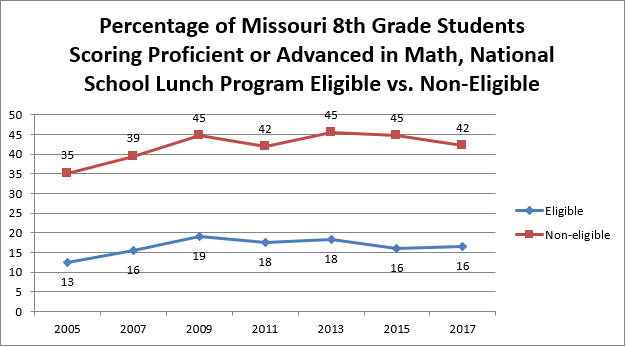
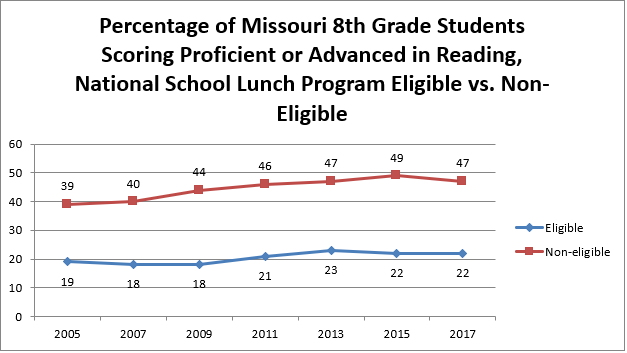
To show just how bad the achievement gap between high- and low-income students is in Missouri, check out the data from the National Assessment of Educational Progress (NAEP). Beginning with 2005, the data points represent the percentage of 8th grade students in Missouri who were at or above grade level in math and reading, separated by eligibility for the National School Lunch Program (which is for families with incomes below 185 percent of the federal poverty line).

8th grade math proficiency

8th grade reading proficiency

For low-income 8th-graders, only 16 percent were proficient or advanced in math in 2017. The number for reading is hardly better, with only 22 percent of students considered proficient or advanced. Compare that to students who were not eligible for the National School Lunch Program: 42 percent of these kids were at least proficient in math and 47 percent were proficient or advanced in reading. And the gap in both subjects has gotten larger since 2005.

What are the consequences of this failure? As I discuss in my two recent essays, “Intergenerational Poverty in Missouri” and “Creating Pathways for Self-Sufficiency,” quality education and the ability to move up the economic ladder are closely linked. How can Missouri expect to break cycles of poverty if it can’t even educate low-income students well?

Meanwhile, charter schools and private school choice programs are providing opportunities unmatched by many traditional public schools. Graduates from IDEA Public Schools, a charter school network founded in the impoverished Rio Grande Valley in Texas, have a 100 percent college acceptance rate and half of the class of 2012 acquired a bachelor’s degree within six years after enrolling in college. In Florida, tax-credit scholarship recipients have higher college-going and degree completion rates, and charter school students score higher on tests than students in traditional public school students.

So where do we go from here? Should we be satisfied with reforms that just tinker around the edges of our education system and increase spending indefinitely for programs that are failing? Or should we allow more competition and innovation through choice that will make schools more responsive to families of all economic backgrounds? Based on the failure of the education bureaucracy to close the gap in the last 50 years, it seems Missouri’s best option is to start trusting parents. 


Texas Advancing Its Own Checkbook Transparency Legislation

It appears that local government transparency measures are catching on across the country! The latest example comes from Texas. The Houston Chronicle has the details:

Governments would no longer be able to keep secret the amount of taxpayer funds spent on concerts, parades and other entertainment events if a bill advancing in the Texas House is passed into law.

House Bill 81, sponsored by Rep. Terry Canales, D-Edinburg, would require that information to be available to the public.

The bill, which cleared a key vote in the House on Wednesday, was prompted by the city of McAllen’s refusal to release records about how much it paid pop singer Enrique Iglesias for performing at a holiday concert. News reports later showed the city lost more than half a million dollars on the event. [Emphasis mine]

The proposal appears to be but a slice of a larger transparency push in the Lone Star State. Later in the article, Kelley Shannon, executive director of the Freedom of Information Foundation of Texas, made that clear, and also made a policy point that we often make—that if governments can spend it, they should report it to you:

“Taxpayers have an absolute right to see how their money is spent, whether on small projects or large ones,” Shannon said. “This, along with other transparency proposals at the Capitol, will help repair and strengthen the Texas Public Information Act.”

Our own work showed that some Missouri cities are willing to charge the public thousands, and even tens of thousands of dollars, to see what they’re spending the public’s money on. That is bad policy and completely contrary to objectives of good governance. Cities already have to file financial reports with the state that are based around their revenue and spending practices; it is altogether reasonable that the underlying transactions that form those reports be made available to the state and the public.


Electricity Choice Would Be Good for Missouri Consumers

Whether it’s buying a car or choosing where to go for dinner, Missourians like having choices—but when it comes to electricity, Missourians are left with few. In fact, currently those of us who want electricity from the grid must get it from a single monopoly utility provider.

But that may soon change. Senate Joint Resolution 25 would finally give Missourians a choice about choice, at least for our electricity. The legislation authorizes a statewide referendum on electricity competition that should spark a much-needed conversation about the benefits of reforming the state’s 100-year-old regulatory structure and requiring those that provide our power to compete for customers rather than letting them take Missouri taxpayers for granted.

For most of the 20th century, every state operated under an electricity system similar to Missouri’s. Local monopoly utilities provided power to customers and were heavily regulated by state utilities commissions. Electricity rates were set based on the utilities’ expenses (plus a return of profit), leading to a situation where the more a utility spent, the more money it made. This system encouraged wasteful spending and discouraged innovation, but since every state had the same system, it was hard to compare what was to what could be.

Beginning in the 1990s, however, a number of states began to restructure their electricity markets, allowing for greater competition. Today, more than a dozen states have adopted some form of choice for electricity.

And the results have been positive. From 2008 to 2016, the average price of electricity decreased 8 percent in states with competition, while rising 15 percent in monopoly states. Unfortunately, Missouri has gone in the wrong direction on this front; electricity rates in the Show-Me State increased by nearly 40 percent between 2008 and 2016. While Missouri once had among the lowest electricity rates in the nation, today electricity rates in Missouri are above the national average.

Lower electricity prices nationally have translated into billions in cost savings for consumers. For example, one recent study found that the introduction of electricity competition in Illinois resulted in $37 billion in consumer savings from 1998 to 2013. Another study found $15 billion in savings for electricity customers in Ohio over the course of this decade.

The fact that competition leads to cost savings for consumers shouldn’t be surprising. One of the chief ways businesses attract customers is by offering better quality services at a lower price than their competitors. Businesses under competition are constantly looking for new ways to improve their products or make them at a lower cost, and that applies to hamburgers, to health care, to schools, to electricity . . . to just about everything.

By contrast, when utilities are shielded from competition, they tend to resist innovation and are slow to adapt to changed circumstances. In the coming decades we are likely to see major changes in the way the electricity system operates. New technologies will give consumers much greater control over where they get their power and how they use it. Competition will help ease this transition.

Missouri itself increasingly faces competition from states such as Illinois, which can offer businesses the advantages that electricity choice provides. It’s time for Missouri to think seriously about whether to join more than a dozen other states and allow electricity competition. It would be good for the state, good for our businesses, and good for our families.

Support Us

The work of the Show-Me Institute would not be possible without the generous support of people who are inspired by the vision of liberty and free enterprise. We hope you will join our efforts and become a Show-Me Institute sponsor.

Donate
Man on Horse Charging