Charter Schools Offer Flexibility

In partnership with the Department of Conservation, the Columbia school district is developing a 10-day program where fifth graders from Boone County can get hands-on learning experience outdoors. Kids that get to participate may enjoy getting out of the classroom to learn about wildlife, conservation, and survival skills. But why limit project-based learning to a few days?

At one elementary school in Kansas, kids in kindergarten through fourth grade split time between their classrooms, a greenhouse, and a small farm right on school grounds. As a charter school, Walton Rural Life Center is able to replace traditional curriculums with a project-based program that focuses on agriculture. Students at Walton have chores and sell plants they grow and eggs from chickens they raise to supplement what they learn in the classroom.

I am thankful that my niece and nephew are able to attend Walton and I know how much the community cherishes the school, but I wonder why students in Missouri do not have access to similar opportunities. The article about the Columbia project mentions that the idea for a magnet-type nature school fizzled out because of a lack of state funding a few years ago. But using the charter school model could help solve that. A charter school, as in the case of Walton, would be eligible for additional federal funds to help defray starting costs.

With the flexibility and innovation that comes with charter schools, communities in Missouri could have customized schools that meet the needs and interest of their students instead of settling for programs that last just a few days. Whether it is project-based learning or a college-prep academy, charter schools can provide new opportunities to students in all parts of the state.


Charter Schools Don’t Cause Financial Distress

One of the most common arguments made against charter schools is that they financially harm traditional public schools. However, new research from the Center for Reinventing Public Education (CPRE) helps debunk this claim. The CRPE study looked at school districts in California and found no evidence that charter school enrollment increases the likelihood of financial distress (defined as a condition in which is a district is likely to fall short of financial obligations in the next two years) in California school districts.

The study found no statistically significant correlation between the financial status of school districts and their charter enrollment. Charter school critics note that when a student transfers from a traditional public school to a charter school, their previous school no longer receives funding associated with that student (which makes perfect sense, since the school is no longer responsible for the student). But the data in the study gives no indication this process is causing financial problems for districts. When CRPE looked at long-term trends regarding charter enrollment and the number of districts in financial distress, it found that while charter enrollment has steadily increased, the number of districts in financial distress has not increased every year.

Many factors contribute to financial struggles in school districts. Costs of pensions, benefits and grossly overestimating enrollment can cause a district to be short on money. These are the real causes of financial troubles in school districts, not the convenient bogeyman of charter schools. While the study looked at California schools, there’s no real reason to think the results would be different in Missouri. Charter schools shouldn’t be limited in Missouri out of misplaced worry that they will financially harm school districts; they should instead be expanded for the opportunities they provide students.


What Can Credentials Get You?

Missouri’s employers have open positions that they want to fill, but they struggle to find qualified applicants. It’s a situation that should spell opportunity for anyone who is ready to embark upon a career; however, “qualified” is the key word here. Conventional wisdom tells us that a college degree is the key to a good job, but what if you don’t have the resources or the time to invest in a 4-year college degree?

Fortunately, the findings from a recent nationwide survey conducted by Gallup, the Strada Education Network, and the Lumina Foundation, suggest that a college degree isn’t necessarily the only thing that employers are interested in. Researchers looked at two types of credentials that can be earned without a college degree and measured their impact on the employability and the earning power of the people who earned them. The credentials studied were the following:

  • Certificates “awarded by educational institutions for completion of professionally oriented courses that typically represent a year or less of work.”
  • Certifications “awarded by independent bodies that verify specific skills and competencies through testing”

The survey looked at adults 18 to 65 years old who had no postsecondary degree and compared those who had earned a certificate/certification with those who had not. The results suggest that earning a credential offers some real benefits in terms of employment rate and income.

  Percentage employed full-time Median income
With credential 85% $45,000
Without credential 78% $30,000

It’s important to note that the study involved subjects of widely varying educational levels. Some had been to college (but hadn’t earned a 4-year degree), while others hadn’t completed high school. Those who hadn’t finished high school are overrepresented in the non-credentialed group, while those who had gone to vocational/technical school are overrepresented in the credentialed group. This means that we can’t easily separate the effect of the credential from the effect of the amount of education a participant has had.

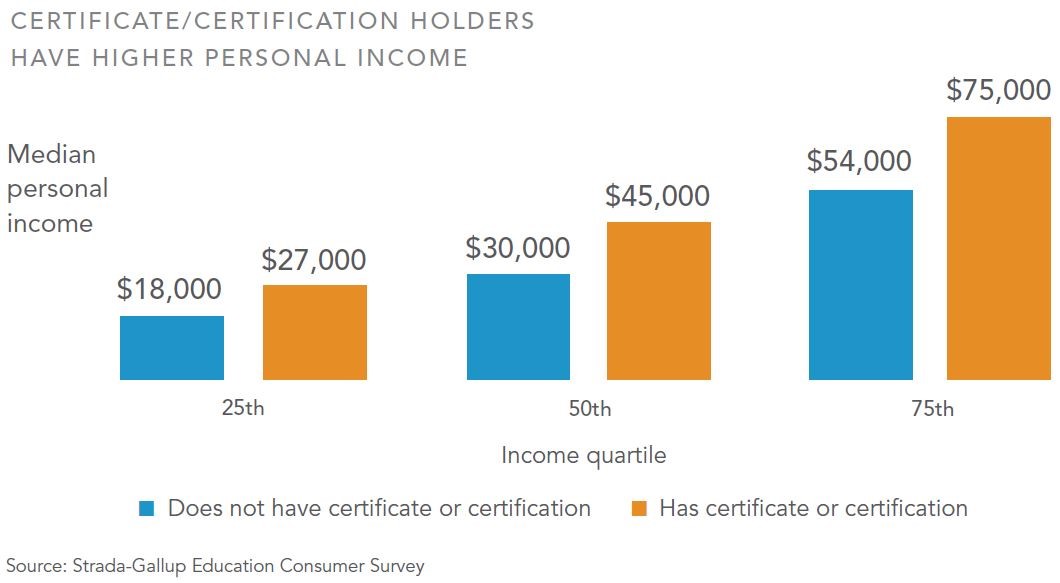
However, the study also found a benefit to having a credential among low-, middle-, and high-income earners:

Certificate holder income

There’s strong evidence that educational programs that result in students earning these certifications provide real benefits, but what does that mean for Missouri?

It could mean a lot, especially with respect to prioritizing needs when allocating the money Missouri spends on education. Credentialing programs appear to offer a positive return to students on the money invested in them. So why can’t these programs capture the imaginations of the public (and of policymakers) in the way that things like pre-K programs do—even though the case for the long-term benefits of pre-K is anything but ironclad?

Nothing against imagination, but when making spending decisions, policymakers are better off being guided by the facts. Although this survey covered adults aged 18 to 64, investing in high schoolers so they can earn industry-recognized credentials could help students leave high school qualified to enter the Missouri workforce immediately. In this case, the facts are lining up behind credentialing programs as a possible way to help Missouri’s workers and employers alike.


It’s Easier to Prepare Someone than to Repair Them

We have a workforce problem in Missouri. There are thousands of middle-skill jobs that we can’t fill. Companies are reluctant to locate here because they can’t find employees with the skills they need. At the same time, labor participation rates continue to decline. Sadly, the Missouri Department of Elementary and Secondary Education (DESE) reported that in 2017, just 42 percent of high school graduates left school college or career ready.

If we had just $10 million to spend on fixing this situation, would it be better to ensure students are career ready before they graduate from high school, or put that money towards those who were part of the 58 percent and have not been successful? To be certain, both are important. But which is the better investment? I think the former.

One of the most high-profile bills in the 2019 legislative session awarded corporate welfare to General Motors. Tacked on to that bill was a measure spending $10 million to create the Fast Track workforce development program. The program will cover tuition for Missourians who are at least 25 years old, make less than $40,000, and want to go back to school to pursue a degree in a “high demand” field. Students are allowed to transfer and can take up to one year off. And when they’re finished, they must remain in the state for three years and be employed full time within twelve months. If students don’t comply with these requirements, the grant will then convert to a loan.

Missouri community college tuition averages $5,750 for in-state students. If a student qualifies for a Pell Grant, most of that cost would be covered. Pell Grants are generally awarded to students with total household incomes below $20,000, which means Fast Track would primarily cover people making between $20,000 and $40,000. Let’s just say, for the sake of argument, that a typical Fast Track student received a quarter of their funding from the program and finished their program in two years, which is an extremely conservative estimate Under this scenario, the program could serve a maximum of 7,000 students. It’s a lot of money to put toward a complicated program that likely won’t be able to serve many students and may or may not result in a more skilled workforce in Missouri.

What about the first option—improving the career readiness of our students before they leave high school? One proven way to do this is to create financial incentives for career and technical education (CTE) teachers who make sure their students are career ready. These are students who earn an industry-recognized credential (IRC), such as the Automotive Service Excellence credential or the Certified Nursing Assistant credential. At a cost of just $500 per credential-earning student, with some of that going to the district, some to the CTE student, and some to the teacher, $10 million could improve career outcomes for 20,000 Missourians each year. States that have implemented programs like this have seen exponential growth in the number of students who leave high school with an IRC in hand.

Giving CTE teachers an opportunity to earn a few thousand extra dollars each year is a simple and direct way to improve our workforce. Creating a new government bureaucracy to manage a complex new government program very well may not be.


When Will Kansas City Officials Address Bike Lane Safety Concerns?

Kansas City is spending a tremendous amount of taxpayer dollars on the installation of bike lanes around town, including $700,000 to install the 3-mile stretch along Armour Boulevard alone. There are currently plans in place to spend an additional $400 million on a massive bike lane expansion.

The expenditure is questionable when you consider that less than half of one percent of the city’s population currently uses the bike lanes. Even worse, the bike lanes might be introducing a new set of safety risks.  

Drivers have had concerns about the safety of Kansas City’s new parking-protected bike lanes since the pricy installation began, including complaints about limited visibility and dangerous intersections. If 311 complaints about near-misses and crashes weren’t enough, a near-fatal accident seems to have highlighted the problems.

A crash occurred on May 11 along Armour Boulevard after a driver whose view of oncoming traffic was obstructed by the bike lane was struck by another vehicle. Her Chevy Suburban was flipped on its side, and a responding police officer told her family members that they likely would have been planning their daughter’s funeral if not for the size of the vehicle she was driving.

This driver was lucky that she was in such a large vehicle, but what if that had been a smaller car? Or, even worse, what if that had been a cyclist crossing through one of the intersections or into turn lanes? Limited visibility is not just a problem for cars; it poses a major risk to cyclists in certain sections of the lane.

In response to the accident, a spokesperson from Kansas City Public Works stated:

[W]e plan to make sight line adjustments and add vertical delineators as part of the [safety] pilot here in a few weeks. We are still working on timing and date details. Depending on neighborhood feedback and the impacts of the pilot location, we will coordinate with the Parks Department to make those modifications along the corridor.

Really? It is going to take a “few weeks” to install a No Parking sign (“vertical delineator”) at a dangerous intersection in the wake of a serious accident. I probably shouldn’t be surprised, considering that the promised pilot program to investigate and address safety programs along the route has been delayed for months.

Safety improvement plans are all well and good, but shouldn’t a problem as obvious as lack of visibility have been addressed before the city started funneling money into this project? If taxpayer money is going to be put toward infrastructure like this, all elements need to be thoroughly considered in advance, including the safety risks. Will the city address these concerns before they spend money on lane expansion? I hope so.


Missouri Education Spending Continues To Grow

Earlier this week, the Census Bureau released the Annual Survey of School System Finances. It provides detailed spending figures for states and large school districts across the country. The numbers from this week reflect spending in fiscal year 2017.

Missouri’s education spending has continued its upward march. Current spending is up 2.7% from the year before, to $10,589 per student. This is roughly in line with previous year-over-year increases (which were 1.6%, 2.7%, 2.9%, and 1.7%, respectively).

When looking at the total revenue figure, which is a good way of looking at the total amount of money that schools spend (not just on current expenses), Missouri schools received $12,492 per student.

Every time I see spending figures like this, I have to ask myself, where does all of this money go? If you think of a class of 18 students, those children are generating over $190,000 in current revenue alone. How much is the teacher getting? Less than half?

The Kansas City Star’s Editorial Board took to its pages earlier this year to decry low teacher salaries that haven’t even kept pace with inflation. But no where in there did they try to square the circle that spending is actually up! Its just that the new money is not making it to teachers.

Looking at a slightly longer time horizon, Missouri per student spending is up 33% since 1992 while teacher salaries are down 4%. This is largely because both the number of teachers and the number of staff members in Missouri schools have grown substantially faster than the growth in students. While the student population is up 9% over that time period, the number of teachers grew 28% and the number of all other staff grew 24%.

These are policy decisions. We can make different ones.

Our education system has become bloated with bureaucrats, administrators, and non-teaching staff that are sucking up money that could be going to the people who are in the classroom every day doing the hard work of educating children. If you want to be outraged about something, be outraged about that.

Bottom line: we are spending enough money to adequately compensate teachers. We just aren’t spending it on them.


School Choice Fails, While Corporate Welfare Succeeds in the Missouri Legislature

No one enters the legislature saying, “I’m going to be the champion of corporate welfare.” Many, however, do say they want to be a champion for children.

Yet in the 2019 Missouri legislative session, neither the House nor the Senate passed a single school choice bill. Reform for Bryce’s law, which would provide assistance for special needs students to attend private institutions in order to receive specialized instruction, never made it out of committee. A bill to create Empowerment Scholarship Accounts, which would allow school children to pay for tutoring, tuition, or other education services, was filibustered on the Senate floor. And charter school expansion, which would have extended educational opportunities outside of St. Louis and Kansas City, never received a vote on the Senate floor.

Critics said these programs lack accountability, fail to improve outcomes, and take money away from public schools.

At the same time, the legislature pushed through a gigantic corporate welfare bill for General Motors—a bill that would take money away from public schools, has little accountability, and is based on an idea (placating companies with massive subsidies) that has a track record of questionable results.

Why is it that school choice bills have such a tough time passing, while subsidies for big business see such little opposition (except from some of those same school choice supporters)?

The answer is quite simple—organization and power. The education establishment is organized and on message. Through the halls of the capitol, lobbyists for the teacher’s unions, the school administrator’s associations, and the school boards’ association walk in lockstep. They have a clear constituency with concentrated interests. Ask any politician and they will tell you the education lobby is one of the strongest in the state.

And what of the reformers? They seem to be a ragtag bunch, dispersed throughout the state. There is no single group bringing them all together. There is no widespread coalition, just a bunch of individuals who think kids deserve to have educational options.

School choice proponents may never have the kind of power that the education establishment and big business have. That doesn’t mean that legislators shouldn’t do the right thing. If they say they are champions of children, then they should champion children and the policies that give them educational options.


KC’s economic development study parroted exactly what the city wanted

The following commentary also appeared in the Kansas City Star.

Businessman John Wannamaker famously quipped, “Half the money I spend on advertising is wasted; the trouble is I don’t know which half.” The same may be true for Kansas City’s economic development incentives, but when the City Council sought to study their effectiveness, the folks who benefit from the current system had their own ideas.

Kansas City leaders have been enriching politically connected private developers through a seeming endless stream of taxpayer incentives. Politicians and developers alike claim the subsidies are necessary to revitalize downtown Kansas City. This is debatable. Though taxpayers have subsidized new restaurants and bars, data from the city’s Regulated Industries Division indicate that the number of liquor licenses and health cards has been flat citywide. Subsidies didn’t create businesses or jobs, they merely moved them. And thanks to generous incentive deals, they moved to areas where they don’t contribute to the tax base.

Likewise, the city has given generous subsidies to companies to build their headquarters here; this includes H&R Block, which, rather than actually adding jobs just moved them from elsewhere in the region. Kansas Citians recently learned the subsidies to hotels are so big and numerous that the market is overbuilt—causing the city’s convention and visitor’s bureau to fret that hotel room rates may crash! Meanwhile, all these subsidies direct money away from a school district in which 90 percent of children qualified to receive free or reduced-price meals.

Worse, none of these subsidies appear to be helping Kansas City’s economy. A recent report from the Brookings Institution ranked Kansas City 78th out of the top 100 metropolitan areas in economic growth—a score that is likely padded by the growth of Johnson County, Kansas.

In the face of public unrest over Kansas City’s subsidy culture, the city council called for a study of incentives and their impact. As reported in the Star, the city awarded the study contract to a trade group sponsored by developers and their lawyers. The resulting study, if one wants to use that term, contained so many methodological lapses that a reader could be forgiven for thinking they were intentional. When the report was presented to the council, it was clear that it did not deliver on its basic purpose: helping policymakers adopt better policy.

From my own investigation into the study process—using the open records law to examine the proposal and bids received, draft reports, and emails—it is clear that the incentive report relied greatly on individuals and organizations with interests in maintaining the current system. One email from a development financier made explicit that the study needed to politically protect the subsidies against the interference of “citizen petitioners.” That note was dutifully passed on from the head of the organization that vets subsidy applications, to the city employee overseeing the study, to the vendor writing it. And when the Greater Kansas City Chamber of Commerce drafted a statement opposing an effort by those same “citizen petitioners” to cap tax-increment financing incentives, they cited the study’s findings. The report seems to have accomplished its mission.

The way this study was undertaken should outrage everyone in Kansas City, especially the councilmembers who called for it to be written. The council should retract the study, investigate how it was conducted, and act swiftly to hold individuals and organizations accountable. A new, independent study is needed.

Moreover, the system by which Kansas City awards such subsidies is in need of overhaul. Taxpayer funds should be protected against self-interested developers, attorneys, and consultants, as well as the organizations they fund. Taxpayers have sacrificed too much—and seen too little return—for mere half measures.


Support Us

The work of the Show-Me Institute would not be possible without the generous support of people who are inspired by the vision of liberty and free enterprise. We hope you will join our efforts and become a Show-Me Institute sponsor.

Donate
Man on Horse Charging