A Snake, or CID, in the Grass

After a year of controversy and egregious accounting errors, the University City TIF plan has been approved. The plan calls for $70 million in future property, sales, and other tax revenues to be returned to the developer, Novus, as a subsidy for the $190 million development.

There is much to bemoan in the deal. Besides the fact that nearly half of the project’s costs will be covered by taxpayers, the upfront payments from Novus the city negotiated—funds to improve the Olive Blvd. corridor and Third Ward in general—have been cut in half, at least in the short term.

But there is something else lurking in the deal worth worrying about.

Although it seems to have been a part of the plan from the outset, a community improvement district, or CID, will be created in the main development area. The district will be controlled by the developer, and will collect a 1% sales tax to fund . . . pretty much anything associated with the development (see pp. 20-21). (CIDs often fund site improvements, such as earthwork and infrastructure, but it is not uncommon for them to fund developments more directly.) And while the final agreement states that no other CIDs or related districts may be formed in the area, it only prohibits proposed districts that would overlap with the main development area, not the entire development footprint, which extends south of Olive Blvd (see pp. 21-22). So there could be even more special sales taxes for University City in the future.

So, what does this mean? In short, more taxpayer money than meets the eye will subsidize the project. In more concrete terms, it means that everyone who shops in the main development area, where a Costco is slated to be built, will pay an extra 1%. That might not sound like much, but it is important to keep in mind that CIDs and their close cousin, transportation development districts (TDDs), have collected more than a billion in revenue from Missourians since their inception. As I’ve detailed previously, CIDs and TDDs are growing at alarming rates, and have altered the state’s tax landscape. Perhaps it should be no surprise that they’re written into this recent mega-deal. 

If policymakers at the local level seem inclined to approve handouts like these, what can be done to stop taxpayer abuse? As Patrick Tuohey and I make clear in a recent paper, the most effective reforms would come at the state level, and would either prohibit developers from forming CIDs and TDDs without a public vote (what will likely happen in the case of this CID) or rescind their sales taxing authority. Short of these reforms, consumers can only brace themselves for higher and higher taxes.

Disclaimer: The author lives in University City’s Third Ward.


Don’t Be Nostalgic for A Failed Policy

There are a lot of policies that seem like a good idea, but aren’t. Busing low-income children of color to schools far away from their home in order to expose them to more middle-class white children is one such idea. And busing children in both directions for the sole purpose of achieving racial balance, as was done in Charlotte-Mecklenburg, North Carolina, has also proven to be a failed policy. Giving disadvantaged children “opportunities” to witness the way middle-class kids move through the world is a patronizing idea. And it doesn’t reduce educational achievement gaps.

Busing may have been the only option for blending the two separate school systems in the South in the latter half of the last century. But today, it remains wildly unpopular with parents. White, middle-class children are the key to the policy and yet, when busing goes into effect, they tend to flee the school. Many urban districts don’t have enough white children to create any sort of balance. And suburban districts are often not interested in participating.

The research on the academic impact of such programs is labeled “variable” at best by its most ardent supporters. In fact, there is stronger evidence that having a teacher of the same race as the student improves academic outcomes. In other words, the race of the person at the front of the room can make a difference in a way that the race of the other students doesn’t.

You know what is popular with parents, and especially with low-income parents of color? Getting to choose where their children attend school rather than having them be assigned or bussed to one. And in many cases, parents would prefer to be able to choose a school where the staff looks like their child, rather than a school where the other students don’t. Researchers at Stanford have determined that low-income black and Hispanic students who attended charter schools of their choice made significant academic gains when compared to their matched peers who attended traditional public schools in the same district. This is a policy that works.

Before there were options like charter schools, the only way to get children from distressed neighborhoods out of their troubled schools was to pick them up every day and take them somewhere else. We now know that giving every parent options for where to send their children to school negates the need for districts to shuffle kids around. It’s time to stop arguing about who’s for or against a failed policy from 50 years ago and give disadvantaged parents the educational options they want and need.


TIF Tyranny Claims Another City

Last month, big business scored yet another victory at the expense of taxpayers.

The University City Council unanimously approved a measure to use tax-increment financing (TIF) to fund a private development at the intersection of I-170 and Olive Boulevard. The developer now gets $70.5 million for a $190 million project.

This vote comes after more than a year of controversy and scrutiny. One concern is that the project would force out dozens of low-income families, several small businesses, and even a Korean church. And earlier this year, University City was criticized for its lack of transparency and closed-door negotiations. The city also underestimated the projected tax revenues of the project by $27 million.

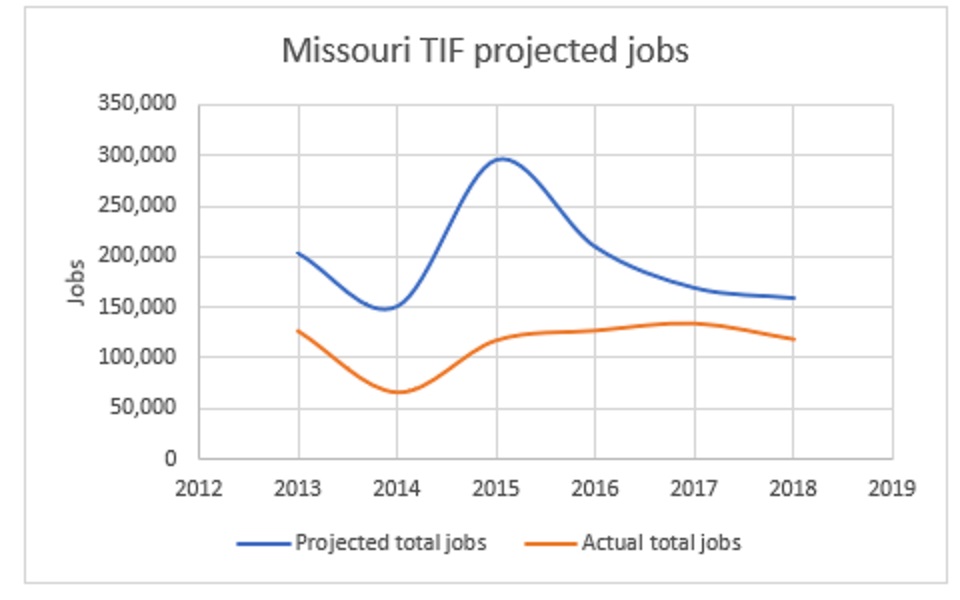
And what do the residents of U City get in return? The city promised the project would bring 150 to 250 “livable wage” jobs to residents, but the agreement does not guarantee any particular number of jobs nor does it require that the developer mandate that its tenants hire locally. The developer must merely request that tenants hire locally. And there is nothing that guarantees that the development won’t be abandoned after the 23-year life of the TIF, once the tax breaks are gone.

Nevertheless, TIF advocates almost always seem to prevail. As  Show-Me Institute researchers have pointed out countless times before, development subsidies primarily just boost revenue figures for favored businesses and pad sales tax revenue for cities. There is no conclusive evidence that TIFs do anything to increase jobs, and they deprive local taxing districts of millions of dollars in foregone property tax revenue.

The 3rd Ward of University City may well become the next case study on why TIFs are ineffective.


Student Loan Forgiveness Isn’t Education Policy

Yes, we have a student loan debt crisis. And it’s growing. In Missouri, 58 percent of 2017 college graduates had debt when they graduated, and the average amount owed among those with debt was $27,108. Fortunately, creative ideas for getting out of this mess abound. Many of them revolve around more flexible payment schedules, improving the financial literacy of young people, making sure that colleges and universities have some skin in the game, or just making college more affordable.

And while loan forgiveness would provide immediate relief to debt holders, it’s important to make the distinction between debt relief and actual education policy. Loan forgiveness would be a very costly policy that wouldn’t expand access to college. In fact, a recent analysis of the costs and benefits of several forms of “free college” found that only one didn’t create education benefits that exceeded the costs. And that was loan forgiveness. Why? Because in this case, those who qualify have already received their education. The benefit of that education is there whether their loans are forgiven or not. So the benefit stays the same, and the cost goes up.

If a student loan holder truly didn’t understand what they were signing up for, they should have a broad array of repayment options tied to their salary. If they were scammed by a loan processor or for-profit college that was selling snake oil, by all means they should have recourse. But a plan to take one point in time and forgive all debt for all holders, regardless of their occupation, income, or repayment status is being floated in order to make headlines by those who make a living spending other people’s money on other people.

We can do better.

Many Missourians Are Moving . . . To Missouri

If you live in a rural community in Missouri and it feels like your neighbors are moving away, you might be right—but they aren’t going as far as you might think. A recent report from the Jefferson City News Tribune notes that according to the Census Bureau, at least 52 Missouri counties and St. Louis City lost population from July 2017 to July 2018. That means almost half the counties in Missouri had negative population growth.

But while population loss in roughly half of Missouri’s counties sounds terrible, there’s more going on here.

A great deal has been written about the growth of big cities across the country, but news outlets are slowly picking up on a trend that shows small and middle-sized cities gaining steam with young people. Think cities like Waco, TX and Knoxville, TN as opposed to Austin, TX and Nashville, TN—cities that aren’t necessarily state population hubs but that play an important role in their regional economies.

In fact, it seems that young people’s attraction to big cities is often overstated. Research increasingly suggests they are equally drawn to the less-costly option of smaller cities and suburban areas. Census Bureau data show that suburban growth is outpacing large city growth, with large city growth tapering off.

How is this playing out in Missouri? While most rural counties and Saint Louis City saw population declines, many medium-sized cities—Springfield, Columbia, and Lee’s Summit to name a few—have seen population increases according to the Census Bureau. Since Missouri’s total population only grew by a small percent, most of this population change is attributed to intrastate migration.

So while it is true that rural populations are dipping, it’s at least in part because of regional population consolidation in cities not far from where residents formerly lived.

And when you think about it, this migration trend makes a lot of sense. Small and medium-sized cities provide many employment, entrepreneurial, and social opportunities that may not always be available in rural areas, and these cities are often more affordable and community centered than big cities. While this trend isn’t great for rural counties—that is, the political subdivisions themselves—it is good for the people moving toward better economic and social prospects. As farms in rural areas become more productive and require fewer laborers, having access to city resources and opportunities will be all the more important for these residents.

Unfortunately, Missouri has struggled with overall population growth in recent years. During that same July 2017 to July 2018 time period mentioned above, Missouri was 29th in the nation in population growth, with a paltry 0.3% increase. This rate is consistent with the low population growth rates that we’ve seen for years. So, while this trend of intrastate migration is positive, we can’t forget that Missouri still struggles to attract new residents.


Kansas City Star Editorial Gets It Right on Tax Subsidies

Developers in Kansas City are asking for yet another subsidy, this time with a price tag of $63 million. One of the loudest opponents of the deal is the editorial board of the Kansas City Star—and they are right in their call to reject this proposal.

The proposal, which is being considered by the Kansas City Council, seeks funding to help build an office tower and parking garage combination (requiring $27 million and $36 million in subsidies respectively). The building site is at the corner of 13th and Main, right in the heart of downtown. Supporters of the project argue that the subsidies would help provide needed office space.

As ludicrous as the idea of government subsidizing private development in a popular area already is, it gets better—there are no tenants lined up to occupy the space. In other words, economic development officials want the government to spend $63 million on office space . . . just in case.

Jon Stephens, CEO of Port KC (which is currently an active participant in this proposal), attempted to explain this reasoning: “The demand for ready-to-occupy space has been proven in other markets. The demand appears to be present here.”

The editorial board is asking the correct questions in response to Stephens’ comment. If the demand is there, why are taxpayer dollars needed? If the demand isn’t, why would you ask taxpayers and government to take on that risk?

If downtown Kansas City is attractive to a company, then the company should pay for building its own office space. Private developers should be building based on market forces, without being cushioned from risk by taxpayer subsidies.

The Star’s editorial board is right: “It’s time for downtown projects in Kansas City to stand on their own merits, not on public dollars subsidizing private development.”


Band-Aids Can’t Fix the LIHTC

On last week’s Politically Speaking podcast, State Treasurer Scott Fitzpatrick indicated the governor would stick to his pledge of not reviving the state’s low-income housing tax credit (LIHTC) program until it is reformed. This is welcome news, but now lawmakers need to decide what constitutes adequate reform.

As I’ve discussed before, there are many problems with Missouri’s LIHTC program. The LIHTC program doesn’t actually increase the amount of available affordable housing across the state, making it a bad investment for Missouri taxpayers. Last month, Fitzpatrick concurred and stated, “The long-term benefit of making some meaningful change to the program outweighs the short-term cost of there being a backlog of people wanting housing.”

During this past legislative session, both chambers separately passed measures intended to improve the program, though neither became law. Ideas for reform included allowing transferability of credits, improving the program’s transparency, and providing a cap on credits the state could authorize yearly. While each change would be an improvement, none of them address the program’s core issues.

Reviving a low-income housing program in which barely forty cents of each dollar actually goes toward building new housing for low-income individuals is simply not a good use of taxpayer dollars. Any effort to provide “meaningful change” to the program must address this glaring concern. For ideas on substantive reform, why don’t lawmakers begin by examining how other states have been able to do more for less?

Minor tweaks won’t make the LIHTC a good investment for Missouri. It is time for a major overhaul.


What’s Wrong with St. Louis Economic Development Incentives? Everything

Growing a business is difficult. Business owners who have successfully overcome all the usual obstacles have my respect. Policymakers can help entrepreneurs by making sure regulations are minimally intrusive, taxes are least disruptive, and the marketplace is open and fair.

Unfortunately, that isn’t usually what happens in practice when government tries to help business.

Consider a recent story in the St. Louis Business Journal about the owner of the Civil Life brewery and his effort to use taxpayer subsidies to expand. Everyone seems to be well meaning, but good intentions aren’t enough in designing good policy.

The business owner sought special tax treatment from the city in order to expand his business. The St. Louis Development Corporation (SLDC) agreed, and the businessman thought he had a deal. Before the 33-member St. Louis Board of Aldermen—and you thought presidential primaries were crowded—could approve the deal, one member introduced a resolution seeking a slightly better deal for the city. The owner objected to this new deal and scrapped the expansion plan.

The executive director of the SLDC told the Journal, “Generally, most of the aldermen are very comfortable with our analyses.” I cannot understand why this would be the case. The SLDC’s own examination of its economic development incentives concluded, “. . . it is clear that the City gains no net benefit from an extremely costly program with no real economic development impact.” The SLDC’s point is that they are necessary to help save the city from enacting bad programs. But if that’s the case, why is St. Louis rife with extremely costly programs with no real economic development impact?

In the Journal piece, Megan Green, the alderwoman who sought a better deal in this particular case, made an excellent point about the business in question:

If their business model is such that they cannot expand and pay a few thousand dollars more in taxes, the difference between a 95 percent and 90 percent abatement, after having a 100 percent abatement for the last eight years, then the business model needs to be re-evaluated.

Unfortunately, this statement didn’t go far enough. If the business needs any subsidy at all then the business model may need to be re-evaluated. After all, if a business is seeking a subsidy, the business owner in question has an idea that private investors do not think is a good one. If private investors won’t invest their own money, why should taxpayers invest theirs?

This whole episode speaks to the utter dysfunction of economic development policy in St. Louis. If the alderwoman can be faulted for anything, it isn’t standing in the way of this deal; it’s for not standing in the way of every deal. Her reasoning is correct; it just needs to be more widely applied.


Support Us

The work of the Show-Me Institute would not be possible without the generous support of people who are inspired by the vision of liberty and free enterprise. We hope you will join our efforts and become a Show-Me Institute sponsor.

Donate
Man on Horse Charging