Mission (not) Accomplished

I knew it might be too good to be true. During the 2018 legislative session, lawmakers passed and the governor signed a bill that allows all public school students to take courses online with their home district covering the tuition. Students don’t need to justify why they want to take a course online, but the school could deny them if they think it’s not in the student’s “best interest.”

This means that students in rural schools without a wide course selection could take any AP course. Students with irregular schedules—possibly because they’re intensely committed to a sport—could take some classes in a building and some online. Bullied students could choose to take their entire courseload online. Parents who want to homeschool, but aren’t comfortable doing it themselves, would get assistance. In other words, it means giving parents options that they want and need.

But the devil, in this case, is in the implementation. I’d heard rumors that districts weren’t complying with the law’s requirement that they make the availability of this option clear on their websites. I’d heard that Missouri’s Department of Elementary and Secondary Education (DESE) was interpreting the law’s requirement that the program launch in fall 2018 as a requirement to begin looking into curriculum providers in 2018.

But now, what concerned me most has happened. A parent has had to sue their child’s district to get access to the program. The parents wanted to choose an existing virtual program, known as MOVA, provided by the Grandview R-2 district. Their home district, Fulton, denied the request because they don’t use curricula from other districts. They haven’t even gone through the process of determining if it’s in the child’s best interest, as required by the law. They just gave them a flat “no.”

Survey after survey tells us that parents, especially young parents, want more choice regarding their children’s education. The powers that be may be able to deny them for a little while, as is happening in the Fulton Public School District. But parents can be a powerful force, and that approach won’t work forever.

CID, TDD Collections Jump by More than $13 Million

Missourians pay far more taxes than they think they do.

Because of special taxing districts like community improvement districts (CID) and transportation development districts (TDD), many shoppers pay up to an extra two percent in sales taxes.

Over the past few years, my colleagues and I have written extensively about CIDs, TDDs, and other special districts. In short, most special districts are created by developers to funnel additional sales tax revenues into developments. Most shoppers don’t know about the taxes because they never voted on them and because many businesses in CIDs and TDDs don’t post statutorily required notices.

In a recent paper, Patrick Tuohey and I detailed the growth of these districts and their tax collections. But more recent data on last year’s collections provide even more evidence that CIDs and TDDs have gotten out of control.

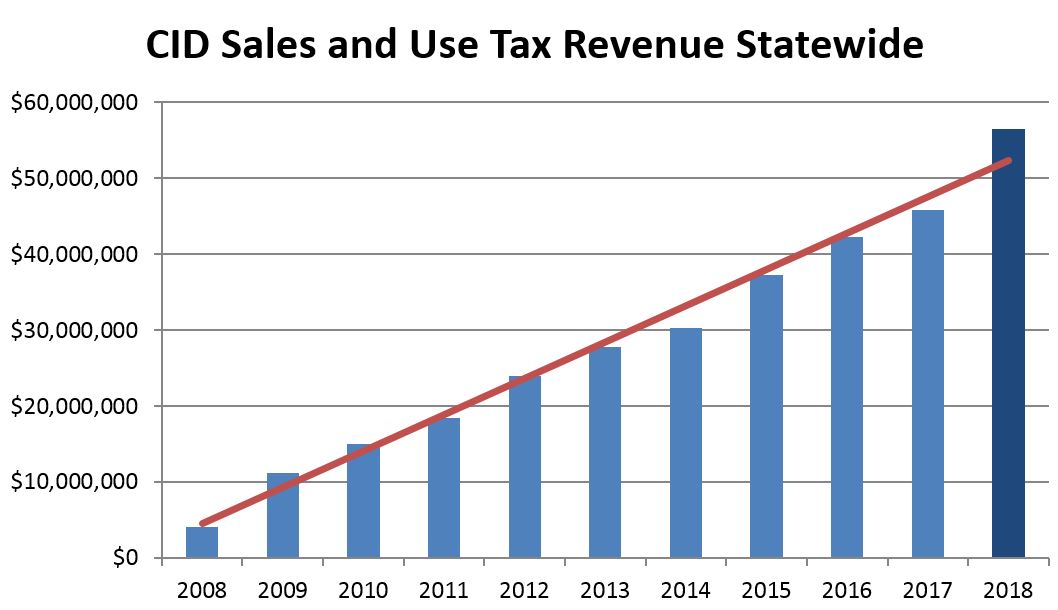
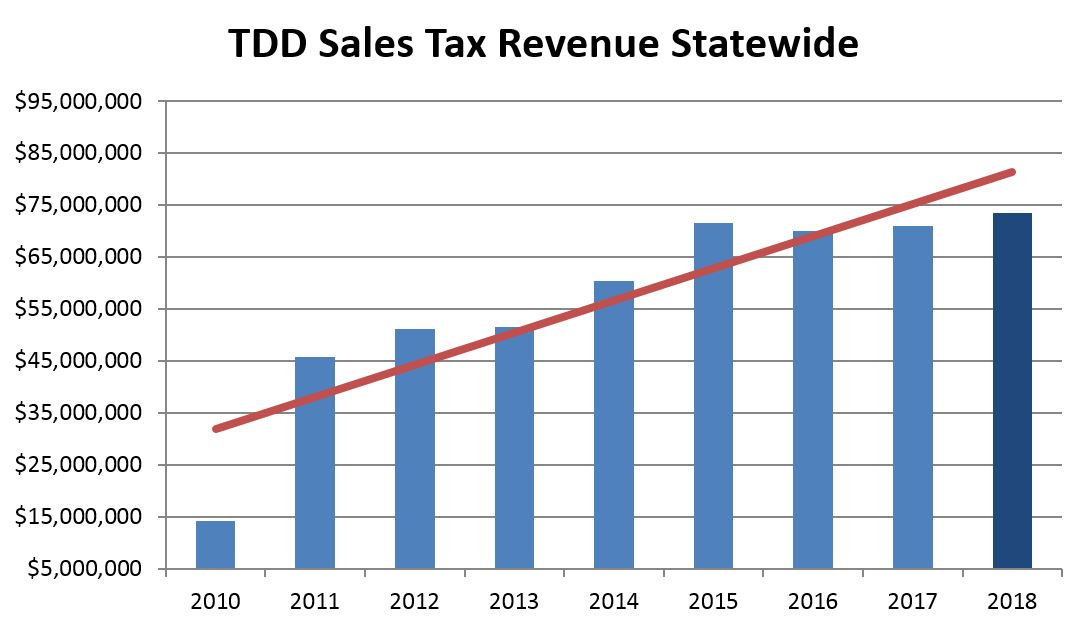
The graphs below depict revenues for CIDs and TDDs. From 2017 to 2018. Statewide CID revenues jumped nearly $10.7 million, the single highest year-to-year increase in Missouri’s CID history. Over the same period, TDD revenues jumped a more modest $2.5 million, but are nonetheless at their highest levels to date, at $73.5 million.

CID sales tax collections


TDD sales tax collections

In our paper, Patrick and I detail reforms to help curb CID and TDD abuse. I would encourage readers to learn more about them here. Policymakers should recognize the sizable burden these districts place on taxpayers and enact reform sooner rather than later.

How Strange: Private Money for Public Good

When our blog posts are plastered with discussions of public money for private gain, recent news regarding the Rock Island Trail brings some welcome relief.

Senate Bill 196 creates a fund to allow private donors to help defray the costs of building a 144-mile long hiking and biking trail, which runs east–west south of the Katy Trail. The bill was needed because, while the trail is a priority for policymakers, current state funding isn’t enough to acquire and construct the trail.

This is good news for Missourians and, in particular, outdoor-recreation enthusiasts. It’s also good news for liberty-minded folks who favor funding infrastructure and other public goods privately (and voluntarily). Should negotiations between the current landowner (a railroad) and the state go well, and should enough money be raised, Missouri could have one of the longer continuous trails around.   

While this isn’t the first privately-funded trail project in the state (there are some very nice private biking trails and parks, especially this one in Springfield), it is exciting to see the infrastructure in place to make such a large-scale project happen. Congratulations to policymakers for doing what makes entirely too much sense: creating the opportunity for enthusiasts to give to projects they’re passionate about.

When You Buy Your Coffee, Remember “I, Pencil”

Leonard E. Read’s “I, Pencil” is often first-day reading for introductory economics courses, and rightfully so. This spirited tale narrated by a pencil highlights two important truths. Since I’m a millennial, I’m going to apply these truths to everyone’s beloved and necessary morning cup of coffee

The first truth is that it’s impossible to list all the supplies that go into the creation of any item. Sure, your morning coffee is coffee beans and water, but don’t forget about the bag for the beans, the coffee filter and maker, the cup, the delivery truck it all came on, and the barista. Each of these items has individual components as well. The coffee cup includes paper and plastic, and it comes from a factory, which needs metal for machines, electricity, and workers who need safety training and gloves—this can go on forever. The supplies that went into your morning joe are so complex and widespread that they are innumerable.

The second truth from “I, Pencil” is that no one is directing the infinitely complex process of getting that cup of coffee in your hand. No one person decides how much electricity to give to the plastic factory, which paper should become coffee cups, where the cups should be delivered, or who should buy the coffee today. No one person controls the supplies for your coffee, and yet there it is every morning at your local coffee shop.

Here’s the ultimate insight: your coffee is ready every morning because of people working in the free market. Millions of people have the freedom to make their own decisions using their individual knowledge. These decisions linked the supplies together that brought you your coffee. If it were up to one mind, or even the government, to link these innumerable pieces together, it would take an impossible amount of time and resources. Worse yet, your coffee would be much more expensive, and it might not be there every morning!

So when you buy your next cup of coffee, think of “I, Pencil” and remember that markets work.

What Is Educational Pluralism?

Ashley Berner has spent a lot of time examining educational systems around the world, and she concludes that the American system is unique. Berner, the deputy director of the Johns Hopkins Institute for Education Policy, is the author of the 2017 book, “Pluralism and American Public Education: No One Way to School.” She recently authored a white paper on the topic for the Manhattan Institute, which opens with this: “A majority of the world’s democracies support school systems in which the state funds and regulates, but does not necessarily operate a mosaic of schools.”

Berner goes on to offer examples from the United Kingdom, Belgium, the Netherlands, Canada, and many other countries that support a broad variety of schools. In a pluralistic system, students or their parents are allowed to choose the type of school that their child will attend. The school may be religious, it may have a specific pedagogical practice, or may have various other defining features, but it will still receive public funds.

Berner suggests that the key to a pluralistic education system is that there must be some form of accountability for all schools, even private ones.

While I may not completely agree with Berner on the extent to which the government should regulate private schools, her paper offers an excellent overview of what educational pluralism is, the perceived obstacles to pluralism in the United States, and an overview of compelling educational research.

To learn more, give her paper a read or check out her recent op-ed on the matter here.

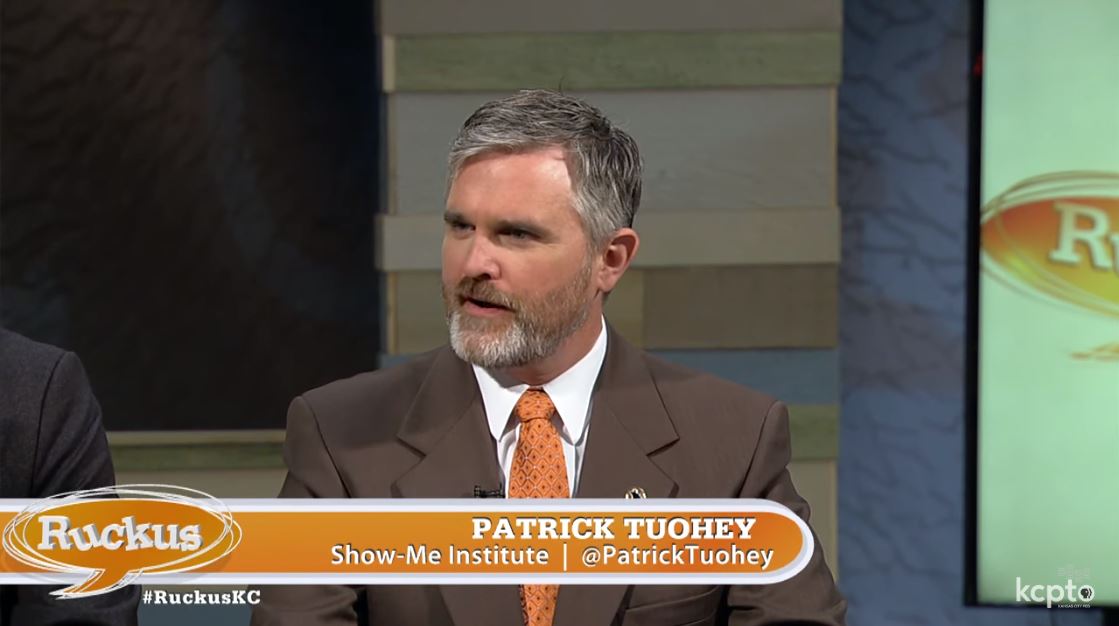
Patrick Tuohey on KCPT’s Ruckus

On Thursday, July 18, Show-Me Institute Director of Municipal Policy Patrick Tuohey appeared on KCPT’s Ruckus to discuss taxpayer subsidies for a failing baseball team in Wyandotte County, Kansas, the tenure of outgoing Kansas City Mayor Sly James, and more taxpayer subsidies for a Sun Fresh grocery store that cannot seem to pay its bills despite millions in previous and ongoing subsidies. Click above to see the entire episode.


Better Is a Relative Term

Rumor has it that later this month Major League Soccer (MLS) will announce the next cities to be blessed with professional soccer teams. St. Louis appears to be at the top of the list, and that’s great.

Proponents claim the current stadium deal, negotiated between the prospective team’s owners and city officials, is far superior to the previous proposal to lure the MLS to St. Louis. While this is true, the deal is still not all that great.

Before explaining why, let me reiterate that the current deal to bring the MLS to St. Louis is better than the 2017 effort. That effort (led by a different ownership group), which lost at the polls by a narrow margin, pushed intelligence-insulting stadium benefits, would have cost taxpayers more than $100 million, and seemed generally dishonest. Along with the St. Louis Post-Dispatch’s Dave Nicklaus, I’m glad voters rejected that effort. Moreover, I’m glad the current effort has engaged in relatively little economic pandering (save this (p. 1), and this).  

So what of the new ownership group’s current proposal?

The current plan, approved by the Board of Aldermen late last year, includes the following public incentives:

·         Free use of the land the stadium will be built on (the land will be purchased by the city from the Missouri Highway and Transportation Committee).

·         A complete abatement of property taxes on the stadium and the land it sits on (since the property will be owned by the city).

·         A 3 percent sales tax, generated by three distinct and overlapping special taxing districts, which will be levied on stadium-goers and may go toward stadium funding.

·         A reduction in the city’s 5 percent amusement tax for soccer ticket sales, bringing it to 2.5 percent, and the squirreling away of that 2.5 percent for future stadium improvements.

·         A complete sales tax exemption on materials used to construct the stadium.

Overall, the above incentives are valued at just shy of $40 million.

So what makes this plan better than the previous one?

First, the amount of incentives is significantly lower; the total incentives offered in the previous proposal totaled more than $120 million. Second, some of the incentives in the current proposal act like user fees, impacting only those who visit the stadium. The previous proposal would have relied on use taxes levied on city businesses, and ultimately would have been passed on to ordinary consumers, whether they visited the stadium or not. That also means we don’t need to further exhaust St. Louis’s sales tax capacity to make the deal work. (That funds are being saved for future improvements is also a plus, but how those funds may be spent will need to be hammered out in a lease agreement, which is yet to be finalized.)

Even so, I wouldn’t call this deal a good one for taxpayers.

First, there still is that $40 million. While that’s less than what city officials across the country usually cough up for a major league sports stadium, it is still $40 million. Second, since the city will purchase the land from the Missouri Highway and Transportation Committee, city taxpayers will likely bear that cost. And even though the land is currently publicly-owned, if it were sold to a private entity that would be tax liable, it could generate property taxes for local jurisdictions. Third, the city will lose out on millions from the sales tax exemption on construction materials. While the city is projected to come out on top in terms of overall sales tax revenue under the current proposal, it is no serious shot in the budget division’s arm. It’s also unclear (I have requested the analysis from the city but have yet to receive it) whether those “new revenues” will be genuinely new revenues or just diverted from other spending in the city.  

Now, none of this is to say that the current deal isn’t worth it, or is a bad deal all things considered. St. Louis may very well be better off with an MLS team than with $40 million. But that doesn’t change the economic reality of the situation: government is giving very special treatment to a select, wealthy few. Even if the (30-year!) sales tax revenue projections are right, and the city makes some money on the deal, there are often more pressing needs or better investments the city could throw its limited resources at. But the decision has been made, and, not surprisingly, taxpayers are now at the behest of a major league sports entity.

(And a word for Bernie Miklasz: I live in St. Louis, and so, am very welcome to criticize St. Louis policies.)


It’s Time for Missouri to Embrace Innovation in Education

Missouri is one of 13 states without any statewide programs to promote Next Generation Learning (a term coined by the advocacy group ExcelinEd to describe a set of innovative education models that can be tailored to each state’s unique circumstances). Most other states give schools more flexibility to explore methods like mastery-based education (see below), among others. Missouri, however, continues with its one-size-fits-all approach, apparently uninterested in experimenting with better ways to educate students. Meanwhile, student performance in our state continues to fall behind. And what, exactly, are other states trying?

  • In Nebraska, Scottsbluff High School received an innovation grant from the state department of education to establish career academies within the school. The academies began operation in 2016, and students have the opportunity to graduate with college credit, job offers, and even associate’s degrees in six different career fields.
  • In Florida, the Principal Autonomy Program Initiative began in 2016 in order to encourage principals to embrace innovation by relaxing certain regulations in return for improved student achievement. What started out as a pilot program was made permanent in 2018.
  • Four states—Illinois, Michigan, Nevada, and Utah—created programs to promote competency-based education, including grants to help schools transition to the competency-based instruction model. Instead of students taking classes at same speed as their peers and either passing or failing a course, competency-based learning requires students to master certain skills but allows them to do so at their own pace. They advance as their skill set grows, not because the semester or school year is over.

Of course, states need to evaluate these new programs to ensure they are working and are a worthwhile use of tax dollars. Before launching any program, school administrators should establish specific metrics and goals by which the program will be assessed. For instance, career academies should be tracking graduation rates, training-related job placement, and the number of students earning industry-recognized credentials. If programs are not meeting expectations or are too costly, then they should be phased out so resources can be directed to programs that are delivering.

Whether it is grants for new programs, waivers for certain regulations, or embracing models like charter schooling, why doesn’t Missouri’s state education policy welcome local innovation and reward high performance? Sitting on the sidelines while educators in other states experiment with new ways of teaching the next generation of students isn’t working.

Public Education Is More Important Than Tourism

Having worked in education reform for more than twenty years, I’ve often found myself in a familiar debate about public education: Is it a private good—for the benefit of the child being educated—or a public good—for the benefit of society? Of course, it’s both. But what it isn’t, or shouldn’t be, is a pawn to prop up the tourism industry in a state.

Missouri has made the decision to mandate the earliest dates that schools can open each year, even as other states are moving away from similar policies. The reason? So that families have an extra week or two to vacation in the state’s tourist areas. I’ll be very curious to see how many families change their plans because of this law.

Where is the outrage from parents with full-time jobs who have to make summer arrangements for their children for a longer stretch of time? Where is the outrage from school boards that clamor for local control? Where is the outrage from principals who know full well about the impact of the summer slide?

The Missouri legislature had the opportunity to improve education in the state by encouraging innovative ideas and options for parents. Instead they chose to manipulate the public school system in the hope that it will benefit the Lake of the Ozarks and Branson. The next time a lawmaker claims that public education is their priority, pay attention to their actions, not their words.


Support Us

The work of the Show-Me Institute would not be possible without the generous support of people who are inspired by the vision of liberty and free enterprise. We hope you will join our efforts and become a Show-Me Institute sponsor.

Donate
Man on Horse Charging