
St. Louis’s Ridiculously High Sales Taxes

It is often claimed that Missouri is a low-tax state (which it is not), but it is painfully clear that some of Missouri’s cities are certainly not “low-tax” cities.

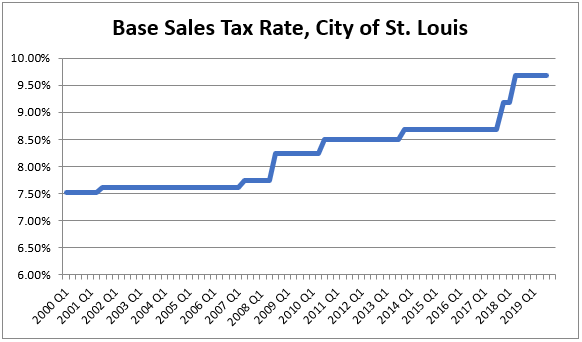
The sales tax rate in St. Louis is now one of the highest in the nation, only behind places like Chicago and Seattle. Currently, the base sales tax rate in the City of St. Louis sits at 9.679%. So, when you shop, you’re paying nearly 10% extra in taxes, and when you shop in one of the many areas with overlapping special taxing districts, you’re paying close to 12%. The rate is high relative to other cities, and it is high absolutely—it is pretty darn expensive to spend your own money in the Arch City.

The chart below depicts the base sales tax rate in St. Louis over the past 20 years. Slowly and steadily (and sometimes in quick bursts), it has been on the rise.
Sales tax graph

Source: Missouri Department of Revenue, Sales/Use Tax Rate Tables

Recent increases are due to special sales taxes for additional public safety funding and expanded economic development initiatives (like the north–south MetroLink expansion, which is unlikely to spur any development).

As I’ve written before, with each increase in the sales tax rate, policymakers will have fewer and fewer chances to go to taxpayers for projects that truly need funding. St. Louis may soon reach a point where the public is simply unwilling to cough up more of its money, however pressing the public need. Some residents and businesses may just call it quits and move elsewhere.

Moreover, we should all ask ourselves whether we’re getting the government we’re paying for. When the city has basic infrastructure woes (you should see the road I drive on every day for work), has trouble keeping refuse trucks running, and seems most occupied with giving away subsidies, it is hard to believe St. Louis government is worth nearly 10 cents on the dollar (in addition to the numerous other taxes it levies). 

Policymakers, like the rest of us, could always use extra cash. But there is a point at which we must make do with what we have. St. Louis officials should begin tightening their belts instead of asking for more, just like the average taxpayer must.

Kansas City Controls Its Police Department

For eight years Kansas City was served by a mayor who didn’t seem to understand his role in overseeing the Kansas City Police Department. But as has been argued in this space previously, the mayor not only serves on the Board of Police Commissioners, he controls the police department’s budget. In fact, the Kansas City mayor wields veto power over the police budget—perhaps the greatest power any political leader could have over a department.

City leaders’ influence over policing was confirmed when I spoke to a number of former members of the police board last year. And it was confirmed again when Kansas City Police Chief Rick Smith was interviewed this week by KCMO Radio’s Pete Mundo. Smith said (starts at 3:44):

We’re still funded by the city. So we still talk with the city manager and go through the budget process just as every other department head in the city does. We go through this process and talk about, “hey, where can we make gains, where can we not?” The last two years we’ve had additional officers, it’s been a handful.  Sometimes it’s 25; I think last year a dozen. We’re getting some, it’s just slow.

There are plenty of discussions to be had about what ought to be done to help the Kansas City police better respond to rising crime rates, and not all of it can be done through policing. But we know that policing matters and specifically that increasing the number of police reduces homicides. The fact that the number of police in Kansas City has fallen during a years-long spike in homicides is unconscionable. Whatever policies are adopted to combat this increase, it is good to know that those charged with making the decisions understand how policy is made.


Here Is Where LIHTCs Go

Since its introduction in 1996, Missouri’s Low-Income Housing Tax Credit (LIHTC) has been the state’s primary tool for incentivizing the development of affordable housing. It has also been Missouri’s costliest tax credit program, and one of its most inefficient. For a program that has cost the state billions, Missouri taxpayers deserve to know how the money is being spent.

That’s why I reached out to the state agency in charge of allocating the tax credits, the Missouri Housing Development Commission (MHDC). The MHDC charged $122.76 for a list of projects and costs from the last 19 years of LIHTC allocation. (I also requested similar data from the 14 other states that have a state LIHTC program; they all provided the information free of charge.)

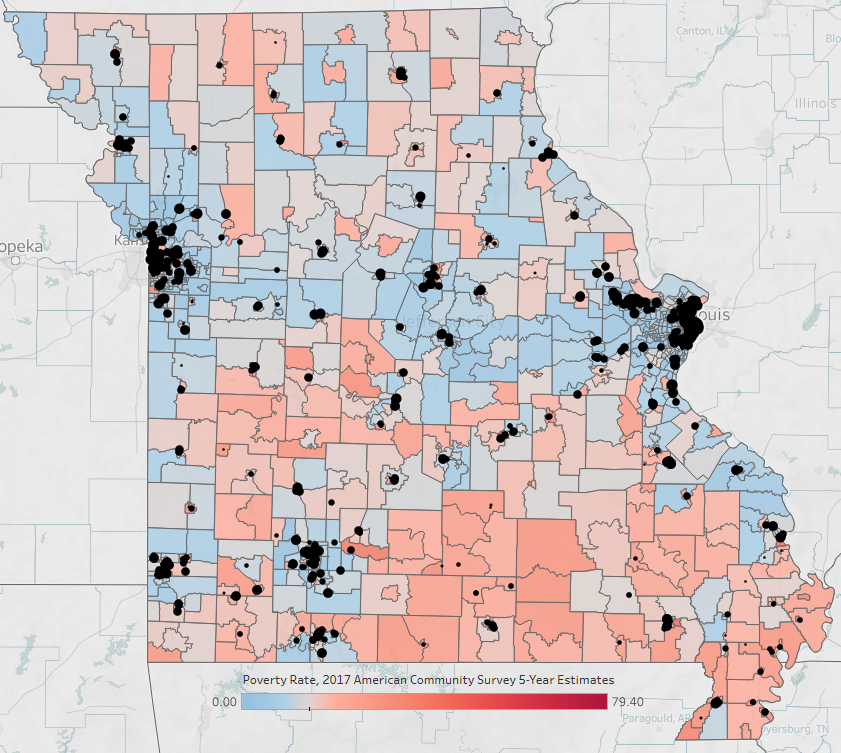
Missourians now can find where these LIHTC projects are located and how much they receive in subsidies from state and federal governments. The link below has a map displaying data on LIHTC projects since 2000:

LIHTC Interactive Map

The census tracts are colored by poverty rate, with the red and blue diverging at the statewide poverty rate of 14.6 %. The black dots represent every LIHTC project awarded since 2000. When hovering over a dot, the project’s name, address, city, county, owner, year awarded, and federal and state annual LIHTC allocation are shown.

Having this data is a good first step in analyzing and ultimately proposing solutions to the complex, problematic system that is Missouri LITHC.


The Entirely Predictable Failure of Sports Teams Subsidies

The River City Rascals are taking their ball and going home. This was not entirely surprising as the team was operating under a one-year lease extension with the city of O’Fallon.  According to the St. Louis Business Journal:

The one-year extension came together after O’Fallon in October 2018 terminated the Rascals’ lease at CarShield Field and barred the team from the facility, saying at the time that the team’s ownership was “repeatedly behind on rent.” O’Fallon later let the Rascals back into the facility as it worked through negotiations with the team for new lease. O’Fallon said Monday that the Rascals still owe the city a balance of $36,600 on a debt of $60,000 from several years ago, and plans to discuss the debt with the team as it winds down operations.

Let’s not mince words: The city of O’Fallon was spending taxpayer money on a private enterprise exactly because the people of O’Fallon and the surrounding areas decided not to spend their own money on it. How was this ever a good idea? This comes on the heels of a similar situation in Wyandotte County, Kansas that we discussed and wrote about previously: A city spending limited taxpayer resources on a faltering private enterprise that only postposed the inevitable.

Incredibly, the larger cities on both sides of Missouri are contemplating even bigger versions of the same mistake, either by building a baseball stadium in downtown Kansas City or a Major League Soccer stadium in downtown St. Louis. The owners may be different, but the policy remains the same: City leaders using taxpayer dollars to shift the risk (but not the reward) from private investors to public taxpayers.


Bring the Free Market to College Athletics

Popular video game developer EA Sports has recently hinted at a return of its cult-classic game, NCAA Football. The game was discontinued in 2014 after a lawsuit settlement required EA Sports to begin paying student-athletes for the use of their likeness, a course of action made impermissible by NCAA amateurism bylaws. Nevertheless, speculation about the game’s possible revival is surfacing following a May announcement that the NCAA would be reviewing its policy on student-athletes’ ability to benefit from their own image. The impact of this issue exceeds the realm of virtual entertainment, and there is much the state of Missouri can do to promote free-market solutions to the financial woes of college athletes.

Missouri should be as cognizant of the benefits student-athletes provide public universities as any other state. The University of Missouri athletic department brought in $107.3 million worth of revenue in 2018, and its men’s basketball ticket revenue rose nearly 70 percent after signing highly-touted recruit Michael Porter Jr. in 2017. Although student-athletes do receive a sort of payment in free tuition and room and board, this compensation often pales in comparison to the massive sums of money the players generate. Shouldn’t Missouri allow student-athletes greater opportunities to profit from their position in the market?

Other states are already addressing the question of student-athlete compensation. Both Colorado and California have proposed bills in the past few months granting student-athletes the ability to sign endorsement deals, superseding the authority of the NCAA. Federal legislators have even gotten in on the action, as several members of the House of Representatives have introduced a bill that would alter the tax code definition of an amateur to allow college athletes to profit from public appearances.

Legislation like this provides benefits for all involved parties. It allows student-athletes whose performance merits it to earn money without imposing costs on universities. Since schools no longer use third-party endorsement deals or individualized merchandise, students profiting from such deals wouldn’t interfere with university revenue. Moreover, providing these opportunities to student-athletes may give Missouri schools an edge in recruiting battles. In short, these policies introduce the free market to college athletics, and if Missouri acts it could be a win for the state.

Why “Developer” Is and Is Not a Dirty Word

In a recent piece at the New York Times, a writer laments:

Real estate developers are indeed fraught characters in city life. . . . And the history of American development certainly includes shady land speculation schemes, racist intentions and bloated egos. . . . But at its best, development has also meant progress in America. And that possibility has been banished from recent debate.

The worry is that “developer” has become a dirty word, and that our mostly negative perception of developers and development is off-base. While urban politics demonizes developers, we ought to be grateful there are people who work to develop and build our cities, the thinking goes.

This assessment is both right and wrong.

It’s right inasmuch as developers shouldn’t be demonized for providing what consumers demand through market forces. People need housing and space for their businesses, and developers provide just that. Just as we shouldn’t lambast farmers and grocers for “profiting off” our hunger, we shouldn’t bemoan developers for profiting off of our need for homes and office towers. (Indeed, we all profit off of someone else’s needs through the exchange of goods and services for money.) As Adam Smith remarked in his Wealth of Nations, it is incredible that, without any sort of orchestration, the market is full of goods and services we need and want. What Smith said about butchers, bakers, and brewers is equally true of developers.

But the Times article also misses the mark in some ways. While there is nothing wrong with providing housing by chasing profits, there is something wrong with advocating that the public subsidize projects for private gain. Developers don’t invest just their own money; they often invest taxpayer money as well. Through subsidy programs like tax-increment financing, abatements, and special taxing districts, developers reduce their private risk. And since policymakers are often generous with these subsidies, for some developers it pays—and pays very well—to chase down subsidies and ensure they continue to flow for years to come.

The economist William Baumol, in his famous paper “Entrepreneurship: Productive, Unproductive, and Destructive,” argues that market agents are after profit, and they will try to get it through productive means or unproductive means. He thought that when governments have the power to pick winners and losers in the economy, entrepreneurs will chase government favor instead of working to meet consumer demand competitively. Many developers, like many market agents, have become infatuated with government handouts, and that is deserving of criticism.    


The Myth of Supposed Market Failures

Markets are said to be failing when supply doesn’t respond to demand—like a beachside shop refusing to sell sunscreen. When it comes to public policy, the markets are more complex and the process of diagnosing a failure is often difficult. If policymakers determine that a market is failing, their question then becomes what, if anything, the government should be doing about it. The problem is that poorly targeted government intervention can be more harmful than if nothing had been done at all.

If a market is truly failing, there can be economic justification for government policies in response. Though in practice, government intervention rarely hits the mark. For example, Missouri’s state and local governments would have you believe the housing market is failing. Their argument is that the market is failing to provide a sufficient supply of affordable housing. In 1996, the state’s elected officials decided that they should intervene. But is Missouri’s housing market any better for the state’s low-income residents today than it was 23 years ago?

More than two decades have passed since Missouri implemented the state’s version of the federal low-income housing tax credit (LIHTC). In that time, billions of dollars have been devoted to building new housing with 30-year rent protections, yet the program’s wait list is supposedly longer than ever. If that is really the case, it’s time to question why policymakers would consider continuing a government intervention that is failing to solve the problem it was intended to address.

LIHTC is predicated on the idea that subsidizing the development of housing will increase access to more affordable places to live across the state. But this is only true if there is currently not enough housing because it’s too expensive to build, and if subsidizing new developments will spur further housing investment by private entities. Without both of those conditions being met, the program can’t be effective—which matches the academic research on the subject and more importantly, Missouri’s past experience.

If the market is failing and there is an insufficient supply, policymakers should look into what may be causing the inefficiency. Restrictive regulations and zoning laws add to project costs, which discourage investment in neighborhoods where an increase in housing supply may be needed. Or if there is already enough housing but it is simply unaffordable, demand-side fixes such as housing vouchers or other measures that effectively lower the cost of already existing housing may be more appropriate.

It’s extremely unlikely that the issues plaguing the housing market in St. Louis are identical to those being faced in Pilot Grove. Policymakers shouldn’t expect broad-stroke statewide policy actions to be equally successful in both Missouri’s metropolitan and rural areas.

The fact of the matter is that very little has been done to establish whether Missouri’s supply of housing is actually lacking or why that may be the case. Without that information, it’s nearly impossible for policymakers to successfully intervene. Two things they do know are that many of their constituents would appreciate greater access to less expensive housing, and that developers have told them that issuing tax credits is the only way to make that construction worthwhile.

For some reason, policymakers continue to act as though the LIHTC program is their only tool for “fixing” housing in Missouri, when that couldn’t be further from the truth. Instead of doubling down on an already-failed policy, why don’t Missouri’s elected officials take a closer look at the underlying causes of the supposed market failure to find a new path forward for Missouri; or better yet, step back and let the market take care of itself.


Support Us

The work of the Show-Me Institute would not be possible without the generous support of people who are inspired by the vision of liberty and free enterprise. We hope you will join our efforts and become a Show-Me Institute sponsor.

Donate
Man on Horse Charging