Is Turo a “Motor Vehicle Leasing Company”?

We’re still a few months from the legislative session, but it’s becoming clear that one hot topic in 2020 will be whether the Missouri legislature will clarify the state’s rental car statutes to affirmatively include—or exclude—car-sharing companies like Turo.

For those unfamiliar with the company, Turo connects car owners to car renters. For example, if I own a car and want to make some extra money when I’m not using it, I could list my car on the Turo platform and get paid to let someone else drive it around.

If Turo’s model makes it sound like a rental car company, well, there’s an argument to be made for that. And if you think Turo’s model sounds a lot like the Uber or Lyft business model—where independent contractors essentially rent their services and vehicles like a taxi—then you wouldn’t be wrong there, either (minus the driver, of course.)

The problem is that under Missouri law, the taxes and regulations that cover “motor vehicle leasing companies” appear to exclude Turo from oversight. One of the touchstones of having a car leasing company in Missouri is the nature of the vehicle itself, and the state’s leasing law covers vehicles “which are to be used exclusively for rental or lease purposes.”

The cars rented through Turo typically are not used exclusively as rentals, and if it weren’t for a company like Turo, many of these vehicles would be exclusively personal vehicles. So the state’s rental car tax provisions do not neatly apply to Turo’s business model.

That isn’t to say that Turo is exempt from all fees dealing with rental cars in Missouri. For example, Kansas City’s rental car ordinance captures Turo’s business model in its definition of a “rental car agency”:

Rental car agency means an individual person or business entity as described in section 40-61 that provides the service of renting, leasing or letting passenger vehicles for compensation, whether the provision of such service is the primary, secondary, or incidental business of such person or entity.

Turo is a business entity that provides the service of renting passenger vehicles for compensation, and under Kansas City’s definition, the vehicle doesn’t have to be used exclusively or primarily as a rental vehicle; incidental rentals are enough to subject the business to the city’s  fee of $4 per day for rental cars.

There are important policy questions in play here. High among them is whether car rental (and hotel, and other tourism-type) taxes should exist in the first place. While politically attractive because visitors tend to pay such taxes rather than residents, I and other researchers at the Show-Me Institute have expressed policy reservations about such regimes many times before.

The most likely question to be debated in the legislature, however, isn’t whether such taxes should exist, but whether state rental car taxes and regulation should apply to these particular companies. Existing state law does not appear to contemplate these types of arrangements. The language of municipal statutes like Kansas City’s may offer legislators a blueprint for updating state laws that were drafted well before the advent of car share companies like Turo. Truthfully, if the state intends to impose taxes and regulations on rental car companies, it seems like Turo would fall under a common definition for such enterprises, even if it isn’t captured currently.

But—If such a tax is applied to Turo vehicles, legislators should simultaneously commit to reducing the associated taxes on all rental car companies against any added revenue expected from Turo rentals—that is, as they broaden the base for the tax, they also should lower the rate of the tax imposed for all involved. (This is much like my position on internet sales taxes in the state.) To be clear, I question whether rental car taxes should exist, but if they are going to exist, they should be applied equally and in a revenue-neutral fashion.


 

Is Missouri Discouraging Business Investment?

The Tax Foundation just released a publication urging states to continue reforming taxes on tangible personal property (TPP). This is advice Missouri should take.

Tangible personal property taxes fall under the large umbrella of property taxes. TPP is property that can be moved or touched, like business equipment and furniture. This is separate from real property (land and structures) and intangible property (stocks, bonds, intellectual property). 

The Tax Foundation study reported personal property as a percentage of the state property tax base for all 50 states. This number tells us how much states are relying on personal property as part of their property tax base. Nationally, personal property made up 9.98% of the average state property tax base in 2017. Missouri’s number is nearly double that; personal property made up 18.79% of Missouri’s property tax base in 2017.

Okay, Missouri is relying heavily on TPP taxes. So what?

Well, TPP taxes are inefficient and distort decision-making. With respect to businesses, taxes on machinery, inventory, and other capital discourages them from expanding and investing. Businesses can avoid the TPP tax by moving to lower tax areas and changing their capital investment decisions. They also pass along the tax costs to consumers by raising prices. All of this alters the business environment and reduces business investment. Distortions occur on the consumer side of the market as well when TPP, like cars, are taxed—as they are in Missouri. We see a lot less of these distortions with real property taxes because they are much more difficult to avoid (you can’t move your land to a lower tax area) and the costs generally cannot be dispersed to third parties.

In general, property taxes are more efficient than other taxes, but tangible personal property taxes are less efficient than real property taxes. Missouri’s heavy reliance on such an inefficient form of property tax is a red flag. If we want to create a tax environment that encourages business investment, maybe we need to rethink our property tax base.


But How Will They Get to School?

A common point of resistance to school choice programs is figuring out how to make sure that each student has transportation to and from school. Meanwhile, plenty of districts, cities, and businesses are finding ways to adapt transportation methods so that students can attend their school of choice. Transportation may look different as more students choose their school, but it’s not a reason to restrict educational freedom.

An article in EducationNext discussed recent research on transportation methods in cities where many students exercise choice. The article describes how Denver, Detroit, New Orleans, New York, and Washington D.C. are finding ways to provide transportation to students who attend a school of choice. It also found that in most cases, students don’t have long commutes. 

In some cities, like New Orleans and New York, the district simply provides students with transportation, including students who choose their schools. Washington D.C. has school district-provided transportation or free access to public transportation for all students. Denver provides students who exercise choice with a free shuttle-bus service. And many individual charter schools will provide transportation, like in Detroit.

More places than those mentioned in the study are creating ways to help students with transportation. Low-income families in Minnesota can qualify for transportation cost reimbursements if their child enrolls in a charter school or open enrollment in the local district. Businesses are also stepping in, as parents and school districts have connected with rideshare programs, tailored specifically to get students to and from school.

And in Missouri, where charter schools are eligible for state transportation aid, these schools can work with the local district or use another contractor to arrange transportation.

Concern over transportation shouldn’t determine where students go to school. Transportation is a means to an end and shouldn’t prevent students from attending the school of their choice.


We’re on the Road to Nowhere . . .

The Missouri Department of Elementary and Secondary Education (DESE) released preliminary test scores for the 2018–19 school year. And for the first time in six years, DESE used the same test for two years in a row . . . and the results were just more of the same.

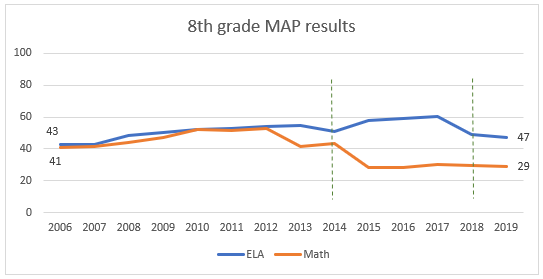
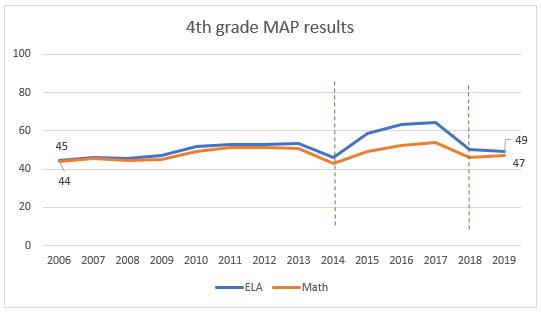
In math, the percentage of students who scored Proficient or Advanced was the same for both the 2017–18 and 2018–19 school years in 5th grade and 7th grade, a percentage point lower this year in 3rd grade and 8th grade, and a percentage point higher this year in 4th grade and 6th grade. The results in reading are similar, except that no grades between 3rd and 8th showed improvement.

But it’s really not helpful to just look at two years. Let’s go back further. Clearly, the years between the dashed lines in the figures below were periods of upheaval in Missouri testing—new standards and new tests—and DESE would tell you that they’re not comparable to anything before or after. Even if we take those years out, the fact remains that we have not been able to get more than half of our public school students to be Proficient or above in either subject. We’ve been stuck in the forties since the Cardinal’s first game in Busch Stadium.

So now money is being poured into developing new science and social studies assessments and creating the new Missouri School Improvement Plan (MSIP) 6 to replace MSIP 5. What are the chances that any of that will impact the nearly 500,000 students in the state who can’t seem to achieve proficiency in the core subjects? Moreover, if more than half of our students have been starting high school with below grade level skills in reading and math for nearly 15 years, should we be surprised when families and jobs move elsewhere?

8th grade MAP results

4th grade MAP results

Source: Missouri State Report Card, 2009, 2010, 2011, 2012, 2013, 2014, 2015, 2016, 2017, and 2018. Retrieved August 15, 2019 at https://apps.dese.mo.gov/MCDS/Reports/SSRS_Print.aspx and Missouri Board of Education August Board meeting agenda item


You Can Say That: A Lecture from David French

Event Details: 

Where do we draw the line on free speech? On its tenor? On its subject matter? Have we taken political correctness too far, making individual Americans feel less free to speak their minds amid online shame campaigns, economic boycotts, firings, and even physical threats?

Attorney and National Review senior writer David French explores the issue, raising the question of whether speech is really free if it can’t touch on weightier, sometimes uncomfortable matters. “Every American,” he says, “should be able to handle a challenge to his or her most foundational values. Healthy pluralism requires nothing less.”

RSVPhttps://www.kclibrary.org/node/27183/register

Guest Speaker:

David French, senior fellow at the National Review Institute*, attorney (concentrating his practice in constitutional law and the law of armed conflict), and a veteran of Operation Iraqi Freedom.

David French is the author or co-author of several books including, most recently, the No. 1 New York Times bestselling Rise of ISIS: A Threat We Can’t Ignore. He is a graduate of Harvard Law School, the past president of the Foundation for Individual Rights in Education (FIRE), and a former lecturer at Cornell Law School. He has served as a senior counsel for the American Center for Law and Justice and the Alliance Defending Freedom. David is a former major in the United States Army Reserve (IRR). In 2007, he deployed to Iraq, serving in Diyala Province as Squadron Judge Advocate for the 2nd Squadron, 3rd Armored Cavalry Regiment, where he was awarded the Bronze Star. He lives and works in Columbia, Tennessee, with his wife, Nancy (who is also a New York Times bestselling author), and three children.

Presented By:

Show-Me Institute

Kansas City Public Library

National Review Institute

*National Review Institute is a non-profit, 501(c)(3), journalistic think tank, established to advance the conservative principles William F. Buckley Jr. championed, and complement the mission of the National Review magazine by supporting and promoting NR’s best talent. For more info head to www.nrinstitute.org.


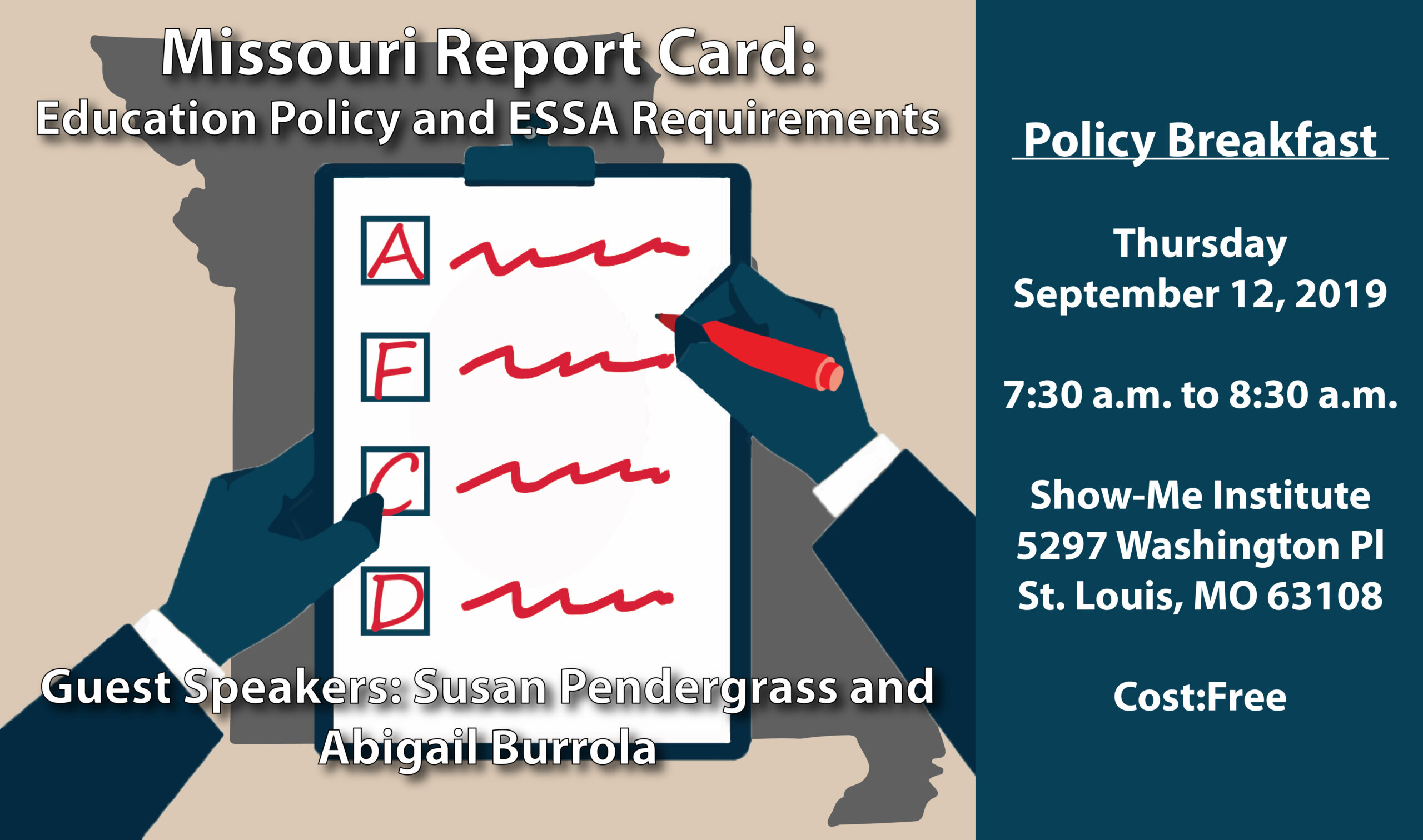
Missouri’s Report Card and ESSA Requirements

Event Details: 

Missouri has spent more than $6 billion in 2019 on public education.

Do we know what we are getting for our money? How well are our schools performing? Which schools are performing better than others?

Dr. Susan Pendergrass and Abigail Burrola have created a report card that evaluates and grades how well Missouri provides school performance information based on federal requirements in the Every Student Succeeds Act (ESSA).

Join us at this St. Louis Policy Breakfast where they will present their findings.

RSVP here.

Featured Speakers:

Susan Pendergrass, Director of Research and Education Policy

Before joining the Show-Me Institute, Susan Pendergrass was Vice President of Research and Evaluation for the National Alliance for Public Charter Schools, where she oversaw data collection and analysis and carried out a rigorous research program. Prior to coming to the National Alliance, she was a senior policy advisor at the U.S. Department of Education during the Bush administration and a senior research scientist at the National Center for Education Statistics during the Obama administration. Susan holds a doctorate in public policy from George Mason University with a concentration in social policy.

Abigail Burrola, Analyst

Abigail Burrola graduated from Azusa Pacific University with a bachelor’s degree in political science in 2018. She is originally from the Minneapolis area, and her policy interests include special education practices and rural school choice.

Kansas City Should Rely On Its Strengths

Everyone knows that Kansas City is one of the best places in America to find barbeque, but according to a recent report, it is also among the best in another category: cities best positioned for economic growth.

Business Facilities’ 2019 Metro Rankings Report scored Kansas City in the top ten on its list of major American cities with the highest potential for economic growth.

Kansas City landed on the list based on a few different factors, including the city’s quality of life and cost of living. Researchers at the Show-Me Institute have often urged Kansas City to play to exactly these strengths. Back in 2016, urban policy expert Wendell Cox published a paper walking through the advantages the region offers:

The fundamental question is, “What competitive advantages does Kansas City have over other metropolitan areas, and how can it maintain or expand those advantages?” The answers are clear. Kansas City’s strongest advantages are its low cost of living (the result of superior housing affordability), superior mobility, and a complete array of lifestyle choices. However, each of these advantages could be threatened by policies that currently enjoy favor within urban planning circles.

These factors might not be the most impressive on paper, but they are very important to those choosing to move into or stay in the region. Instead of playing to these simple strengths, Kansas City officials seem to be determined to become the next Denver, Dallas, or Seattle, using economic incentives to build trendier entertainment districts and businesses.

But Kansas City is unique, and has a lot to offer without trying to chase the trends of other areas. People live here for simple reasons like affordability and ease of transportation. A city government that chooses to spend taxpayer dollars on subsidizing things like sports stadiums or streetcars instead of bolstering basic city services is doing the region a disservice.

Kansas City risks squandering its potential for growth if policymakers fail to understand what the city does best. As my colleague Patrick Tuohey has previously stated, “If we want Kansas City to succeed, we need to understand exactly what we have to offer.”


Hoping for the Best with the Internet Sales Tax

Last year Show-Me Institute writers discussed the possibility of Missouri imposing a new tax for online purchases, but there was no action taken on the issue during the 2019 legislative session. However, it’s likely the “Internet sales tax” discussion will come up in the 2020 legislative session, so this is what you should know about the issue.

In the June 2018 South Dakota vs Wayfair decision, the U.S. Supreme Court overturned what was essentially a “physical presence” rule for requiring a seller to collect a sales  tax in the United States. That means states can now impose a sales tax collection responsibility on internet retailers even if they don’t have property or employees in the state.

Some assume large companies will be most affected by this change, but many big companies have a physical presence in the states they do business, so they already collect and remit sales taxes. For example, Amazon has a warehouse in Missouri and collects taxes on its sales in the state accordingly. This means that those likely to be most affected by a new collection responsibility are smaller Internet retailers based outside of Missouri.

In the Wayfair majority opinion, Justice Kennedy claimed the physical presence rule “has prevented market participants from competing on an even playing field.” This may be true, but policymakers should consider how a tax increase could affect Missourians. Internet sales taxes aren’t paid by retailers; they’ll be paid by Missouri taxpayers. The costs of “evening the playing field” through tax policy have to be paid by someone, and it’s almost always consumers that have to pick up the bill. This could add to an already-high sales tax burden for Missourians.

A bill introduced last year that would have implemented an Internet sales tax made some progress in the legislature, but the legislative session ended before any real action could be taken.  It’s a good bet that this issue will come up again in 2020. Missourians interested in tax policy should monitor the debate closely, as a new law implementing an Internet sales tax could have big ramifications for our state.


Support Us

The work of the Show-Me Institute would not be possible without the generous support of people who are inspired by the vision of liberty and free enterprise. We hope you will join our efforts and become a Show-Me Institute sponsor.

Donate
Man on Horse Charging