It Might Take Stan Kroenke to Reform Missouri’s Special Taxing Districts

The St. Louis Post-Dispatch has a great piece by Jacob Barker on an effort by the city of Wentzville to partner with a private developer to finance and build a rec center it has long wanted. The outrage is that the private firm is connected to Stan Kroenke, owner of the St. Louis Los Angeles Rams, perhaps the most hated man in the St. Louis region.

The rest of the piece catalogues the standard objections to special taxing districts, which in this case is a Community Improvement District (CID). They include: unfair taxation, developer subsidies, a blight finding so that the developer is even less constrained in spending the CID funds, and the lack of transparency in the tax collection and spending.

While everything in the Post-Dispatch story is true, none of it is unique. Kroenke’s involvement may make it even less palatable, but special taxing districts such as these are common and becoming more so. My colleague Graham Renz and I wrote about it in this essay, which includes some especially odious examples and ideas for reform. It would be a wonderful irony if a man like Kroenke, who has profited so handsomely from such subsidies, was himself a cause for their reform. One can hope.


Even Kansas City’s Director of Economic Development Knows that CDFA’s Incentive Study is Bogus

If, despite all that has been written here and elsewhere about how Kansas City’s Incentives Study was a complete and utter sham, you still think there may be something to it, consider this additional item. The Kansas City Star reported the other day that in 2018, Kansas City spent $175 million in economic development incentives. The story includes this gem:

City Hall officials say it’s difficult to establish what Kansas City gets in return for it its investment in incentives.

Kerrie Tyndall, director of economic development for Kansas City, said the benefits of incentives are spread over several years and agencies and, thus, “extremely difficult to quantify.”

Extremely difficult? The city just spent $350,000 on a report Tyndall oversaw that concluded, “each incentive dollar invested generated $3.83 in additional tax revenue.” So to quantify the benefits of incentives for 2018, we just take the $175 million spent on incentives and multiply by 3.83. That gives us . . . $670,250,000 in additional tax revenue! Voila!

Even if that $670 million in additional tax revenues doesn’t appear right away, Kansas City has been doling out more than $100 million each year in incentives for quite a while. Where exactly in the budget might we find that tax revenue windfall?

Nowhere. The city sees nowhere near the return on incentives claimed by CDFA in a report Tyndall personally oversaw for two years. The fact that she doesn’t mention the multiplier today suggests that even she knows it is laughably wrong. Laughable, that is, if these subsidies weren’t so tragically destructive to Kansas City.


Some Good News Regarding Missouri’s Highways

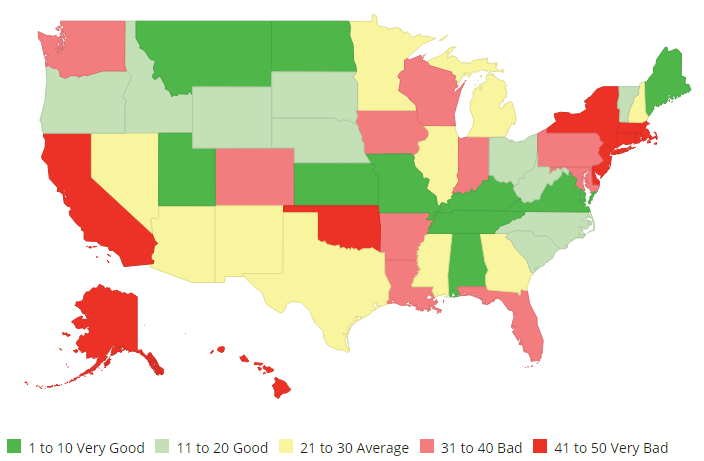
The Reason Foundation just released its 24th Annual Highway Report, ranking Missouri’s highway system as the third best overall, behind North Dakota and Virginia. This is good news.

According to the study, the assessment is based upon:

. . . data that states submitted to the federal government, [and] ranks each state’s highway system in 13 categories, including traffic fatalities, pavement condition, congestion, spending per mile, administrative costs and more. This edition of the Annual Highway Report uses state-submitted highway data from 2016, the most recent year with complete figures currently available, along with traffic congestion and bridge data from 2017.

The write up specific to Missouri is here, and it is worth reading in its entirety. While some states spent in excess of $200,000 per mile, Missouri maintained a high rating while just spending under $24,000 per mile. This did not come at a cost to pavement condition, where Missouri ranked higher than some of the states that greatly outspent us.

It’s also worth noting that Missouri scored the worst on bridges (40 out of 50). Some good news is that the governor just announced a federal grant of $20 million to address exactly that.

My colleagues and I have written a great deal about the need to increase MODoT revenue and have suggested some possibilities. Advocates of restrained government are right to demand that government spend existing money wisely before seeking more revenue. This report from Reason suggests that MoDOT is being more responsible with taxpayer money than other states.


Missouri Should Follow Our Neighbor’s Lead and Review Occupational Licensing

Should you need to train for 175 days to be a skin care specialist? How about more than 700 days of training to apply pest control products? These requirements may seem excessive, but nonetheless are mandated by Missouri’s occupational licensing laws.

According to a study released by the Mercatus Center, the Missouri Division of Professional Registration subjects 240 occupations to varying forms of licensure. This means that in Missouri, 21.3 percent of the workforce is licensed (with an additional 5.4 percent requiring certification).  

An earlier study conducted by the Institute for Justice examined 102 low- to moderate-income occupations and noted that Missouri requires a license for 31 of these occupations. Licensing requirements can be costly, both financially and in terms of time, and serve as a barrier to entry for job seekers.

The licensing requirements in Missouri also are not especially well matched with actual safety risks (like consumer health risks). As the Mercatus Center explains, “Occupations that are less likely to involve risk to the public are often more highly controlled than riskier occupations.” For example, Missouri requires emergency medical technicians (EMTs) to undergo 23 days of training while athletic trainers are required to undergo 1,460 days of training.

What can be done about excessive licensing? Show-Me Institute researchers have previously written about license reciprocity, but Missouri could also take a cue from its neighbor, Nebraska.

Nebraska is beginning a legislative review of all the state’s occupational licensing laws. The review will be carried out over the next five years with the ultimate goal of identifying less restrictive options for professional regulation (and identifying which professions need these regulations at all).

Reviewing each license and the options for reducing or eliminating licenses seems like a great place to start in reforming occupational licensing.

Missourians should be able to practice the profession of their choice without excessive barriers to entry. Instead of making it harder for people to work, shouldn’t we be removing unneeded roadblocks?


When City Leaders Aren’t Concerned, Taxpayers Should Be

In a recent story in The Kansas City Star about cost overruns for the downtown convention hotel, Steve Vockrodt wrote:

City manager Troy Schulte said he wasn’t concerned about the increased price of the hotel since cost overruns are covered by the developer.

“We are actually getting a better project with lower public commitment,” Schulte said.

This seemed ominously familiar to me. A quick search confirmed my suspicions. Back in 2009, Vockrodt wrote in the Kansas City Business Journal about Cordish’s effort to reduce the property valuation for the Power & Light District. He included this:

Kansas City Councilman Ed Ford said he was told by city attorneys that the Power & Light District’s dispute would not put the city on the hook financially.

“It looks like the city is not going to have a dog in the hunt on that,” Ford said.

But of course it did affect the city because a low property tax assessment meant Cordish paid less in property taxes, which in turn meant there was less TIF money available to apply to bond payments. And because city leaders committed Kansas City taxpayers to paying any bond shortfall, we very much did have a dog in that hunt.

This doesn’t mean that hotel cost overruns will necessarily cost the city—unless the hotel so underperforms that taxpayers are told they need to add amenities to improve performance, exactly as has happened in the past. When it comes to publicly financed projects, being told by city leaders that there is no cause for concern seems itself to be a cause to be concerned.


Finally, a Developer Using the Free Market

Do people want a garage inside a garage? I’m not sure, but luckily, people will get to decide if this project succeeds instead of the government.

Developer Brian Hayden is creating private, suburban-style garages within a larger parking garage. The outer ring of his building will be Gallery Villas, and residents here will have their own private garage structure just like the ones attached to houses in the ‘burbs. When you open the garage door, you’ll be in a large parking garage for residents and businesses of other buildings.

The project is novel and a little unconventional, but is it a good one? Time will tell, but the good news is Hayden is willing to submit his ideas to the free market for approval. Hayden is not using tax abatements, tax credits, or other public financing methods to prop up his development. Rather, he’s relying on private investors and consumer demand for these private garages. Hayden is quoted as saying “I believe a project should fully financially support itself,” and I agree.

In the free market, a developer relies on people to decide if a project succeeds or fails—either people like the idea of a garage inside a garage and put money toward it (investing or buying the product) or they don’t. It’s as simple as that. Unfortunately, many developers don’t just submit their project to the free market. They seek money from the government to finance their projects, allowing bureaucrats to decide if an idea is good or bad. The boost from government dollars means developers don’t have to work as hard to convince investors and consumers that their project is worthwhile. As my colleague Patrick Tuohey has asked before, “If private investors won’t invest their own money, why should taxpayers invest theirs?”

When risk-takers, like Hayden, offer up their good (and bad) ideas to the free market, we get to use our hard-earned money to decide on the ideas that we like. Isn’t that better than having bureaucrats spend our money on ideas they like? I applaud Hayden for taking a risk with his innovative garage project and leaving it up to consumer to decide if it will succeed.


Where Are Those Jobs, Cerner?

In 2014, Cerner received “the largest economic development project in the history of the state” to build its new headquarters at the former site of Bannister Mall. In return, it promised taxpayers it would create 16,000 new jobs in Kansas City. How is it doing?

At the time of the subsidy application in late 2014, Cerner claimed it had just over 10,000 employees in Kansas City alone. In Exhibit 4B of its application for tax-increment financing (TIF) it promised to create 15,659 “permanent jobs to be CREATED IN Kansas City” as a result of the new headquarters building [emphasis in original]. And Cerner claimed it would accomplish this in 10 years.

One of the unmet challenges with economic development incentives is that it is difficult to know whether any economic growth is due to the subsidies themselves. Growth, if there is any, may have happened for reasons other than incentives, such as an improving economy overall. As we have noted time and again, the economic literature makes clear that there is little evidence that economic development incentives themselves actually drive any growth.

Five years in, it seems the company is struggling to keep the promise about jobs. Just this week, The Kansas City Star reported that Cerner had 14,000 employees in the Kansas City region (presumably including its Wyandotte County, Kansas location). This is 4,000 more employees than what it reported in 2014. That’s pretty good growth for any company in just a few short years. But it’s nowhere near the 26,000 (a baseline of 10,000 jobs plus the 16,000 additional promised) it should have by 2024.

Maybe Cerner will make a lot of new hires in the next five years, but it needs to bring on at least 12,000 people in Kansas City to make good on its commitment.

If Cerner fails to live up to the promises that made it Missouri’s top recipient of taxpayer subsidies according to Good Jobs First, what are the consequences? Did the issuing agencies insist on clawbacks? Were subsidies issued on a performance basis? Or did taxpayers’ representatives just believe what they were told and not insist that Cerner actually deliver on its promises? If experience is any indication, it’s likely the latter.


Why Are Missouri School Districts Blocking Course Access?

Educational options are scarce for Missouri students. Missouri’s new virtual learning program should be a resource providing more options for students, but it’s being slowed down by red tape. Some parents have to go to great lengths—in some cases hiring lawyers—to access the virtual learning program. A family in the Warsaw R-IX district with a child who has a debilitating medical condition had to hire a lawyer to force the district to allow the child to enroll in a virtual learning program.

A few months ago, the Department of Elementary and Secondary Education (DESE) took the first steps to implement the virtual learning program. The newly mandated course access program offers options to students beyond their assigned public school and can provide a full-time virtual program for students.

But in July, a parent had to sue the Fulton School District so her three children could access an existing virtual learning curriculum known as Missouri Virtual Academy (MOVA). The judge ultimately ruled in favor of the parent, stating that DESE had to list MOVA as an authorized course access program provider because the plain language of the law required that MOVA be automatically approved. This was the first case when a family had to take legal action to access online courses.

You would think that after the Fulton case, the student in Warsaw R-IX should have had access to MOVA as well. But that’s not what happened.

The family in Warsaw R-IX had decided, after consulting with doctors, that a full-time virtual education would be best for their child for safety and educational purposes. The child was initially approved for course access, but the district rescinded the approval without following the proper protocol and despite no changes to the student’s circumstances.

The Warsaw R-IX district required MOVA to prove that it complies with state requirements. But that’s not what the law says, and DESE had already been ordered to list MOVA as an approved course provider. The district asked the family to choose either a part- or full-time traditional in-building class schedule for the student. The family was forced to hire a lawyer in response, and only then did the district allow the student to enroll in MOVA.

The virtual instruction program was intended to provide families with choices for their children’s education, and families want to use it. The first case in Fulton was troubling. The second case makes you wonder whether some Missouri public school districts simply oppose the legal right of parents to choose online classes and are willing to throw up roadblocks unless legally challenged. In these cases, whose interest is the district really serving?


 

Support Us

The work of the Show-Me Institute would not be possible without the generous support of people who are inspired by the vision of liberty and free enterprise. We hope you will join our efforts and become a Show-Me Institute sponsor.

Donate
Man on Horse Charging