CID Transparency in St. Charles County?

Ever wondered why you pay way more in sales tax at one store than at another store just down the street? St. Charles County shoppers might soon get the answer, as some want increased transparency for Community Improvement Districts (CIDs). CIDs are political subdivisions that were originally intended to fund public improvements through taxes and fees. Unfortunately, CIDs are now often used in ways that primarily benefit private developments. St. Charles County recently announced the introduction of a bill that would inform consumers about the extra sales taxes they pay in those districts and the benefit the owner received from their tax dollars.

This bill would require businesses located in CIDs to display signs at public entrances and point of sale areas that state the rate of the tax imposed or increased at the business by the CID. The signs must also include the direct benefit received by the owner of the property on which the business resides and the expiration date of the tax. 

According to the news release, the bill is intended to:

. . . highlight that often a small number of property owners can authorize sales taxes that are paid by all shoppers in the CID, and that businesses in a CID can be forced to collect a sales tax that does not directly benefit the property on which it is located.  

Analysts at the Show-Me Institute often discuss these very problems with CIDs. Consumers are typically unaware of district locations and voters hardly ever get a say on CID sales taxes.  The information on these signs would provide people the information they need to make informed decisions as consumers.

Increasing transparency for CIDs would be a good thing for the shoppers of St. Charles County, but why are reforms like this confined to one county? Special taxing districts like CIDs will continue to take tax dollars from uninformed citizens until these districts are reformed statewide.


 

Aquarium Project Repeats Familiar Mistakes

Local media in St. Louis is abuzz over the imminent completion of the Union Station renovation project. The St. Louis Wheel will open later in October, with the St. Louis Aquarium following suit in December. This is all part of a $187 million renovation project for Union Station headed by Lodging Hospitality Management (LHM), a firm that purchased Union Station in 2012. The chairman of LHM said of the mid-December aquarium launch date: “It’s our Christmas gift to St. Louis.”

Typically, a gift doesn’t require a contribution from the person on the receiving end. But St. Louis taxpayers are ponying up for nearly half the cost of the aquarium, as described in a St. Louis Post Dispatch article:

[Twenty] million of the St. Louis Aquarium’s construction costs will come from an existing tax-increment financing agreement and two special tax districts that carry a 1 percent tax on sales at Union Station. Included is LHM’s intent to use $5 million in historic preservation tax credits to help restore the 11-acre shed.

Show-Me Institute analysts have spent years documenting the failures and abuses of tax-increment financing (TIF), special taxing districts, and historic preservation tax credits. These programs take public dollars and shift investment risk to taxpayers, while allowing private investors to reap the benefits.

If the aquarium is a good idea, why aren’t there private investors lining up to fund the project?

Maybe it’s because aquariums are a pretty risky bet financially. A recent article in The Atlantic outlined the financial struggles of aquariums in big cities across the United States:

The stress of acquisition and maintenance often leads to financial struggle . . . In this century, the Denver aquarium, which opened to much fanfare in 1999, declared bankruptcy in 2002 because of defaults on building loans. (It was purchased by Landry’s, a hospitality company, and reopened in 2003.) More recently, the newly opened Shreveport Aquarium has struggled with almost $500,000 in unpaid construction debt. Many of these spaces are subsidized by tax breaks and bonds, to be paid back when an aquarium becomes profitable. But too often, this goal is not realized. As economic-development projects, aquariums are risky.

The South County Times reports that the St. Louis Aquarium expects 1.5 to 2 million visitors per year. That seems like a curiously optimistic projection. The Shedd Aquarium in Chicago gets just over 2 million visitors per year, and it has 5 million gallons in total volume for tanks and exhibits; the St. Louis Aquarium will have just 1.3 million total gallons.

It’s not clear why planners project the St. Louis Aquarium to nearly the match the Shedd Aquarium in total attendance with a much smaller aquarium in a much smaller city. But if visitor numbers don’t match expectations and revenue lags as a result, (the aquarium is not free; a ticket price of around $24 is expected for adults) will taxpayers be asked to chip in again to cover the shortfall?

If all of this sounds familiar, it should. In 1985, Union Station was renovated in a massive $150 million project that included generous tax breaks. And what was the city left with? A mall in Union Station that was largely abandoned after barely more than 20 years. And thus the cycle begins anew: The mall was sold, was bought by a new developer, and is being renovated with the help of taxpayer dollars.

We all want what’s best for St. Louis, and it’s exciting to see big new projects generate enthusiasm. But the definition of insanity is doing the same thing over and over again and expecting different results. That seems to perfectly describe economic development policy in St. Louis.

Thank You to the Urban League of Greater Kansas City

I remain grateful to the Urban League of Greater Kansas City, and to its president Gwen Grant, for including my essay on economic development incentives and efforts to study the costs and benefits in their new publication, 2019 State of Black Kansas City: Urban Education, Still Separate and Unequal. This is the second time the Urban League has published one of my essays of economic development incentives, the first time being in 2015.

Many cities are failing their primary task to provide basic services, and one big reason they are failing is because too much time and money is being spent trying to attract big projects such as airports, convention hotels, stadiums and the like. As a result, money that would go to schools, libraries, roads and police is diverted away. It’s true in Kansas City and St. Louis and most cities across the country.

There is plenty of opportunity to debate how public dollars should be spent to provide better services—and plenty of room to disagree. The Urban League and Show-Me Institute agree on at least this much— public dollars should be used for core services and not diverted away to private developers to do what the research tells us they were going to do anyway.


Theoretical Jobs

H&R Block once claimed to have created more than 2,000 new jobs by moving employees to a different building, courtesy of tax-increment financing (TIF). This is a perfect example of why Missouri’s TIF reporting is untrustworthy. Counting the number of jobs created is a mystery, as the number is solely dependent on what developers claim with no additional verification. A company with 100 employees could move across the street into a TIF district and claim those as new jobs. This is what H&R Block did when it moved into a new building built with more than $290 million of abated taxes through TIF.

But even if these inflated jobs claims were accurate, would they be worth celebrating?

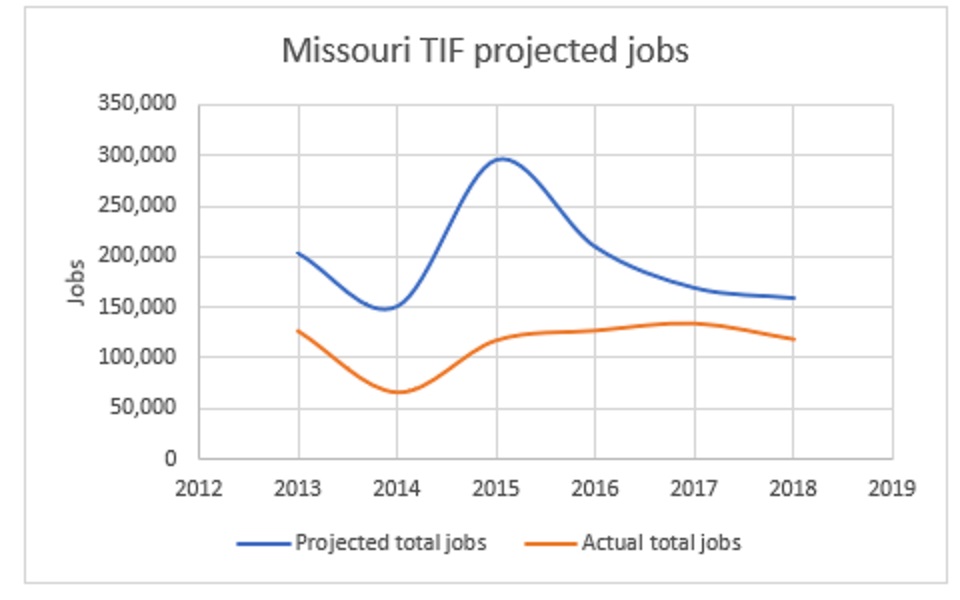
The state of Missouri publishes an annual report cataloging every existing TIF project. While the job projection numbers are squishy (as mentioned above), we can still compare the promised benefits with reported reality.

The spike in the graph at the top of this post could be attributed to a larger number of projects granted TIF benefits in 2015. The Missouri Department of Revenue has not responded for comment on how the numbers are calculated. However, even without that blip, the highest number of claimed jobs in any of the six years has not reached the lowest number of promised jobs.

Even though some projects meet or exceed projections, most do not. In all, the job shortfall from these six years is over half a million jobs, counting promised new and retained jobs.

Further, taxpayers are on the hook for almost a quarter of the total costs for these projects:

  Projected Reimbursements as Percent of Total Cost  
Year Total Project Costs Total Anticipated TIF Reimbursable Costs
2013 $24,181,041,121 $4,919,658,493
2014 $24,558,363,481 $4,255,772,786
2015 $36,736,538,004 $7,054,673,240
2016 $43,393,299,405 $9,045,087,943
2017 $39,487,575,379 $7,688,364,501
2018 $39,205,508,672 $15,445,602,846
Total $207,562,326,062 $48,409,159,809
TIF % of Total   23.32%

Source: Missouri Department of Revenue Tax Increment Financing in Missouri reports, 2013-2018. Table created by author.

If these projects routinely produce fewer jobs than expected at a large expense to the taxpayer, what is the public benefit? We have reported several cases of companies using TIF for private benefit, and this appears to be a consistent trend. In many cases, for up to 23 years, developers in a TIF district receive a refund of some portion of the local sales taxes, utility taxes, and earnings taxes (if applicable)  generated by the project and only pay property taxes on the value of their property before the improvement was made.

While the public return may be questionable, the private benefit seems clear. TIF-related property values came a little shy of tripling in value between 2013 and 2018. What business would not want its property to increase in value, especially when it has received a 23-year tax abatement?

People with good intentions can differ on economic development policy, but it should be plain to everyone that Missouri’s current TIF policy isn’t working.


SMI Podcast with Shoshana Weissmann: License to Regulate

Show-Me Institue analysts have been writing about wrongheaded occupational licensing policies for years. We were thrilled to have Shoshana Weissmann join us for the latest SMI Podcast to discuss how occupational licensing laws serve as barriers to employment, and ideas for reform. Social media regulation was also discussed. Weissmann manages social media and marketing for the R Street Institute, while also working on occuaptional licensing issues. You can listen to the whole podcast here:

https://soundcloud.com/show-me-institute/smi-podcast-shoshana-weissmann-license-to-regulate

Bike Walk KC’s Fuzzy Math and Incorrect Claims

Kansas City leaders have been considering a proposal to spend millions on a bicycle master plan for the city. The effort has sparked controversy, and advocacy group BikeWalkKC’s executive director Eric Rogers appeared on KCPT’s Ruckus last week to discuss the matter. Host Mike Shanin asked about the number of people who commute to work in Kansas City and Rogers offered, “And [biking is] on the increase. We know from the Census data that here in Kansas City biking to work, in particular, has gone up 20 percent since the 90s. And it’s actually gone up 130 percent since just 2016.”

These struck me as very large increases in such a short period of time. The last census report on biking to work was published in May 2019 and only includes data up to 2017. It indicated that only 0.6 percent of U.S. workers commute to work by bike. In Kansas City, the 2017 census data indicated that the number was 0.3 percent in the city and only 0.2 percent in the broader metro area. Where is the data that bike commuting has jumped 130 percent since 2016?

After Rogers stated those percentages, Shanin asked him what the numbers of commuters were [starts 3:39]. Rogers declined to answer, suggesting instead that viewers could do the math on their own. But they can’t from what Rogers provided; a percentage increase does not indicate the actual numbers. In fact, the high percentage increases may be a function of low actual bike commuting numbers. If two people in Kansas City biked to work in 2016, and three more joined them in 2018, that would represent a 150 percent increase—but it’s still hardly impressive.

Rogers has yet to respond to several requests for the data underlying his claim.

Incidentally, Rogers still has a blog post on BikeWalkKC that makes demonstrably false claims. In an April 1 (!) post titled, New Bike Plan Will Save Lives and Boost the Local Economy, he writes, “Economic Impact Analysis shows new bike master plan will save 36 lives every year, add $500 million to the regional economy, and create 12,000 jobs.” My colleague Kelvey Vander Hart addressed the claim about saving lives earlier this year.

But the jobs claim is just flatly wrong. The summary of findings upon which the Bike KC Master Plan claims are based states on page 6 that “this increase in economic activity leads to 12,600 additional jobs (measured in job years) over the period.” The period is 30 years, 2020 through 2050. Dividing 12,600 “job years” by 30 years gets 420 actual jobs. (Frankly even that seems high, but it’s not 12,600!)

Contorting data to justify dubious claims about job creation doesn’t help anyone. It only gives Kansas Citians even more reason to be skeptical as advocates ask taxpayers to spend hundreds of millions of dollars for something in which some neighborhoods see little value.

LIHTC 101: How Does it Work?

I recently wrote a post explaining what the low-income housing tax credit (LIHTC) is. But how does it actually work? Let’s start by saying you’re a developer, and you want to build a low-income housing project. What would the process of obtaining low-income housing tax credits and financing the associated project look like?

First, you need to develop a plan for the project and estimate how much it will cost. For simplicity, let’s assume you want to build a new apartment complex for low-income individuals, and it will cost an estimated $1.25 million. Of those costs, only $1.11 million are eligible for tax credits because land and several other expenses aren’t eligible.  In this case, the project would be eligible for the new construction credit, which means that up to 90% of all projected costs could be covered. So if approved, you could receive nearly $1 million in state and federal credits over ten years.

To start the process, you have to get your project approved by the Missouri Housing Development Commission (MHDC), the state’s housing agency. This complex approval process includes filling out a slew of forms, completing audits of your finances, hosting inspections of the property, and paying a variety of fees.

Once you jump through the required hoops and get your project approved, you will likely need to sell the tax credits to begin development. (This is because many firms need the startup capital to fund construction; the credits are paid out over several years) To do this, most developers find a tax syndicator, which is simply a business that helps find investors willing to buy credits in exchange for financing the project. This process can be difficult because Missouri’s tax credits are non-transferrable, which means they cannot be transferred or sold to any investor that isn’t part of the development group. Thus, new legal partnerships are formed for most projects that include the developers and investors to allow them to buy and use the credits.

Once you have people willing to buy your credits, how much can you expect them to pay? The first hurdle is the federal tax implication for each investor. Paying less in state taxes (because they’re using credits) reduces the claimable portion of the federal tax deduction that comes from state taxes paid. In other words, using state tax credits can increase their federal tax liability. As a result, the value of the state credit to each investor drops by the federal tax rate they would have to pay on those funds—typically around 35% of the credit’s value.

In addition, getting money for tax credits today requires selling them at a discount, because the tax credits are issued over ten years. Selling all your credits today, adjusted for net present value, and including all fees for the syndicator’s efforts, you can expect to receive around 65% of the remaining value. After all is said and done, your $1 million in LIHTCs results in around $420,000 cash for project construction. These figures are in line with the analysis completed by Missouri’s State Auditor’s Office.

The rest of the project’s financing has to come from the developer, other investors, or mortgages. No matter the amount MDHC awards in tax credits, the end result is the same; there will typically only be around $0.42 of each dollar in tax credits available for actual construction. More than half the state’s investment in your project is lost by the time the construction can begin. This is a big reason why the program is such an inefficient use of taxpayer dollars.

For the next post in this series, I’ll look into the LIHTC program’s measurable impact (or lack thereof) on the supply of affordable housing in Missouri.


Charter Schools Can Fill the Void in Rural Areas

Finding options for your child’s education can be challenging to begin with, but living in a rural area can make it even harder. I’ve written before about how charter schools can provide more opportunities for students in rural areas, and a new EducationNext study shows how charter schools can serve rural communities by filling specific educational needs.   

The study examined four different rural charter schools in New Mexico, Minnesota, Florida and Arizona and described the factors that contributed to their success.

According to the researchers, a close connection to the community and the ability to fill an academic need was critical to the success of the charter schools they studied. For example, the Glacial Hills Elementary charter school in Minnesota started up after the local district school closed in 2005 due to issues with finances and declining enrollment. Opening a charter school meant that students had a local educational option instead of having to travel an hour each day to the nearest school.

In a rural community in Florida, families were quickly moving out of the local school system or enrolling in private schools for a quality education, so Crossroads Academy opened to provide a local, rigorous public education for students.

I bet there are Missouri families who would like to shorten their child’s daily commute to school or have a quality academic option nearby. According to the National Center for Education Statistics, about 61 percent of Missouri’s rural school districts have experienced a decline in enrollment from 2010 to 2016. This is part of a larger migration trend in Missouri, but those who remain in rural areas still deserve a quality education. The Minnesota and Florida schools mentioned above show how charter schools can thrive in rural areas with declining enrollment.

The researchers also produced a website that has more in-depth analysis on their findings, and it’s worth a look for more information on each charter school.

Other states are leading the way in providing quality options for rural students. Why doesn’t Missouri do the same?  


LIHTC 101: Program Basics

Since the program’s inception, the low-income housing tax credit (LIHTC) has been the federal government’s primary tool for increasing the supply of affordable housing across the nation. The program has become so prominent that 15 states, including Missouri, have implemented their own versions. Today, Missouri’s LIHTC program is the state’s most expensive tax credit. And despite the enormous cost to Missouri taxpayers, very few resources exist that explain how the state’s program actually works or what it is trying to accomplish.

In 1986, the federal government enacted the LIHTC program with the second round of President Reagan’s tax cuts. The idea was simple: provide a supply-side incentive to make housing more affordable. LIHTC represented a new approach to government-funded housing policy. Instead of directly subsidizing the rents of low-income individuals, the program forgoes future federal tax revenues to incentivize developers to build more housing. And in exchange for the tax credits, the developers must agree to reserve a portion of the subsidized units for low-income tenants and to cap rents for low-income tenants for thirty years.

Each year, the Internal Revenue Service allocates federal LIHTCs across all 50 states based on population. It is then the responsibility of each state’s housing agency to distribute those credits for approved projects. Last year, Missouri was allocated $2.75 per full-time resident from the federal government, which translated to $17 million in tax credits available for new projects. But not every project is eligible for the same amount of tax relief. Within the federal program, there are actually two types of tax credits: one for new construction projects and another for rehabilitations. The credits for new construction are the most popular, and can cover up to 90% of all construction costs over 10 years. The rehabilitation tax credits are less lucrative and cover closer to 40% of construction costs over the same period.

Awarding tax credits for the cost of construction lowers the investment required by the project developers, but not in the way you’d expect. Developers rarely use the credits to build housing directly; instead, developers typically sell the tax credits to independent investors at a discount to finance the originally approved project. The project’s investors then use the credits as dollar-for-dollar reductions in their business or individual income tax liability over the following 10 years.

And the way Missouri has implemented its state LIHTC program has made things worse. In response to claims from developers that the federal program alone cannot make projects profitable, Missouri’s LIHTC program fully matches each federal credit dollar for dollar with a state credit.

Over a series of upcoming blog posts, I’ll discuss how the LIHTC program as described fundamentally fails to effectively or efficiently improve Missouri’s affordable housing landscape.


Support Us

The work of the Show-Me Institute would not be possible without the generous support of people who are inspired by the vision of liberty and free enterprise. We hope you will join our efforts and become a Show-Me Institute sponsor.

Donate
Man on Horse Charging