Show Me the Money

As my colleague recently wrote, the Missouri Department of Transportation (MoDOT) appears to be making do with the money they have to keep Missouri’s roads in respectable shape, but not bridges.

While it is good news that MoDOT appears to use available funds efficiently, that does not mean it has enough money to cover all needed infrastructure repairs in Missouri.

MoDOT has been in the midst of a years-long funding strain (pages 33-38). Between 2000-2010, MoDOT relied heavily on federal reimbursements and issued billions of dollars of bonds to fund its projects. Both sources, however, began to dwindle in 2011. While Missouri has the seventh-largest highway system in the country, it has the second-lowest fuel tax. Multiplying the problem, a decrease in money raised in Missouri for transportation means a decrease in matching federal funding.

Federal money makes up 42% of MoDOT’s budget. The fuel tax is the second largest component at 23%. The gasoline tax was set at $0.17 in 1996 and is still $0.17, meaning the value of that money has dropped significantly due to inflation. Relative to the size of the highway system, the revenue Missouri brings in per mile is less than a quarter of the national average. Simultaneously, construction and upkeep-related expenses have significantly increased due to lower productivity and higher regulatory barriers, as well as asphalt, crushed stone, and paving mixtures being significantly more expensive than just a decade ago. Having less money to spend on more expensive projects has made upkeep more difficult.

The amount of money MoDOT spent fell in 2011 and has not kept up with inflation, as you can see in the graph below:
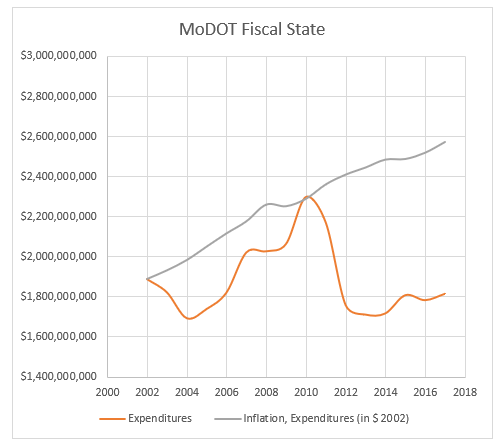
MoDOT expenditure graph

Source: Missouri Budget Fiscal Years 2003–2017. Graph made by author. https://www.modot.org/previous-reports-joint-committee.

The surge in expenditures in 2010 coincides with the passage of the American Reinvestment and Recovery Act (ARRA) in 2009, commonly known as the federal stimulus package. The ARRA added $400 million to MoDOT’s budget, which dissipated just as quickly due to the large number of projects for which it was needed. In 2014, ARRA funds totaled less than 1% of MoDOT’s revenues dedicated to the highway system (page 8).

Relying on large and sudden injections of federal money is not a viable funding solution, and any bonds that are issued face their day of repayment.

To raise the revenue needed to maintain our roads and bridges, a clear solution presents itself – increased use of user fees. The concept is simple and works in everyday life. Those who use a service pay for that service in return.

Numerous other states employ user fees in the form of more effective gasoline taxes and tolling, significantly boosting transportation revenue in a market-based way. Legal hurdles remain, though. Tolling interstates in Missouri would require federal approval, as Missouri turned down the opportunity to toll I-70, and questions remain regarding constitutional limits on where the funding to construct a turnpike authority can originate.

User fees may only be part of MoDOT’s solution, but they could increase its budget to meet current needs.

 

Tennessee Proposal Leading Medicaid Reform

Policymakers searching for ways to improve Missouri’s Medicaid program should look no further than Tennessee. A new proposal from the Volunteer State would reform the way the federal government pays for Medicaid services in Tennessee. Instead of the open-ended funding relationship currently used across the country, Tennessee has requested the federal government begin offering Medicaid dollars as a lump sum payment, or block grant. Though there are many details yet to be ironed out, the plan represents a promising approach for states to begin reining in Medicaid’s ever-growing costs.

If approved by the federal government, Tennessee’s proposal would be the first of its kind. Medicaid’s current funding relationship between states and the federal government is riddled with “misaligned financial incentives”. Medicaid currently uses a matching dollar structure. For every dollar Missouri spends on an approved service, the federal government will spend nearly two. Because there is no limit to the amount of federal Medicaid dollars Missouri can receive, the arrangement encourages further state spending which grows the overall cost of the program. This structure also discourages states from finding innovative ways to provide better care at a lower cost. Under Tennessee’s plan, the state would actually get to keep 50% of the money it saves as a result of more efficiently administering the program.

Block grants also provide the opportunity for states to improve quality of care. Once the anticipated program savings are achieved, the dollars saved could be invested back into the program for initiatives chosen by each state depending on individual state needs. And as Tennessee’s governor noted, there won’t be a change to eligibility requirements or a reduction in benefits under the block grant proposal.  Advocates of the Tennessee proposal believe that by properly aligning Medicaid’s funding incentives and increasing local control of the program, up to a billion dollars per year could be saved.

Medicaid block grants are not a new idea; Show-Me Institute analysts have promoted block grants for years. But this idea remains as important as ever. It is not a coincidence that the cost of Medicaid has continued to rise each year since 2014 when the federal government expanded its role in the state/federal partnership. Missouri’s policymakers should pay attention to what happens in Tennessee, because a similar proposal may be the best way to fix Missouri’s Medicaid program.


Student Achievement Rises with More Charter Schools

Missouri has long resisted the expansion of charter schools into any suburban or rural area. Opponents of charter schools argue they threaten the success of students, but the research doesn’t support this claim.

A new study from the Fordham Institute found that a higher percentage of charter school enrollment (referred to as “charter market share”) among black and Hispanic students in large urban areas is associated with higher English language arts and math achievement. A similar result was found for Hispanic students in suburban and rural districts, and black students in rural districts. And these results are measuring overall achievement in an area—not just the students attending charter schools.

The study used data from the Stanford Education Data Archive containing student performance on NAEP, the National Assessment of Educational Progress exam. The data contained scores from both charter and traditional public schools. Further analysis of the individual geographic areas in the study could help determine if the effect of competition from charters on traditional public schools varies across regions. But the study does contradict the argument that charter schools only have higher achievement because the best students transfer to charter schools. If that were the case, then overall achievement would not rise.

Charter schools in Missouri wouldn’t be a threat to traditional public schools. They could provide educational opportunity for many students who do enroll in a charter school and also boost overall achievement. Missouri shouldn’t be afraid to offer students who happen to live outside of Kansas City and St. Louis opportunities like charter schools.


What Happened to Those 800 Dangerous Buildings?

Three and a half years ago, Kansas City leaders were so embarrassed by a KCPT documentary on urban blight they committed to tearing down hundreds of dangerous buildings. Were they successful?

According to The Kansas City Star back in February 2016:

City Manager Troy Schulte recently estimated it would cost $10 million to knock down all the most dangerous houses and other buildings in the city. That backlog of 870 buildings has built up because in the past, the city has only been able to spend about $800,000 annually to demolish about 100 houses, and more properties keep getting added to the list every year.

The city sold bonds to raise the $10 million to pay for the demolition. Work started in June 2016 and it was to take two years to tear down about 800 buildings. In April 2018, Channel 41 reported that the city surpassed it goal and “taken care of” 895 buildings in two years. That is because many were sold and rehabilitated, not demolished.

According to city data, only 609 buildings actually have been torn down by the city in the three years since. While this is slower than initially planned, it represents good progress toward addressing blight.

As of October 7, 2019, there are 343 dangerous buildings remaining on the city’s list.


Want More Housing? Get out of the Way

If there is an affordable housing shortage in Kansas City, why is that so? Could the very housing policies meant to help actually be part of the problem? No less than Bob Langenkamp, the man formerly in charge of handing out economic development subsidies in Kansas City, said these subsidies were necessary to offset the increased costs of city regulation. This stayed with me because I suspect he is exactly right, and it occurs to me again as Kansas City contemplates policies to encourage more affordable housing construction. Rather than increase costs and then offer subsidies, the city ought to be reducing costs and staying out of the way.

Some were quick to argue last year that the greatest threat to affordable housing is the ending of low- income housing tax credits (LIHTC). This is demonstrably wrong. The program was fully funded up through the end of 2017; any current affordable housing shortage in Kansas City has nothing to do with a lack of state tax credits. And the data from the Missouri Housing Development Commission show that the number of housing units in the construction pipeline has not decreased since state funding for LIHTC was zeroed-out.

The simple problem in Kansas City, St. Louis and elsewhere is in part due to the high cost of housing regulations and city bureaucracy; it is simply too expensive to build so-called affordable housing.

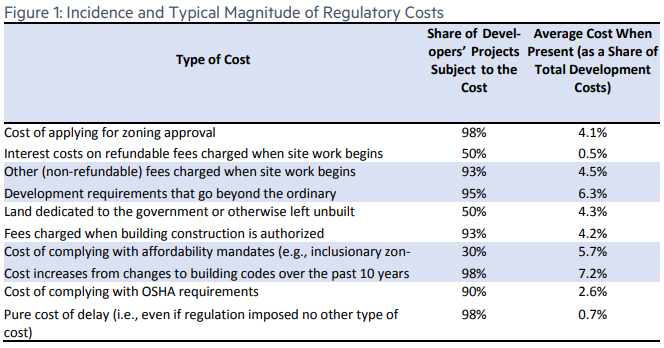
A 2018 paper issued by the National Association of Homebuilders (NAHB) and National Multifamily Housing Council (NMHC) concludes that:

Regulation imposed by all levels of government accounts for an average of 32.1 percent of multifamily development costs, according to new research released today by the National Association of Home Builders (NAHB) and the National Multifamily Housing Council (NMHC). In fact, in a quarter of cases, that number can reach as high as 42.6 percent.

The table at the top of this post shows the impact on housing costs of several types of government-imposed costs such as changes in building codes or requirements over and above common standards. The NAHB paper goes on to say: “Over 90 percent of multifamily developers also incur costs of delays caused by sometimes lengthy approval processes.”

A study released in 2016 concluded: “. . . on average, regulations imposed by government at all levels account for 24.3 percent of the final price of a new single-family home built for sale.”

Sometimes, exactly because the government is trying to help solve a problem, the problem becomes worse. Seattle for Growth, née Smart Growth Seattle, published in 2015:

Affordable housing projects have many unique costs, and often cost more because of financing, construction, and labor requirements. Affordable housing projects can be more expensive than market-rate due to some of these unique costs.

Regulations regarding health and safety are necessary, and one does not need to argue that housing construction should go unregulated to suggest that some obstacles are not worth the expense. Some of these obstacles, such as time spent waiting on permits and approvals may simply be due to city offices being overworked and understaffed. Cities ought to understand the barriers to housing construction and the additional costs of regulation before they act to add even more regulation or spend limited tax dollars on subsidies.


Does Building Market-Rate Condominiums Help the Affordable Housing Market?

Affordable housing was a big issue in the recent Kansas City mayoral race, and there may be more legislation coming to address the issue. As Kansas City figures out how to increase the stock of affordable housing, many—including this author—have bemoaned the focus Kansas City has placed on subsidizing luxury market-rate high rises downtown. Some recent research, however, suggests that building market-rate units, even luxury ones, helps increase housing stock at all levels.

A new paper by Evan Mast of the W. E. Upjohn Institute for Employment Research concludes:

The short-run effect of new market-rate housing on the market for middle- and low-income housing is crucial to the current policy debate, where government intervention and market-based strategies are often pitted against each other. My results suggest that new market-rate construction loosens the housing market in such areas and, moreover, could do so in less than five years. This implies that market-based strategies can play an important role in improving housing affordability for middle- and low-income households.

In other words, building housing of all types helps those seeking middle- and low-income housing. This is a promising conclusion and largely intuitive. If there is more of a thing available, prices go down. Perhaps Kansas City and St. Louis really need to focus on building housing of all kinds, knowing that this alone will increase the availability of affordable housing.

Still, there will be advocates for more government subsidies to try to direct the housing market to provide for so-called affordable housing, such as a state low-income housing tax credit (LIHTC) to match the federal program of the same name. Despite the lofty intentions, research shows the state version of the program is largely ineffective.

To borrow from a common phrase regarding energy, Missouri governments ought to encourage people to “build, baby, build!” Governments don’t need to offer subsidies, but they ought to review their building codes and permitting processes with an eye towards reducing the burden on builders. Government has demonstrated it cannot solve the housing shortage; it ought to get out of the way and let the private market do what it does best: meet demand.


Kansas City Hotel Privately Built?

Several outlets in Kansas City have reported that Choice Hotels International is planning a six-story, 149-room hotel in downtown Kansas City. An official of the Economic Development Corporation of Kansas City (EDCKC) confirmed to me that the company has not sought any economic development incentive from the EDCKC.

This is good news. If the company really is building the hotel on their own, without incentives or tax credits, it represents a real investment in Kansas City. Next time someone argues that without such taxpayer subsidies, “we may as well put up a sign that says Kansas City is once again closed for business,” be aware that they might just be shilling for wealthy developers.


Support Us

The work of the Show-Me Institute would not be possible without the generous support of people who are inspired by the vision of liberty and free enterprise. We hope you will join our efforts and become a Show-Me Institute sponsor.

Donate
Man on Horse Charging